
Proactive incident prevention combines continuous telemetry, AI-driven anomaly detection, and automated remediation to catch network problems before they become outages. It replaces reactive ticket queues with systems that flag abnormal behavior across SNMP, ICMP, syslog, and flow data, then resolve routine issues automatically. The measurable payoff is consistent: MTTR reduction, higher ticket deflection, and fewer emergency escalations. Platforms like Netverge build this into a single pipeline so MSPs and multi-location IT teams stop discovering failures from customer complaints.
TL;DR:
- Continuous telemetry across SNMP, syslog, flow, and packet capture must be baseline-tuned to accurately detect deviations and prevent false positives.
- Automated remediation should start with reversible actions, staged through audits and supervision, to minimize risks of overautomation.
- Success relies on phased rollouts, focusing on high-impact sites, and establishing clear governance, ownership, and review cycles for runbooks and automation scope.
- Key KPIs like MTTR, incident volume, ticket deflection, and false-positive rates guide ongoing tuning and demonstrate tangible improvements.
- Slack between teams should be minimized by using a shared, real-time system for monitoring, ticketing, and dependency mapping, ensuring coordinated incident response.
Table of Contents
- What Is Proactive Incident Prevention in Network Operations?
- Why Does Proactive Incident Prevention Matter for MSP Margins?
- What Telemetry and AI Capabilities Does Proactive Prevention Require?
- How Do You Roll Out Proactive Incident Prevention in Phases?
- Which KPIs Prove Proactive Incident Prevention Is Working?
- How Should Ops, NOC, and Client-Facing Teams Coordinate on Prevention?
- What Do Successful Proactive Prevention Deployments Look Like?
- What Are the Biggest Pitfalls in Proactive Incident Prevention?
- How Do Feedback Loops Improve Prevention Over Time?
- How Do You Tune Alerts to Reduce Fatigue Without Missing Real Incidents?
- The Gap Between Monitoring Theory and What Actually Prevents Outages
- Get Started With Netverge's Proactive Prevention Platform
- Key Takeaways for Starting Proactive Incident Prevention This Week
What Is Proactive Incident Prevention in Network Operations?
Proactive incident prevention means monitoring infrastructure continuously enough to catch failures while they're still silent, then acting on them before a user notices. It's distinct from preventive maintenance schedules or manual health checks. It's an active loop: telemetry feeds an AI detection layer, the detection layer flags or scores anomalies, and either a human or an automated playbook resolves the issue.
A flapping switch interface is the textbook case. Monitoring tools catch the flap in the RMM console, an engineer or an automated remediation step corrects it remotely, and no ticket ever gets opened. That's the entire value proposition compressed into one event: a problem that would have surfaced as a client complaint instead surfaces as a log entry nobody but the ops team ever sees.
The industry-standard term for this discipline is proactive monitoring, though vendors and analysts also describe it as preventive risk management or hazard identification applied to network infrastructure. Whatever label you use, the mechanics are the same: instrument everything, detect deviations early, and automate the response wherever it's safe to do so.
Why Does Proactive Incident Prevention Matter for MSP Margins?
Every outage an MSP catches before a client notices is revenue protected, not revenue earned. Unplanned downtime costs money in SLA credits, emergency labor, and churn risk. Proactive monitoring turns unknown failures into scheduled, low-cost remediations instead of 2 a.m. war rooms.
The math is straightforward once you isolate the two levers that matter most:
- MTTR reduction. Automated detection and remediation cut the time between "something broke" and "it's fixed," often before a human is even paged.
- Ticket deflection. Anomaly detection and automated remediation pipelines resolve routine incidents autonomously, which keeps L1 tickets from ever reaching a technician's queue.
- Fewer emergency escalations. Early detection converts middle-of-the-night pages into next-morning maintenance windows.
- Better capacity planning. Trending data from continuous monitoring shows where infrastructure is heading, not just where it stands today.
- Lower churn. Clients notice fewer outages and faster resolutions, and both show up in renewal conversations.
Pro Tip: Track avoided-downtime hours as a line item in quarterly business reviews. Clients rarely see the outages that never happened, so you have to show them.
Independent MSP cost modeling and vendor case studies point the same direction: proactive monitoring correlates with lower incident volume and higher customer satisfaction scores. That's the business case in one sentence, but the operational case takes a bit more explaining.
What Telemetry and AI Capabilities Does Proactive Prevention Require?
You can't detect what you can't see, and most networks have more blind spots than teams realize. A complete proactive prevention stack layers several telemetry types, because each protocol answers a different operational question:
- SNMP polls device state, interface counters, and hardware health at regular intervals.
- ICMP confirms basic reachability and latency between endpoints.
- Syslog captures event-level detail, including the error messages that explain why something failed.
- Flow monitoring (NetFlow, IPFIX, sFlow) reveals traffic patterns and bandwidth trends over time.
- Packet capture provides forensic-level detail when you need to prove exactly what happened on the wire.
None of these substitute for the others. SNMP tells you a device is degraded; syslog tells you why; flow data tells you whether the degradation is traffic-driven; packet capture gives you courtroom-grade evidence when a root cause is disputed.
Raw telemetry only becomes useful once an AI layer baselines normal behavior and flags deviations. Effective anomaly detection correlates multiple signals rather than firing on a single threshold breach, and it assigns a confidence score so low-certainty anomalies get routed for human review instead of triggering automated action. That confidence scoring is what separates a mature detection system from one that trains your team to ignore alerts.
Remediation should follow the same caution. Staged automation, documented runbooks, and full audit trails let a system act on high-confidence, low-risk issues while escalating anything ambiguous. And none of it works quickly without a knowledge graph mapping service-to-device dependencies. Queryable topology data is what lets an automated playbook find the actual root cause in seconds instead of a technician tracing dependencies by hand for twenty minutes.
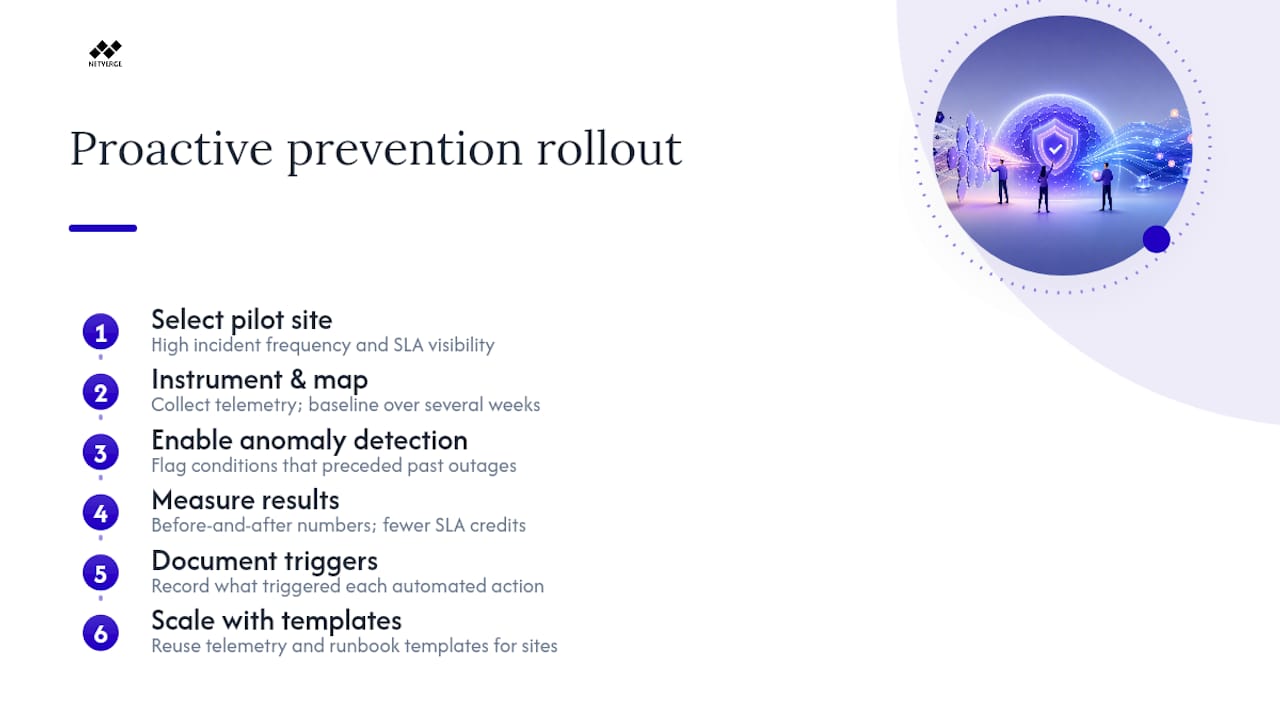
How Do You Roll Out Proactive Incident Prevention in Phases?
Trying to instrument everything and automate everything on day one is the fastest way to build a system nobody trusts. A phased rollout gets you to full autonomy with fewer surprises.
- Pick a pilot with real stakes. Choose a customer or site with meaningful incident frequency and an SLA that makes success visible, since a low-traffic pilot won't prove much.
- Instrument before you automate. Decide between agent-based and agentless collection for each site, and add out-of-band access so you retain visibility even when the primary network path is down.
- Establish baselines and tune alerts. Set thresholds, hysteresis windows, and rolling averages before turning on anomaly detection, or you'll drown in false positives from day one.
- Layer in anomaly detection. Let the system flag deviations against the baseline for a few weeks before you connect any automated action to it.
- Automate the safe cases first, then scale. Start with audit-only runs, move to reversible actions under supervision, and reserve full autonomous remediation for low-risk, well-documented playbooks.
Governance can't be an afterthought here. Every runbook needs sign-off before it goes live, every automated action needs an audit trail, and rollback needs to be as automatic as the action itself.
- Expect ticket deflection to shift L1 workload, not eliminate headcount.
- Retrain L1 technicians toward exception handling and runbook maintenance rather than routine triage.
- Budget for a change-control process that reviews automation scope quarterly, not annually.
Which KPIs Prove Proactive Incident Prevention Is Working?
Four metrics carry most of the weight in a proactive prevention program, and each one has a straightforward formula behind it.
| Metric | What it measures | Typical formula |
|---|---|---|
| MTTR | Average time to resolve an incident | Total resolution time ÷ number of incidents |
| MTTD | Average time to detect an issue | Total detection time ÷ number of incidents |
| Incident count | Volume of incidents over a period | Raw count, tracked monthly |
| Ticket deflection rate | Share of tickets resolved without human escalation | Automated resolutions ÷ total tickets |
A monthly cadence works for most MSPs, with MTTR and ticket deflection reported to operations leadership and a lighter summary going to finance and vCIO stakeholders who care about SLA compliance and cost avoidance more than raw incident counts.
Tuned alert thresholds with sustained-breach detection matter here too, because a poorly calibrated system inflates false positives and makes your deflection numbers look better than they are. Give any new automation at least one full billing cycle before attributing downtime savings to it. Attributing an outage-free month to automation you turned on three days earlier is a measurement trap, not a result. Telemetry gaps are the other common trap: if a segment isn't instrumented, its incidents simply won't appear in your numbers, which can make a partial rollout look more successful than it is.
How Should Ops, NOC, and Client-Facing Teams Coordinate on Prevention?
Proactive incident prevention breaks down fastest at the handoff points between teams, not inside any single tool. A NOC engineer might silence an alert that a client-facing account manager needed to know about, or a runbook might get updated without informing the technicians who rely on it daily.
The fix is a shared source of truth rather than a shared meeting schedule. When monitoring data, ticket status, and topology all live in one system, a NOC technician and an account manager are looking at the same facts instead of reconciling two different tools during a client call. That single view matters more for coordination than any standing sync ever will.
Runbook governance needs a named owner, not a committee. Someone has to be accountable for approving changes to automated playbooks, and that person needs visibility into which automations are firing and how often. Without that ownership, runbooks drift out of sync with the infrastructure they're supposed to manage.
Escalation paths deserve the same clarity. Define, in writing, which anomaly types page a human immediately versus which ones get logged for the next business day. Ambiguity here is what causes both alert fatigue and missed incidents. And client communication should be proactive on its own terms: a brief note that "we caught and resolved an issue overnight" builds more trust than silence ever does, even when the client never felt any impact.
What Do Successful Proactive Prevention Deployments Look Like?
The interface-flap example is a small-scale version of a pattern that repeats at larger scope across MSP deployments. A site with recurring latency complaints gets fully instrumented, its baseline behavior gets mapped over several weeks, and the anomaly detection layer starts flagging the exact conditions that preceded prior outages, sometimes days in advance.
What separates the deployments that stick from the ones that get quietly abandoned is pilot discipline. Programs that start with a single customer or site chosen for incident frequency and SLA visibility generate concrete before-and-after numbers, fewer SLA credits, shorter MTTR, fewer 2 a.m. pages that make the case for expansion internally. Programs that try to instrument every client simultaneously tend to generate so much noise that nobody trusts the alerts by month two.
The MSPs seeing the strongest results typically report a pattern: proactive maintenance shifts a meaningful share of technician time away from firefighting and toward planned, often billable, advisory work. That shift alone changes the economics of a support contract. When incident response stops eating unplanned hours, capacity opens up for the kind of client work that grows margin instead of just protecting it.
Scale-up follows the same shape every time it works: prove the model on one site, document what triggered every automated action, then extend the same telemetry and runbook templates to the next site rather than reinventing the pilot from scratch.
What Are the Biggest Pitfalls in Proactive Incident Prevention?
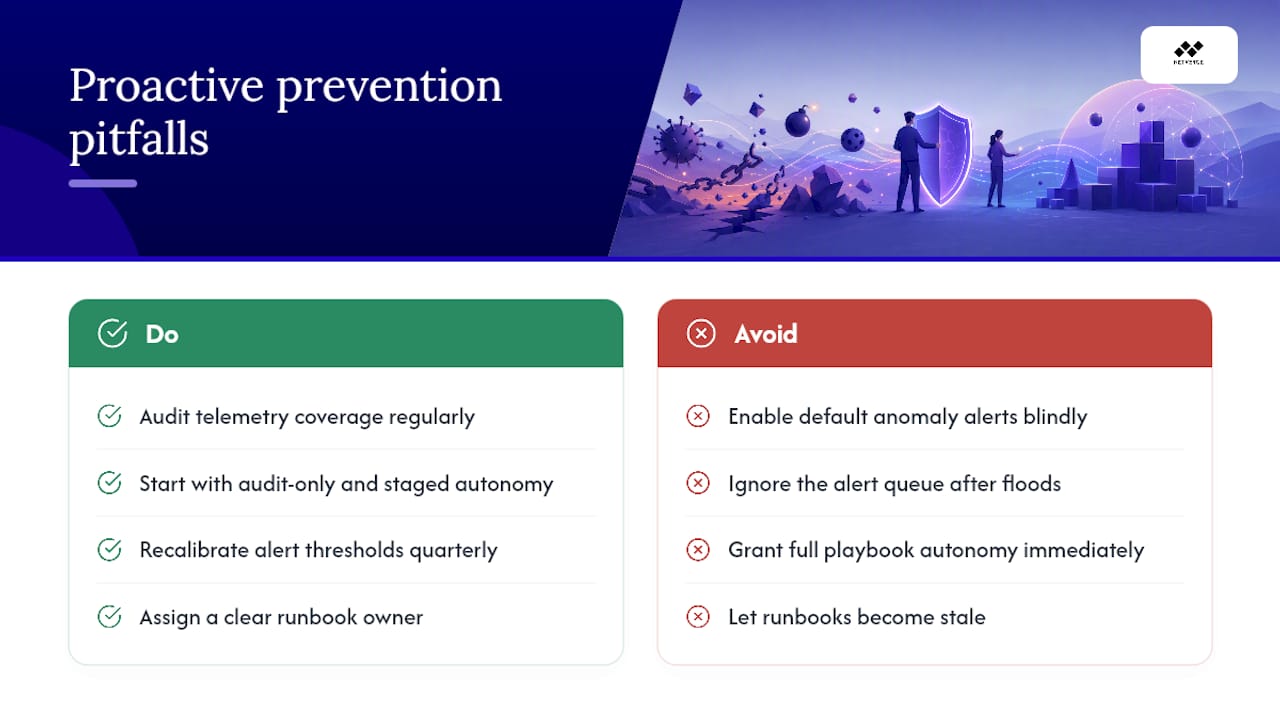
Alert fatigue is the most common failure mode, and it's almost always self-inflicted. Teams turn on anomaly detection with default thresholds, get flooded with low-value alerts in the first week, and start ignoring the alert queue entirely, including the alerts that actually matter.
Telemetry gaps cause a quieter version of the same problem. A segment without SNMP polling or flow visibility simply won't generate anomalies, which can look like success when it's actually a blind spot. Audit your coverage before you trust your incident counts.
Overautomation is the third trap, and it's the one that does the most reputational damage. Granting full autonomous remediation to a playbook before it has proven itself under supervision risks an automated action making a bad situation worse, at scale, without a human in the loop to catch it. Staged autonomy, starting with audit-only runs and graduating to reversible actions before full autonomy, exists specifically to prevent this.
Governance drift rounds out the list. Runbooks that were accurate at rollout become stale as infrastructure changes, and nobody notices until an automated action fires against outdated assumptions. The fix isn't more automation, it's a recurring review cycle: quarterly runbook audits, alert threshold recalibration, and a clear owner accountable for keeping both current. None of these pitfalls are exotic. They're the predictable cost of skipping the phased rollout in favor of flipping everything on at once.
How Do Feedback Loops Improve Prevention Over Time?
A proactive prevention program that doesn't learn from its own history will plateau within a few months. Every resolved incident, whether a human handled it or an automated playbook did, contains information that should feed back into the baseline and the runbook library.
The most useful feedback loop is the simplest one: when an anomaly detection model produces a false positive, someone documents why, and that documentation gets used to adjust the threshold or the correlation logic, not just to silence the individual alert. Do that consistently and the false-positive rate drops measurably over a few quarters instead of staying flat.
Runbooks need the same discipline. Every time a runbook resolves an incident, note whether it worked cleanly or needed manual intervention partway through. Runbooks that consistently require intervention are candidates for revision, not for abandonment, since the gap is usually a missing edge case rather than a flawed approach.
Postmortems matter even for incidents automation resolved without human involvement. A five-minute review of what triggered the anomaly, how confident the detection score was, and what action fired keeps the team's understanding of the system current. Skip that step and the team's mental model of "how the automation behaves" drifts away from what it's actually doing, which is exactly when trust in the system erodes.
How Do You Tune Alerts to Reduce Fatigue Without Missing Real Incidents?
Alert fatigue kills proactive prevention programs faster than any technical failure, because a team that has learned to ignore its alert queue is functionally back to reactive support. Fixing it starts with three specific tuning mechanisms rather than a vague call to "reduce noise."
Thresholds need to reflect actual operating ranges, not textbook defaults. A link that normally runs at 60% utilization shouldn't share the same threshold as one that idles at 5%.
Hysteresis prevents an alert from firing and clearing repeatedly when a metric hovers right at the threshold line. Requiring a sustained breach before an alert fires, rather than triggering on a single sample, cuts a large share of nuisance alerts immediately.
Rolling windows smooth out momentary spikes that don't reflect a real problem. Correlating multiple signals over a rolling window before escalating catches genuine degradation while filtering out the noise from a single bad polling cycle.
Severity tiering matters just as much as the thresholds themselves. Not every anomaly deserves a page. A tiered system, informational, warning, critical, lets teams route low-severity anomalies to a daily digest while reserving immediate paging for the conditions that actually threaten an SLA. Get this tuning right during the pilot phase, because a team that loses trust in alerts during rollout rarely gets that trust back without a lengthy rebuild of the entire alerting configuration.
The Gap Between Monitoring Theory and What Actually Prevents Outages
Most advice on this topic treats proactive incident prevention as a checklist: buy monitoring, add AI, watch the dashboards. That framing undersells how much the sequencing matters. Teams that turn on anomaly detection before they've tuned alert thresholds don't get proactive prevention, they get an alert fatigue problem with better branding.
The conventional wisdom also underweights governance. Vendor pitches love to talk about autonomous remediation and skip past the audit trails and staged rollback that make autonomy safe to grant in the first place. A remediation pipeline without a rollback path isn't automation, it's a liability with good intentions.
If you're starting from zero, prioritize telemetry coverage and alert tuning before you touch automation. A perfectly baselined, well-tuned alerting layer with a human still in the loop beats a half-instrumented network running unsupervised playbooks every time. Automation should earn its autonomy incident by incident, not get granted it on day one because a product demo made it look effortless.
— Jim
Get Started With Netverge's Proactive Prevention Platform
Netverge brings the telemetry, detection, and automation described above into one system instead of the five or six disconnected tools most MSPs currently stitch together. Its AI anomaly detection baselines device behavior across SNMP, syslog, and flow data, then routes high-confidence issues into automated remediation while flagging ambiguous cases for review. A built-in knowledge graph maps service-to-device dependencies so root-cause analysis takes seconds, not a technician manually tracing a topology diagram.
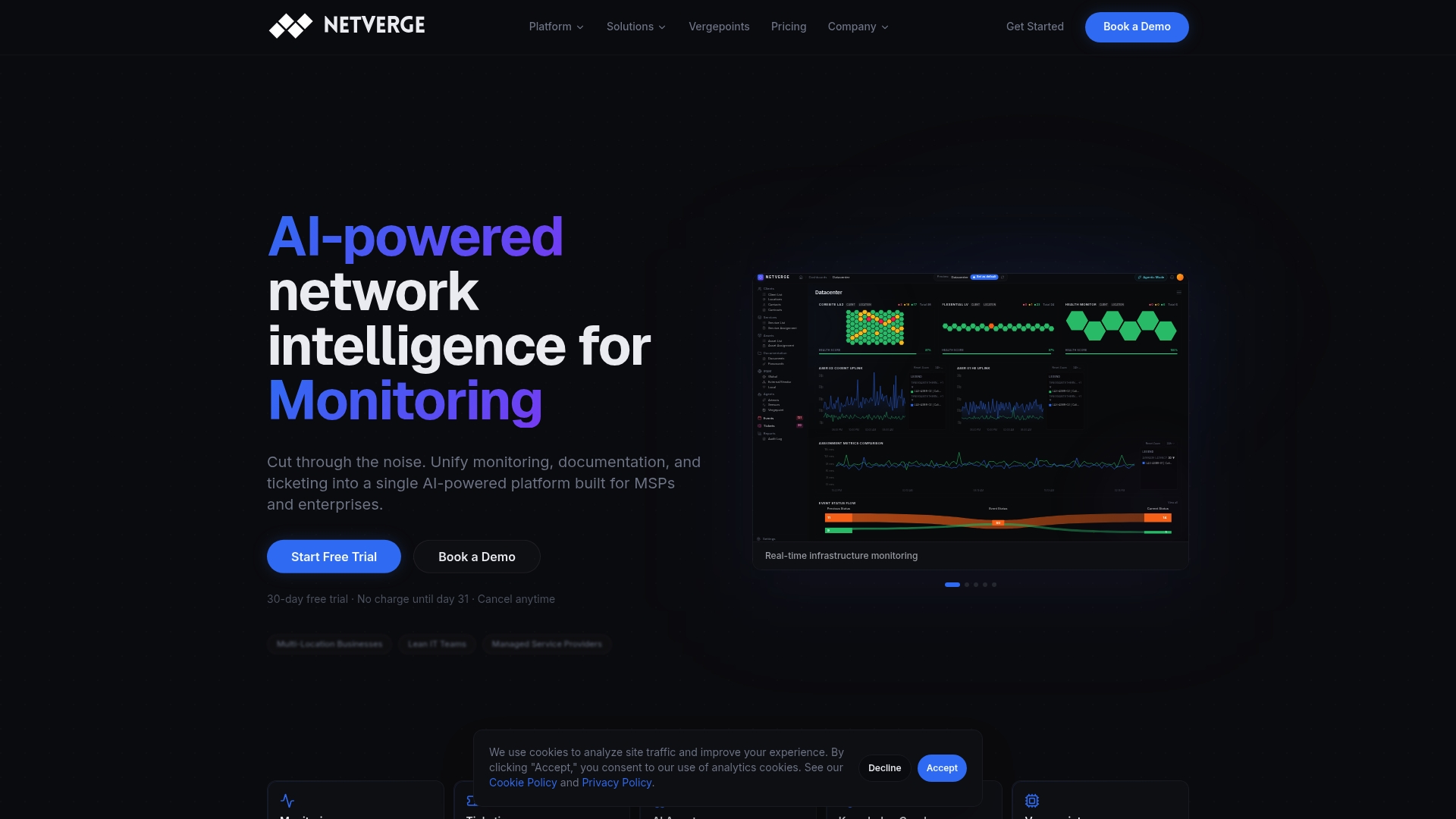
For on-site visibility, Vergepoints hardware delivers plug-and-play observability at locations without existing infrastructure, backed by more than 28 intelligent sensors. On the software side, the AI-powered ticketing module handles triage automatically, which is where most of the ticket deflection gains described above actually get realized. If you're evaluating a platform to run a pilot against one customer or site, the Netverge monitoring platform is built for exactly that phased rollout, start with one location, prove the MTTR and deflection numbers, then scale. Request a demo to see how your existing telemetry maps into the system before you commit to a full deployment.
Key Takeaways for Starting Proactive Incident Prevention This Week
- Pilot one high-impact customer or site first. Instrument its telemetry, tune alert thresholds, then enable anomaly detection.
- Roll out automation in stages: audit-only, then supervised reversible actions, then full autonomy for low-risk playbooks only.
- Keep an audit trail and approval step on every automated action from day one, not as a later addition.
- Track MTTR and ticket deflection rate monthly, and share both with finance and vCIO stakeholders alongside SLA compliance data.
- Review runbooks quarterly and treat every false positive as data for recalibrating thresholds, not just noise to dismiss.