
When a network incident hits, the first six steps determine whether you contain the damage or watch it spread. Isolate affected segments immediately, preserve logs before any remediation action, rotate exposed credentials, notify your stakeholders, escalate to your SOC or IR team, and document every action with a timestamp. That sequence is your stabilization checklist, and it applies whether you are managing a single-site enterprise or 200 distributed locations.
- Prioritize life-safety and critical services — confirm operational technology and safety systems are unaffected before anything else.
- Isolate affected segments — disconnect at the switch level if multiple subnets are involved; unplug ethernet or remove from Wi-Fi if a full network takedown is not feasible.
- Preserve logs and forensic artifacts — capture flow data, firewall logs, and endpoint telemetry before touching affected systems.
- Rotate exposed credentials — change passwords and revoke tokens for any account that touched the compromised segment.
- Notify stakeholders — alert your internal IR team, customer contacts, and legal/compliance per your contract.
- Escalate to IR team or SOC — hand off with a concise situation report including scope, affected assets, and actions already taken.
Quick triage commands (safe to run during stabilization):
- Capture a NetFlow snapshot:
nfdump -r /var/cache/nfdump/nfcapd.current -o extended | head -200 - Snapshot endpoint volatile state (Windows):
wmic process list brief > C:\IR\processes_snapshot.txt && ipconfig /all >> C:\IR et_snapshot.txt - SIEM quick search (Splunk example):
index=network sourcetype=firewall action=blocked earliest=-1h | stats count by src_ip, dest_ip, dest_port | sort -count
Pro Tip: Per CISA advisory guidance, keep printed, up-to-date copies of your IR and communications plans in a secured offline location. Ransomware can render every digital playbook inaccessible within minutes.
Table of Contents
- What does the network incident response lifecycle look like?
- How should you assign roles and contractual visibility across MSP and customer teams?
- What telemetry should you collect, and how long do you keep it?
- How do you triage and preserve evidence without destroying it?
- How do you contain and remediate threats across distributed networks?
- What are your notification obligations and how do you communicate during an incident?
- How do you run an effective post-incident review?
- When should you automate incident response, and when should you stop?
- What KPIs and test cadence prove your IR program is improving?
- Key Takeaways
- The part most IR guides get wrong
- Netverge gives MSPs faster detection and response across every site
- Authoritative references and further reading
What does the network incident response lifecycle look like?
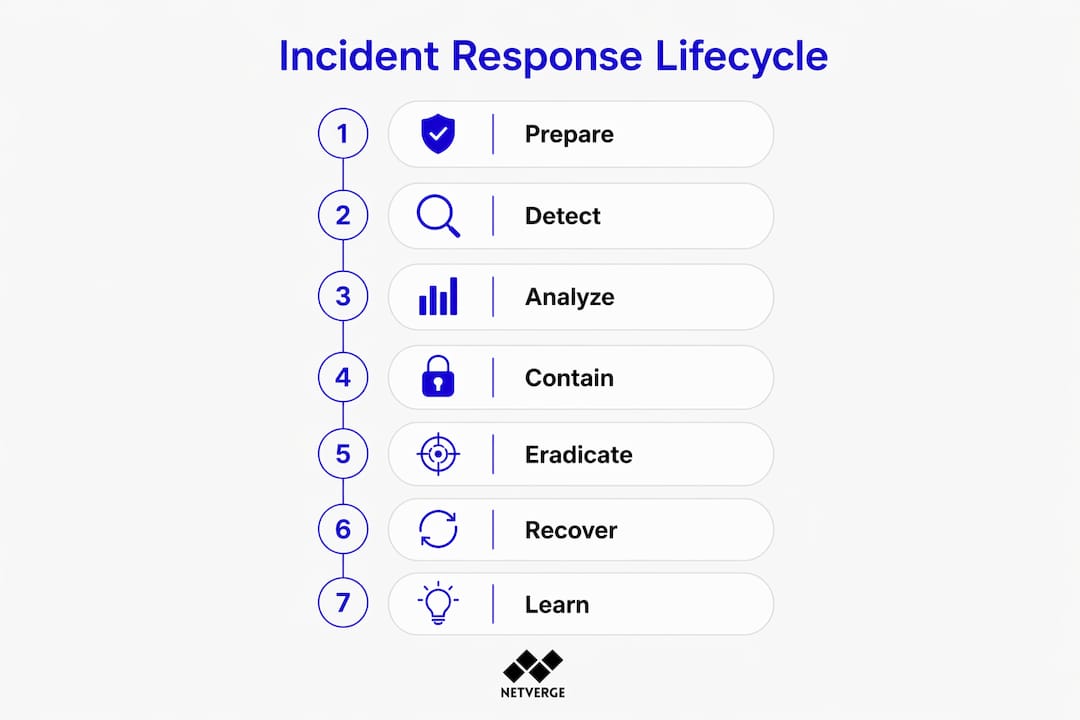
The NIST SP 800-61 lifecycle defines seven phases: Prepare, Detect, Analyze, Contain, Eradicate, Recover, and Learn. CISA and SANS both reinforce a core principle: prevention alone is not a realistic goal. Your posture must emphasize resilience — resist, detect, and respond — because some intrusions will succeed regardless of perimeter controls.
Each phase produces specific artifacts. During Detect, you collect flow logs, endpoint telemetry, and packet captures. Analyze produces a scope assessment and an initial timeline. Contain generates ACL changes, isolation records, and credential rotation logs. Eradicate closes with a validated clean-state report. Recover ends with a service restoration sign-off. Learn produces an updated runbook and a prioritized action list. Skipping artifact production in any phase creates gaps that hurt both forensics and future prevention.
How should you assign roles and contractual visibility across MSP and customer teams?
Every IR engagement needs a RACI before an incident occurs, not during one. CISA recommends that MSP contracts explicitly state logging responsibilities, notification timing, and escalation protocols so there is no ambiguity when minutes count.
| IR Task | MSP SOC | Customer IT | Legal/Compliance | Executive |
|---|---|---|---|---|
| Detection & alerting | R | I | — | — |
| Initial triage | R | C | — | — |
| Containment decisions | R | A | C | I |
| Customer notification | C | R | A | I |
| Regulatory reporting | I | C | R | A |
| Recovery authorization | C | R | C | A |
MSP contract checklist (CISA-aligned):
- Explicit statement of which logs the MSP collects and retains
- Minimum retention period per CISA guidance
- Notification timing: when and how the customer is informed of a confirmed incident
- Scope of pre-authorized containment actions the MSP can take without customer approval
- Escalation path to customer legal and executive contacts
For a deeper look at MSP responsibilities and governance, align your contract language with these obligations before you onboard a new customer.
What telemetry should you collect, and how long do you keep it?
Collect network flows, firewall and router logs, endpoint telemetry, DNS query logs, authentication logs, and short-window packet captures. CISA mandates a minimum of six months of log retention and expects MSPs to give customers visibility into what is being collected and how.
- Network flows (NetFlow/IPFIX): retain multiple months in indexed SIEM storage
- Firewall and router logs: forward to a segregated logging tier, not co-located with managed systems
- Endpoint telemetry (EDR): retain three months in hot storage, and longer-term in warm storage
- DNS and authentication logs: critical for lateral movement detection; retain multiple months minimum
- Packet captures: selective full-packet capture for high-risk segments; 30-day rolling window is practical for most environments
Pro Tip: Use a hot/warm/cold tiering model. Keep 30 days in hot SIEM storage for fast querying, 90 days in warm compressed storage, and archive to cold (object storage like S3 Glacier) for the remainder of your retention window. Selective full-packet capture on admin VLANs costs far less than capturing everything. For alert tuning strategies that reduce false positives and improve detection signal, see real-time network alerting guidance.
How do you triage and preserve evidence without destroying it?
Capture volatile data first, then persistent data. Running memory images, active connections, and process lists disappear on reboot. Firewall logs and disk artifacts do not. Sequence your collection accordingly, and never reimage a system before documenting its state — you may be destroying the only record of how the attacker moved.
Collect in this order: active network connections (netstat -ano), running processes, logged-in users, memory image if the host is a critical pivot point, then firewall and application logs. Avoid rebooting, patching, or reimaging any affected host until forensic collection is complete. NIST SP 800-86 covers chain-of-custody practices for network traffic data, including how to document collection methods for legal review. If law enforcement involvement is possible, coordinate with legal counsel before touching any system, and maintain a time-stamped sequential log of every command and decision.
How do you contain and remediate threats across distributed networks?
Containment must be tiered by scope and blast radius. Start at the host, expand to the segment, then act at the WAN edge only if the threat has spread across sites.

| Scope | Containment Action | Credential Rotation | Edge Action |
|---|---|---|---|
| Single host | Isolate via EDR or switch port disable | Accounts on that host | None required |
| VLAN/subnet | ACL block at layer 3, quarantine VLAN | All accounts in segment | Monitor upstream |
| Single site | Site-level firewall block, VPN suspension | All site admin accounts | Block C2 IPs at WAN |
| WAN backbone | Emergency BGP null-route or upstream filter | All admin and service accounts | Full edge ACL review |
Step-by-step remediation sequence:
- Apply short-term ACLs to block confirmed malicious IPs and lateral movement paths.
- Move management interfaces behind a dedicated admin network with VPN/firewall protection, per CISA-FBI guidance.
- Enforce emergency MFA enrollment for all privileged accounts.
- Rotate credentials for every account with access to the affected segment.
- Patch the exploited vulnerability or apply a compensating control.
- Restore services from verified, known-good backups only after a clean-state validation.
For network security practices covering admin interface hardening in MSP environments, that resource covers the technical controls in depth.
What are your notification obligations and how do you communicate during an incident?
Notify affected customers and your legal/compliance team as soon as a confirmed incident is declared. U.S. state breach notification laws vary significantly: some states require notification within 30 days, others within 72 hours for certain data types. Your IR plan must map to the specific obligations of each customer's operating states.
Stakeholder notification tiers:
- Technical (T+0): IR team, SOC, customer IT lead — scope, affected systems, containment status
- Executive (T+1 hour): business impact summary, estimated recovery window, decisions needed
- Legal/Compliance (T+1 hour): regulatory exposure, evidence preservation status, law enforcement consideration
- Customers/Regulators (per contract/law): factual incident description, actions taken, next steps
Customer holding statement template:
Use out-of-band communication (phone, separate email domain) during active incidents to avoid tipping off a threat actor monitoring your primary channels.
How do you run an effective post-incident review?
Run your lessons-learned session within two weeks of incident closure. Waiting longer allows context to fade and action items to stall. Keep the output concise: an executive summary, a timeline, a root cause statement, and a prioritized list of remediation actions with owners and deadlines.
- Executive summary: one paragraph covering what happened, business impact, and resolution.
- Incident timeline: chronological log from first indicator to full recovery.
- Root cause analysis: specific technical and process failures, not generic observations.
- Remediation actions: each item gets an owner, a deadline, and a success criterion.
- Runbook updates: feed findings directly into detection rules, playbook revisions, and patching cadence.
- Customer communication: share a sanitized summary with affected customers and update contract terms if gaps were exposed.
When should you automate incident response, and when should you stop?
Automate low-risk, high-repeatability tasks: alert enrichment, ticket triage, standard host isolations, and credential lock actions triggered by confirmed indicators. Keep human approval gates for high-impact changes — WAN-level ACL modifications, mass credential resets, and any action that affects production services for multiple customers simultaneously.
Example runbook snippet (compromised VPN admin account):
- Trigger: authentication anomaly alert on VPN admin account from unexpected geography
- Automated: disable account, open P1 ticket, pull last 24 hours of auth logs, notify on-call engineer
- Human gate: confirm scope before rotating shared service credentials or suspending VPN access site-wide
- Audit: every automated action logged to immutable audit trail with timestamp and triggering alert ID
Pro Tip: Run every new automated playbook in dry-run mode against historical alert data before enabling live execution. A playbook that isolates the wrong host during a forensic preservation phase can destroy evidence and extend your MTTR significantly.
Disable automation during active forensic preservation phases. An automated remediation action that wipes a process or clears a log entry can invalidate your entire evidence chain. See MSP tool stack guidance for integration recommendations.
What KPIs and test cadence prove your IR program is improving?
Test regularly. Track key performance indicators such as Mean Time to Detect (MTTD) and Mean Time to Respond (MTTR), evidence completeness, and notification timing for affected customers.
| Test Type | Frequency | Primary Output |
|---|---|---|
| Tabletop exercise | Quarterly | Process gaps, role clarity |
| Technical drill (simulated attack) | Semi-annual | Detection coverage, MTTD measurement |
| Full restore exercise | Annual | RTO validation, backup integrity |
Target MTTD under four hours for critical incidents in MSP-managed environments. MTTR under 24 hours for contained incidents is a reasonable baseline; sub-8-hour MTTR is achievable with pre-authorized containment actions and automated triage. Tie these KPIs directly to customer SLAs and include them in quarterly business reviews. Customers who see MTTD/MTTR trending down renew contracts; customers who see unexplained gaps do not.
Key Takeaways
A complete network incident response guide requires contractual clarity, tiered containment, and measurable KPIs — not just a checklist.
| Point | Details |
|---|---|
| Six-step stabilization | Isolate, preserve, rotate credentials, notify, escalate, and document — in that order, every time. |
| CISA log retention | Retain all log categories for a minimum of six months; state this explicitly in every MSP contract, as mandated by CISA guidance. |
| RACI before incidents | Assign detection, containment, notification, and recovery ownership before an incident occurs, not during one. |
| Test quarterly | Run tabletop exercises every quarter and track MTTD and MTTR against SLA targets in customer reports. |
| Netverge for MSPs | Netverge unifies telemetry, automated triage, and documentation into one platform to reduce MTTD and MTTR across distributed sites. |
The part most IR guides get wrong
Most incident response frameworks treat the plan as the product. Write the playbook, check the box, move on. The organizations that actually recover faster are the ones that treat the plan as a living artifact — one that gets updated after every incident, every tabletop, and every near-miss.
The contractual visibility piece is where MSPs consistently underinvest. CISA's guidance on MSP logging obligations is not a suggestion; it is the baseline expectation regulators and customers will hold you to after an incident. MSPs that cannot show a customer exactly what was logged, when, and how they were notified are exposed — legally and commercially. Pre-authorized containment actions matter just as much. Decision lag during an active incident is where damage compounds. If your SOC has to call three people before isolating a compromised segment, you have already lost 30 minutes you cannot recover.
The other underrated element: offline IR plans. It sounds obvious until ransomware encrypts your SharePoint and your on-call engineer cannot find the escalation contact list. Physical copies in a secured location are not a legacy practice. They are operational insurance.
Netverge gives MSPs faster detection and response across every site
Fragmented monitoring tools and disconnected documentation are the two biggest contributors to slow MTTD in distributed environments. Netverge consolidates telemetry, automated alert triage, ticketing, and network documentation into a single platform — so your SOC works from one source of truth instead of five dashboards.
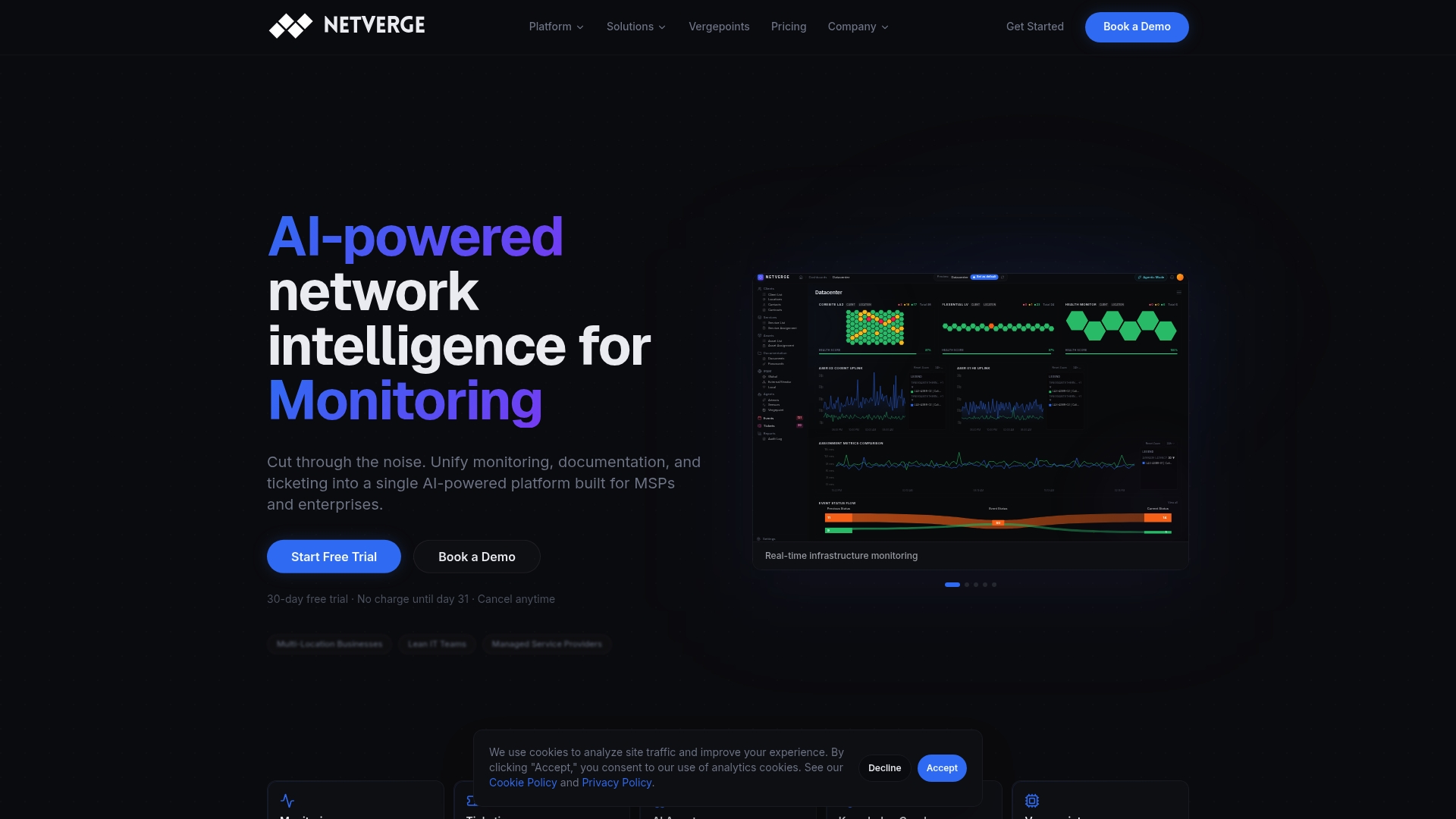
Vergepoints hardware deploys at physical sites to deliver local telemetry collection without relying on existing infrastructure. AI-driven anomaly detection surfaces incidents before they escalate, and automated runbooks handle low-risk triage actions while routing high-impact decisions to the right engineer. Integrated ticketing creates the time-stamped audit trail your legal and compliance teams need. For MSPs managing network monitoring across distributed locations, Netverge reduces the operational gap between detection and containment. Request a demo at netverge.com to see how it maps to your current IR workflow.
Authoritative references and further reading
Primary standards used in this guide:
- CISA: Protecting Against Cyber Threats to MSPs and their Customers — MSP logging obligations, notification protocols, and contractual visibility requirements
- CISA Joint Advisory AA22-131A — segregated logging, SOC triage, and offline IR plan recommendations
- NIST SP 800-61r2: Computer Security Incident Handling Guide — lifecycle phases, organizational planning, and post-incident analysis
- NIST SP 800-86: Guide to Integrating Forensic Techniques into Incident Response — network data sources, chain-of-custody, and forensic collection procedures
- CISA #StopRansomware Guide — ransomware-specific response checklist and notification guidance
- SANS: The Big Picture of the Security Incident Response Cycle — resist/detect/respond framing and practical IR cycle overview
Further reading:
- Cybersecurity best practices for modern businesses — practical controls and risk reduction guidance applicable to MSP-managed environments
- Tips for MSPs managing distributed networks — operational guidance for multi-site network management and incident coordination