Blameless Postmortem: How to Run One That Gets Fixes Shipped
Published
- blameless postmortem
- post-incident review
- postmortem template

A blameless postmortem is a written review of an incident that explains what happened, why the system allowed it, and what will change, without blaming any person or team. It assumes everyone acted with good intentions on the information they had. It still ends with owned, dated actions. This guide covers when to hold a post-incident review, who joins, a template you can copy, and how to make sure the fixes get done.
TL;DR
- A blameless postmortem asks what conditions made the error possible, not who made it. People are named for context, never for fault.
- Hold one after user-visible downtime, data loss, manual intervention such as a rollback or reroute, or a monitoring miss. Finish the review within about 5 working days.
- Use a fixed template: summary, impact with numbers, timeline, contributing factors, resolution, and action items.
- Blameless is not consequence-free. Every finding becomes an action with an owner, a deadline, and a closure criterion.
- The review is only as good as its data. Alerts, tickets, and network documentation in one place make the timeline accurate.
Table of Contents
- What a blameless postmortem means
- Blameless does not mean nobody is accountable
- When to hold a post-incident review
- Who should attend
- How to run a blameless postmortem, step by step
- A postmortem template you can copy
- Turning findings into owned, trackable actions
- Common mistakes to avoid
- See your incident timeline in one place
- FAQ
- Sources
What a blameless postmortem means
A postmortem, also called a post-incident review or retrospective, is the record of an incident written after service is restored. Google's SRE book says its primary goals are to document the incident, understand the contributing root causes, and put effective preventive actions in place to reduce the likelihood or impact of recurrence.
"Blameless" describes how the document is written and how the meeting runs. The same source says a blameless postmortem must focus on the contributing causes of the incident without indicting any individual or team for bad or inappropriate behavior. It starts from the assumption that everyone involved had good intentions and did the right thing with the information available at the time.
For a network operations team, that changes the questions you ask:
| Blame-focused question | Blameless question |
|---|---|
| Who pushed the bad change? | What allowed a bad change to reach production? |
| Why didn't the engineer notice the alert? | Why was the alert one of 400 that hour, and why did it lack context? |
| Who forgot to update the diagram? | Why is documentation not updated as part of the change itself? |
| Who approved this? | What information did the approver see when they approved it? |
The left column ends the conversation. The right column produces a fix.
Blameless does not mean nobody is accountable
The most common objection is that blameless reviews let people off the hook. They don't, because accountability moves from the past to the future. Nobody is asked to defend what they did. Someone is asked to own what happens next.
Two habits keep that balance:
- Name people for context, not fault. GitLab's handbook allows references to individuals or team names for firsthand context, and states those references are never intended to cast blame. The focus stays on the sequence of events, decision-making, and the challenges people faced. "The on-call engineer rolled back the switch config at 02:14" is a fact. "The on-call engineer should have caught it" is a verdict.
- Require owned actions. A finding without an owner is a wish. Each action needs a named owner, a due date, and a clear definition of done.
Google's guidance also describes a postmortem as a learning opportunity for the whole company, not punishment. If someone repeatedly ignores agreed process, that is a management conversation held separately from the review, not inside it.
When to hold a post-incident review
Not every alert needs a full review. Writing one takes time, so decide in advance which events qualify. Google's SRE book lists common triggers:
- User-visible downtime or degradation beyond a set threshold
- Data loss of any kind
- On-call engineer intervention, such as a rollback or rerouting of traffic
- Resolution time above a set threshold
- A monitoring failure that meant the incident was found manually
For MSPs and multi-site IT teams, translate those into your own thresholds. A reasonable starting set: any Severity 1 or 2 incident, any outage affecting a whole site or client, any event where the customer reported the problem before your monitoring did, and any repeat incident within 30 days. If you already classify incidents, tie the trigger to your incident priority matrix so the decision is automatic rather than debated each time.
It also helps to confirm that the event was a real incident first. Our guide to alert vs incident validation explains how to check impact before opening a review.
How soon to hold it
Hold the review once the issue is mitigated and while memory is fresh. GitLab expects an incident review to be closed within 5 working days of resolution, and for Severity 1 incidents a public root cause analysis within 7 days. Those are useful reference points for a team setting its own service levels: a draft within two or three days, a meeting within 5 business days, and actions assigned before the review closes.

Who should attend
Keep the room small and relevant:
- The incident lead and the people who worked the incident
- Subject-matter experts for the systems involved (WAN, firewall, wireless, cloud connectivity)
- A facilitator who did not lead the response
- Stakeholders who need to approve or fund the fixes, such as a service delivery manager or client success lead
The facilitator matters more than most teams expect. Good options are the author of the postmortem document, the incident lead, or a neutral reviewer from a rotating internal pool. A neutral facilitator is often easiest when the incident lead is emotionally invested or senior enough that others hesitate to speak freely.
How to run a blameless postmortem, step by step
This is a practical sequence you can adopt as is. The timings are our recommendation, built around the reference points above.
1. Collect the evidence before the meeting
Within a day of resolution, assign an author and pull the raw record: alert history, ticket notes, chat logs, change records, configuration diffs, and monitoring graphs. Build the timeline from system timestamps, not from memory. Memory edits stories to make them tidier and more flattering.
This is where fragmented tooling hurts. When alerts live in one tool, tickets in another, and network diagrams in a shared drive, the author spends hours reconciling clocks and guessing which device was where. Keeping documentation current and tickets linked to the alerts that created them shortens this step considerably.
2. Draft the document first
The author fills in the template below before anyone meets. Circulate it 24 hours ahead, and ask participants to correct facts, not to argue conclusions. The meeting is then spent on analysis, not on reading a timeline aloud.
3. Open the meeting with ground rules
The facilitator states the purpose in one minute: align on what happened, build shared understanding, and identify improvements. Then state the rule: we describe actions and conditions, not character. If a sentence starts with "why didn't you," rephrase it as "what made that option look right at the time."
4. Walk the timeline, then ask "how" repeatedly
At each decision point, ask what the person saw, what they knew, and what options seemed available. Look for contributing factors in several layers:
- Detection: Did monitoring catch it, or did a user?
- Triage: Was the ticket routed and prioritized correctly?
- Context: Could the responder find the right diagram, credentials, or runbook quickly?
- Change management: Was there a recent change, and was it reviewed with full information?
- Communication: Did the client or internal stakeholders hear from you at the right time?
Avoid stopping at a single root cause. Most network incidents have several contributing causes, and a one-line cause usually hides the useful ones.
5. Convert findings into actions before the meeting ends
For each contributing factor, ask what would have made it less likely or less severe. Write the action in the room, assign an owner, and set a date. Then test each action: if this had been in place, would the incident have been prevented or shortened? GitLab's guidance has the incident owner keep probing whether corrective actions truly prevent a repeat, and widen the group involved if they do not.
6. Publish and share
Share the finished document internally. AWS's DevOps guidance says post-incident analysis should not be used to place blame, and recommends documenting and sharing findings, anonymized where appropriate, for broader learning (AWS Well-Architected). For client-facing incidents, an MSP can send a shorter customer version. Our incident communication templates cover the wording.
A postmortem template you can copy
A good template is short enough that people finish it and specific enough that two authors produce comparable documents. Use these sections:
| Section | What goes in it |
|---|---|
| Summary | Two or three sentences: what broke, who was affected, how long, how it was fixed |
| Impact | Exact numbers: minutes of degraded service, sites and clients affected, users affected, tickets opened, SLA breaches |
| Timeline | Timestamped events in one time zone: first signal, detection, escalation, mitigation, resolution, with links to graphs, tickets, and logs |
| What happened | A plain narrative of the sequence, written without judgment |
| Contributing factors | The conditions that allowed or worsened the incident, grouped by detection, process, tooling, and documentation |
| Resolution | What restored service and what is still temporary |
| What went well | Practices and tools that helped, so you keep them |
| Action items | Each with owner, due date, ticket link, and closure criterion |
| Communication | The internal update and the customer or status message that were sent |
Two details separate useful postmortems from forgettable ones. First, record impact in numbers, not adjectives: "37 minutes, 4 sites, 212 users" beats "significant disruption." Second, include the "what went well" section. It stops the review from reading like a charge sheet and records the habits worth repeating.
A worked example
Here is an illustrative scenario, not a real client case. A branch office loses its primary WAN link at 02:10. Failover to the backup link does not trigger, and the site is offline for 41 minutes until an on-call engineer reroutes manually.
A blame-focused review would say the engineer who last edited the routing policy made a mistake. A blameless review finds more:
- The failover threshold was changed three weeks earlier, and the change record had no test step.
- The alert for the primary link arrived alongside 60 related alerts, and the one that mattered was not distinguished.
- The runbook for that site referenced a circuit that had since been replaced.
- The customer called before monitoring escalated, which meets the "manual discovery" trigger.
The actions: add a failover test to the change template (owner: network lead, due in two weeks), correlate related alerts into one incident (owner: monitoring lead), update the site runbook and diagram (owner: documentation owner), and add a synthetic check on the backup path. Every action is about the system. Nobody is singled out, and every item can be checked off.
Turning findings into owned, trackable actions
A review fails when it produces findings and no follow-through. The action list is the output that matters, so treat it like production work:
- Create a ticket for each action in the same system your team already works from, and link it to the postmortem. Tag it consistently so you can report on open postmortem actions each month.
- Assign one owner per action. A team can be the owner of record only if one person coordinates it.
- Set a due date and a closure criterion. "Improve monitoring" is not closable. "Add a backup-path check for all 14 branch sites and confirm it alerts in a test" is.
- Separate categories: fixes for this incident, preparedness work such as runbooks and drills, and process changes to your incident response.
- Review open actions weekly until they close, and do not close the postmortem until every action has an owner. GitLab requires all corrective actions to be assigned to a team before a review can be closed.
If you manage field technicians, the same principle applies to repair work: when every tech follows the same documented steps, results stop depending on who picked up the ticket. Standardized workflow templates for repair steps show how that consistency supports clear ownership. Our network ticketing workflow checklist covers the equivalent for network tickets.
Common mistakes to avoid
- Stopping at "human error." That is where the analysis should begin. Ask what made the error easy to make and hard to catch.
- Writing the document alone and presenting it as final. Circulate the draft and let responders correct the facts.
- Skipping the small incidents that were near misses. A failed failover that happened to fix itself carries the same lessons.
- Letting actions pile up. If the backlog of postmortem actions grows, either the actions are too large or capacity is not reserved. Break them down or schedule time for them. Our guide on how to reduce a ticket backlog can help with the capacity side.
- Never reading old postmortems. Search past reviews when a new incident opens. Repeats show which actions were not done or did not work.
Our perspective
We build tools for the people who run networks at 2 a.m., so we see where postmortems break. It is rarely the culture. It is the evidence. When alerts, tickets, and documentation sit in separate tools, the timeline takes hours to assemble, and the team ends up arguing about what happened instead of why.
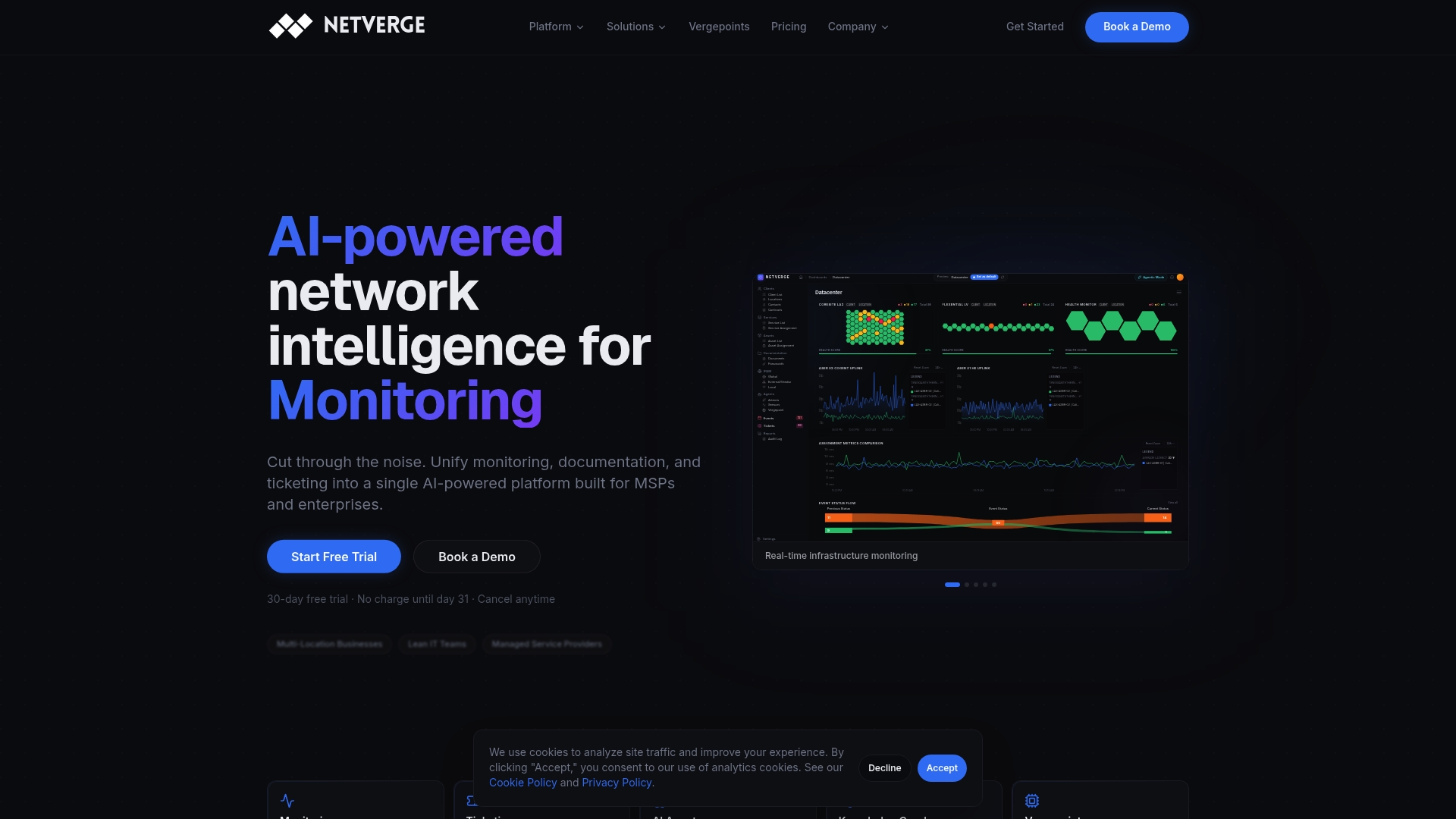
That is why we designed Netverge to bring monitoring, ticketing, documentation, and automation into one platform. Our approach is built around a few ideas. Correlated alerts mean the first signal is visible in one incident, not buried in noise. A knowledge graph gives responders the context of which device connects to which site and client. Vergepoints add on-site visibility, so you can see the network from the edge during an outage. Autonomous AI agents are designed to diagnose and act on routine issues, which frees engineers for the analysis that needs people.
A blameless review needs accurate facts, a short path from finding to ticket, and a place where the fix is documented. We think those belong in the same system you use to run the network.
Jim
See your incident timeline in one place
If your last postmortem took a day to reconstruct, the problem is scattered data. Netverge combines real-time monitoring, anomaly detection, AI-powered ticketing, and documentation for MSPs and multi-site IT teams. Plans start with the Starter Package at $299 per month, and edge visibility is available through Hardware Vergepoints at $49 per month per device or a Software Vergepoint at $29 per month per Vergepoint. See the pricing guide for add-ons, or start your free trial and review your next incident with the full picture.
To see how it fits your environment, you can also request a demo from the Netverge site.
FAQ
What does "blameless postmortem" mean?
It is a post-incident review that looks for the system conditions behind a failure rather than a person to fault. It assumes people acted with good intentions and the information they had. The result is a document with a timeline, contributing factors, and owned action items.
What is the difference between a postmortem and a post-incident review?
In practice they are the same activity under different names. Some teams prefer "post-incident review" or "retrospective" because "postmortem" sounds final. What matters is the method: factual timeline, contributing causes, and tracked actions.
How long after an incident should we hold the review?
Once service is stable and while details are fresh. Common practice from large engineering organizations is to complete the review within about 5 working days of resolution, with a draft ready before the meeting. Severity 1 incidents may warrant a faster written summary.
Who should write the postmortem?
Usually someone who took part in the response, often the incident lead or a designated author, working from system records rather than memory. A neutral facilitator can run the meeting so the author is not also defending the decisions in the document.
Does blameless mean no one is held accountable?
No. Accountability shifts to the fixes. Each finding becomes an action with an owner, a due date, and a closure criterion, and open actions are reviewed until they close. Ongoing performance concerns are handled separately by management.
Sources
- Google SRE Book: Postmortem Culture, Learning from Failure
- GitLab Handbook: Incident Review
- AWS Well-Architected DevOps Guidance: Conduct post-incident analysis for continuous improvement