
The fastest, most reliable way to improve first response time is to cut actionable alert noise and put AI-enriched context in front of responders within the first two minutes. This combination of symptom-based alerting, conservative automation, and telemetry built for instant correlation is what separates teams that react in minutes from teams still hunting through consoles. Google SRE has measured a reduction in mitigation time of about 44% when AI enrichment supports investigation, and the tactics below show exactly how to get there within a single quarter.
TL;DR:
- Reducing alert noise and delivering AI-enriched context within two minutes can cut mitigation time by nearly 44 percent.
- Automating low-regret actions and routing alerts to the correct teams without adding headcount significantly improve response speed.
- Establishing clear incident declaration thresholds, short runbook checks, and automated notifications prevent response delays and support blameless postmortems.
- Integrating logging, telemetry, and event-driven data in one platform enables responders to pivot quickly from alerts to the root cause.
- Maintaining narrow, supervised automation combined with continuous process tuning and training accelerates first response without increasing risk.
Table of Contents
- Six tactical changes you can implement this quarter
- Design logging and telemetry so responders can pivot fast
- Automate triage and enrichment without scaling broken processes
- Declare incidents early and use concise runbooks
- Measure first response and close the loop with better metrics
- Training and upskilling first responders for efficiency
- Implementing real-time collaboration tools
- Balancing automation with human oversight to avoid missed alerts
- Author perspective: sequencing work and avoiding common traps
- Netverge: how a unified platform supports faster first response
- FAQ
- Sources
Six tactical changes you can implement this quarter
Shortening the gap between alert and triage rarely requires new headcount. It requires discipline about what fires, what gets enriched automatically, and what a human sees first.
- Tune alerts to customer impact. Rewrite thresholds around symptoms a customer would notice, not internal system fluctuations, and retire alerts that never lead to action.
- Deduplicate and suppress intelligently. Group related alerts into a single incident record and apply suppression windows so one root cause does not generate ten tickets.
- Route by role automatically. Send each alert type directly to the team that owns it instead of a shared queue that adds a triage step.
- Automate low-regret actions. Let automation discard known false positives, restart a known-safe service, or attach recent deploy history to a ticket before a human opens it.
- Cap enrichment time. Set a hard budget, under two minutes, for any automated context-gathering step so it never becomes the new bottleneck.
- Write two-minute runbook checks. Give first responders a short, fixed list of what to confirm and what to isolate before they do anything else.
Clear on-call rotations, documented escalation rules, and a short acknowledgement SLA round out the list. None of this is glamorous, but it is the difference between a five-minute first response and a forty-minute one. For a deeper look at tuning thresholds, see this real-time alerting process guide.
Pro Tip: Review your alert catalog monthly and delete any alert that has not driven a distinct action in 90 days.
Design logging and telemetry so responders can pivot fast
First response time collapses when responders can jump from an alert straight to the data that explains it, instead of switching between five different dashboards. That starts with deciding what gets ingested first.
- Identity logs show who touched what, and when, across the environment.
- EDR telemetry flags endpoint behavior tied to the alert's blast radius.
- Network flow data confirms whether the issue is isolated or spreading.
- Change and deployment records often explain the root cause before a human asks.
- Critical application telemetry ties the technical signal back to customer impact.
CISA's guidance on SIEM and SOAR implementation recommends prioritizing this kind of log ingestion so automated actions can be triggered from reliable telemetry rather than guesswork. Event-driven streaming should be the default; polling is acceptable only as a bounded fallback when a source cannot push events natively. Every log record needs user or resource identifiers, change IDs, accurate timestamps, and provenance metadata, a practice CISA's Logging Reference Architecture ties directly to faster, more trustworthy pivots between alerts and correlated datasets. Centralized, searchable storage then supports both the two-minute triage and any forensics that follow. The goal is a SIEM or SOAR setup where one click moves a responder from the alert to the exact dataset that confirms or rules out the cause, a workflow covered in more depth in this incident correlation breakdown.
Automate triage and enrichment without scaling broken processes
Automating a bad manual process just makes the bad process faster. The sequence that works is to simplify the human workflow first, distill the decision logic that remains, and only then translate it into automation. Skipping that step tends to produce automation that executes confusion at machine speed.
CISA's "Enabling Automation in Security Operations" strategy recommends automating the triage logic analysts already use: discarding known false positives, taking low-regret actions, and building enriched tickets pulled from primary, corroborative, and authoritative sources. That is the pattern Netverge's AI agents follow. Vergepoint hardware feeds edge telemetry into the platform, the knowledge graph links that telemetry to related incidents and recent changes, and the AI agents stage a short incident hypothesis with links back to the source evidence rather than acting unilaterally on anything material.
Informational assistance, meaning AI-provided context and incident hypotheses, speeds human triage without granting full autonomy over response actions.
Autonomous actions stay scoped narrowly, enrichment tasks stay under the two-minute budget Google SRE associates with faster mitigation, and anything with real consequences waits for a human to approve it. Netverge customers using this pattern report a 30 to 55% reduction in ticket backlog within 90 days, an internal figure worth treating as illustrative of what disciplined automation can do rather than a guaranteed outcome for every environment.
Pro Tip: Start autonomous actions with read-only enrichment tasks, and only expand scope once a few months of logs show zero false remediations.

Declare incidents early and use concise runbooks
Hesitation at the start of an incident costs more time than almost anything downstream. NIST SP 800-61 Revision 3 frames incident response as a cycle of detection, response, and recovery, and recommends declaring incidents against clear, pre-agreed criteria instead of leaving that judgment call to whoever is on call that night. Early declaration pulls in the right framework immediately and takes the decision fatigue off the first responder.
- Set declaration thresholds in advance so an engineer does not have to debate severity while an outage is active.
- Write a three or four-step runbook covering what to check, what to isolate, and what indicators to collect first.
- Wire declaration logic into automation so routing and notifications fire the moment thresholds are met, with no manual relay step.
- Run blameless postmortems to adjust thresholds and runbook steps based on what actually happened, not assumptions.
A partner guide on building an incident reporting workflow covers how to keep that loop from quietly breaking down after the first few incidents.
Measure first response and close the loop with better metrics
First response time is the elapsed time from alert detection to the first human or automated triage action, and that definition needs to be consistent across every system that reports it. Breaking the window into Detect, Review, Analyze, Identify, and Notify, paired with Collect, Validate, and React, shows exactly where time disappears instead of leaving teams to guess.
- Pull the raw timestamps from SIEM, incident management, and ticketing systems rather than relying on self-reported times.
- A/B test automation changes against a control group of incidents before rolling them out everywhere.
- Watch for misleading averages, since a single long outlier can make raw MTTR look worse than the typical case.
- Set short-term, specific targets and revisit them after every postmortem cycle.
A measured 44% drop in mitigation time came from AI-assisted investigation dashboards in Google SRE's research, with informational assistance alone accounting for roughly 10% of that gain, a reminder that even modest context-surfacing tools move the needle. A monthly alert and metrics review, like the cadence in this alert fatigue playbook, keeps the numbers honest over time.
Training and upskilling first responders for efficiency
Tools only get a team so far if the people on call cannot act on what the tools surface. Fast first response depends on responders who recognize patterns quickly, trust the runbook, and know when to escalate rather than investigate further on their own.
Rotational shadowing, where newer engineers sit in on live incidents before taking primary on-call duty, builds that pattern recognition faster than documentation alone. Tabletop exercises that replay past incidents, with the clock running, train the muscle memory needed for the two-minute checks covered earlier. Cross-training across network, security, and application domains also matters, because a narrowly specialized responder often loses time just figuring out who else to call.
Refresher sessions tied to actual postmortems work better than generic training calendars. When a runbook step gets changed after an incident, that change should be the subject of the next team briefing, not a line buried in a wiki update. Response speed compounds when training reflects what the team just learned instead of a standing curriculum that never evolves alongside the environment.
Implementing real-time collaboration tools
A fast first response still stalls if the responder cannot immediately loop in the right people. Real-time collaboration tools, chat channels tied to specific services, shared incident bridges, and dashboards visible to the whole on-call group, remove the delay of figuring out who to notify and how.
The most effective setups auto-create a dedicated incident channel the moment an alert crosses the declaration threshold, pre-populated with the enriched ticket, recent changes, and a link to the relevant runbook. That removes several minutes of manual coordination that used to happen before anyone even started investigating. Status updates posted to that channel, rather than scattered across email threads, also keep stakeholders informed without pulling the responder away from active triage.
Shared dashboards matter just as much as chat. When everyone on the bridge can see the same live telemetry instead of describing it verbally, misunderstandings about scope and severity drop sharply. The goal is a collaboration layer that mirrors the telemetry pivot described earlier: one click from alert to shared context, not five people independently pulling up different consoles.
Balancing automation with human oversight to avoid missed alerts
Automation that runs unchecked eventually misses something a human would have caught, and the fix is not less automation but narrower, better-supervised automation. The safest pattern keeps automation focused on enrichment and low-regret actions, while anything with real consequences, like restarting a production service or closing an incident, waits for human sign-off.

Alert suppression is the clearest place this goes wrong. A suppression rule written to cut noise can just as easily hide a genuine escalation if it is scoped too broadly or left untouched for months. Reviewing suppression rules on the same cadence as the alert catalog itself prevents that drift. Automated enrichment should also fail loudly: if a data source is unreachable or a correlation step times out, the ticket should say so rather than silently presenting an incomplete picture as complete.
Human-in-the-loop does not mean a human reviews everything. It means the scope of fully autonomous action stays narrow and auditable, expanding only after enough incident history shows the automation makes the same call a trained responder would. That balance is what keeps automation adding speed instead of adding risk.
Author perspective: sequencing work and avoiding common traps
The order these changes happen in matters more than most teams assume. Fix telemetry first, then tune alerts, then add enrichment, then automate the lowest-risk actions, then measure, then iterate. Reversing that order, automating before the telemetry is trustworthy or before alerts are actionable, just scales whatever inefficiency already exists.
The most common trap is treating automation as the goal instead of the result of a simplified process. A close second is skipping the sub-metrics: a team that only tracks overall MTTR has no way to know whether a change helped triage, enrichment, or escalation specifically. Leadership's job here is less about buying tools and more about funding the unglamorous work, runbooks, training time, and a real measurement cadence, while keeping automation's final actuation limited to scopes that have earned trust through evidence.
— Jim
Netverge: how a unified platform supports faster first response
Most of the tactics above require stitching together a SIEM, a ticketing system, and a separate monitoring tool, which is exactly the fragmentation that slows first response in the first place. Netverge combines monitoring, AI-driven triage, and documentation into one platform, so the knowledge graph that links an alert to a recent change and a similar past incident sits in the same interface as the ticket itself.
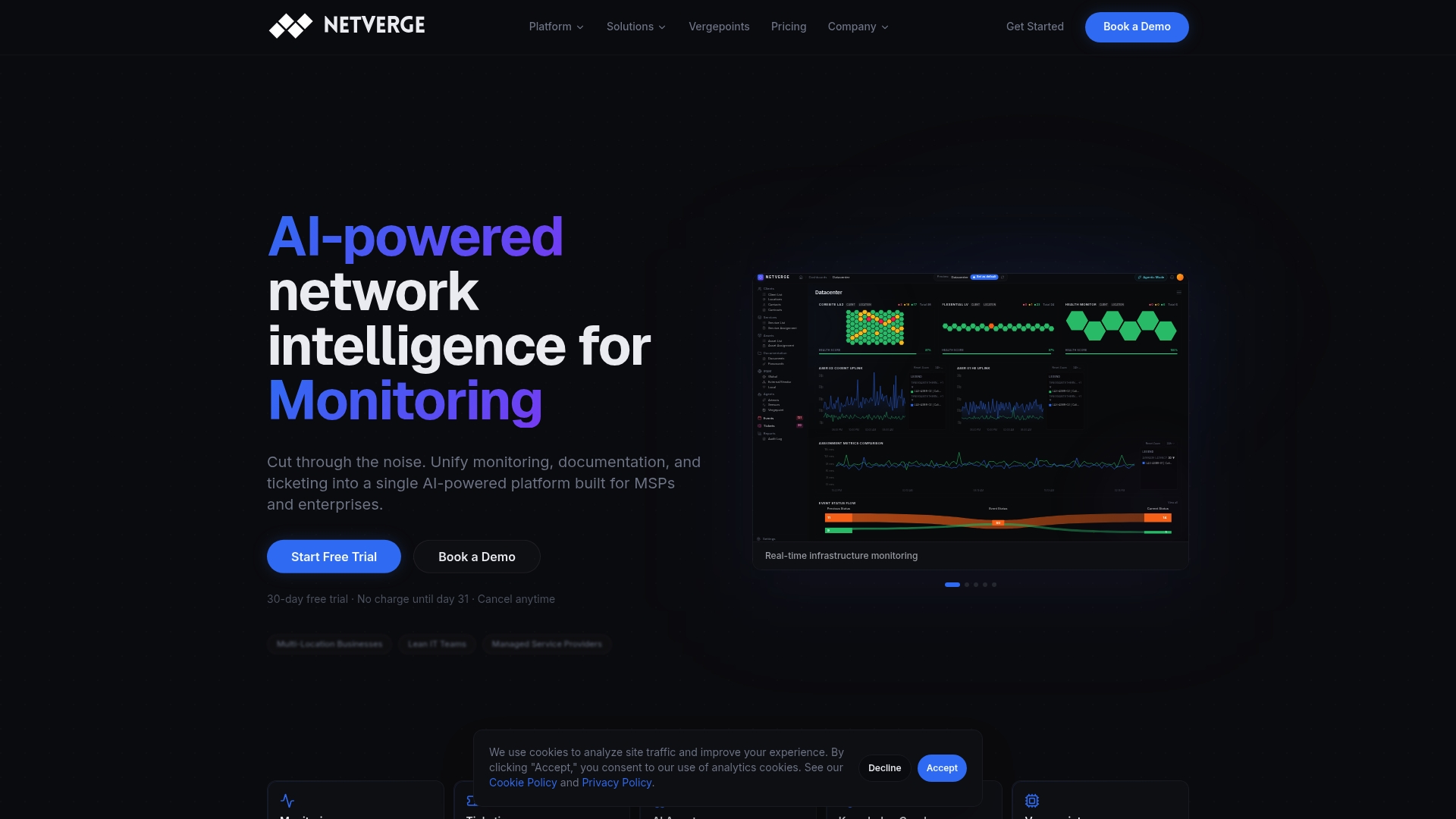
Vergepoint hardware adds edge-level telemetry for distributed sites without a separate monitoring stack, and the AI agents handle the enrichment work described earlier under the same two-minute, human-in-the-loop constraints. Customers running this setup have reported the 30 to 55% ticket backlog reduction in 90 days referenced in the AI triage example above, an internal result worth weighing as one data point rather than a universal guarantee.
| What you need | How Netverge addresses it |
|---|---|
| Unified alert and ticket context | Knowledge graph links alerts to changes, related tickets, and history |
| Edge telemetry for multi-site networks | Hardware Vergepoints for on-site monitoring |
| Time-budgeted AI enrichment | AI agents stage context and hypotheses before human review |
| Entry point for evaluation | Starter Package at $299 per month |
Teams ready to see this in their own environment can start with the Starter Package or explore sensor, agent, and storage add-ons on the pricing guide.
FAQ
What counts as a good first response time for network incidents?
There is no single industry-wide number, since it depends heavily on alert severity and team size, but the goal outlined by Google SRE's research is enrichment delivered to the responder within about two minutes of detection. Teams should set their own target based on current baselines and tighten it gradually through measured iteration.
How does AI enrichment actually speed up triage?
AI enrichment pulls together recent deploys, related alerts, and incident history into a single context package before a human opens the ticket, which removes the manual searching that normally happens first. Google SRE measured a reduction in mitigation time of about 44% when this kind of investigation support was in place.
Should every alert be automated for faster response?
No, automation should focus on low-regret actions and enrichment while leaving material decisions to a human, according to CISA's automation strategy guidance. Over-automating an inefficient manual process tends to scale the inefficiency rather than fix it.
What's the difference between first response time and MTTR?
First response time measures the gap between alert detection and the first triage action or acknowledgement, while MTTR covers the entire window until full resolution. Relying on MTTR alone can mask whether a slowdown happened in detection, triage, or recovery, which is why breaking the process into sub-metrics like DRAIN and CVR components matters.
Does Netverge replace the need for a SIEM or SOAR tool?
Netverge is built to unify monitoring, ticketing, and AI-driven triage for MSPs and multi-site enterprises, consolidating tools that would otherwise sit separately. Whether it replaces a given SIEM or SOAR deployment depends on an organization's existing stack, and teams can review current integrations on the pricing guide page.
Sources
- AI engineering for reliable operations — Google SRE
- New guidance for SIEM and SOAR implementation — CISA
- Computer Security Incident Handling Guide (NIST SP 800-61r3)