
Why documentation is the backbone of IT and software development
Documentation is not a support function. It is the operational foundation that determines whether your technical capabilities actually deliver results. The 2023 DORA State of DevOps Report found that trunk-based development has significantly greater impact on organizational performance when high-quality documentation is in place compared to low-quality documentation environments. That figure alone reframes how IT teams should think about documentation investment.
The role of documentation in IT spans every layer of the organization. It preserves institutional knowledge as personnel change, aligns teams on processes before misalignment causes errors, and gives both engineers and AI agents a reliable source of truth for decision-making. Without it, technical practices lose much of their force.
Key functions documentation serves in IT and software development:
- Knowledge preservation: Captures decisions, configurations, and procedures so they survive team turnover and organizational change
- Team alignment: Forces explicit agreement on processes, reducing ambiguity and rework
- Cognitive load reduction: Gives engineers direct answers instead of requiring them to reconstruct context from code or memory
- Error reduction: Standardizes procedures, cutting the rate of configuration mistakes and missed steps
- Compliance support: Creates the audit trail that regulators and internal governance processes require
- Onboarding acceleration: Cuts the time new team members need to become productive contributors
- AI readiness: Provides structured, machine-readable context that AI agents and automation tools can act on
What types of documentation does IT actually use?
Industry standards, including ISO/IEC/IEEE 15289:2019, recognize six primary categories of software and systems documentation. Each serves a distinct audience and purpose, and conflating them is a common source of documentation debt.
- Requirements specifications: Define what a system must do, written for stakeholders and development teams. These anchor scope decisions and change control processes.
- Architecture and design documentation: Capture structural decisions, component relationships, and technology choices. Architecture Decision Records (ADRs) are the most durable format here, recording not just what was decided but why.
- API documentation: Describe interfaces, endpoints, authentication, and data schemas for developers integrating with or building on a system. Auto-generated from OpenAPI or similar specs, but still requires human-authored context.
- Code-level documentation: Inline comments, docstrings, and README files that explain logic at the source level. Clean code standards treat these as part of code quality, not optional extras.
- User-facing documentation: Manuals, help systems, and tutorials governed by IEEE Std 1063 and ISO/IEC/IEEE 26511, targeting end users rather than engineers.
- Operations and deployment documentation: Runbooks, disaster recovery procedures, and deployment guides that support incident handling and compliance audits. These are the documents your team reaches for at 2:00 AM during an outage.
The distinction between authored and generated documentation matters in practice. Generated docs (from code annotations or API specs) stay current automatically but lack the reasoning and context that only a human author can provide. The most effective teams combine both.
How good documentation benefits your team and your projects
The performance impact of documentation quality is not marginal. The DORA research demonstrates that it acts as a multiplier across every technical capability a team deploys, from continuous integration to security practices.
Concrete benefits IT teams see from high-quality documentation:
- Faster onboarding: New engineers reach productivity faster when runbooks, architecture docs, and API references are current and findable
- Fewer incidents: Standardized procedures reduce configuration errors that cause outages
- Reduced burnout: The DORA report found that quality documentation lowers cognitive load, which directly correlates with lower burnout rates and higher job satisfaction
- Better knowledge transfer: Documentation scales institutional knowledge across the organization and through time, even as team composition shifts
- Improved collaboration: Writing documentation forces teams to explicitly agree on processes, which surfaces disagreements before they become production problems
- Stronger incident response: Runbooks and network infrastructure documentation give responders a clear path through complex troubleshooting scenarios
Pro Tip: Track documentation coverage as a metric alongside code coverage. If your CI/CD pipeline reports test coverage at 85% but you have no visibility into documentation completeness, you are missing a key quality signal.
IT documentation best practices that actually hold up in production
The teams that maintain useful documentation treat it as operational infrastructure, not a project deliverable. That framing changes everything about how documentation gets created, owned, and updated.

Assign explicit ownership. Every critical document needs a named owner who is accountable for keeping it current. Without ownership, documentation decays by default. Ownership does not mean one person writes everything; it means one person is responsible for accuracy.
Integrate documentation into your CI/CD pipeline. Documentation updates integrated with code changes prevent the drift that makes docs unreliable. When a pull request changes an API endpoint or a deployment procedure, the corresponding documentation update should be part of the same review cycle.
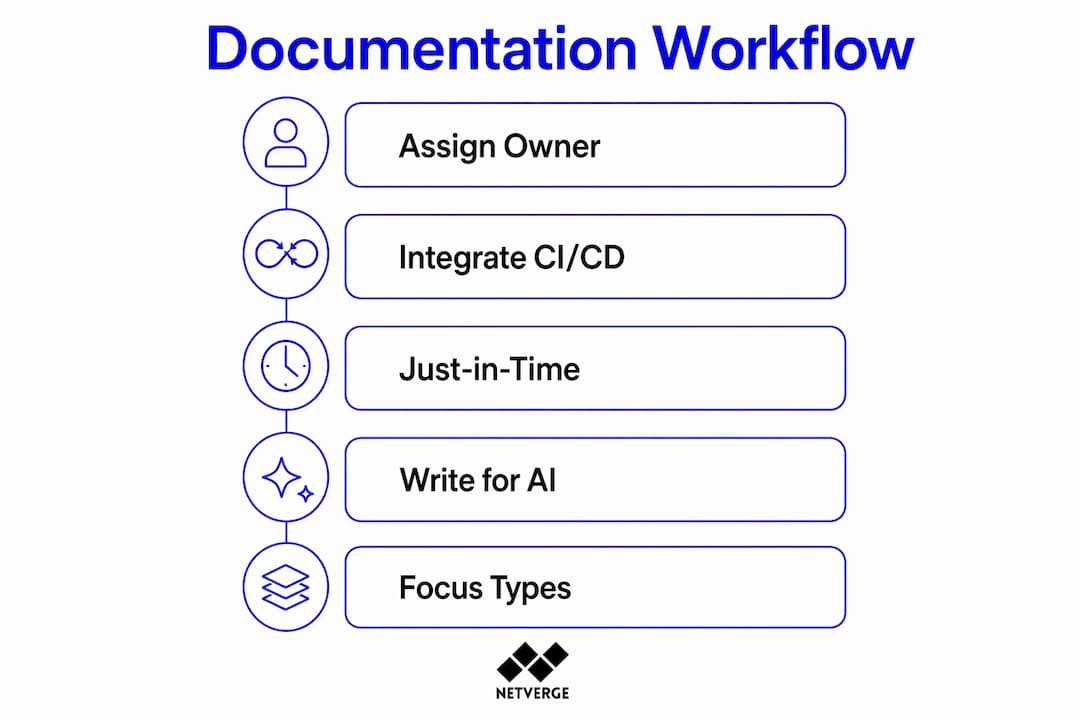
Use just-in-time documentation in Agile environments. Heavy upfront documentation rarely survives contact with an evolving codebase. Agile teams get more value from minimal, adaptive docs written at the moment of decision, included as part of the Definition of Done for each sprint.
Write for both humans and AI agents. Plain Markdown with clear headings, consistent terminology, and modular structure works for engineers reading at 2:00 AM and for AI agents parsing runbooks to automate responses. Designing for both audiences costs nothing extra and extends the operational value of every document you write.
Focus effort on high-leverage document types. Onboarding guides, runbooks, and Architecture Decision Records deliver outsized value relative to the effort they require. A well-written ADR prevents the same architectural debate from happening three times across three years.
Pro Tip: Make documentation updates a required check in your pull request template. A single checkbox, "Documentation updated where applicable," creates accountability without adding process overhead.
Key practices at a glance:
- Assign a named owner to every critical document
- Trigger documentation reviews on code changes, not on a calendar schedule
- Include documentation in the Definition of Done for every sprint
- Use ADRs to capture architectural decisions with their rationale
- Structure docs in plain Markdown for both human readability and AI consumption
- Prioritize runbooks, onboarding guides, and API references as your highest-value documents
What current research says about documentation's impact on IT
The 2023 DORA State of DevOps Report is the most comprehensive recent study on documentation's role in software delivery performance. Its findings go well beyond the 12.8x multiplier cited earlier.
Documentation quality correlates directly with reduced burnout and higher job satisfaction among technical teams. The mechanism is straightforward: when engineers can find accurate answers quickly, they spend less time in frustrating dead-ends and more time on work that requires their expertise. The DORA researchers found that much of this effect flows through knowledge sharing. Good documentation makes knowledge accessible to everyone on the team, not just the person who built the system.
A common misconception in Agile circles is that documentation conflicts with the Agile Manifesto's preference for "working software over comprehensive documentation." The Atlassian community's guidance on the Definition of Done makes the actual position clear: Agile requires adaptive documentation, not the absence of it. Living documents, ADRs, and sprint-integrated updates are fully compatible with Agile delivery. Teams that eliminate documentation in the name of agility tend to accumulate knowledge debt that slows them down later.
The emerging frontier is documentation designed for AI consumption. When runbooks and operational procedures are structured in modular Markdown, AI agents can parse them to automate troubleshooting steps, generate incident summaries, and surface relevant context during active incidents. Documentation becomes an operational control surface, not just a reference artifact. This is where integrated documentation approaches are heading in 2026.
Common challenges and pitfalls in maintaining IT documentation
Documentation quality degrades predictably, and the failure modes are well understood. Recognizing them is the first step to preventing them.
Documentation decay is the most common problem. Docs written during a project go stale as the system evolves, and no one updates them because no one owns them. Within months, the documentation describes a system that no longer exists.
Discoverability failures undermine even well-written docs. If engineers cannot find the right document quickly, they stop looking and either ask a colleague or guess. A fragmented documentation stack spread across wikis, shared drives, and ticketing systems makes discoverability nearly impossible to maintain.
Inconsistent quality across teams creates an uneven experience. Some teams produce thorough runbooks; others write nothing. The result is that documentation reliability varies so much that engineers stop trusting it as a source of truth.
Undocumented tribal knowledge is the most operationally dangerous pitfall. When critical system knowledge lives only in the heads of specific engineers, every departure or vacation creates risk. This is especially acute in network operations, where configuration details and troubleshooting logic are often never written down.
Scope creep in documentation is the opposite problem: teams that try to document everything end up with bloated, unreadable docs that no one maintains. Focusing on high-leverage document types prevents this.
How to keep your documentation current and reliable
Keeping documentation current requires process, not willpower. Teams that rely on engineers to "remember to update the docs" consistently fail at it.
The most effective approach ties documentation updates to system changes at the workflow level. When a code change triggers a CI/CD pipeline run, the pipeline can also check whether related documentation files were modified. If they were not, the pipeline flags the gap. This is not about blocking deployments; it is about making documentation drift visible before it becomes a problem.
Review triggers work better than review schedules. Instead of auditing all documentation quarterly, assign each document a set of triggers: a related system component changes, an incident reveals a gap, or a new team member reports confusion. Trigger-based reviews keep documentation current where it matters most without requiring a full audit cycle.
Ownership combined with onboarding creates a self-reinforcing loop. When new engineers join, they read the existing documentation and are encouraged to flag anything unclear or outdated. Their fresh perspective catches decay that experienced team members no longer notice. Assigning new hires as co-owners of specific documents during their first 90 days builds this habit into the onboarding process itself.
For network operations teams, automated network diagnostics platforms can surface configuration states that diverge from documented baselines, making documentation drift detectable in real time rather than during a post-incident review.
How documentation shapes software maintenance and troubleshooting
Software maintenance is where documentation quality has its most direct operational impact. The majority of a system's total cost of ownership accumulates during the maintenance phase, and the speed and accuracy of maintenance work depend heavily on how well the system is documented.

When an engineer encounters a bug in a system they did not build, their first question is always: what was this supposed to do? Good architecture documentation and inline code comments answer that question in minutes. Without them, the engineer reconstructs intent from behavior, a process that is slow, error-prone, and often incomplete.
Troubleshooting follows the same pattern. A runbook that maps known failure modes to diagnostic steps and remediation procedures cuts mean time to resolution significantly. The engineer does not need to rediscover the fix; they execute a documented procedure. This is why operations documentation, including runbooks and disaster recovery guides, is treated as a first-class operational asset in mature DevOps organizations.
The connection between documentation and software maintenance extends to change impact analysis. When a team considers modifying a component, documented dependencies and architectural decisions tell them what else might break. Without that context, changes carry hidden risk that only surfaces in production.
How documentation supports regulatory compliance and audit processes
Compliance requirements in regulated industries treat documentation as evidence, not explanation. SOC 2, ISO 27001, HIPAA, and PCI DSS all require organizations to demonstrate that controls exist and are followed consistently. Documentation is how you prove it.
Audit processes rely on three documentation types above all others: policies and procedures that define expected behavior, change logs that record what was modified and when, and incident records that show how problems were detected and resolved. Gaps in any of these create audit findings that range from minor observations to material deficiencies.
The operational value of compliance documentation extends beyond audit cycles. Procedures written to satisfy a SOC 2 auditor also give your team a clear, tested path through security-relevant processes. The discipline of documenting controls forces teams to think through edge cases and failure modes that might otherwise go unaddressed.
Change management documentation is particularly critical. Regulators want to see that changes to production systems follow an approved process, with documented approvals, testing evidence, and rollback procedures. Teams that treat change documentation as a compliance checkbox rather than an operational record tend to produce documentation that satisfies auditors but fails engineers during an actual rollback.
Real-world examples of effective documentation practices
Google's Site Reliability Engineering (SRE) model treats runbooks as living operational documents, updated after every incident as part of the post-mortem process. The post-mortem itself is a documentation artifact: it captures what happened, why, and what changes will prevent recurrence. This practice turns every incident into a documentation improvement cycle.
Architecture Decision Records in practice: Teams using ADRs create a lightweight record for each significant architectural choice, typically a short Markdown file stored in the repository alongside the code. When a new engineer asks why the team chose a particular message queue over alternatives, the ADR provides the answer with full context, including the options considered and the constraints that drove the decision. This prevents the same debate from recurring every time team composition changes.
Agile teams embedding documentation in the Definition of Done report that documentation quality improves without requiring separate documentation sprints. When "documentation updated" is a required condition for closing a story, it becomes part of the delivery habit rather than a separate task that competes with feature work.
Network operations teams that maintain current, structured network topology documentation can resolve configuration-related incidents faster than those relying on tribal knowledge. When every device, connection, and configuration parameter is documented and accessible, troubleshooting becomes a lookup rather than a reconstruction.
Key Takeaways
High-quality documentation multiplies the impact of every technical practice your team deploys, with the 2023 DORA research estimating a substantial performance difference between high-quality and low-quality documentation environments.
| Point | Details |
|---|---|
| Documentation multiplies technical impact | High-quality documentation significantly amplifies technical practices' impact on organizational performance according to DORA 2023. |
| Ownership prevents decay | Every critical document needs a named owner; without it, documentation goes stale as systems evolve. |
| Integrate updates into CI/CD | Tying documentation changes to code changes in your pipeline prevents drift and keeps docs reliable. |
| Compliance depends on documentation | SOC 2, ISO 27001, HIPAA, and PCI DSS all require documented evidence of controls, procedures, and change records. |
| AI readiness starts with structure | Plain Markdown with clear headings and modular structure makes documentation usable by both engineers and AI agents. |
Netverge unifies network visibility, documentation, and AI-powered monitoring into a single platform for MSPs and multi-location enterprises. If your team is managing distributed infrastructure with fragmented tools and disconnected documentation, Netverge gives you a single source of truth for network state, incident response, and operational knowledge.
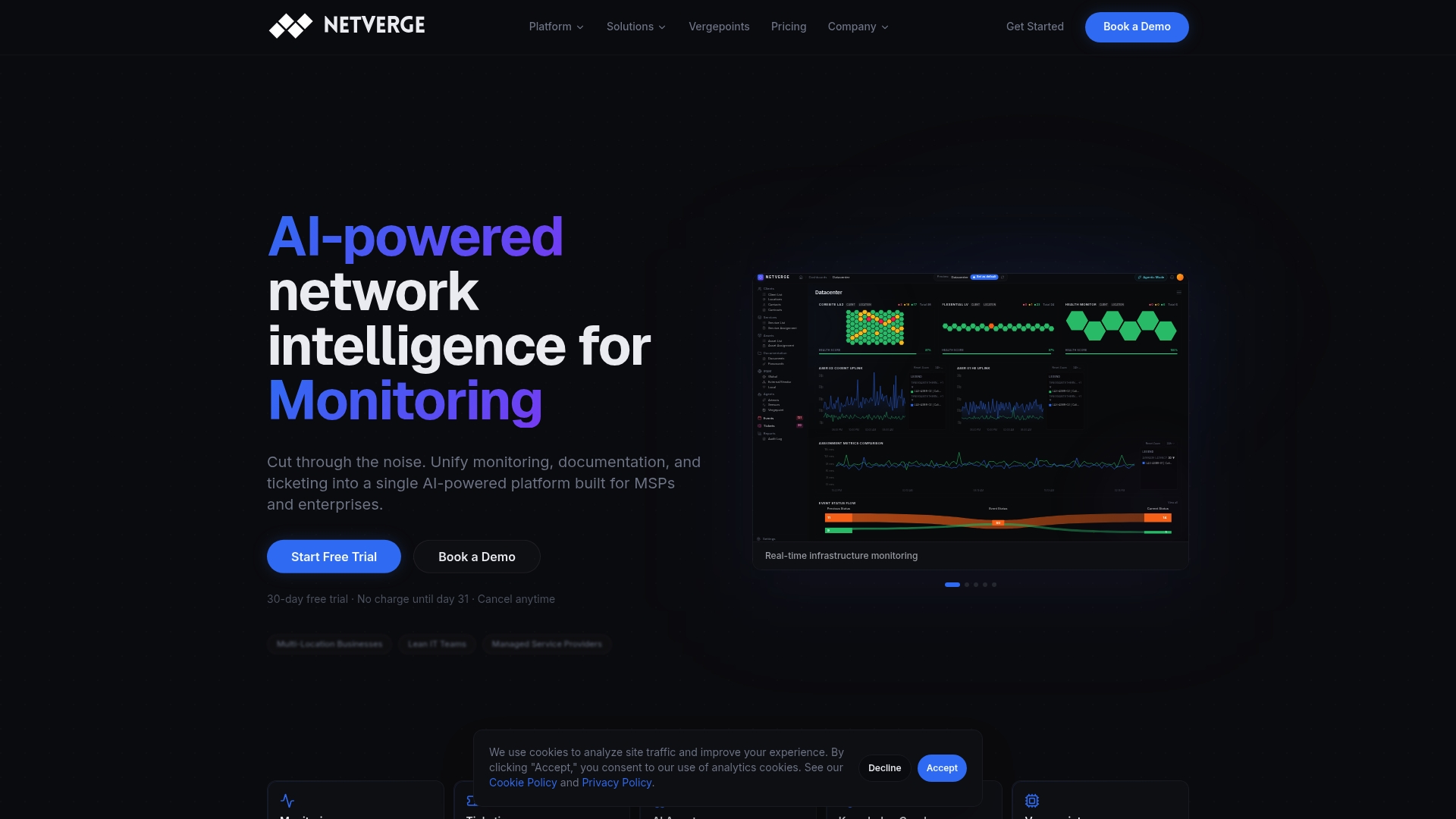
See how Netverge connects real-time network monitoring with structured documentation to accelerate troubleshooting and reduce operational risk. Request a demo today.