
An alert is a detected notification; an incident is a validated adverse event that meets impact or policy thresholds and requires coordinated response. NIST SP 800-61 Rev. 3 and CISA guidance both treat the move from one to the other as a judgment call. Validate impact, scope, and policy context first, then declare the incident.
TL;DR:
- Correlate alerts by asset, identity, time, or topology, then let analysts decide whether evidence warrants an incident rather than relying on automated severity labels.
- Escalate for service impact, data exposure, privileged misuse, lateral movement, legal risk, or uncertainty beyond analyst authority; assign an owner, set priority, and preserve evidence.
- Write escalation criteria into runbooks and authorize analysts to declare incidents; federal agencies must also follow required notification rules and reporting timelines.
- Tune noisy rules, deduplicate related signals, and add asset context; review rules monthly and track verification time, resolution time, and alert to incident conversion rates.
- After declaration, teams should scope the event and record its timeline before containment, then remove the cause, restore service, and update detection rules.
Table of Contents
- What do event, alert, and incident mean in daily operations?
- How do alerts turn into incidents?
- When should you escalate an alert to an incident?
- What happens after you declare an incident?
- How can you cut alert fatigue and improve triage?
- Why does accurate classification protect efficiency and SLAs?
- Our perspective: shortening the path from alert to incident
- Next steps: put alert validation to work with Netverge
- FAQ
- Sources
What do event, alert, and incident mean in daily operations?
Shared vocabulary keeps NOC and SOC handoffs clean. Use these definitions as a baseline and adapt them to your runbooks:
- Event: any observable occurrence involving computing assets, such as a log entry, a telemetry sample, or a user action. Example: a switch port changes state.
- Alert: a notification triggered when a detection rule, threshold, or model is met. Example: a monitoring rule fires because a WAN link has repeatedly flapped.
- Incident: under the federal framing, an occurrence that actually or imminently jeopardizes confidentiality, integrity, or availability, or violates security policy. Example: the flapping link turns out to be a failed carrier circuit at a site that cannot process payments.
Most events never become alerts, and most alerts never become incidents. The categories exist so you can say which stage a signal has reached. For a closer look at alert categories, see our guide to types of network alerts.
How do alerts turn into incidents?
An incident is a container, not a louder alert. Signals move through a pipeline, and each step adds context:
- Telemetry from devices, sensors, logs, and identity systems flows in continuously.
- Events are recorded from that telemetry.
- Alerts fire when rules or models flag an event as notable.
- Correlated alerts are grouped by shared assets, identities, time windows, or topology.
- The incident container holds the grouped alerts with a timeline, an asset map, and evidence.
Correlation matters because a single alert rarely explains its own cause. Grouped alerts give you chronology, affected assets, and a defensible root cause analysis. Automate grouping and deduplication early in the pipeline, since machines handle volume well. Keep humans on the decision to declare an incident, especially when privileged accounts or regulated data are involved. Our walkthrough of incident correlation for ITOps covers a staged approach.
When should you escalate an alert to an incident?
Escalation is a judgment about scope, urgency, impact, and cause. A vendor severity label is an input, not the answer. NIST's incident response guidance points to the same conditions. Escalate when validation shows any of these:
- Material or imminent impact on a service, site, or customer
- Evidence of data access or exfiltration
- Unauthorized use of privileged or high-value accounts
- Lateral movement or persistence on a host or segment
- Multiple related signals across assets
- A potential legal, regulatory, or policy violation
- Safety or availability consequences
- Uncertainty that exceeds the frontline analyst's authority
Tie these triggers to risk-based prioritization. CISA's National Cyber Incident Scoring System scores incidents from 0 to 100 for national-level triage. Adopt the principle of weighing impact, confidence, and context, not the score itself, as your internal severity scale.
Once you declare the incident, act in a fixed order: assign an owner, set a priority, capture scope and timeline, and preserve evidence before anyone starts remediating.
Pro Tip: Write the escalation criteria into the runbook and give analysts the authority to declare an incident without waiting for a manager.
What happens after you declare an incident?
Declaring an incident starts the response lifecycle. NIST SP 800-61 Rev. 3, published April 3, 2025, aligns incident response with the CSF 2.0 functions and treats it as a continuous organizational capability rather than a SOC-only phase. In practice, the steps look like this:
- Prepare: maintain asset inventories, access controls, playbooks, and contact lists before anything breaks.
- Detect: monitoring generates the alerts that feed triage.
- Analyze and triage: validate the signal, determine scope, and decide whether the incident threshold is met.
- Contain: limit spread by isolating hosts, revoking credentials, or rerouting traffic.
- Eradicate: remove the cause, whether malware, a misconfiguration, or a failed component.
- Recover: restore services and confirm normal operation.
- Learn: document what happened and feed the findings back into detection rules.
Collect evidence and define scope early, because both shape every later decision. Brief stakeholders on a schedule, and keep reporting duties in view. Federal agencies follow the US-CERT Federal Incident Notification Guidelines, which list required data elements and reporting timelines.
CISA: Rapid and effective cyber incident response is critical to national security, and the agency offers tools and the NCISS to help organizations prepare, detect, and respond.
Call in extra resources when scope is unclear after initial triage, when privileged systems are touched, or when an external reporting channel applies. Our network incident response guide maps these steps to MSP and enterprise environments.
How can you cut alert fatigue and improve triage?
Fatigue comes from too many alerts with too little context. Fix both the technology and the process:
- Tune thresholds so rules fire on conditions that matter, not on every blip.
- Deduplicate and correlate related alerts into one working item.
- Enrich alerts with asset, identity, and site context before an analyst sees them.
- Build playbooks for the alert patterns you see every week.
- Set verification SLAs so every alert is validated or closed within an agreed window.
- Review rules monthly, retiring or rewriting the noisiest ones.
Track three metrics as directional goals: alert-to-incident conversion rate, time to verify, and mean time to resolve. Falling verification time with a stable or rising conversion rate means your alerts are getting better. A monthly review routine is described in our post on how to reduce alert fatigue, and our guide to event correlation covers the noise-reduction side.
Pro Tip: Start with your ten noisiest alert rules. Fixing those usually frees more analyst time than any new tool.
Why does accurate classification protect efficiency and SLAs?
Misclassification costs you in both directions. Treat every alert as an incident and responders burn out, queues back up, and genuine emergencies wait behind noise. Treat real incidents as routine alerts and containment starts late, so the damage grows while the ticket sits unread.
Accurate classification keeps severity, ownership, and response clocks aligned. When your service desk knows an item is an incident, it can start the correct SLA timer, page the right team, and communicate with affected customers. When it is only an alert, it can be handled in the normal queue without touching incident SLAs. Clean classification also makes your reporting honest. Conversion rates, response times, and recurring root causes mean something only when the incident count reflects real incidents.

Classification also affects planning. Teams that separate the two categories can see which rules produce confirmed incidents and which only produce work, then shift engineering effort accordingly. For MSPs, this protects margin: analyst hours go to validated problems, and SLA penalties come from genuine misses rather than from clocks started by the wrong label.
Finally, consistent definitions help new hires. A shared standard from NIST and CISA, applied through written criteria, shortens onboarding and reduces arguments about whether something counts.
Our perspective: shortening the path from alert to incident
Most delay between an alert and an incident declaration is manual verification: finding the asset, the owner, the site, and the related signals. We built Netverge to remove that work by keeping telemetry, documentation, and ticketing in one place. AI triage, a knowledge graph for context, and Vergepoints for on-site visibility give analysts the facts they need at the moment an alert fires. A simple flow: an alert arrives, the platform attaches the asset's documentation and recent related alerts, and the analyst confirms or dismisses it instead of hunting for data. The analyst decides. The platform removes the searching.
— Jim
Next steps: put alert validation to work with Netverge
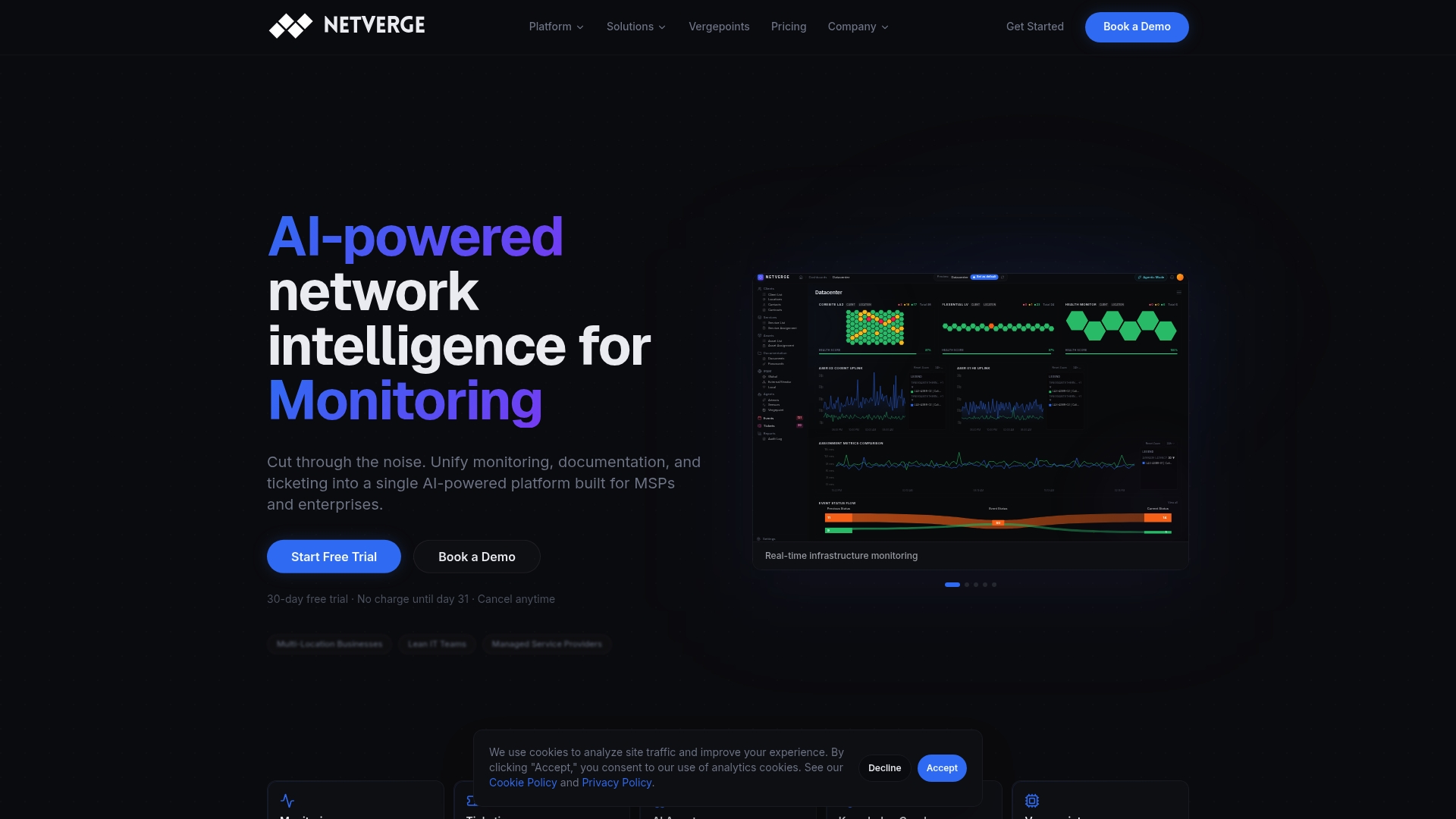
We designed Netverge as a unified monitoring and automation platform so your team can validate alerts faster and act on real incidents sooner. Here is how to start:
- Start your free trial and see alerts, documentation, and tickets in one view.
- Review the Starter Package, listed at 299 USD per month.
- Explore Vergepoints for plug-and-play visibility at remote sites.
Pick one site, connect it, and watch how much faster validation gets.
FAQ
What is the difference between an alert and an event?
An event is any observable occurrence, such as a log entry or a device state change. An alert is a notification generated when a rule or model decides an event deserves attention. Many events never produce alerts.
How does NIST define an incident?
NIST's incident response guidance, SP 800-61 Rev. 3, treats adverse cybersecurity events as needing further analysis to determine whether an incident has occurred. The federal framing, used by CISA, describes an incident as an occurrence that actually or imminently jeopardizes confidentiality, integrity, or availability, or violates policy.
What are the common types of alerts?
Network alerts are typically grouped by what they signal: availability, performance, security, configuration, and capacity. Teams often add severity levels on top. Our guide to network alert types lists examples for each group.
What types of incidents should teams plan for?
Plan around impact rather than a fixed list. Common categories include service outages, unauthorized access, malware, data exposure, and policy violations. Define each category's escalation owner and response steps in advance.