
Cutting log noise starts with three moves you can make today: filter noisy events at the source, move collection to TLS with local buffering, and correlate related events into single alerts instead of dozens. Guidance from NIST and CISA backs each step, and platforms like Netverge build correlation directly into the monitoring layer. Done right, these changes shrink alert volume and shorten mean time to resolution within weeks.
TL;DR:
- Filtering at the source, such as disabling non-critical messages and applying regex filters, can significantly reduce log volume quickly.
- Moving critical logs to TLS with local buffering and normalizing data at collection prevents data loss and maintains context.
- Correlation, deduplication, and aggregation within your monitoring tools cut down false positives and repetitive alerts.
- Implementing a layered pipeline with hot and cold storage, synchronized timestamps, and failover ensures noise reduction without losing important forensic data.
- Regular review of filtering rules, process discipline, and automation is essential to sustain noise reduction and adapt to evolving network conditions.
Table of Contents
- Quick checklist: 8 tactical steps you can run in hours
- Logging governance: decide what to log and why
- Technical controls: filtering, transport, and collection design
- Reduce alerts by correlation, aggregation and deduplication
- Pipeline architecture: hot/cold storage, normalization, and failover
- Operational playbook: runbooks, review cadence, and change control
- First-person perspective: how this approach scales for distributed ops
- How Netverge helps reduce log noise
- FAQ
- Sources
Quick checklist: 8 tactical steps you can run in hours
Most teams can cut a meaningful share of noise before lunch. Start here, in order:
- Disable informational and debug-level messages from less critical sources using facility and severity selectors.
- Apply regex-based filters where your syslog implementation allows pattern matching.
- Switch important sources to TLS transport and enable local buffering with retry logic.
- Enable deduplication and time-window aggregation in your collector or SIEM tools.
- Temporarily mute known flood sources, documenting each change with a timestamp and owner.
- Adjust severity levels so routine events no longer escalate to "critical" tickets unnecessarily.
- Move raw logs to archival storage while keeping concise, actionable alerts in active storage.
- Review filtering rules regularly and maintain a rollback plan for every filter implemented.
Pro Tip: Document every temporary mute with an expiration date. Silent, permanent mutes are how real incidents get missed.
Logging governance: decide what to log and why
Technical filters only hold if a policy backs them. Without one, teams drift back to logging everything, which defeats the purpose of filtering in the first place.
- Define logging requirements by use case: security investigations, operational troubleshooting, and compliance each need different event fidelity.
- Inventory every log source, classify it as critical or informational, and record the decision in a written logging plan.
- Set retention tiers: decide what stays hot for active analysis and what moves to archive, and for how long.
- Require approval and a rollback window before any filter goes live, so nobody silently drops data that investigators later need.
- Use NIST SP 800-92 and the CISA Logging Reference Architecture as reference points when documenting source coverage, normalization, and retention decisions.
A written plan also gives you something to point to when a client or auditor asks why a source stopped reporting. Our guide to event log essentials walks through prioritizing sources by what they actually tell you during an incident.
Technical controls: filtering, transport, and collection design
Noise reduction works best when you stop it before it reaches your pipeline, not after. NIST SP 800-92 treats event filtering and reduction as core tasks for log management, carried out at the collection and analysis layers rather than by editing original source files.
- Filter as early as possible: configure selectors directly on the device, agent, or collector using facility and severity pairs, with regex patterns where the syslog model supports them.
- Favor TLS transport over plain UDP for production traffic. UDP syslog lacks congestion control, which means high volume can cause silent message loss, a risk the RFC 5424 syslog standard flags directly.
- Build durable handoff into collectors: local buffering, checkpointing, and replay so a network blip does not drop a high-severity event.
- Normalize fields at ingestion, but keep the original source fields intact. Over-flattening removes the context investigators need later.
- Reserve sampling and compression for long-term archival, where reduced fidelity is an acceptable tradeoff, never for sources still used in active detection.
Encrypted, centralized collection is a baseline expectation, not an optional upgrade: CISA's enhanced visibility guidance recommends encrypting logging traffic with TLS or IPsec and storing off-site copies to protect against tampering.
Our syslog monitoring guide covers collector configuration in more depth if you are rebuilding a pipeline from scratch.

Reduce alerts by correlation, aggregation and deduplication
Filtering controls volume at the source. Correlation controls what happens once events still reach your analysts, and it is where most of the remaining noise disappears.
- Build rule-based correlation for known patterns, such as collapsing five failed logins in two minutes into one authentication incident instead of five separate alerts.
- Use time-window aggregation and deduplication so repeated identical entries merge into a single alert with a count, not a flood of duplicates.
- Layer in behavioral or anomaly detection, and consider decoys for high-fidelity signals that cut down on false positives in mature monitoring environments.
- Remap severity consistently so low-value events stop inflating into critical tickets, which is a common source of priority creep.
- Track signal-to-noise ratio, alerts per day, and analyst time saved to confirm correlation is actually working rather than just rearranging noise.
Pro Tip: Start correlation rules small. Deploy two or three, measure false-positive suppression for a week, then expand.
CISA's event logging guidance calls out manual correlation as a common pitfall and recommends automated correlation for handling volume at scale. Our six-stage event correlation plan breaks this process into stages you can roll out gradually.
Pipeline architecture: hot/cold storage, normalization, and failover
A resilient pipeline keeps noise from overwhelming your analysis tools while preserving the forensic depth you need after an incident.
- Structure the flow in layers: collectors feed brokers or streams, which feed enrichment and normalization, which feed your SIEM and cold archive.
- Keep condensed, actionable events in hot storage and route raw logs to a cold archive with a documented access policy.
- Synchronize clocks with NTP and preserve original source timestamps and provenance fields, since correlation depends on accurate sequencing.
- Estimate bandwidth and storage impact before widening source coverage. An unplanned expansion can overload the exact systems meant to reduce noise.
- Monitor pipeline health continuously: queue depth, latency, error rates, and whether replay is actually available if a node fails.
The CISA Logging Reference Architecture lays out this kind of layered design in detail, including delivery patterns and durable handoff requirements that keep high-severity events from getting lost during transport failures.
Operational playbook: runbooks, review cadence, and change control
Technical fixes decay without a process to maintain them. Treat noise reduction as an ongoing operational discipline, not a one-time project.
- Write runbooks for your most common noisy events, with a clear escalation path for anything that does not match a known pattern.
- Schedule quarterly rule reviews, and require a change ticket with a rollback timeline before muting any source.
- Track KPIs: alerts per analyst per shift, mean time to an actionable alert, and the percentage of alerts that turn out to be false positives.
- Train analysts to document every rule fix and tag recurring issues that need a policy change rather than a quick patch.
- After major incidents, run a noise-root-cause review to find and fix whatever kept generating repeat floods.
Our guide to cutting alert fatigue outlines a monthly review structure that keeps these gains from eroding over time.
First-person perspective: how this approach scales for distributed ops

For MSPs running dozens of client networks, noise reduction is a margin issue, not just a comfort issue. Every unnecessary alert is analyst time billed against a flat-rate contract, and manual correlation does not scale across tenants.
Governance paired with automated correlation and AI-assisted triage is what keeps per-client overhead predictable as the client count grows. The outcome worth tracking is simple: fewer alerts reaching a human, faster time to an actionable one, and a visible drop in repeat floods month over month.
— Jim
How Netverge helps reduce log noise
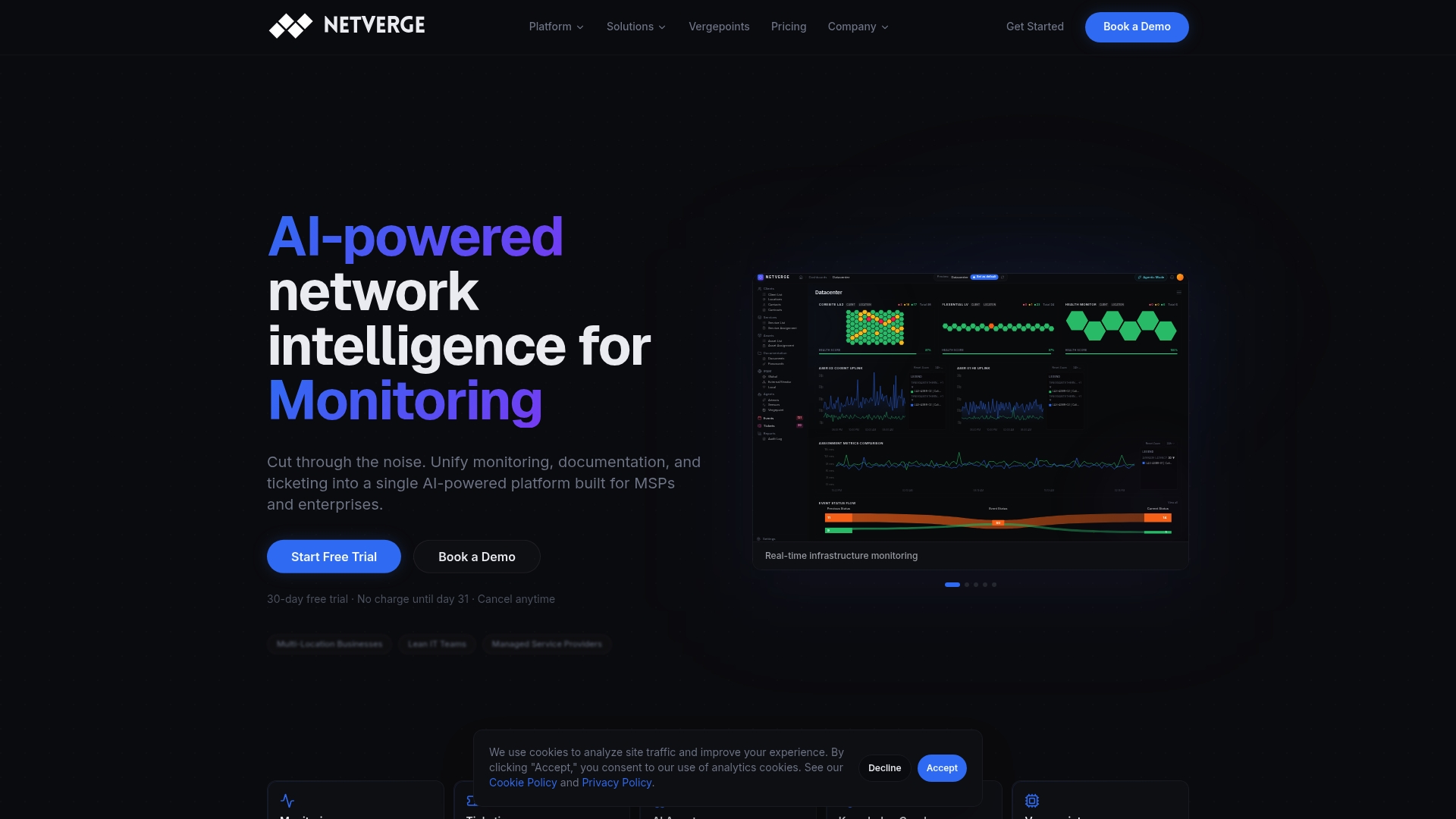
We built Netverge around the same principles covered here: centralized, encrypted collection, correlation that happens automatically, and context that survives the trip from source to ticket.
- Hardware devices provide on-site visibility at remote or edge locations, so local events get captured before they turn into unexplained gaps.
- Our AI agents handle correlation and triage directly, collapsing related events into a single ticket instead of a pile of duplicates.
- A knowledge graph keeps source context attached to every alert, which matters when an analyst needs to investigate past the summary.
If you are ready to see this running against your own network, our Starter Package starts at $299 per month, or you can start a free trial first and bring in Vergepoints when you are ready to extend visibility to additional sites.
FAQ
What is the fastest way to reduce log noise this week?
Start with source-level filtering: disable debug and informational messages from non-critical systems, then enable deduplication in your collector. NIST SP 800-92 treats this kind of early filtering as a core task of log management, and it produces the fastest visible drop in alert volume.
Does filtering logs at the source risk losing important data?
It can, if you filter without a policy. A documented logging plan with retention tiers and a rollback window lets you filter aggressively on low-value sources while keeping full fidelity on anything tied to security or compliance.
Why does UDP syslog cause log loss under heavy volume?
UDP has no congestion control, so when volume spikes, messages can drop silently with no retry. RFC 5424 recommends TLS transport for most production environments to avoid this failure mode.
How does event correlation actually cut down alert counts?
Correlation groups related events, such as repeated failed logins within a short window, into one incident instead of many separate alerts. CISA's logging guidance recommends automated correlation specifically because manual correlation does not keep up with volume.
Can Netverge replace our existing SIEM for correlation?
Netverge centralizes collection and runs AI-driven correlation and triage directly in the platform, which reduces reliance on separate correlation tooling for day-to-day alert handling. Specific integration scope depends on your existing stack, so it is worth confirming during a trial.
Sources
For the original standards and architecture guidance behind this playbook, start with NIST's log management guide and CISA's logging resources below.