
The most effective way to reduce alert fatigue combines four moves: alert stewardship, deduplication, dynamic thresholds, and routing tied to a scoring model. Quality improvement teams using this combination have cut interruptive alerts by 39% in a single QI project, and cloud-native frameworks using dynamic baselining have dropped daily alert counts from 12.3 to 3.4 per system while keeping 99% detection of critical issues. Some platforms build this exact pattern into a single platform rather than a patchwork of scripts.
TL;DR:
- Implementing dynamic thresholds takes two to four weeks to stabilize but effectively eliminates false positives caused by static rules and seasonal variation.
- Routing alerts to the appropriate domain experts cuts response times and prevents unnecessary handoffs, especially for complex infrastructure or security systems.
- Using scoring models to rank alerts by severity and impact helps teams prioritize critical issues over routine noise, improving actionability and reducing burnout.
- Automating alert correlation, deduplication, and routing with platforms like Netverge enables ongoing governance and reduces manual tuning, addressing alert fatigue as a systemic issue.
Table of Contents
- What Is Alert Fatigue and Why Does It Matter?
- What Causes Alert Noise in the First Place?
- Which Strategies Actually Reduce Alert Fatigue?
- How Do You Implement a Governance-Based Reduction Program?
- What Metrics Actually Prove Alert Fatigue Is Improving?
- How Do AIOps Patterns Cut Through Alert Noise?
- How Netverge Applies These Practices
- Treat Alert Fatigue as a System Problem, Not a Tuning Task
- Get Alert Management Built In, Not Bolted On
- Sources
- FAQ
What Is Alert Fatigue and Why Does It Matter?
Alert fatigue, sometimes called alarm fatigue or notification fatigue, happens when the sheer volume of alerts desensitizes the people meant to act on them. Staff start skimming, dismissing, or auto-acknowledging notifications, including the ones that actually matter. Clinical research puts the scale of the problem in stark terms: between 33% and 96% of clinical alerts are ignored, and primary care physicians face a median of 63 alerts every single day.
By the Numbers: Primary care physicians face a median of 63 alerts per day, with ignore rates for clinical alerts ranging from 33% to 96% depending on the system and alert type.
The same pattern shows up in IT operations and security centers. Engineers stop trusting the alert stream, response times slip, burnout climbs, and the one alert signaling a real outage gets buried under a hundred that don't matter.
What Causes Alert Noise in the First Place?
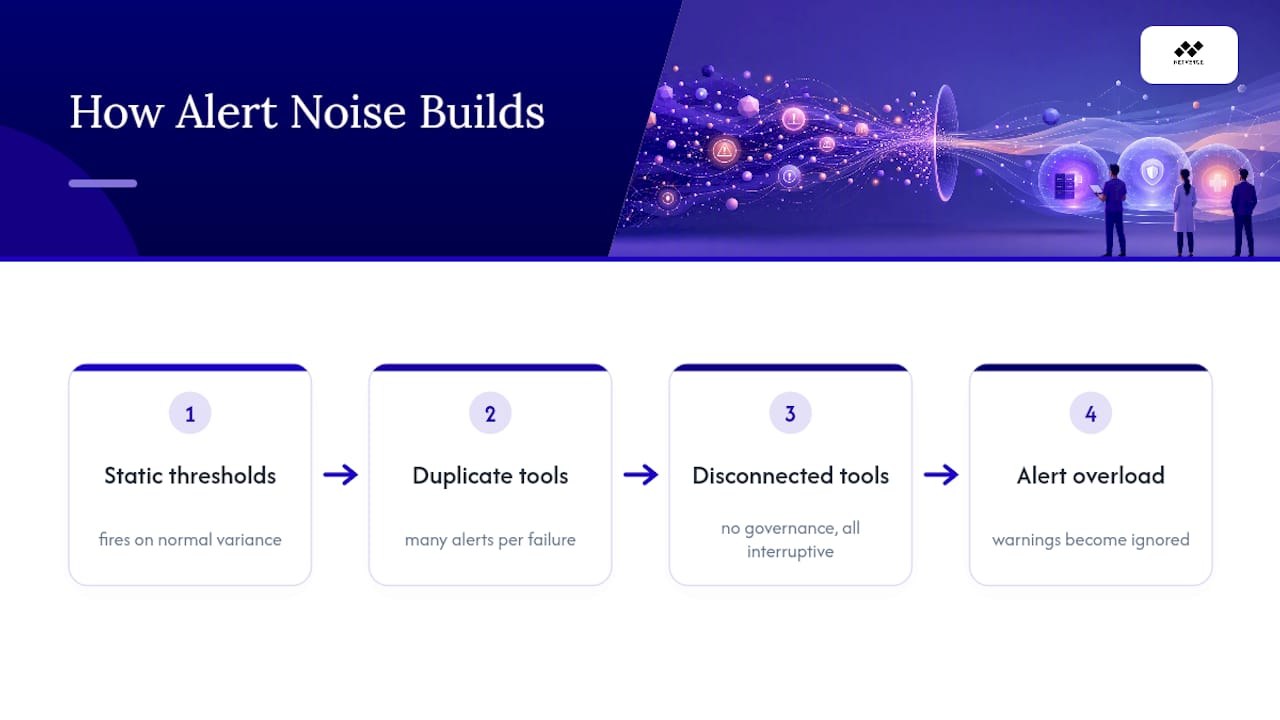
Most alert fatigue traces back to a small set of repeatable failures. False positives top the list: a monitoring rule fires on normal variance because nobody ever tuned the threshold. Static thresholds compound the problem. A CPU alert set at 80% might be reasonable for a database server at 2 PM and completely wrong during a nightly batch job that spikes usage every night at 1 AM, generating the same false alarm on a loop.
Redundant alerts are another culprit. When five monitoring tools watch the same infrastructure layer, a single failure can trigger five separate notifications for one root cause. Add too many disconnected tools, no shared governance model, and a habit of marking every alert as interruptive regardless of severity, and you get a workforce that has learned to stop paying attention. The SmartAlert framework research found that raw, uncorrelated alerting is one of the biggest drivers of this exact failure mode in cloud operations.
Which Strategies Actually Reduce Alert Fatigue?
Not every fix carries equal weight. Some tactics deliver results in days; others need weeks of learning before they pay off. Here's the order that produces the fastest, most durable reduction in alert burden.
Deduplicate at the source. Group alerts by a shared key (host, service, error code), collapse repeats inside a time window, and suppress child alerts when a parent dependency is already down. This alone often cuts visible alert volume by half within days, since most noise comes from the same root cause firing repeatedly rather than from distinct problems.
Move to dynamic thresholds. Static limits can't account for normal seasonal or cyclical variation. Anomaly detection models that baseline "normal" behavior for a given time of day or day of week typically need two to four weeks to stabilize, but once trained, they eliminate the recurring false positives that static rules generate on a schedule.
Route by domain expertise, not by default queue. A database alert sent to a generalist on-call rotation wastes time in handoffs. Mapping alert types to the team or individual with the right context cuts resolution time and stops alerts from bouncing between people who can't act on them.
Score and rank, don't just list. A scoring formula combining severity, business impact, number of affected downstream systems, and time-to-exhaustion turns a flat alert feed into a ranked queue. Teams triage the top of the list first instead of working chronologically through noise.
Reserve interruptive alerts for genuine high-severity events. Research on alert fatigue consistently shows that low-value interruptive alerts erode trust in the entire system, a version of the "boy who cried wolf" effect. Everything below a defined severity threshold should route to a passive channel: a dashboard, a digest, a ticket queue.
Use quiet hours and morning digests. Batch low-priority notifications into a scheduled summary instead of pinging on-call staff overnight. Reserve real-time push notifications strictly for alerts that meet your defined critical threshold.
Pro Tip: Before you disable or demote any alert, run it in silent mode for two weeks and log what would have fired. That gives you evidence for the decision without risking a missed incident, and it's the single best way to build trust with skeptical stakeholders who worry about liability.
How Do You Implement a Governance-Based Reduction Program?
Start by forming a small alert stewardship committee, typically two to four people spanning operations, security, and whoever owns the monitoring tools. Their first job is Pareto analysis: pull twelve months of alert data and identify the top 20 to 25 alert types generating most of the volume. Set a concrete target, such as a 35% reduction in that group, and track it with a control chart rather than a vague goal.
Run a monthly review against every alert on that list, using three decision questions:
- Was this alert actioned the last time it fired?
- Did it represent the first real signal of a problem, or a downstream symptom?
- Did the response produce a clear, documented action?
| Review outcome | When to apply it |
|---|---|
| Delete | Alert has never led to a documented action in the review period |
| Demote | Alert is valid but low severity; move it to a passive channel |
| Reroute | Alert is valid but reaches the wrong team |
| Redesign | Alert logic is sound but the threshold or condition needs rework |
The AHRQ primer on alert fatigue frames this as alert stewardship, deliberately modeled on antimicrobial stewardship: iterative, documented, and willing to retire alerts that cause more harm than they prevent. That documentation matters for liability. Teams that skip it tend to keep every alert active out of fear, which is exactly what drives the fatigue in the first place.
What Metrics Actually Prove Alert Fatigue Is Improving?
Track actionability rate first: the percentage of alerts that lead to a real, documented response. Below that range, you're generating too much noise; above it, you may be missing early warning signals that don't look urgent yet.
- Alerts per provider hour (or per on-call shift) measures raw exposure and burnout risk.
- Actionability rate shows what portion of alerts actually drive a response.
- False positive rate flags rules that need retuning or removal.
- Mean time to resolution (MTTR) for P1 and P2 incidents shows whether prioritization is working.
- Missed criticals, the balancing metric, confirms you're not cutting volume by hiding real problems.
By the Numbers: One QI initiative that focused editing on a prioritized alert set reduced weekly interruptive alerts from 7,250 to 4,400, a 39% drop, without a corresponding rise in missed criticals.
Build a dashboard around these five metrics and review it on the same monthly cadence as your Pareto list. A weekly glance is too noisy to spot trends; a quarterly one is too slow to catch regressions before they compound.
How Do AIOps Patterns Cut Through Alert Noise?
Multi-tier alerting separates symptom from cause. When a database goes down, dependent services throw dozens of downstream errors; dependency-aware suppression recognizes the parent failure and holds the child alerts instead of flooding the queue with duplicates.
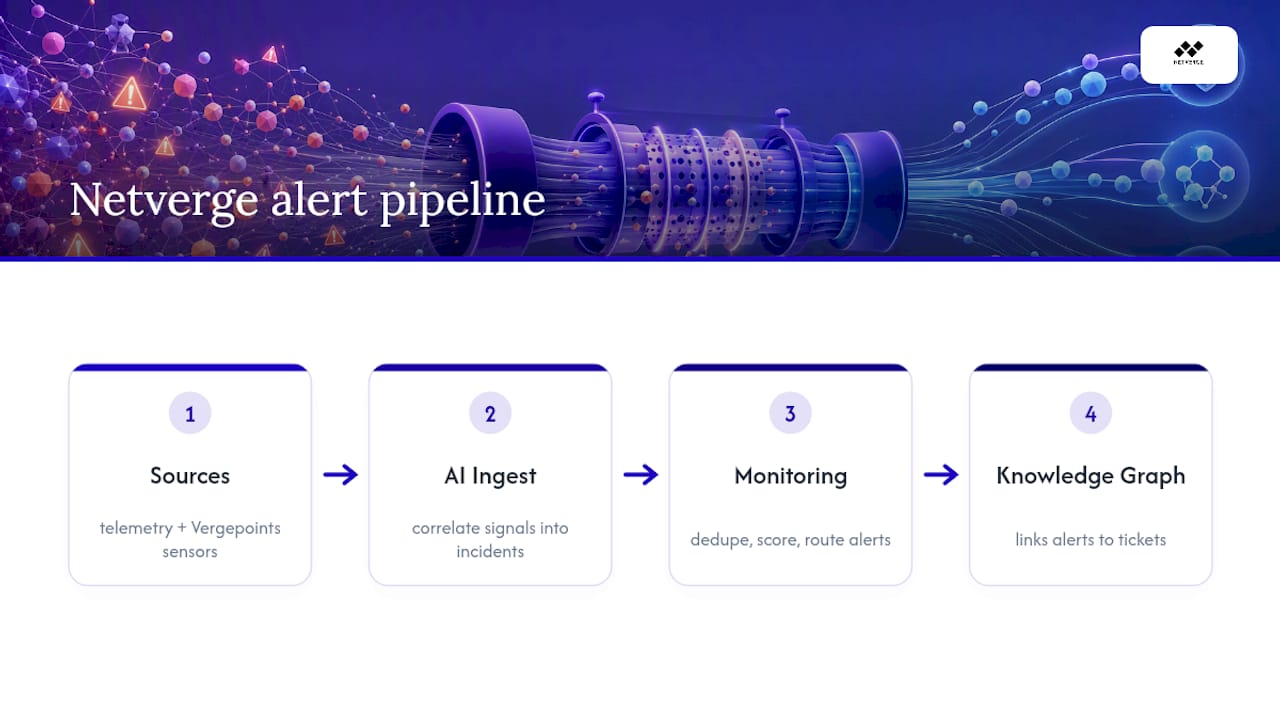
Correlation is the deeper shift. Instead of a raw stream of individual notifications, an AI layer ingests, deduplicates, and groups related signals into a single contextualized incident. Healthcare security operations teams report this move from raw alerts to a prioritized incident queue as one of the biggest single improvements available to overloaded teams.
- Scoring rubrics that weigh severity, impact, and affected systems give triage staff a ranked list instead of a chronological one.
- Machine learning baselining models generally need real production data for two to four weeks before their thresholds are trustworthy.
- Rollback plans matter: a mis-tuned model can suppress real signals just as easily as a static threshold, so keep a manual override path during the learning window.
Data quality is the quiet risk in all of this. A scoring model trained on mislabeled historical incidents inherits those errors, so audit your incident labels before you trust any automated ranking.
How Netverge Applies These Practices
Netverge builds deduplication, scoring, and routing into the monitoring layer itself rather than leaving teams to stitch it together. Its AI agents ingest raw telemetry, correlate related signals into a single incident, and triage by severity before a human ever sees the alert. Vergepoints hardware adds physical, on-site sensor visibility for multi-location networks, closing the gap between remote monitoring and what's actually happening at the edge.
The knowledge graph gives context to every alert, linking it to related tickets and prior incidents so routing goes to the right team automatically. Dashboards support the monthly review cadence stewardship committees rely on, surfacing the highest-volume alert types for exactly the kind of Pareto-driven prioritization that QI research backs.
Treat Alert Fatigue as a System Problem, Not a Tuning Task
Most teams try to fix alert fatigue by silencing individual alerts one at a time. That's a losing game. The QI evidence is clear: sustained reduction comes from governance that revisits the whole alert inventory on a fixed schedule, not from one-off tuning sessions.
Start this month. Pick your top 20 alerts by volume, set a 35% reduction target, and commit to reviewing them monthly.
Pro Tip: Run any alert you're considering demoting in silent mode first, and document the decision. That single habit resolves most of the liability concerns that keep teams from acting.
— Jim
Get Alert Management Built In, Not Bolted On
Most teams reduce alert fatigue by cobbling together scripts, a ticketing system, and a monitoring tool that don't talk to each other. Netverge replaces that patchwork with one platform where deduplication, AI-driven scoring, and role-based routing already work together, so the governance steps described above take days to configure instead of months to build.
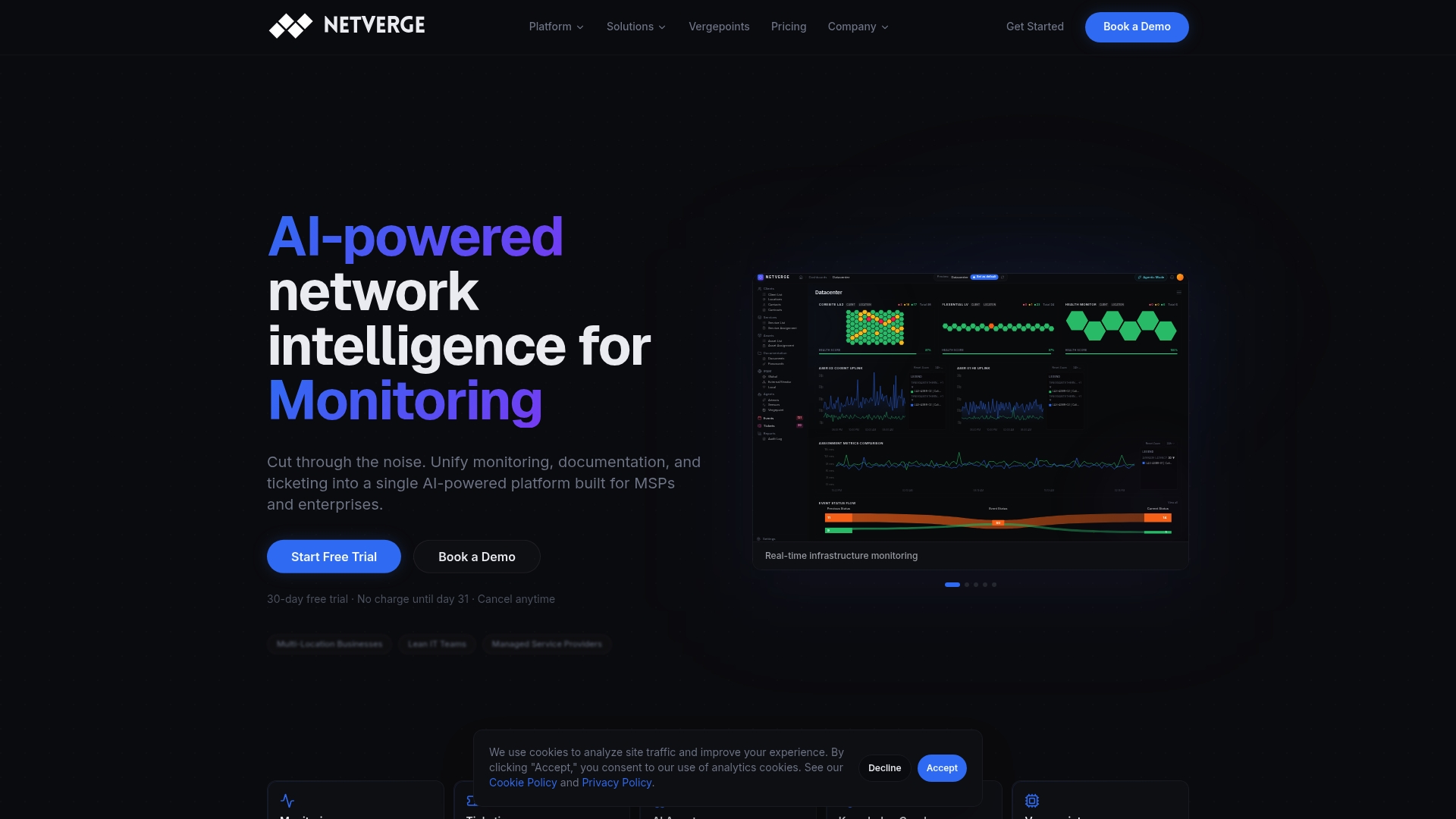
The AI agents handle correlation and triage automatically, Vergepoints hardware covers on-site visibility for distributed sites, and the dashboard structure supports the monthly stewardship review this article recommends without extra tooling. The Starter Package runs $299 per month, with Hardware Vergepoints available at $49 per month per device and Software Vergepoint at $29 per month per vergepoint for teams that need to scale coverage.
None of this replaces governance. Pair the platform with a real stewardship committee and a monthly review, and the technology does the heavy lifting the QI research says works. Start a free trial to see how your current alert volume looks once it's deduplicated and scored.
Sources
- Reducing Interruptive Alert Burden Using Quality Improvement Methodology
- Improving Patient Safety by Combating Alert Fatigue
- AHRQ PSNet primer: alert fatigue
- SmartAlert: A Data-Driven Cloud-Native Framework for Intelligent Alert Management in Cloud Operations
This article is general information, not a substitute for advice from a qualified doctor. Consult a qualified healthcare professional about your own circumstances before acting on anything here.
FAQ
What Helps Reduce Alarm Fatigue?
Deduplicating repeat alerts, moving to dynamic thresholds instead of static ones, and reserving interruptive notifications for true high-severity events are the three highest-impact changes. QI projects combining these tactics with monthly governance reviews have cut interruptive alert volume by 39% in a matter of months.
What Does Alert Fatigue Mean?
Alert fatigue occurs when the volume of notifications desensitizes the people responsible for acting on them, causing dismissed, delayed, or ignored responses. It's also called alarm fatigue in clinical settings and shows up in IT operations and security teams the same way it does in hospitals.
What Is Notification Fatigue?
Notification fatigue is a broader term for the same phenomenon: too many alerts across too many channels erode a person's ability to distinguish urgent signals from routine noise. It leads to slower response times, missed critical events, and burnout among on-call staff.
What Is the Key Strategy for Avoiding Alarm Fatigue?
The strategy with the strongest evidence behind it is targeted governance: identify the small number of alerts generating most of the volume and run a monthly review that decides whether each one should be deleted, demoted, rerouted, or redesigned. Platforms like Netverge support this by automating the deduplication and scoring that make the monthly review manageable in the first place.