
Distributed network management is the practice of monitoring, securing, and operating IT infrastructure spread across multiple physical locations, client sites, and cloud environments from a centralized control plane. For MSPs, this is the defining operational challenge: you are responsible for dozens of client environments simultaneously, each with different hardware vendors, security postures, and SLA requirements. The complexity of multi-vendor environments grows exponentially with each new client onboarded. The tips for MSPs managing distributed networks covered here address that complexity directly, from unified visibility and secure access to automation, standardization, and operational resilience.
1. Centralize visibility before anything else
The single most effective tip for distributed network management is building a unified operational view before attempting to optimize anything else. Without it, your technicians are stitching together data from siloed dashboards during every incident, which is the fastest way to miss SLAs and lose client trust.

A reflective digital twin consolidates a network's telemetry, topology, and configuration into a single source of truth. This means that when a BGP route flaps at a client site at 2 a.m., you are not toggling between five vendor portals to correlate the event. You see it in one place, with full context.
Key capabilities to look for in a centralized visibility platform:
- Vendor-agnostic telemetry ingestion using standards like NetFlow, sFlow, and SNMP across Cisco, Juniper, Fortinet, and other hardware
- Topology mapping that auto-discovers devices and updates in real time as configurations change
- Predictive analytics that forecast infrastructure degradation and trigger proactive fixes before users notice
- Multi-tenant dashboards that isolate client data while giving your NOC a consolidated view
Pro Tip: Deploy a network dashboard that supports role-based views so your tier-1 technicians see alert summaries while senior engineers access full telemetry depth. This reduces noise without hiding critical data.
Successful distributed network management is primarily an orchestration problem. Having a single digital twin view prevents costly manual dashboard stitching during outages.
2. Secure remote administrative access with a layered model
Remote administrative access is the highest-risk surface in any MSP operation. You need persistent, auditable access to client infrastructure without creating a security liability that a single compromised credential can exploit.
The three dominant models each carry distinct trade-offs:
| Access Model | Strengths | Weaknesses |
|---|---|---|
| Bastion host | Simple to deploy, reduces public exposure | Limited auditability, single point of failure |
| VPN | Familiar, broad device support | Flat network access, hard to scope per client |
| Zero-trust | Identity-centric, granular, fully auditable | Higher initial configuration complexity |
Bastion hosts reduce public exposure effectively but need to evolve to zero-trust for auditability and tight client trust. This matters because enterprise clients increasingly require access logs, session recordings, and just-in-time provisioning as part of their vendor security reviews.
Strong identity-centric zero-trust models improve auditability, contractor control, and client trust beyond what VPN or bastion hosts can provide. Platforms like Cloudflare Access, Zscaler Private Access, and Tailscale implement zero-trust principles with MSP-friendly multi-tenant configurations.
Practical steps to implement layered access security:
- Enforce multi-factor authentication on every administrative path, including break-glass accounts
- Use privileged access management (PAM) tools such as CyberArk or BeyondTrust to record and time-limit sessions
- Segment administrative VLANs from production traffic so a compromised client device cannot pivot to your management plane
- Rotate service account credentials automatically using secrets management tools like HashiCorp Vault
Pro Tip: Treat your bastion host as a transitional architecture, not a permanent solution. Build zero-trust access in parallel and migrate clients in priority order based on their audit and compliance requirements.
3. Build out-of-band management paths for resilience
Most MSPs rely on VPNs and jump hosts, but out-of-band management infrastructures provide operational resilience that is critical at scale. This is the distinction between an MSP that can remediate a production network outage remotely and one that has to dispatch a technician on-site.
VPNs and jump hosts fail MSPs at scale because they depend on the production network and are susceptible to routing failures, firewall misconfigurations, and outages. When the network you are trying to fix is also the network carrying your management traffic, you are locked out at the worst possible moment.
Out-of-band management uses independent secondary WAN paths, including 5G and satellite connectivity, to give your engineers persistent access even during production network failures. Hardware like ZPE Systems Nodegrid or Opengear console servers provides this capability at the device level. The investment pays back immediately the first time you avoid a four-hour on-site dispatch because a router lost its default route.
Isolated management infrastructure ensures MSPs maintain access even when the production network is down, directly improving incident response times and SLA compliance.
4. Automate routine operations to protect technician capacity
Automation is the primary lever MSPs have for scaling service delivery without proportional headcount growth. The goal is not to replace technicians but to eliminate the repetitive, low-judgment tasks that consume their time and introduce human error.
PSA platforms prevent MSPs from losing 5 to 10% of annual revenue and productivity by reducing manual errors and inefficiencies. That figure represents real money: for a $5 million MSP, it is $250,000 to $500,000 in recoverable value sitting in unbilled time, missed renewals, and manual invoicing errors.
Automation priorities for distributed network operations:
- Patch management scripting using RMM platforms like NinjaRMM or ConnectWise Automate to deploy patches across client endpoints on a defined schedule without technician involvement
- Alert correlation and ticket creation so that related events from the same client site generate a single ticket rather than flooding the queue with duplicates
- Incident response runbooks that trigger automated diagnostics, such as ping sweeps, interface checks, and log pulls, the moment a threshold alert fires
- Billing reconciliation through PSA integration that matches time entries to contracts and flags discrepancies before invoicing
PSA platforms that connect time tracking, ticketing, billing, and contract data automate financial processes and eliminate revenue leakage common in MSP operations. ConnectWise Manage, Autotask, and HaloPSA each offer this integration depth.
Pro Tip: Start automation with the three tasks your technicians complain about most. Quick wins build internal confidence in automation and surface the workflow gaps that matter before you invest in complex orchestration.
5. Standardize your tech stack across client environments
Standardization is the operational discipline that makes everything else in this list work at scale. When every client environment runs a different monitoring agent, endpoint management tool, and firewall vendor, your technicians are context-switching constantly and your patching coverage has gaps you cannot see.
Standardizing the MSP tech stack shortens technician training time, improves consistent security, and simplifies patching across multiple client environments. A new hire who learns your standard toolset is productive on day one instead of spending weeks learning client-specific configurations.
Define an approved stack for each functional category:
- Endpoint management: one RMM platform deployed uniformly, not a mix of agents per client preference
- Network monitoring: a single unified monitoring platform that ingests telemetry from all supported hardware vendors
- Security tooling: standardized EDR, DNS filtering, and SIEM solutions with pre-built integration to your PSA
- Documentation: a centralized knowledge base, integrated with your PSA, so runbooks and network diagrams are always current and accessible
Standardization also reduces your exposure to single points of failure. When a senior technician leaves, their institutional knowledge about a client's custom tool configuration leaves with them. A documented, standardized environment means any technician can pick up the work. The benefits of consolidating network tools extend beyond efficiency: they directly reduce operational risk.
6. Plan for scale before you need it
The operational decisions you make at 20 clients become liabilities at 100. MSP strategies for network control that work at small scale frequently break under growth because they were never designed for multi-tenant complexity.
Specific practices that protect you as you scale:
- Identity federation: Deploy a centralized identity provider such as Microsoft Entra ID or Okta with multi-tenant support so that adding a new client does not require rebuilding your access model from scratch
- SLA tracking automation: Use your PSA to generate SLA compliance reports automatically rather than relying on manual review, which degrades as ticket volume grows
- Incident simulation: Run tabletop exercises quarterly to test whether your team can recover a client network using only documented runbooks, without relying on tribal knowledge
- Continuous training: Budget for certifications in platforms your stack depends on, including Cisco, Fortinet, and Microsoft Azure, so your team's skills stay current as client environments evolve
Automation tools like AI-driven monitoring, scripted patch management, and workflow automation reduce operational overhead and enable proactive service delivery. This is the difference between an MSP that reacts to client calls and one that resolves issues before clients notice them.
Pro Tip: Audit your fragmented monitoring tools annually. Every redundant tool in your stack is a training burden, a licensing cost, and a potential integration gap. Consolidate aggressively.
Key takeaways
Effective distributed network management for MSPs requires unified visibility, resilient access architecture, and disciplined automation working together as a system, not as isolated improvements.
| Point | Details |
|---|---|
| Centralize visibility first | A digital twin view of all client telemetry eliminates dashboard stitching during incidents. |
| Evolve access to zero-trust | Identity-centric access improves auditability and client trust beyond what VPNs provide. |
| Build out-of-band paths | Secondary WAN paths via 5G or satellite keep you connected when production networks fail. |
| Automate to protect revenue | PSA automation recovers 5 to 10% of annual revenue lost to manual errors and unbilled time. |
| Standardize the tech stack | A uniform toolset shortens training, tightens security, and reduces single points of failure. |
What I have learned managing distributed networks at scale
The most common mistake I see MSPs make is treating visibility as a nice-to-have rather than the foundation everything else depends on. You cannot automate what you cannot see, and you cannot secure what you cannot inventory. Every MSP that has struggled with SLA compliance traces the root cause back to fragmented monitoring, not insufficient staffing.
The shift from bastion hosts to zero-trust access is one that most MSPs delay longer than they should. The configuration complexity feels daunting upfront, but the operational payoff is significant. Once you have session recording, just-in-time access, and per-client policy enforcement, your security reviews with enterprise clients become straightforward rather than uncomfortable.
The out-of-band management piece is the most underinvested area I encounter. MSPs spend significant budget on monitoring and automation, then discover during a major outage that their management path runs over the same network they are trying to fix. A 5G-enabled console server at each client site is not glamorous, but it is the investment that prevents the 2 a.m. on-site dispatch.
My practical advice: build your distributed management capability in layers. Start with unified visibility, add resilient access, then layer in automation and standardization. Trying to implement all of it simultaneously leads to half-finished deployments that create more complexity than they resolve.
— Jim
How Netverge supports MSP distributed network management
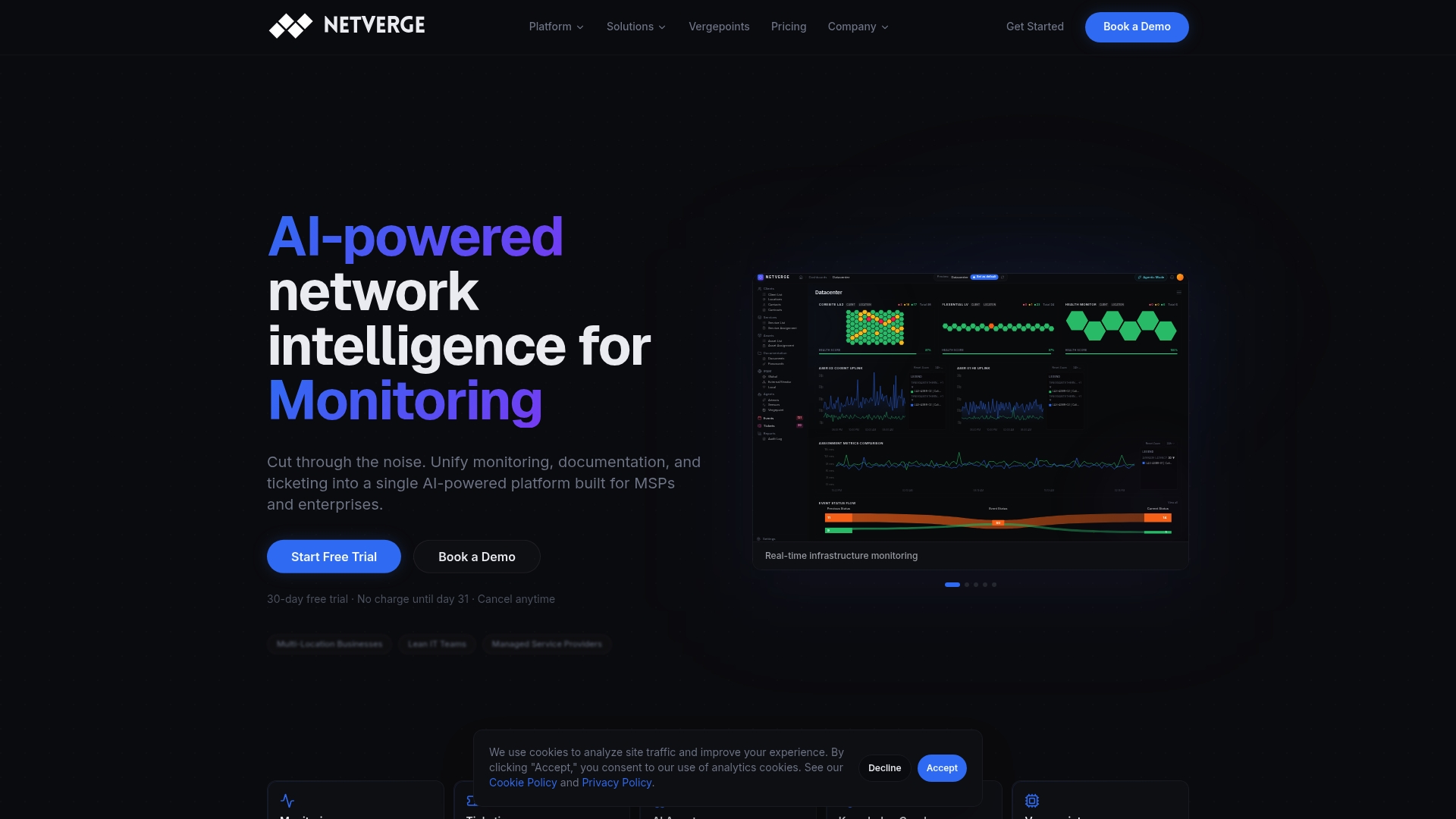
Netverge is built specifically for MSPs managing distributed, multi-vendor environments. The platform unifies AI-powered network monitoring with automated anomaly detection, real-time topology mapping, and intelligent ticket triage into a single interface. Vergepoints provide physical visibility at client sites, while AI agents diagnose and resolve issues autonomously, reducing the manual workload on your technicians. The integrated ticketing and service desk connects event data directly to your workflow, so incidents move from detection to resolution without manual handoffs. If you are ready to replace fragmented tools with a unified platform, explore what Netverge can do for your operation.
FAQ
What is the first step for MSPs managing distributed networks?
Centralizing visibility through a unified monitoring platform is the first step. Without consolidated telemetry and topology data, every other optimization effort operates on incomplete information.
Why do VPNs fail MSPs at scale?
VPNs depend on the production network, making them vulnerable to the same routing failures and outages they are meant to help you resolve. Out-of-band management paths using 5G or satellite provide access that is independent of production network health.
What is zero-trust access and why do MSPs need it?
Zero-trust access is an identity-centric security model that grants access based on verified identity and context rather than network location. It provides session auditability, contractor control, and per-client policy enforcement that VPNs and bastion hosts cannot match.
How much revenue can PSA automation recover for an MSP?
PSA platforms prevent MSPs from losing 5 to 10% of annual revenue caused by manual billing errors, unbilled time, and inefficient workflows. For a mid-size MSP, that represents a substantial recoverable amount through automation alone.
How many tools should an MSP standardize on?
One tool per functional category is the target: one RMM, one monitoring platform, one PSA, and one EDR solution. Standardizing the tech stack shortens technician training and simplifies patching across all client environments.