
Network visibility benefits for MSPs and IT teams

Network blind spots are not a minor inconvenience. For MSPs and IT teams managing distributed infrastructure, they translate directly into delayed incident response, unresolved performance issues, and security threats that persist undetected for days or weeks. When you cannot see what is happening across every site, cloud segment, and device, you are always reacting rather than preventing. This article covers the specific, measurable ways that network visibility transforms daily operations — from faster threat detection and performance optimization to eliminating blame games during multi-vendor incidents — and maps out how modern platforms close the gaps that fragmented tooling leaves behind.
Table of Contents
- Faster threat detection and security response
- Enhancing network performance and efficiency
- Reducing finger-pointing and speeding up issue resolution
- Solving visibility gaps in distributed and multi-cloud environments
- Real-world impact: Transforming MSP and IT team operations
- Why conventional visibility solutions often fall short
- Get advanced network visibility with Netverge
- Frequently asked questions
Key Takeaways
| Point | Details |
|---|---|
| Accelerated threat detection | Network visibility tools help detect threats faster for greater security and faster response times. |
| Improved network efficiency | Identifying bottlenecks and optimizing bandwidth boosts performance across enterprise environments. |
| Reduced operational disputes | End-to-end visibility eliminates finger-pointing, speeds root-cause analysis, and supports collaborative troubleshooting. |
| Overcoming visibility gaps | Unified platforms and packet-level monitoring solve challenges in multi-location and multi-cloud networks. |
| Practical operational impact | Advanced visibility transforms MSP and IT workflows for higher customer satisfaction and fewer unresolved issues. |
Faster threat detection and security response
Security teams that lack full network visibility are working with one hand tied behind their back. Network visibility enables faster threat detection by continuously monitoring traffic for anomalies, malicious activity, and vulnerabilities across every network segment in real time.
For MSPs managing multiple customer environments, this is especially critical. A single unmonitored VLAN or untracked east-west traffic flow can give an attacker lateral movement across an entire customer network before any alert fires. With enterprise network monitoring in place, your team can detect and respond to threats at every layer, not just at the perimeter.
Here is what real-time visibility enables your security workflow to do:
- Monitor internal and external traffic flows simultaneously, catching both inbound attacks and insider threats
- Flag unusual data transfer volumes, irregular login patterns, or unexpected protocol usage within seconds
- Correlate traffic events across sites to distinguish isolated anomalies from coordinated attack patterns
- Trigger automated containment workflows before threats spread laterally
"A manufacturing MSP using full-packet monitoring detected a ransomware precursor script moving laterally through a client's flat network within three minutes of its first execution. The same detection would have taken over forty minutes using alert-only tooling."
Your real-time monitoring guide illustrates how response time shrinks dramatically when telemetry feeds into AI-powered correlation engines rather than static alert rules.
Pro Tip: Configure behavioral baselines for every monitored segment during low-traffic periods. Anomaly detection accuracy improves significantly when the system understands what "normal" looks like per site, per time window, and per device class.
With visibility's role in security established, let's look at how it drives better network performance.
Enhancing network performance and efficiency
Slow networks cost money. Application latency, saturated WAN links, and misconfigured routing all reduce productivity and increase ticket volumes for MSPs. Network performance improves directly when visibility tools identify bottlenecks, bandwidth issues, and slowdowns before they affect end users.
The challenge in multi-location environments is that performance problems are rarely isolated. A bandwidth spike at one branch office can cascade into VoIP quality degradation across an entire region. Without granular telemetry tied to specific devices and interfaces, isolating the root cause takes time your team does not have.
Full visibility gives IT teams the data to act fast:
- Identify bandwidth-intensive applications consuming disproportionate capacity, such as unscheduled backup jobs or unauthorized cloud sync services
- Detect underutilized links that could be load-balanced to improve overall throughput
- Pinpoint routing inefficiencies caused by configuration drift on edge routers or switches
- Isolate congestion events to specific interfaces, VLANs, or time windows for precise remediation
Stat callout: Organizations that implement proactive network monitoring reduce mean time to resolution (MTTR) for performance issues by up to 60% compared to reactive troubleshooting models, according to industry benchmarks across MSP operational data.
Your network dashboard functions play a central role here. Effective dashboards surface utilization trends, flag threshold breaches, and visualize traffic flows across all connected sites from a single interface.
Pro Tip: Set up automated bandwidth trend reports for your top 10 traffic consumers at each site. Review them weekly. You will catch capacity planning issues two to three weeks before they become incidents.

Once performance is optimized, visibility also streamlines accountability and dispute resolution across multiple sites.
Reducing finger-pointing and speeding up issue resolution
Nothing slows an IT incident response down faster than unclear ownership. When an application performs poorly and the network, cloud provider, application team, and ISP are all involved, every party points at someone else. End-to-end visibility for MSPs directly reduces mean time to innocence (MTTI) by mapping the precise path and behavior of traffic across all segments, including customer sites, multi-cloud environments, and third-party networks.
MTTI measures how long it takes to rule out your infrastructure as the cause of an incident. Without visibility, that process involves manual log reviews, phone calls between vendors, and guesswork. With it, you correlate telemetry, identify the exact segment where a packet delay or drop occurred, and provide timestamped evidence in minutes.
Here is a direct comparison of the two workflows:
| Troubleshooting dimension | Legacy approach | Full visibility approach |
|---|---|---|
| Root cause identification | Hours of log analysis | Minutes via correlated telemetry |
| Vendor blame resolution | Requires separate data requests | Evidence available instantly |
| Cross-site correlation | Manual, error-prone | Automated across all segments |
| Customer communication | Delayed, uncertain | Real-time, data-backed updates |
| Escalation rate | High, frequent | Low, with clear handoffs |
| Documentation for post-mortems | Incomplete, reconstructed | Auto-generated from monitoring data |
Additional benefits of full visibility during incidents:
- Shared dashboards allow customer IT teams, MSPs, and vendors to review the same data simultaneously
- Reduces escalations caused by unclear ownership during multi-provider outages
- Shortens the window between incident detection and customer notification
- Builds trust with customers through transparent, evidence-based communication
MSP network monitoring solutions that offer correlated cross-site views make this level of collaboration practical at scale. Teams that previously spent 40 minutes per incident on blame resolution often cut that to under 10 minutes once unified telemetry is available. For more on the specific MSP major problems that visibility addresses, the operational gains extend far beyond incident management.
Having seen improved collaboration, it is vital to address visibility gaps endemic to distributed architectures.
Solving visibility gaps in distributed and multi-cloud environments
Distributed networks create structural blind spots that standard monitoring tools were not designed to handle. In multi-location enterprises, common gaps include limited monitoring at remote and branch sites, edge devices with minimal telemetry output, encrypted traffic that obscures behavior, multi-cloud fragmentation, and configuration drift across dozens or hundreds of devices.
These are not edge cases. They are the norm for any organization with more than a handful of locations. A regional retail chain, a healthcare network with satellite clinics, or a logistics company with warehouse sites all face these challenges simultaneously.
"Configuration drift alone is responsible for a significant percentage of network incidents in multi-location environments. A firewall policy change applied to 90% of branch devices but missed on the remaining 10% can create exploitable inconsistencies that remain invisible without automated configuration auditing."
Here is a structured view of common gaps and the solutions that address them:
| Visibility challenge | Root cause | Effective solution |
|---|---|---|
| Remote branch blind spots | No local monitoring probes | Deploy observability hardware at each site |
| Edge device limited telemetry | Resource-constrained IoT and OT devices | Passive packet capture and flow analysis |
| Encrypted traffic opacity | TLS 1.3 and zero-trust architectures | Metadata-based behavioral analysis |
| Multi-cloud fragmentation | Siloed cloud provider dashboards | Unified cross-cloud telemetry ingestion |
| Configuration drift | Manual change management across sites | Automated config comparison and alerting |
Practical steps to close these gaps:
- Deploy lightweight hardware probes at branch and edge locations to capture local telemetry without requiring full stack deployment
- Use AI-driven platforms that correlate flow data, SNMP traps, and metadata signals even when full packet inspection is not possible
- Implement automated network diagnostics that run continuous checks against known-good configuration baselines
- Feed multi-cloud telemetry into a unified visibility layer so cross-environment correlation becomes possible
The key is eliminating the assumption that a monitoring tool deployed at your core automatically covers your edges. It does not. Every unmeasured segment is a liability.
With technical solutions mapped, let's put it all together: the practical benefits for IT teams and MSPs.
Real-world impact: Transforming MSP and IT team operations
When you combine faster threat detection, improved performance management, reduced MTTI, and closed visibility gaps, the operational impact is significant and measurable. MSPs that implement full-stack visibility typically see fewer escalations, higher customer satisfaction scores, and reduced ticket volumes, all driven by their ability to diagnose and resolve issues before customers notice them.
Packet-level visibility is essential even for non-security IT teams. Issues like TCP retransmissions causing application slowdowns or DNS resolution delays that affect login performance are completely invisible to flow-based or SNMP-only monitoring. Only packet-level inspection reveals the true source of these subtle but impactful problems.
Key operational wins for MSPs and IT teams with full visibility:
- Proactive detection of issues before customer SLA thresholds are breached
- Fewer helpdesk tickets because infrastructure problems are resolved automatically or before users notice
- Shorter onboarding cycles for new customer sites when standardized probe deployment and baseline generation are automated
- Clearer performance reporting for customer business reviews, backed by real telemetry
- Reduced alert fatigue because AI correlation filters noise and surfaces only actionable alerts
Understanding what is actually flowing across your network at the packet level changes how you diagnose everything from slow file transfers to intermittent application errors. An intelligent network interface that delivers packet-level insight alongside flow data gives your team the forensic capability that used to require dedicated security tools.
Pro Tip: Even if your team's primary focus is operations rather than security, deploy packet capture capabilities at critical segments like WAN edges and data center uplinks. When a subtle performance issue appears, you will have the data to diagnose it in minutes rather than days.
The cumulative operational value calls for a deeper perspective into what works best.
Why conventional visibility solutions often fall short
Most organizations do not have a visibility problem because they ignore monitoring. They have it because they accumulated too many disconnected tools. A network monitor here, a cloud dashboard there, a separate logging solution, and a standalone packet analyzer create the illusion of coverage. In practice, the gaps between those tools are exactly where the most damaging incidents occur.
Overcoming blind spots in distributed environments requires unified platforms with remote probes, AI-driven correlation, and packet-level forensics. No combination of siloed tools replicates what a purpose-built, integrated platform delivers when every telemetry stream feeds into a single correlation engine.
The hard-won lesson from working with MSPs managing dozens of customer networks is this: the most costly failures almost always trace back to partial visibility. An alert fires in one tool, but the corroborating context lives in a different system no one checked. The threat or performance issue that looked manageable in isolation turns catastrophic because the full picture was never assembled.
Tool sprawl also creates operational overhead. Each platform requires its own maintenance, its own training, and its own integrations. Engineers spend time managing monitoring tools instead of resolving issues. When something goes wrong, they switch between interfaces instead of acting.
The right architecture is one where a unified platform ingests telemetry from every segment, correlates it with AI, and surfaces clear, prioritized actions. Automated network diagnostics become possible only when the underlying data is unified, not when it is scattered across six different dashboards.
Visibility is not just a feature. It is a foundational capability that determines how fast and how confidently your team can operate. If your current tooling cannot answer "what is happening right now, across every site and cloud, and what caused that anomaly," then the gaps are costing you more than you realize.
Get advanced network visibility with Netverge
Netverge is built specifically for MSPs and IT teams that need unified visibility across distributed, multi-cloud, and multi-site environments. If the challenges in this article sound familiar, the platform gives you the tools to address them directly.
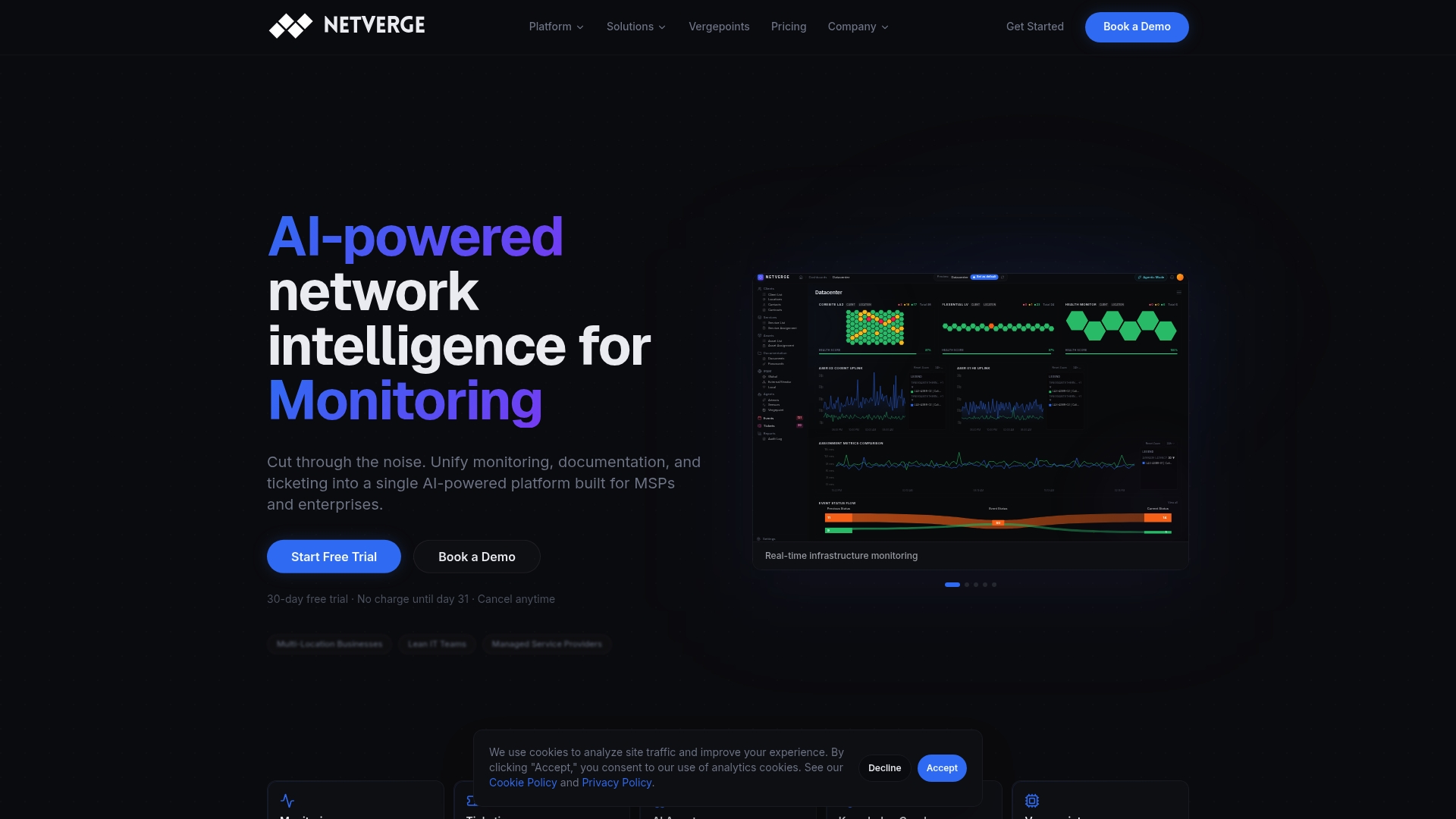
Explore AI network monitoring that combines real-time telemetry, anomaly detection, and automated diagnostics into a single interface. Deploy observability hardware at branch and edge locations to capture packet-level data without complex infrastructure. Purpose-built MSP network solutions support multi-tenant management, cross-site correlation, and intelligent ticket triage, so your team spends time resolving issues, not hunting for context. Request a demo and see what full visibility looks like across your entire network.
Frequently asked questions
How does network visibility improve threat detection?
Network visibility enables faster threat detection by allowing IT teams to monitor traffic continuously, spot anomalies in real time, and respond to threats before they escalate into breaches.
What are common network visibility gaps in multi-location enterprises?
Typical gaps include remote site blind spots, limited telemetry from edge devices, difficulty tracking encrypted traffic, multi-cloud fragmentation, and undetected configuration drift across distributed devices.
Why is packet-level visibility important for IT operations?
Packet-level visibility diagnoses subtle issues like TCP retransmissions and DNS resolution delays that flow-based or SNMP monitoring completely misses, giving IT teams the forensic detail needed for accurate root cause analysis.
How does visibility reduce finger-pointing during network incidents?
End-to-end visibility reduces MTTI by pinpointing where in the traffic path a delay or failure occurred, providing timestamped evidence that resolves ownership disputes between providers, vendors, and internal teams quickly.