
Managing distributed networks is one of the most operationally demanding responsibilities in modern IT. Latency-sensitive applications, geographically dispersed sites, hybrid cloud dependencies, and multi-vendor hardware create a coordination challenge that generic monitoring tools simply cannot address. This distributed network operations guide walks you through the foundational setup, incident lifecycle, automation governance, and edge management strategies you need to run distributed networks reliably at scale. Whether you're an MSP engineer, a network administrator for a multi-location enterprise, or a project manager overseeing a NOC buildout, the practices here reflect 2026 operational standards.
Table of Contents
- Key takeaways
- Distributed network operations: foundations first
- Incident lifecycle management in distributed networks
- Automation and governance at scale
- Managing edge and multi-domain networks
- My take on distributed network operations in 2026
- How Netverge supports distributed network management
- FAQ
Key takeaways
| Point | Details |
|---|---|
| Build a NOC around continuous coverage | Structure your NOC for 24/7 monitoring with defined shift handoffs and escalation paths before adding tools. |
| Follow the full incident lifecycle | Detection through post-incident review forms a feedback loop that reduces repeat incidents over time. |
| Govern automation with decision bands | Define what automation can act on independently versus what requires human approval before deploying any playbook. |
| Map upstream dependencies first | Validate cloud, ISP, and SaaS status before investigating local symptoms to avoid wasted diagnostic effort. |
| Centralize edge lifecycle management | Use orchestration frameworks to prevent configuration drift across geographically distributed nodes. |
Distributed network operations: foundations first
Before you can manage a distributed network effectively, you need clarity on what you're managing. Distributed networks span multiple physical sites, logical domains, and often combine on-premises infrastructure with cloud and SaaS services. The core elements include nodes (routers, switches, firewalls, edge devices), the links connecting them, cloud gateways, and the identity and DNS systems those nodes depend on.
The NOC: your operational command center
A NOC provides 24/7 monitoring and incident coordination to maintain service availability and minimize outages. In distributed environments, the NOC must be designed around visibility across all sites, not just the data center. That means shift-based staffing for continuous coverage, documented escalation paths per site, and a unified alerting view that correlates events across domains.

Core tooling requirements
Your toolset should cover four functional areas:
- Telemetry collection: SNMP, NetFlow, syslog, and IPFIX feeds from all managed devices
- Alerting and correlation: Threshold-based and anomaly-based alerting with suppression rules to reduce noise
- Topology and dependency mapping: Real-time visibility into how nodes connect and what they depend on upstream
- Automation readiness: APIs or orchestration hooks that allow policy-driven responses, not just passive alerting
Personnel and skills
Distributed systems management requires more than generalist network engineers. You need staff with skills across routing and switching, cloud networking (AWS VPC, Azure Virtual WAN), scripting (Python, Ansible), and ITIL-aligned incident processes. Cross-training across these areas is not optional when a site goes down at 2 a.m. on a weekend.
| Role | Primary responsibility |
|---|---|
| NOC Analyst (Tier 1) | Alert triage, initial logging, escalation |
| Network Engineer (Tier 2) | Investigation, diagnosis, resolution |
| Senior Engineer / Architect (Tier 3) | Complex incidents, change authorization |
| NOC Manager | Shift coordination, SLA tracking, reporting |
Incident lifecycle management in distributed networks
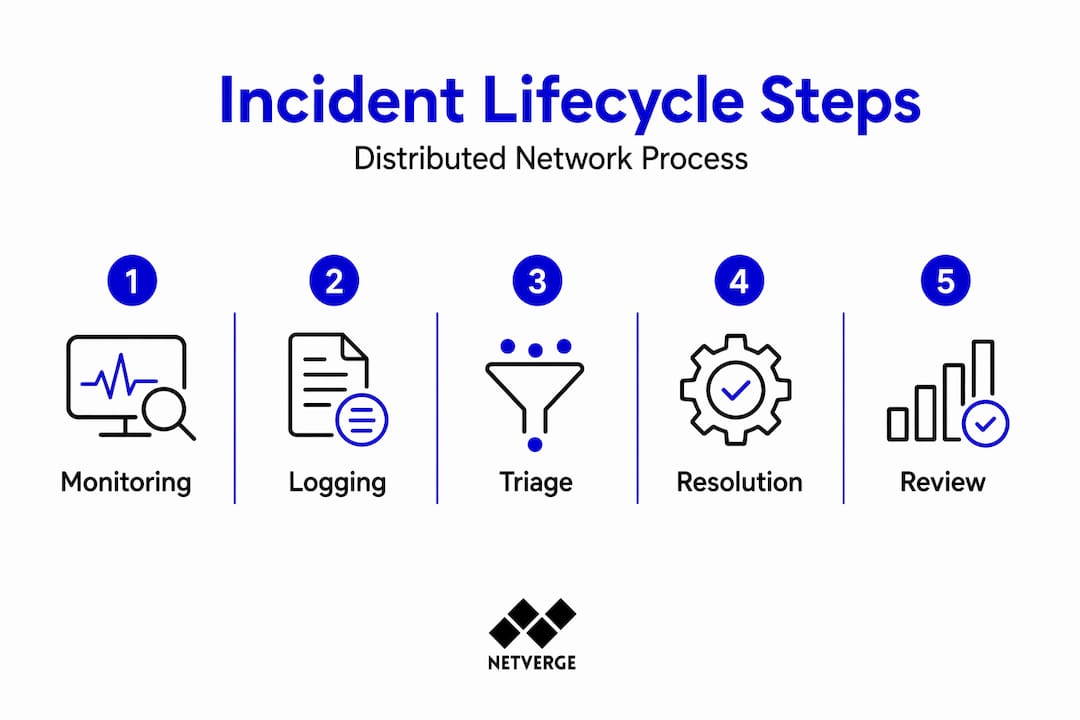
The incident management lifecycle follows a continuous loop: event monitoring, logging, prioritization, triage, investigation, resolution, closure, and improvement. Each phase requires specific inputs and outputs, and skipping steps creates compounding problems downstream.
Step 1: event monitoring and intelligent alerting
Raw telemetry is not the same as useful alerting. Most distributed environments generate thousands of events per hour. The goal is suppressing correlated noise while surfacing real service impacts. Configure parent-child alert relationships so that a core router failure doesn't trigger 50 separate alerts for every downstream device it affects. Anomaly-based thresholds catch degradation before it becomes an outage.
Step 2: logging, categorization, and prioritization
Every detected event must be logged with a timestamp, affected device, site, and initial severity. Categorize by type (performance, availability, security, configuration) and prioritize by business impact. A BGP session drop at a hub site is P1. A non-critical monitoring sensor offline at a branch is P3. That distinction must be codified in your priority matrix, not left to analyst judgment under pressure.
Step 3: triage and dependency-aware investigation
This is where most teams lose time. Before investigating local hardware or configurations, validate upstream dependencies including cloud services, identity systems, SaaS vendors, and ISPs. A 2025 telecom outage in Luxembourg traced to a zero-day exploit in Huawei routers took hours longer to diagnose because teams initially focused on local configuration rather than the upstream traffic crafting the crash. Dependency mapping prevents that kind of misdirection.
Pro Tip: Link your runbooks directly from alerts in your ticketing system. Runbook discoverability is as important as runbook content. An unlinked runbook effectively does not exist when an engineer is managing an active P1 under pressure.
Step 4: resolution and recovery
Resolution steps should be documented in the ticket in real time, not reconstructed after the fact. Include commands executed, configuration changes made, and any temporary workarounds applied. If escalation is required, the receiving engineer needs a full picture without a phone call.
Step 5: post-incident review and continuous improvement
Treating incident and problem management as a feedback loop reduces repeat incidents and improves operational stability. Every P1 and P2 should produce a postmortem with a root cause, contributing factors, and at least two preventive actions with owners and due dates. Teams that skip this step solve the same problems repeatedly.
Automation and governance at scale
Automation in distributed network operations is not a switch you flip. It is a capability you build incrementally, with explicit controls at every stage.
Defining decision bands
Successful automation requires defined decision bands that specify exactly which actions a system can take autonomously and which require human approval. A practical three-tier model looks like this:
- Tier 1 (fully automated): Restart unresponsive monitoring agents, clear stale ARP entries, suppress known maintenance alerts
- Tier 2 (automated with notification): Apply pre-approved ACL changes, reroute traffic over secondary links, restart specific services
- Tier 3 (human approval required): BGP route changes, firewall policy modifications, any change touching more than one site simultaneously
Codifying policy as testable rules
Policy written in plain text documents does not scale. Codify your network policies as machine-readable rules in your orchestration platform, whether that is Ansible, Terraform, or a dedicated network automation controller. This allows you to test policy changes in a staging environment before they touch production.
Pro Tip: Track your rollback frequency as a reliability metric. If you are rolling back automated changes more than 5% of the time, your decision band for that action is set too aggressively. Tighten the scope before widening automation coverage.
Overcoming organizational barriers
Skills gaps are the top barrier to Day 2 network automation, cited by 46% of NetOps teams, followed by tool limitations at 36% and governance constraints at 32%. The technology is often ready before the organization is. Address this by pairing automation rollouts with structured training, clear ownership of automation playbooks, and a governance committee that reviews and approves new automated actions. Human and organizational factors limit automation adoption more than technology does. That is the uncomfortable reality most vendors will not tell you.
Managing edge and multi-domain networks
Edge and multi-domain networks introduce challenges that centralized architectures do not face: configuration drift, geographic compliance requirements, and multi-vendor inconsistency across dozens or hundreds of sites.
Centralized edge orchestration
Centralized edge orchestration frameworks automate OS, cluster, and application lifecycle management across geographically distributed sites. The orchestrator acts as the single source of truth for node state, pushing updates consistently and detecting drift. Without this, engineers at individual sites apply local fixes that never get documented, and six months later no one knows why site 14 is running a different firmware version than every other location.
Geographic compliance and network sovereignty
Network-layer enforcement of geographic boundaries is no longer optional for organizations operating across jurisdictions. Equinix's Fabric Geo Zones demonstrate how traffic can be rerouted or blocked at the network layer to stay within legal jurisdictions. Your network architecture must account for where data flows, not just where it originates.
Centralized vs. distributed management approaches
| Approach | Best for | Key limitation |
|---|---|---|
| Fully centralized NOC | Uniform environments, strong WAN links | Single point of failure if connectivity drops |
| Distributed regional NOCs | Large geographic footprints | Coordination overhead and data silos |
| Hybrid with central orchestration | Most enterprise and MSP environments | Requires strong tooling and process discipline |
| Edge-autonomous with reporting | Remote or bandwidth-constrained sites | Limited real-time visibility from central teams |
Avoiding multi-domain symptom chasing
Multi-domain complexity makes dependency awareness critical to avoid misdiagnosis during distributed incidents. When an application slows at a remote site, the failure could originate in the local switch, the SD-WAN overlay, the regional ISP, the cloud provider, or the identity system authenticating users. A structured triage order that checks upstream systems before local infrastructure prevents teams from spending hours on the wrong layer.
Pro Tip: Turning tribal knowledge into formalized runbooks standardizes response across distributed and remote teams. If your senior engineer is the only person who knows how to handle a BGP failover at site 7, that is a process risk, not just a staffing risk.
Also consider how your team structure aligns with your network topology. Teams organized by technology silo (routing team, security team, cloud team) struggle to coordinate during multi-domain incidents. Cross-functional incident squads with clear communication protocols handle distributed failures faster.
My take on distributed network operations in 2026
I have worked with distributed NOC environments long enough to know that the biggest operational failures are rarely technical. They are process failures wearing technical clothing.
I have seen organizations spend significant budget on monitoring platforms while their runbooks sit in a SharePoint folder nobody can find during an incident. I have watched teams chase local configuration issues for 90 minutes before someone thought to check whether the ISP had a routing problem upstream. The tools were fine. The process was broken.
The skills shortage is real. 46% of NetOps teams cite it as the primary blocker to automation. My experience confirms this, and I would add that the shortage is not just in technical skills. It is in process design skills. Engineers who can configure a router are easier to find than engineers who can design an incident lifecycle that actually gets followed under pressure.
What I have found actually works is incremental automation with explicit guardrails, postmortems that produce real corrective actions instead of paperwork, and dependency maps that get updated every time the network changes. None of that is glamorous. All of it is what separates teams that manage distributed networks well from teams that are permanently reactive.
The organizations getting this right treat distributed network operations as a strategic operational capability, not a cost center to minimize. That framing changes how they invest in tooling, training, and process design. It changes outcomes.
— Jim
How Netverge supports distributed network management
Implementing everything in this guide is significantly easier when your tooling is built for distributed environments from the ground up. Netverge unifies monitoring, documentation, ticketing, and automation into a single AI-powered platform designed for MSPs and multi-location enterprises managing complex, distributed infrastructures.
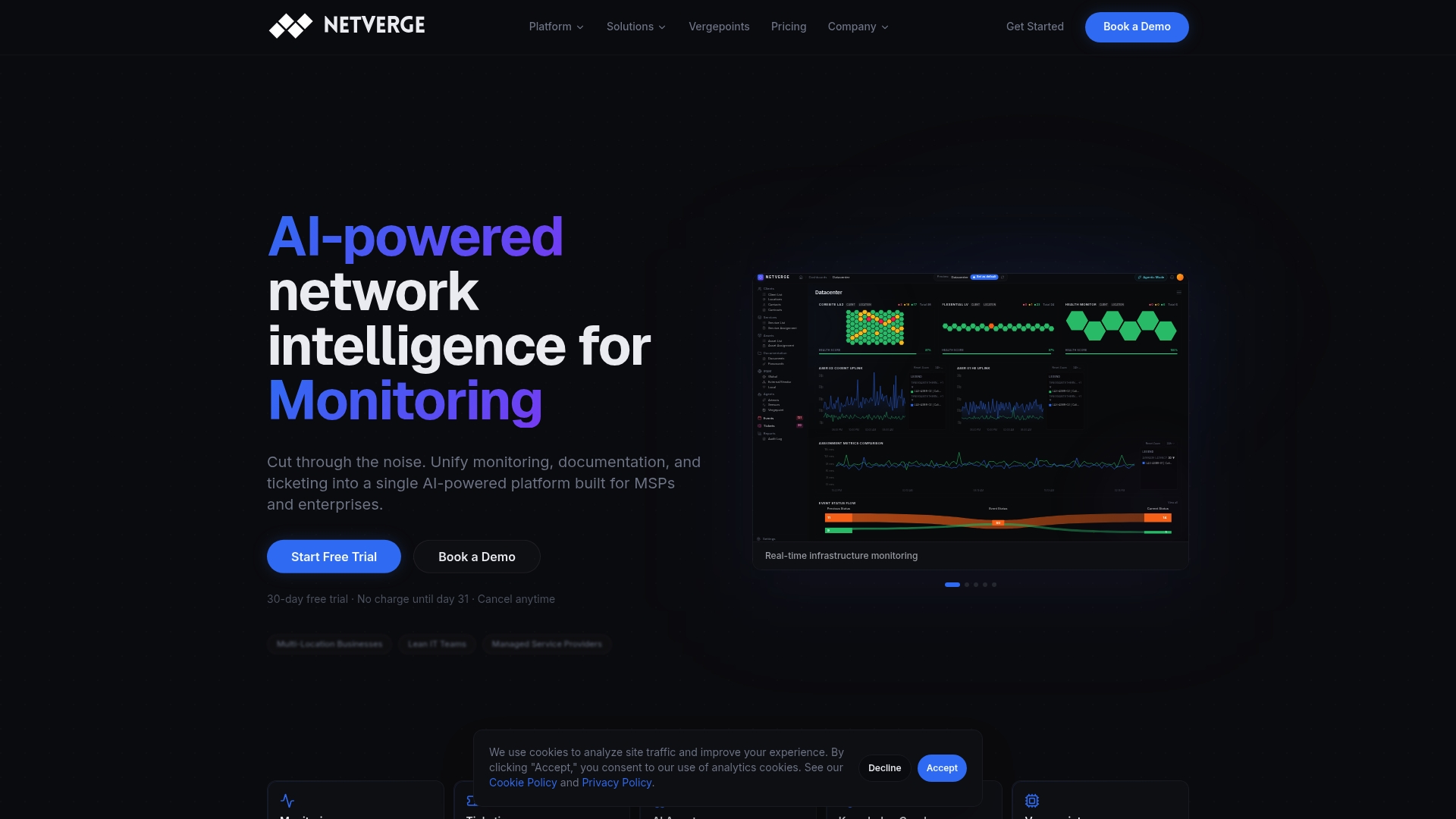
Netverge's AI-powered monitoring provides real-time visibility across all your sites, with anomaly detection that reduces alert noise and surfaces real issues faster. Autonomous AI agents triage incidents, map dependencies, and execute approved remediation playbooks without waiting for a human to notice an alert. The platform's knowledge graph connects device data, topology, and documentation so engineers always have context when they need it most. For teams managing enterprise-scale distributed networks, Netverge also supports full lifecycle event tracking, intelligent ticket triage, and Vergepoints hardware for physical site visibility. If you are ready to move from reactive to proactive distributed network operations, Netverge is built for exactly that.
FAQ
What is a distributed network operations guide?
A distributed network operations guide is a structured reference covering the tools, processes, and team structures needed to monitor and manage networks spread across multiple geographic sites or domains.
How do I manage distributed networks effectively?
Effective distributed network management requires a 24/7 NOC structure, dependency-aware incident triage, centralized edge orchestration, and incremental automation governed by defined decision bands.
What are the biggest challenges in distributed systems management?
The top challenges include alert noise across multiple sites, upstream dependency blind spots, configuration drift at edge nodes, skills gaps in the team, and governance constraints that slow automation adoption.
Why is post-incident review critical in distributed environments?
Post-incident reviews create a continuous improvement loop that reduces repeat incidents. Without structured postmortems, distributed teams resolve the same failure modes repeatedly without addressing root causes.
What tools are best for distributed network operations?
The best tools for network operations in distributed environments combine telemetry collection, topology mapping, intelligent alerting with correlation, automated triage, and centralized orchestration for edge lifecycle management in a single unified platform.