
Most IT teams have more tools than they have time to manage. The average organization runs between 45 and 83 separate tools across its network and security stack, each with its own interface, alert queue, and licensing cost. The assumption behind this sprawl is understandable: more coverage equals better protection. In practice, the opposite is often true. Understanding why consolidate network tools is one of the most pressing decisions IT leaders face in 2026, and the answer goes far beyond cost savings.
Table of Contents
- Key takeaways
- Why consolidate network tools: the core benefits
- Risks and challenges of consolidation
- How to start consolidating: practical steps for IT leaders
- Fragmented tools vs. consolidated platforms
- My take on tool consolidation
- How Netverge supports network tool consolidation
- FAQ
Key takeaways
| Point | Details |
|---|---|
| Tool sprawl is costly and risky | Managing 45–83 tools per organization creates blind spots, alert fatigue, and inflated operational costs. |
| Consolidation improves visibility | Unified platforms enable native telemetry correlation, faster anomaly detection, and fewer missed alerts. |
| Risks must be managed proactively | Blast radius failures and vendor lock-in are real concerns that require isolation planning and phased rollouts. |
| Business outcomes drive success | Define what operational goals consolidation must achieve before selecting or retiring any tools. |
| AI readiness depends on clean data | Consolidated data sources create the authoritative telemetry foundation that AI-driven monitoring requires. |
Why consolidate network tools: the core benefits
The case for consolidation is not abstract. It shows up in license renewals, ticket queues, and incident response timelines. Here are the primary drivers that make the benefits of network tool consolidation worth pursuing.
Licensing and maintenance costs drop significantly. When you eliminate overlapping tools, you eliminate redundant contracts. Consolidating infrastructure instances reduces hardware, licensing, maintenance, and power costs simultaneously, and the effect compounds across large environments.
Visibility improves when data flows through one system. Siloed tools create gaps that slow down investigation and audit cycles significantly. A unified platform correlates telemetry across all network segments, reducing the time between anomaly occurrence and detection.

Alert fatigue decreases. Duplicate alerts and blind spots caused by disjointed tools are among the most damaging outcomes of tool sprawl. When two monitoring products watch the same segment without awareness of each other, your team gets flooded with noise while real threats slip through the gaps.
Security posture strengthens. Integration points between tools represent a major attack surface. Each API handoff, data feed, or connector is a potential entry point. Fewer tools means fewer seams for adversaries to probe.
Staff productivity increases. Engineers spend less time context-switching between dashboards and more time on actual resolution work. The network visibility ROI of this shift is measurable in mean time to resolution (MTTR) and ticket closure rates.
- Fewer tools to patch, update, and monitor for end-of-life
- Centralized access control and audit logging
- Simpler onboarding for new team members
- Cleaner data inputs for AI and automation workflows
Pro Tip: Before calculating ROI, document the total annual cost of your current stack including hidden costs like integration maintenance, staff training time, and incident delays caused by tool gaps. The real number is almost always higher than what shows on the license invoices.
Risks and challenges of consolidation
Consolidation is not a zero-risk move. Understanding the failure modes upfront is what separates a successful rollout from a costly regression.
The most cited technical risk is the blast radius effect. When multiple workloads share a consolidated platform, a failure in that platform affects all of them at once. Robust isolation, resource controls, and high-availability architectures are mandatory to reduce systemic risk. This means designing for failover from day one, not retrofitting it after an incident.
Noisy neighbor problems are equally real. Consolidated environments can experience resource contention where one workload degrades performance for others. Careful workload grouping, performance baselines, and monitoring thresholds are necessary before and after migration.
Vendor lock-in deserves serious attention. Consolidating around a single vendor's ecosystem can accelerate delivery short-term, but it limits future flexibility. Evaluate vendors on open API support, data portability, and exit pathways before committing.
- Map current tool dependencies before retiring anything
- Define isolation boundaries and failover procedures per workload
- Require API documentation and data export capabilities from vendors
- Establish governance policies and role-based access controls early
- Plan a phased transition to reduce operational disruption
Change management is frequently underestimated. Teams that have built workflows around specific tools will resist changes to their processes. Stakeholder alignment, clear communication, and training schedules are not optional steps. They are what make consolidation stick.
Pro Tip: Run a parallel operations period where old and new tools run simultaneously on non-critical segments. This lets you validate data parity and build team confidence before fully decommissioning legacy tools.
How to start consolidating: practical steps for IT leaders
Knowing the reasons to consolidate network tools is one thing. Executing it without destabilizing operations is another. Here is a structured approach that works in practice.
Audit your current stack. List every tool, its function, its cost, and which team relies on it. Identify overlaps where two or more tools perform the same function. Quantify the operational impact of each overlap in terms of alert volume, false positive rate, and staff time.
Define business outcomes first. Consolidation must be driven by clearly defined business outcomes to be effective. Do you want to reduce MTTR by 40%? Cut licensing spend by a third? Improve audit readiness? Your answers determine which tools to keep, which to replace, and what success looks like.
Evaluate platforms against your outcomes. Do not evaluate tools in isolation. Evaluate them as ecosystems. Does the platform provide native telemetry correlation? Does it integrate with your ticketing and documentation systems? Does it support the AI-driven automation workflows your team will need at scale?
Build a phased consolidation roadmap. Start with the lowest-risk, highest-duplication areas. Non-critical monitoring segments or secondary locations are good candidates for early phases. Validate results before expanding scope.
Incorporate AI and automation from the start. Unified network and security architectures enable real-time visibility essential for AI-driven response. A consolidated platform with clean, correlated telemetry is the prerequisite for any meaningful AI capability. Build the data foundation correctly or your AI layer will produce unreliable outputs.
Align stakeholders before launch. Engineering, security, operations, and finance all have a stake in the outcome. Get explicit alignment on goals, timelines, and success metrics before the first tool is decommissioned.
Pro Tip: Track a small set of leading indicators during each phase: alert volume per engineer, MTTR, false positive rate, and licensing cost per monitored device. These four metrics tell you whether consolidation is delivering real value or just shifting complexity.
Fragmented tools vs. consolidated platforms
A direct comparison makes the operational difference clear. The table below reflects typical results seen in mid-to-large IT environments in 2026.
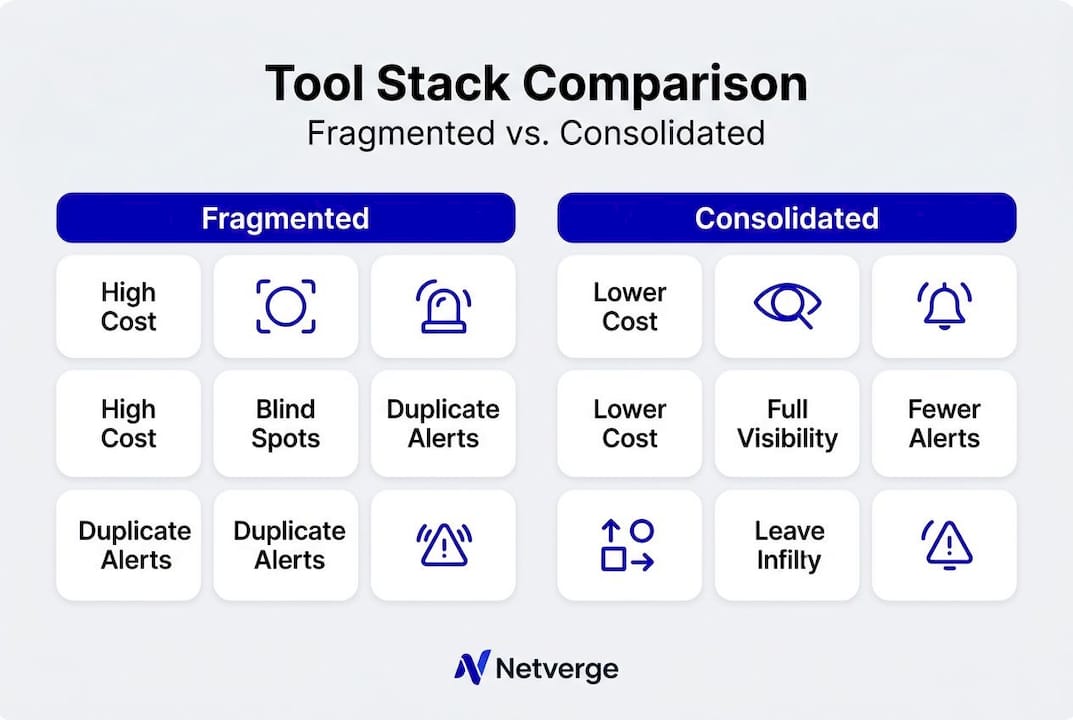
| Metric | Fragmented tool stack | Consolidated platform |
|---|---|---|
| Licensing cost | High, with significant overlap | Reduced through unified contracts |
| Integration complexity | High, with custom connectors per tool | Low, with native API and data sharing |
| Visibility across segments | Partial, with data gaps at tool seams | Full, with correlated telemetry |
| Alert volume and noise | High false positive rate | Reduced through native deduplication |
| Security attack surface | Large, with many integration seams | Smaller, with fewer exposed interfaces |
| Staff productivity | Lower, due to context switching | Higher, with unified workflows |
| AI and automation readiness | Limited by inconsistent data formats | Strong, with clean unified data inputs |
The advantages of unified network management show up most clearly in security and response time. Genuine consolidation replaces siloed tools with native correlation of telemetry and alerts, which drastically improves risk detection accuracy. This is not a marginal improvement. Teams that have moved from fragmented stacks to unified platforms consistently report faster incident identification and lower analyst burnout.
There are scenarios where some fragmentation persists intentionally. Regulated industries sometimes require separate tooling for specific compliance domains. Acquired companies may run legacy stacks during integration periods. These are acceptable exceptions when managed deliberately, not defaults to preserve out of inertia.
The hidden cost of tool sprawl often goes untracked until a consolidation audit surfaces it. When you add integration maintenance, staff context-switching, and delayed incident response to raw licensing costs, the case for fewer tools becomes hard to ignore.
My take on tool consolidation
I have worked with IT teams at various stages of consolidation, and the most common mistake I see is treating it as a technology project when it is fundamentally a business alignment project.
The teams that struggle are usually the ones that start by asking "which tools can we replace?" The teams that succeed start by asking "what operational outcomes are we not achieving right now?" That reframe changes everything. It shifts the conversation from vendor comparison to business impact, and it creates the stakeholder buy-in that sustains the project through the difficult middle phases.
What I have also learned is that waiting makes the problem worse, not better. Every quarter you delay, your tool stack grows by integration dependencies, custom scripts holding legacy tools together, and institutional knowledge baked into specific dashboards. The longer you wait, the higher the transition cost.
The AI readiness angle is also underappreciated. You cannot build reliable AI-driven monitoring on top of fragmented, inconsistent data sources. The teams investing in consolidation now are not just solving a cost or complexity problem. They are building the data infrastructure that makes intelligent automation possible in the next two to three years. That is a competitive advantage that compounds.
My honest advice: start smaller than feels comfortable, measure everything, and treat the first phase as a proof of concept that builds organizational trust. The technology is ready. The question is whether your organization's processes and culture are aligned to support the change.
— Jim
How Netverge supports network tool consolidation
If you are evaluating how to consolidate network tools and want to see what a purpose-built platform looks like in practice, Netverge is worth a close look.
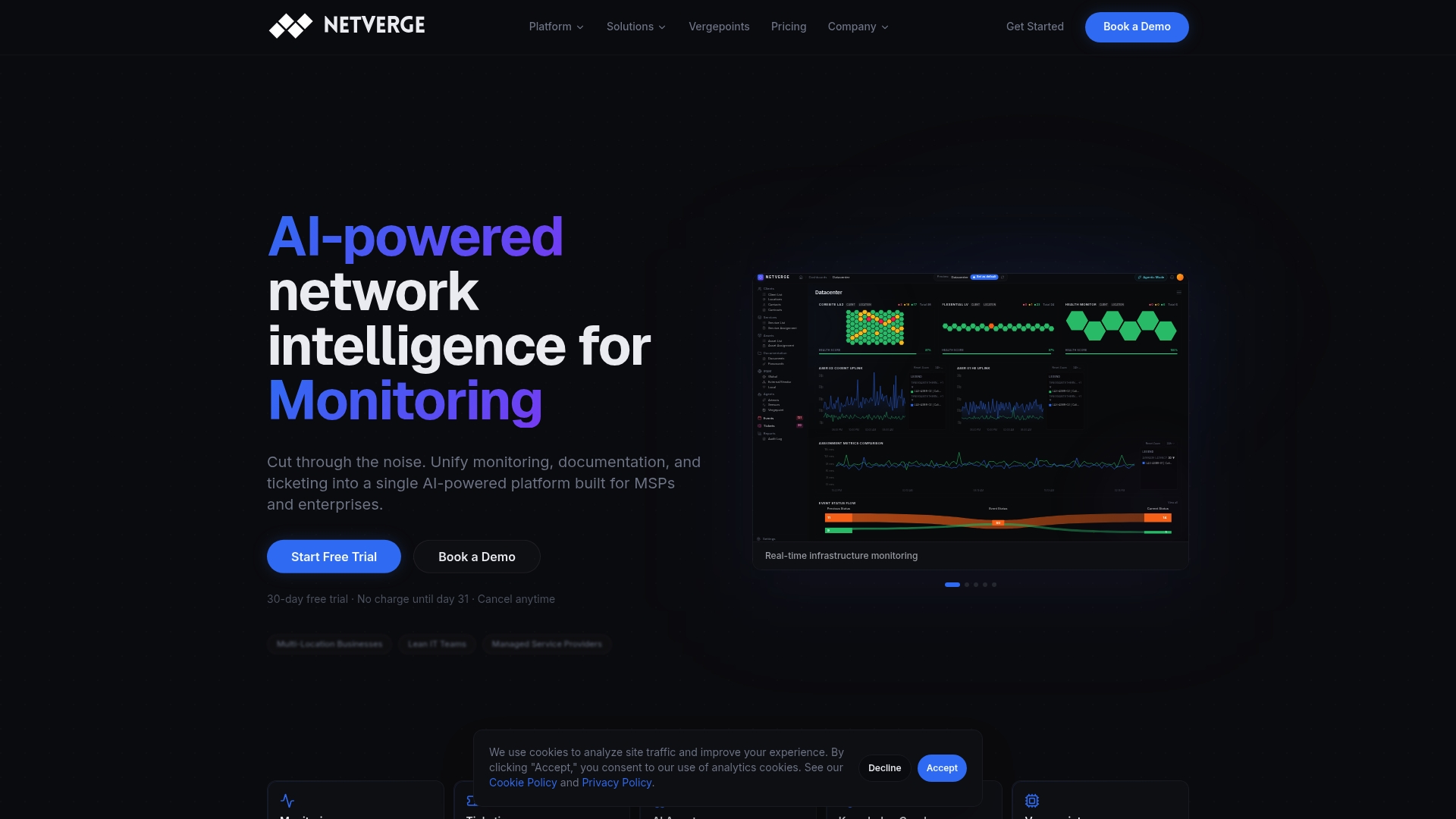
Netverge unifies AI-powered network monitoring and observability, automated ticketing, documentation, and autonomous troubleshooting into a single interface. Its AI agents correlate telemetry across all monitored segments in real time, reducing alert noise and accelerating incident resolution without requiring your team to manually cross-reference multiple dashboards. Vergepoints provide physical visibility at distributed locations, and the platform's AI-powered ticketing layer handles intelligent triage automatically. For MSPs and multi-location enterprises, this is the kind of unified architecture that makes consolidation practical rather than aspirational. Request a demo at netverge.com to see how it fits your environment.
FAQ
What does it mean to consolidate network tools?
Network tool consolidation means replacing multiple overlapping monitoring, management, and security tools with a smaller set of integrated platforms that share data natively. The goal is unified visibility, reduced operational complexity, and lower costs.
Why consolidate network tools instead of keeping best-of-breed tools?
Best-of-breed stacks create integration gaps that adversaries exploit and force engineers to manually correlate data across disconnected interfaces. Consolidated platforms deliver faster detection and lower management overhead.
What are the biggest risks when consolidating network tools?
The primary risk is the blast radius effect, where a failure in a consolidated platform affects multiple workloads simultaneously. Mitigate this with isolation architecture, failover design, and a phased rollout approach.
How do I know if my organization is ready to consolidate?
Start with a tool audit. If you find two or more tools performing overlapping functions, high alert false positive rates, or engineers spending significant time on cross-tool correlation, your environment is ready for consolidation planning.
Does consolidating network tools improve AI readiness?
Yes. Consolidating data sources lays the foundation for AI by creating clean, authoritative telemetry inputs. Fragmented tool stacks produce inconsistent data formats that limit the accuracy and reliability of AI-driven monitoring and automation.