
MSP network management is one of those topics where the terminology gets thrown around constantly, yet the actual operational mechanics stay blurry. At its core, what is MSP network management? It means outsourcing the day-to-day monitoring, maintenance, and support of your network infrastructure to a managed service provider under clearly defined service level agreements. For IT professionals and operations managers dealing with growing infrastructure complexity, understanding exactly what this model covers, how the tooling works, and where the real operational risks hide is the difference between a functional partnership and a costly misalignment.
Table of Contents
- Key takeaways
- What MSP network management actually covers
- Technology and tools powering MSP network management
- Operational best practices and common pitfalls
- Evaluating and selecting MSP network management solutions
- My take: what most MSP buyers get wrong
- How Netverge powers MSP network management
- FAQ
Key takeaways
| Point | Details |
|---|---|
| MSP network management defined | An MSP handles monitoring, maintenance, and support of your network under contracted SLA terms. |
| SLA clarity drives outcomes | Well-defined SLA metrics protect both parties and directly determine service quality and accountability. |
| Tooling integration matters more than tool count | Fragmented platforms slow incident response; unified dashboards reduce diagnostic time across environments. |
| AI accelerates network operations | Automation and machine learning now handle anomaly detection, provisioning, and troubleshooting at scale. |
| Evaluation criteria beyond price | Coverage scope, scalability, workflow integration, and vendor neutrality all determine long-term fit. |
What MSP network management actually covers
The network management definition in an MSP context goes well beyond someone rebooting your switches remotely. MSPs remotely operate, monitor, and maintain networking functions including installation, troubleshooting, configuration, and end-user support. The scope is broad by design.
A typical MSP network management engagement covers the following service categories:
- Continuous monitoring. Device telemetry, traffic patterns, and availability metrics are collected across your environment in real time. Automated alerts flag anomalies before they escalate into outages.
- Configuration and patch management. Firmware updates, OS patches, and device configuration changes are applied on a scheduled or as-needed basis.
- Firewall and security management. MSPs manage firewall rule sets, VPN configurations, and access controls. Managed network services often include managed firewalls, WAN optimization, and compliance support.
- Troubleshooting and incident response. When alerts fire, the MSP works the problem according to the response windows defined in the SLA.
- Reporting and compliance support. Regular performance reports and compliance documentation are delivered under contractual terms.
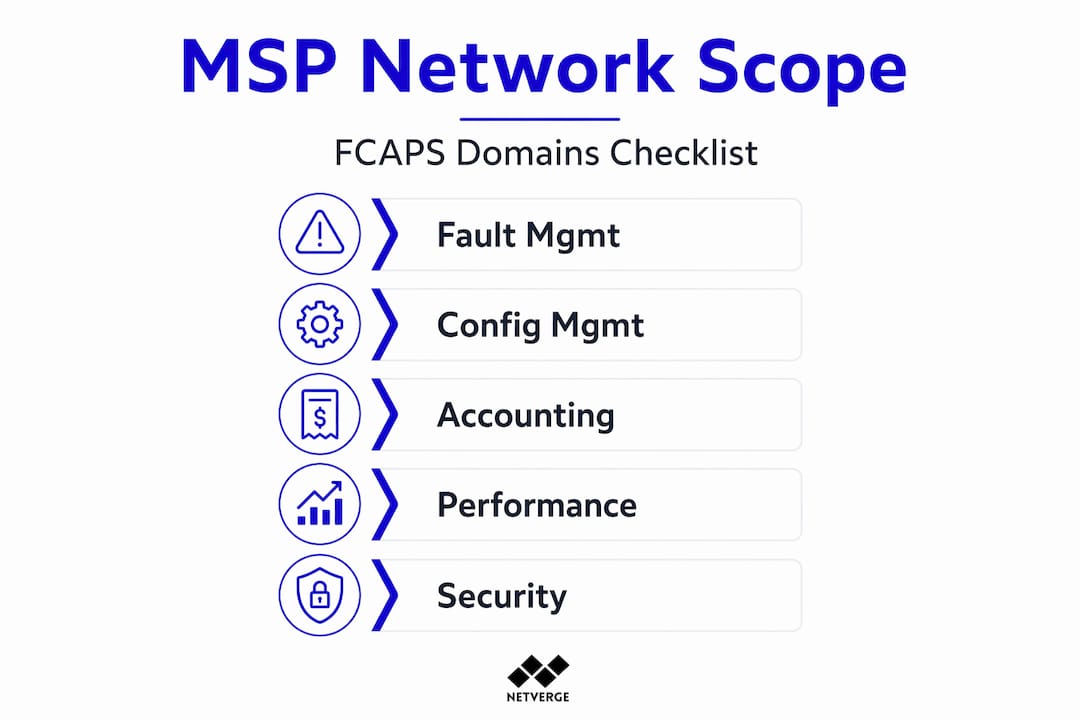
The foundational framework many MSPs use is FCAPS: Fault, Configuration, Accounting, Performance, Security management. Each pillar maps to a specific operational domain, giving both MSP and client a shared vocabulary for what is being managed and how success is measured.
Pro Tip: Before signing any MSP agreement, map every FCAPS domain to a named deliverable in the contract. Vague scope descriptions in managed service agreements are where service gaps hide.
SLAs are not just paperwork. The SLA is the operational backbone of the relationship. It defines response times, escalation paths, uptime commitments, and the metrics your MSP is accountable to. Buyers who prioritize SLA clarity consistently report better outcomes than those who focus primarily on price.
Technology and tools powering MSP network management
Understanding how MSPs work at the tooling level helps you evaluate partners more accurately and spot capability gaps early. The technology stack behind modern MSP network management has evolved considerably.

Core monitoring protocols
| Protocol | Primary use | Key characteristic |
|---|---|---|
| SNMP | Device polling, status monitoring | Widely supported, works across most hardware |
| NETCONF | Configuration management | XML-based, designed for modern network automation |
| Syslog | Event and log collection | Real-time log forwarding from network devices |
| ICMP | Availability checks | Simple ping-based reachability testing |
| NetFlow/IPFIX | Traffic analysis | Granular bandwidth and application visibility |
The choice of protocol matters because it directly affects telemetry quality. An MSP relying solely on SNMP polling for a hybrid cloud environment will have significant blind spots compared to one using a layered approach that combines flow data, API telemetry, and agent-based monitoring.
The single most important tooling feature for MSP network services across multi-site environments is the unified control dashboard. Single-pane dashboards improve diagnostic response times and reduce remediation inconsistencies across distributed networks. When your MSP has to context-switch between five different consoles to diagnose one alert, mean time to resolution climbs fast.
AI and machine learning are increasingly central to how MSPs deliver monitoring services. AI helps automate provisioning, configuration, and troubleshooting, which reduces manual labor and speeds up detection of complex, multi-variable anomalies that traditional threshold-based alerting misses entirely. You can see this in practice with AI automation workflows that are already reshaping how MSP teams handle routine and complex incidents alike.
Pro Tip: Ask any MSP candidate to demonstrate their dashboard live. How quickly can they pull a 30-day performance trend for a specific site? The answer tells you more than any sales deck.
Operational best practices and common pitfalls
Knowing what MSP network management looks like on paper is one thing. Operating it effectively is another. Here are the most common failure points and the practices that prevent them.
Fragmented tooling causes more problems than it solves. Adding more tools without integration increases operational overhead and slows incident response. The MSP industry's maturity gap is not a shortage of monitoring software; it is the failure to connect those tools into cohesive workflows.
Disconnected documentation creates diagnostic delays. When network topology maps, device inventories, and incident histories live in separate systems, technicians waste time gathering context instead of resolving problems. This is one of the most underrated problems MSPs face in day-to-day operations.
SLA ambiguity leads to expectation failures. Vague SLA language around response time versus resolution time is a frequent source of client-MSP conflict. Specifying both, with measured metrics and escalation triggers, protects everyone.
Reactive alerting instead of proactive monitoring. Many MSPs still operate primarily on reactive thresholds. Proactive network monitoring identifies developing issues before users feel any impact.
Vendor lock-in reduces flexibility. Proprietary platforms that cannot integrate with your existing ITSM, SIEM, or ticketing tools create long-term dependency. Vendor-neutral platforms with open APIs preserve your options.
"MSPs need better operational control, not more tools. The organizations that prioritize workflow integration over tool accumulation consistently outperform those that don't." — ChannelE2E
The underlying discipline here is network visibility. When you have full, correlated visibility across devices, traffic, logs, and user activity, many of the above failure points become detectable before they escalate. Visibility is not a feature. It is the operational foundation everything else depends on.
Evaluating and selecting MSP network management solutions
Choosing the right MSP network management partner or platform requires structured criteria. Here is what to evaluate before you commit.
- Service scope. Does the MSP cover your full stack? LAN, WAN, cloud connectivity, SD-WAN, and IoT endpoints all have different monitoring and management requirements. Confirm coverage explicitly.
- Scalability. Can the MSP's tooling and team scale with your growth? This includes both the number of managed devices and geographic distribution.
- SLA structure. Look for tiered SLAs with defined response windows for critical, high, and standard priority incidents. Understand what happens when SLA metrics are missed.
- Tool integration. Does the MSP's platform integrate with your existing systems via API? Integration with ticketing, identity management, and SIEM platforms reduces friction significantly.
- Vendor neutrality. Platforms that support multiple hardware vendors give you procurement flexibility. Proprietary stacks limit your options over time.
Pricing model comparison
| Model | Structure | Best for |
|---|---|---|
| Flat monthly fee | Fixed cost per site or device tier | Predictable budgets, OpEx conversion |
| Tiered pricing | Price scales with service level | Organizations with mixed needs |
| A-la-carte | Pay per service module | Organizations with targeted gaps |
| Bundled | Services packaged together | Full-service engagements |
Pricing models for managed network services range from flat monthly fees to tiered and a-la-carte structures, often with contract terms of one year or more. The transition from capital expenditure to operational expenditure is one of the concrete financial benefits many organizations cite when moving to managed services, particularly for SMBs that gain access to expertise they could not cost-effectively hire internally.
Emerging trends worth tracking include Network as a Service (NaaS), where the network itself is delivered as a subscription, and expanded SD-WAN management offerings that give MSPs deeper control over traffic routing and application performance across distributed environments.
My take: what most MSP buyers get wrong
I've reviewed a lot of MSP engagements over the years, and the pattern I keep seeing is this: buyers spend most of their due diligence evaluating the MSP's tools and almost none of it evaluating the MSP's operational control structure.
The honest reality is that the MSP toolset matters far less than how those tools are connected. I've seen organizations move to MSPs with impressive software stacks only to find that the monitoring platform, the ticketing system, and the documentation repository don't talk to each other. Technicians are copy-pasting IP addresses between screens to diagnose alerts. That is not an MSP problem. That is a workflow integration failure.
The question I'd push you to ask any prospective MSP is this: when an alert fires at 2 AM, walk me through exactly what your technician sees and does in the first ten minutes. The answer will reveal whether they have real operational control or just a collection of tools.
The other thing I've learned is that SLA terms are where the strategic value actually lives. Not in the marketing language around "proactive monitoring" or "24/7 support." The SLA is the contract that determines whether your network problems become your MSP's problems. If those terms are vague, so is the accountability.
For internal IT teams thinking about what to do with time freed up by MSP delegation, the answer is almost always the same: focus on architecture, security posture, and strategic projects that directly support business outcomes. That is where your expertise creates the most value.
— Jim
How Netverge powers MSP network management
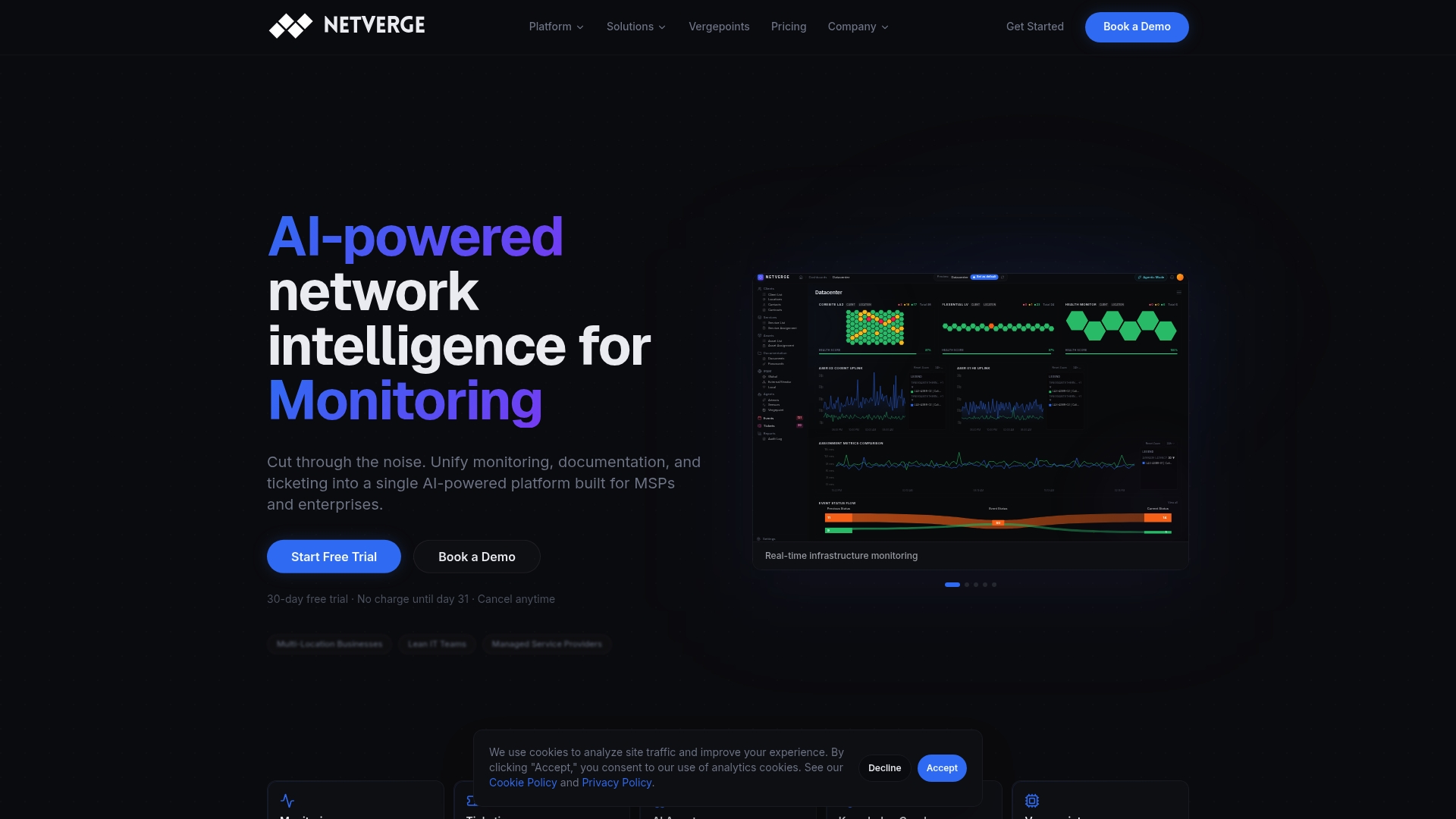
Managing distributed networks without a unified, intelligent platform means your team is always working from incomplete information. Netverge is built specifically to solve that problem for MSPs and multi-location enterprises. The platform combines AI-powered monitoring with real-time anomaly detection, automated troubleshooting, and intelligent ticket triage in a single interface. No more context-switching between disconnected tools.
Netverge's enterprise network monitoring platform includes hardware Vergepoints for physical site visibility, unified dashboards that correlate performance and security data across all your managed sites, and autonomous AI agents that diagnose and resolve issues without waiting for a technician to pick up the ticket. The result is faster mean time to resolution, consistent remediation across sites, and full visibility into what your network is actually doing right now. Request a demo to see it in action.
FAQ
What is MSP network management?
MSP network management means outsourcing the monitoring, maintenance, and support of your network infrastructure to a third-party provider under a service level agreement. The MSP remotely handles tasks including configuration, troubleshooting, patching, and security management.
How does MSP work for network operations?
An MSP uses remote monitoring tools, automation software, and defined workflows to manage your network on your behalf. You retain ownership of the infrastructure while the MSP handles day-to-day operations according to the terms in your SLA.
What is the importance of MSP management for IT teams?
MSP management gives internal IT teams access to specialized expertise and 24/7 monitoring coverage without expanding headcount. It also shifts network operations costs from capital expenditure to predictable operational expenditure, which benefits budgeting and resource planning.
What should I look for in MSP network management solutions?
The most critical factors are service scope coverage, SLA clarity, tool integration via open APIs, and unified dashboard visibility across all managed environments. Avoid platforms that cannot connect monitoring, ticketing, and documentation into a single operational workflow.
What protocols do MSPs use for network management?
MSPs typically use a combination of SNMP, NETCONF, Syslog, ICMP, and NetFlow to collect telemetry across managed devices. Modern MSPs layer AI-driven analysis on top of this data to detect anomalies and automate responses faster than threshold-based alerting alone.