
NOC automation shifts repetitive detection, correlation, and remediation work from human engineers to software and AI agents, cutting alert noise and speeding incident resolution. The result: faster MTTR, fewer 3 AM escalations, and engineers freed for architecture and capacity work instead of ticket triage. This guide covers what to automate first, what governance agentic systems need, and what results are realistic to expect.
TL;DR:
- Nearly all organizations plan to adopt AI-enabled NetOps, but only about a quarter have deployed mature automation systems due to gaps in execution and trust.
- Starting automation with low-risk, repeatable tasks such as routine ticket resolution and scripted health checks minimizes dangers and lays the foundation for expansion.
- A phased rollout, including detection, recommendation, semi-automation, and fully autonomous actions, ensures risk containment and effective performance measurement.
- Reliable data, documentation, and telemetry are essential to prevent automation mistakes; standardizing inventory and validating runbooks are the highest-priority preparation steps.
- Effective governance involves risk tagging, explainability, audit trails, and strict policy controls to prevent automation from causing unforeseen issues or outages.
Table of Contents
- What Is NOC Automation, and How Does Agentic Automation Differ From AIOps?
- Core NOC Automation Capabilities Mapped to Daily Operations
- What Should Your NOC Automate First?
- Getting Your NOC Ready: Data, Runbooks, and Phased Rollout
- Governance and Human-in-the-Loop Controls
- Measuring NOC Automation Success: KPIs and Realistic Targets
- How a Consolidated Platform Puts This Into Practice
- What NOC Leaders Should Actually Expect From Automation
- See How Netverge Fits Your NOC Automation Roadmap
- Sources
- FAQ
What Is NOC Automation, and How Does Agentic Automation Differ From AIOps?
NOC automation is the practice of using rules, scripts, and increasingly AI agents to handle tasks that once required a human to watch a screen, correlate alerts, and manually type commands into a terminal. AIOps, the earlier generation of this idea, mostly means machine learning applied to alert correlation and anomaly detection. It tells you what's wrong faster.
Agentic automation goes further. It closes the loop, taking a validated action and confirming the fix worked, not just flagging the problem for a human to act on. That distinction maps to the maturity levels network operators debate at forums like TM Forum, where Level 2 automation handles detection and correlation, while Level 4 autonomous operations execute and validate remediation with minimal human review.
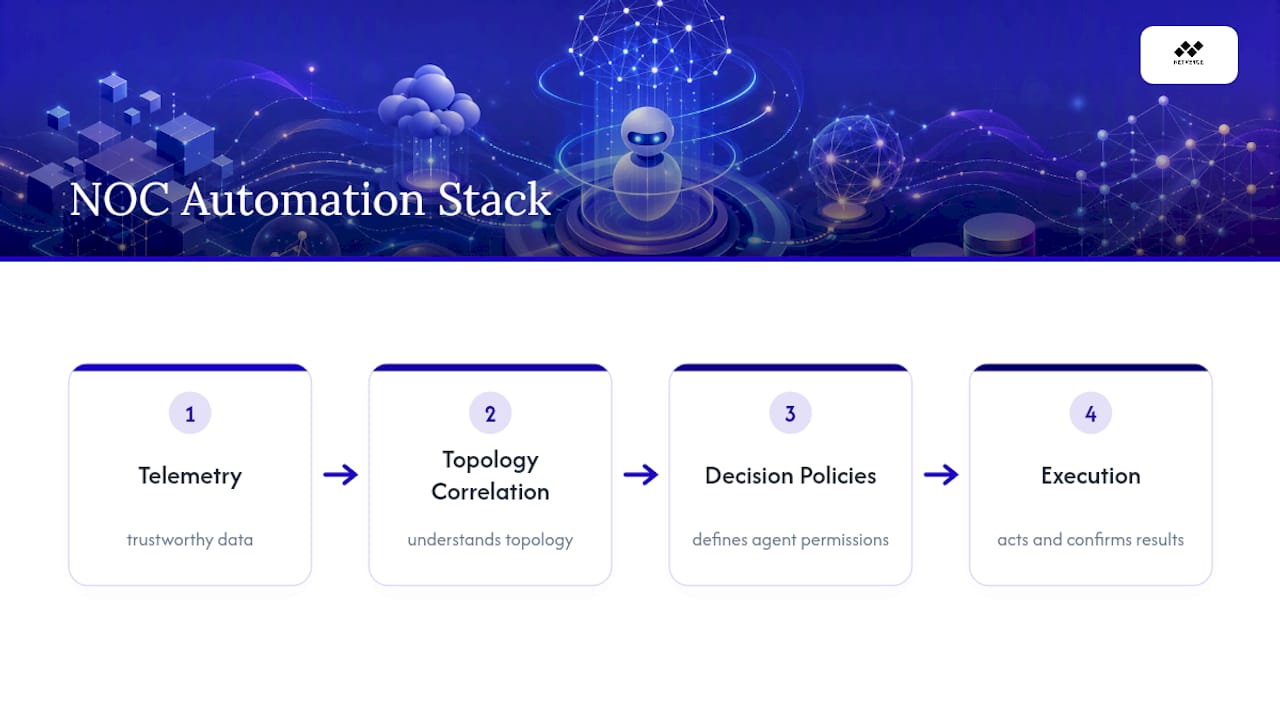
A working automation stack needs four layers: trustworthy telemetry, a correlation engine that understands topology, decision policies that define what an agent may do without asking, and an execution layer that can act and confirm results. Most NOCs have layer one and some of layer two. Very few have built layer four.
That gap is measurable. 92% of organizations plan to adopt AI-enabled NetOps, but only 23% have actually deployed it, and just 27% report mature automation. Intent is nearly universal. Execution is not.
Core NOC Automation Capabilities Mapped to Daily Operations
Every automation platform advertises "AI-driven operations." What actually matters is which specific NOC job each capability replaces or accelerates. Here's how the pieces fit together in a functioning stack.
Event monitoring and telemetry ingestion is the foundation everything else depends on. This means pulling logs, SNMP traps, flow data, synthetic transaction results, and physical sensor readings into one system rather than five disconnected dashboards. If your telemetry has gaps, every downstream automation inherits those blind spots.
Alert correlation and topology mapping turns a flood of individual alerts into a handful of actual incidents. A topology-aware correlation engine models service and device dependencies so it can infer that forty downstream alerts trace back to one upstream router failure, rather than treating each as a separate ticket. Documented case studies show correlation layers like this cutting alert volume by 70 to 95 percent when they replace a fragmented alerting setup. That's the difference between a NOC dashboard screaming at three engineers and a single, enriched incident with a probable root cause already attached.
Automated triage and ticket enrichment is where AI earns its keep on the L1 side. Instead of an engineer manually pulling device history, checking recent changes, and searching a knowledge base, an AI agent attaches that context to the ticket automatically. This workflow is covered in more detail in how AI triage is changing outage response, which walks through how enrichment shortens the decision window before an engineer even opens the ticket.
Automated L1/L2 remediation is the closed-loop piece: restarting a hung service, clearing a stuck queue, rolling back a bad configuration push, or resetting an interface that's flapping. These are the tasks with a known fix and low blast radius, which is exactly why they're the safest place to start.
The critical distinction to hold onto: correlation-only tools tell you what's broken and stop there. A human still has to act. Closed-loop, agentic systems execute the fix and verify it worked, which is the only version of "automation" that actually reduces headcount hours rather than just reorganizing the alert queue. Real-world examples of this in practice are covered in AI-powered network management examples for IT pros.
What Should Your NOC Automate First?
Not every automation candidate deserves the same priority. The safest starting point is anything repeatable, low blast radius, well observed, and easy to test in isolation. Here's a practical order of operations.
- Repetitive L1 ticket resolution. Password resets, known false-positive alert dismissals, and routine access requests. Almost zero risk, immediate time savings.
- Scripted health checks. Interface status, disk space, certificate expiration, and backup verification. These are already scripted in most shops; automation just runs them on schedule and opens tickets automatically when thresholds are breached.
- Routine remediation with a known fix. Service restarts, cache clears, DHCP lease resets. Pick actions your team already documents in a runbook, because that documentation becomes the automation's instructions.
- Config drift correction. Reverting unauthorized or accidental changes back to a known-good baseline, provided you have reliable change tracking.
- Alert deduplication and correlation. Even before you automate any action, correlation alone removes a huge share of manual triage work, since a large share of NOC alert volume is duplicate or downstream noise.
Selection criteria matter more than the list itself. Ask whether the task is repeatable across many instances, whether a mistake has a small and reversible blast radius, whether you have the telemetry to confirm the action worked, and whether you can test it safely before it touches production traffic. If you can't answer yes to all four, it's not ready for automation yet, no matter how tempting the time savings look.
Pro Tip: Run your first automation as a two-week, single-use-case pilot with a hard rollback plan, not a platform-wide rollout. Pick one remediation task, measure ticket volume and resolution time before and after, and use that data to justify the next phase. Fast, narrow proof beats a slow, sweeping deployment every time.
Getting Your NOC Ready: Data, Runbooks, and Phased Rollout
Automation amplifies whatever it's built on. Feed it bad inventory data or undocumented processes, and it will make mistakes faster and at greater scale than a human ever could. Practitioners who've built these systems are blunt about this: standardizing inventory, documentation, and telemetry is the highest-leverage activity before buying any automation tool, because automating bad data only multiplies the errors already baked into your operation.
That means starting with a single source of truth, whatever combination of CMDB, IPAM, and asset inventory your NOC actually trusts. If two systems disagree about which device is which, no automation layer on top of that mess will behave predictably.
Telemetry audits come next. Walk your network segment by segment and ask where visibility actually stops. Remote sites, branch offices, and legacy hardware without modern instrumentation are the usual blind spots. Closing those gaps sometimes means software agents, and sometimes it means physical sensors placed on-site, similar to hardware-level visibility at the edge, feeding data back into the same platform rather than a separate silo.
Then codify the runbooks your team already follows informally into testable playbooks: explicit steps, explicit success criteria, explicit rollback conditions. A runbook that lives only in one senior engineer's head can't be automated. Once documented, test each playbook in a staging environment or a digital twin before it ever touches live traffic.
A phased rollout keeps risk contained at each stage:
- Detect. The system flags issues; a human decides everything.
- Recommend. The system suggests the fix; a human clicks approve.
- Semi-automated. Low-risk actions execute automatically; higher-risk ones still need sign-off.
- Guarded closed-loop. The system acts and validates on its own, within tightly scoped boundaries, with full audit logging.
Each gate needs pass/fail criteria before you move to the next: visibility completeness, a codified playbook, staging validation, and a monitored production rollout with a defined rollback policy. The gap between planning and mature deployment is real. Only 23% of organizations have actually deployed AI-enabled NetOps, versus 92% that plan to, and the difference usually traces back to skipping one of these gates. A workflow map of how these stages fit into daily operations is covered in what network operational workflow looks like for IT teams.
Governance and Human-in-the-Loop Controls
Agentic automation without governance is just a faster way to break things at scale. The systems that actually earn operator trust build policy enforcement into the workflow itself, not as an afterthought bolted on after an incident.
Start with action classification. Every automated task should carry a risk tag: auto-execute for low-risk, reversible actions, and require-approval for anything touching customer-facing services or irreversible state changes. That classification should live in policy, reviewable and auditable, not buried in a script's logic.
Validation strategy matters just as much as the action itself:
- Canary changes on a small subset before wider rollout.
- Digital twin or staging checks that mirror production topology.
- Automated rollback triggers if post-action telemetry doesn't confirm success within a defined window.
- Full audit trails logging what the agent decided, why, and what happened next.
Explainability isn't optional for high-risk actions. If an agent reconfigures a core switch and someone asks why, "the model decided" is not an answer that survives a post-incident review or a compliance audit. Organizationally, this requires someone who actually owns each runbook, a change control process the automation respects rather than bypasses, and executive sponsorship that backs the pace of rollout rather than pushing for a faster timeline than the data supports.
Pro Tip: Treat every agentic action the same way you'd treat a junior engineer's first solo change: require a second signal (a health check, a synthetic transaction, a rollback window) before you trust the outcome, not just the agent's own confirmation that it worked.

Measuring NOC Automation Success: KPIs and Realistic Targets
The KPIs that matter most for NOC automation are percentage of activities automated, mean time to resolution, ticket volume, change velocity, and first-call resolution rate. Track these before you automate anything, so you have a baseline worth comparing against.
Industry targets from documented TM Forum Catalyst projects give a realistic band to plan around rather than a vendor's best-case demo number.
For a rough ROI estimate, model a 12-month horizon with conservative adoption, ramping toward that 30 percent automation target by month six rather than assuming day-one saturation. Include license and implementation costs on one side of the ledger, and on the other, the value of engineer hours reallocated to higher-value work, not just a headcount reduction number that rarely survives budget scrutiny intact. Report progress against the same baseline KPIs quarterly, and adjust scope based on which automated tasks actually held up in production versus which ones needed more guardrails than expected. The business case for this kind of tracking is laid out further in why AI matters for network monitoring.
How a Consolidated Platform Puts This Into Practice
Everything covered so far, trusted telemetry, correlation, triage, guarded remediation, depends on those pieces talking to each other instead of living in five disconnected tools. That's the problem a consolidated platform aims to solve for MSPs and multi-location enterprises running distributed infrastructure.
The platform consolidates telemetry, a knowledge graph of your network topology, ticketing, and autonomous AI agents into one interface rather than forcing your NOC to stitch monitoring, documentation, and a service desk together manually. A few specifics worth knowing:
- Knowledge graphs map device and service dependencies automatically, which is the same topology awareness that drives the correlation benefits described earlier in this guide.
- AI-powered ticketing and triage enrich incoming tickets with device history and context before an engineer opens them.
- Edge hardware with multiple intelligent sensors closes physical visibility gaps that software-only monitoring misses, especially at remote sites and branch locations.
- Autonomous agents are designed to diagnose and, within defined guardrails, resolve issues without waiting for a human to start the process.
A two-week phased proof of automated troubleshooting shows how closing telemetry gaps and codifying runbooks up front lets a pilot demonstrate value on a short timeline rather than a multi-quarter rollout, detailed in the two-week proof for brownfield NetOps. For specific case metrics and independent performance data tied to your own environment, ask about a proof of concept scoped to your telemetry and runbook maturity, since results depend heavily on how much of the readiness work described earlier in this article is already in place.
What NOC Leaders Should Actually Expect From Automation
Agentic automation is achievable, but only for teams willing to do the unglamorous work first. Trusted data and governance aren't a prerequisite you check off once. They're the ongoing discipline that determines whether an autonomous agent makes your NOC faster or just breaks things faster and with less visibility.
The most overlooked shift isn't technical, it's staffing. Roles are moving toward automation engineering and governance oversight rather than pure alert response, and industry trend reporting for 2026 points to the same pattern: rising demand for network professionals who understand cloud, AI, and security together, not siloed. The engineers who thrive in this environment aren't the ones who resist automation. They're the ones who learn to write the playbooks, define the policy gates, and audit the agent's decisions. A more detailed look at that shift is in top trends reshaping network operations with AI.
My strongest caution: don't automate a process just because it's frequent. Automate it because it's documented, observable, and testable. A high-volume task with no clear runbook is a bigger risk automated than left manual, because you're scaling the ambiguity along with the action. Start narrow, prove it in a pilot, and expand scope only when the data backs the next step. Tools that help map process clarity before automation, like Patterns Process Finder AI, can help surface exactly where a workflow is too undocumented to trust to an agent yet.
— Jim
See How Netverge Fits Your NOC Automation Roadmap
Netverge gives you one platform instead of five, unifying telemetry, knowledge graphs, ticketing, and AI agents so the readiness work covered in this guide, standardized inventory, codified runbooks, phased rollout, actually has somewhere to live.
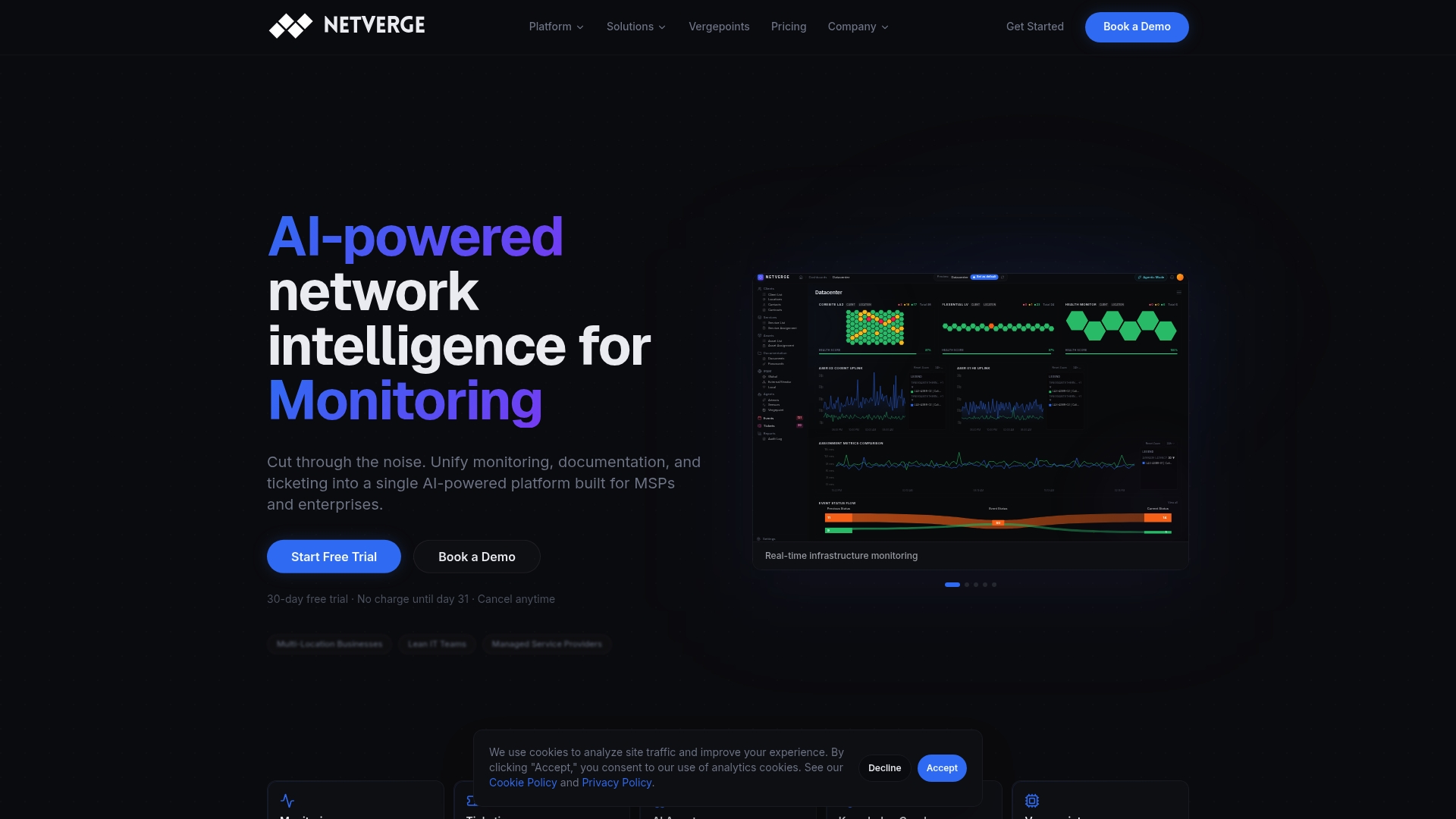
The platform maps directly to what you'd build in-house if you had the engineering time: topology-aware correlation to cut alert noise, AI-driven triage to enrich tickets before an engineer opens them, and Vergepoints hardware to close visibility gaps at remote sites without deploying a separate monitoring stack. Rather than betting a multi-quarter build on getting all of that right internally, a scoped two-week proof lets you test one automation use case against your own telemetry and runbooks before committing further. Start by exploring Netverge's monitoring platform or request a two-week proof of concept scoped to your current NOC workflow.
Sources
- Agentic operations bring AN L4 closer to reality
- Agentic NOC: From Alarm Floods to Autonomous Action
FAQ
What Does NOC Stand For?
NOC stands for network operations center, the team and function responsible for monitoring, detecting, and resolving network issues across an organization's infrastructure.
What Is the Difference Between a NOC and a SOC?
A NOC focuses on network performance, availability, and infrastructure incidents, while a SOC (security operations center) focuses on detecting and responding to security threats and breaches; some organizations combine the two functions.
Is Working in a NOC Stressful?
NOC work can involve high-pressure incident response and shift-based schedules, but automation of repetitive L1 tasks and alert correlation is reducing routine alert fatigue and shifting the role toward more analytical, less reactive work.
Is a NOC Engineer an IT Job?
Yes, NOC engineering is an IT infrastructure role focused on network monitoring, troubleshooting, and incident resolution, and it increasingly requires skills in automation, AI tooling, and cloud networking as NOCs adopt agentic systems.
How Does NOC Automation Improve MTTR?
NOC automation improves mean time to resolution by correlating related alerts into a single incident with context already attached, then executing validated remediation steps without waiting for manual triage, with realistic targets in the roughly between one-fifth and two-fifths MTTR reduction range.