
AI-powered network management, formally known as AIOps (Artificial Intelligence for IT Operations), is defined as the application of machine learning, telemetry analysis, and autonomous agents to monitor, diagnose, and remediate network issues without manual intervention. Platforms like Hughes Network Systems, netAI, and the Incident-Triage agentic framework represent the clearest ai-powered network management examples available to IT teams today. Each demonstrates how AI moves network operations from reactive firefighting to proactive, data-driven control. The 2026 AI networking trends confirm this shift is accelerating across enterprise and MSP environments alike.
1. AI-powered network management examples: top platforms and what they do
The most capable AI network management tools share three core functions: continuous telemetry ingestion, automated root-cause analysis, and remediation execution. Understanding what each platform does concretely helps you evaluate fit before committing to a deployment.
netAI is an open-source AIOps platform that monitors infrastructure continuously, detects threats, predicts device failures, and responds to natural-language queries like "show device health" or "list active threats" through a ChatOps interface. It supports eight vendors with multi-protocol integration and pre-built automation workflows. That breadth of vendor support makes it a practical choice for heterogeneous environments where a single-vendor tool would leave gaps.
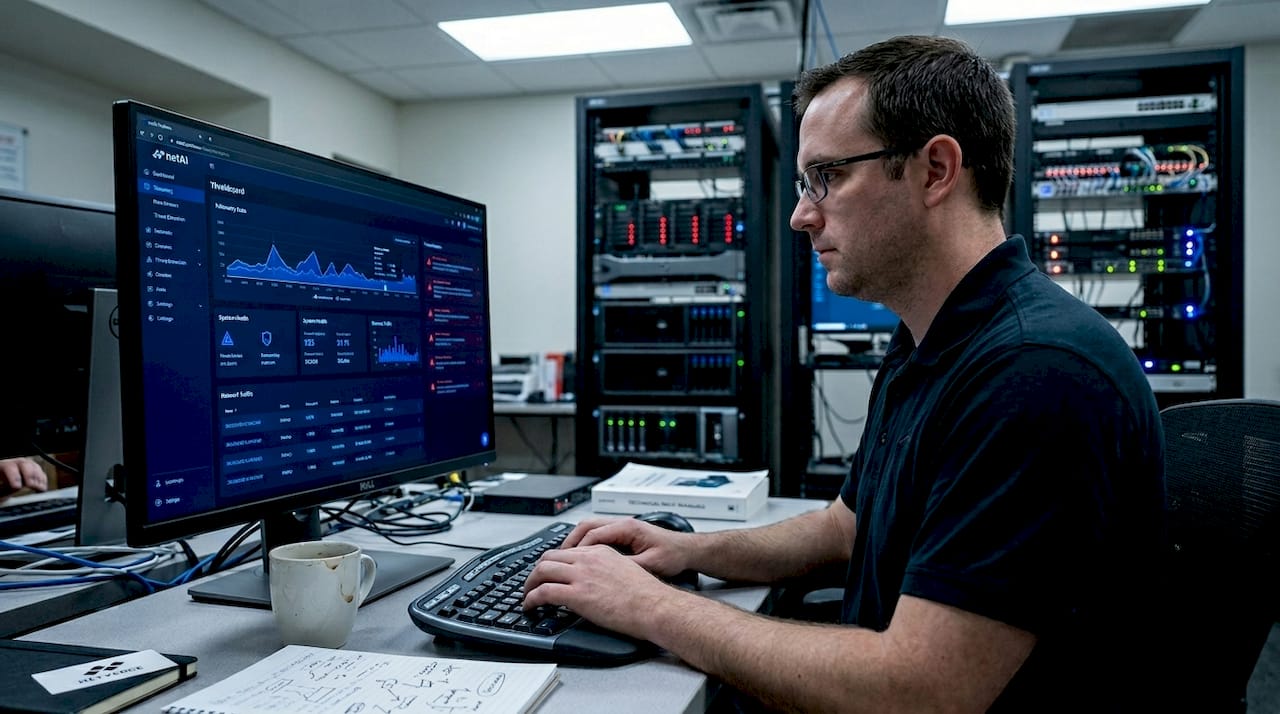
Hughes Network Systems takes a managed-service approach. Its AI-assisted portal performs real-time analysis of network telemetry and delivers actionable root-cause guidance directly to operators. Support interactions drop by 50% within one month of deployment, because the system recommends or executes next steps autonomously through AIOps rather than routing every alert to a human technician.
Cisco and Juniper represent the enterprise tier. ISG research confirms both vendors deploy intent-based networking automation that applies AI and ML to automate configuration changes while keeping human oversight central to the workflow. That combination of automation and operator control is the defining characteristic of mature AI network management deployments.
- Continuous telemetry collection across physical and virtual infrastructure
- Threat detection correlated with device health and traffic anomalies
- Natural language query interfaces for non-specialist operators
- Pre-built automation templates for configuration backup, audits, and threat scans
- Multi-vendor protocol support covering SNMP, NetFlow, syslog, and REST APIs
Pro Tip: When evaluating AI network management tools, ask vendors specifically how their platform handles multi-vendor environments. A tool that covers only its own hardware stack will create blind spots in any distributed network.
2. How AI automates incident triage and root cause analysis
Manual alert triage is the single largest time sink in network operations. A mid-size enterprise network can generate thousands of raw events during a single degradation event, and correlating those events into one actionable incident requires skills and time most NOC teams cannot spare.
Agentic AI systems address this directly. The Incident-Triage framework uses modular agents to analyze large-scale network telemetry, condense thousands of raw events into anomaly summaries that fit within LLM context windows, and output structured, validated incident reports in PDF format. Deterministic QA checks and retry policies prevent the system from producing unverified conclusions. That architecture matters because it separates AI-generated insight from AI-generated noise.
The netlog-ai project takes a complementary approach. It sanitizes logs before LLM processing, redacting sensitive data and stripping irrelevant fields so the model sees only clean, relevant input. The output is not a narrative summary but a prioritized list of vendor-specific CLI commands with rollback and verification steps attached. This sanitize-before-LLM design directly addresses the hallucination risk that makes many IT leaders hesitant to trust AI recommendations in production environments.
"Agentic AI runs trace route, collects telemetry, consults knowledge bases, and generates remediation plans autonomously but under human control." — Computer Weekly, reporting on enterprise AIOps deployments
The practical result of these architectures is measurable. When AI condenses hundreds of alerts into a single incident summary with a probable root cause and ranked next steps, the time from alert to resolution drops from hours to minutes. For MSPs managing dozens of client networks simultaneously, that compression of triage time is the difference between meeting SLAs and breaching them.
3. Predictive failure detection and anomaly monitoring with AI
Reactive monitoring tells you a device has failed. Predictive monitoring tells you it is about to fail, with enough lead time to act. That distinction defines the operational value of AI in network monitoring.
Machine learning models trained on historical telemetry identify trend deviations that precede hardware failures: rising CPU temperatures, increasing error rates on specific interfaces, gradual memory exhaustion. netAI applies these models continuously across all monitored devices, flagging degradation patterns before they produce outages. The platform's graph-based anomaly detection traces causal chains across the network topology, so you see not just which device is degrading but which downstream services are at risk.
| Detection method | What it identifies | Example output |
|---|---|---|
| ML trend analysis | Gradual hardware degradation | "Interface Gi0/1 error rate up 340% over 72 hours" |
| Graph anomaly detection | Causal chain across topology | "Core switch degradation affecting 14 downstream VLANs" |
| Threshold correlation | Multi-metric simultaneous spikes | "CPU + memory + BGP flap correlated on router R3" |
| Behavioral baselining | Deviation from normal traffic patterns | "Unusual east-west traffic volume on VLAN 20 since 02:14" |
Research from TechScience confirms that a graph-augmented multi-agent approach achieves an 88.4% average F1-score in root cause analysis while using adversarial validation between agents to reduce hallucination. That accuracy level is high enough for production use, provided human operators retain approval authority over remediation actions.
Pro Tip: Build an evidence timeline view into your monitoring workflow. Graph-based RCA tools that show causal chains with timestamps give operators the context to approve or override AI recommendations confidently, rather than treating them as black-box outputs.
4. User interfaces and automation workflows in AI network management tools
The quality of an AI network management tool is not determined solely by its detection accuracy. Operators who cannot interpret or act on AI outputs quickly lose confidence in the system, and adoption stalls. Interface design and workflow integration are therefore as important as the underlying models.
Natural language interfaces represent the most significant usability advancement in recent AI network management tools. netAI's ChatOps integration lets engineers query the platform in plain English, eliminating the need to construct complex CLI commands or navigate multi-level dashboards during an incident. A query like "show all devices with high CPU in the last hour" returns a filtered, ranked list in seconds. That speed matters when you are troubleshooting a live outage.
Automation workflow templates address the repeatability problem. Pre-built templates for configuration backup, compliance audits, and threat scans run on schedule or trigger on specific telemetry conditions without manual initiation. Each template includes rollback steps, so if an automated configuration change produces unexpected behavior, the system can revert without operator intervention.
Role-based response formatting is a less-discussed but operationally valuable feature. The same incident can generate a detailed technical report for the network engineer, a plain-language summary for the service desk, and an executive-level impact statement for management. Generating three versions of the same report manually wastes time. AI systems that produce all three from a single telemetry event reduce that overhead to zero.
- Engineers receive CLI-level detail, interface statistics, and suggested commands
- Service desk staff see ticket-ready summaries with affected users and estimated resolution time
- Management receives business-impact framing with SLA status and escalation flags
Controlled automation with human approval gates is the standard recommended by ISG and implemented by Cisco and Juniper. Low-risk actions like configuration backups execute automatically. Higher-risk changes require operator sign-off before execution. That tiered model preserves the speed benefits of automation while protecting against unintended consequences.
5. Comparing AI-driven network solutions: strengths and ideal use cases
Not every AI network management platform fits every environment. The table below maps the key examples covered in this article against the criteria that matter most to IT decision-makers.
| Platform | Multi-vendor support | Automation level | Best fit |
|---|---|---|---|
| netAI | 8 vendors, multi-protocol | High, with NLP interface | MSPs, heterogeneous networks |
| Hughes AIOps portal | Hughes hardware focus | Managed, human-assisted | Enterprises using Hughes infrastructure |
| Incident-Triage framework | Vendor-agnostic telemetry | Agentic, human-in-loop | Large NOC teams, high-volume alert environments |
| netlog-ai | Vendor-specific CLI output | Semi-automated, operator-verified | Security-conscious teams, regulated industries |
| Cisco/Juniper intent-based | Single-vendor ecosystems | High, policy-driven | Large enterprises with standardized infrastructure |
The key features for IT pros to prioritize when selecting from these options are telemetry breadth, hallucination controls, and the granularity of human oversight controls. A platform that automates everything without operator gates is a liability in regulated environments. A platform that requires manual approval for every action defeats the purpose of automation.
Forward Predict adds a dimension worth noting: digital twin pre-verification lets operators model the impact of a proposed network change in a simulated environment before executing it on live infrastructure. That capability is particularly valuable for closed-loop autonomous operations where the cost of a misconfiguration is high.
Key takeaways
AI-powered network management delivers measurable operational gains only when telemetry accuracy, hallucination controls, and human oversight are built into the platform architecture from the start.
| Point | Details |
|---|---|
| Triage automation reduces resolution time | AI condenses thousands of alerts into single incident summaries, cutting hours of manual correlation to minutes. |
| Sanitize-before-LLM prevents hallucinations | Redacting logs before AI processing produces reliable, vendor-specific CLI remediation instead of unverified narratives. |
| Predictive detection outperforms reactive monitoring | ML trend analysis and graph-based anomaly detection identify failures before outages occur, protecting SLAs. |
| Human oversight gates remain non-negotiable | Tiered approval workflows separate low-risk automated actions from high-risk changes requiring operator sign-off. |
| Platform fit depends on vendor diversity | Multi-vendor environments require tools like netAI; single-vendor enterprises gain more from Cisco or Juniper intent-based automation. |
Why AI network management adoption requires more discipline than most vendors admit
I have spent enough time evaluating AIOps platforms to know that the gap between vendor demos and production reality is wider in network management than in almost any other IT domain. The demos show clean telemetry, fast resolution, and confident AI recommendations. Production environments show noisy telemetry, legacy devices that do not speak modern APIs, and AI recommendations that occasionally contradict each other.
The platforms that actually deliver value share one characteristic: they treat human oversight as a feature, not a limitation. The AI triage workflows that work in practice are the ones where the AI surfaces evidence and the operator makes the call on high-risk changes. Full autonomy sounds appealing until an automated config change takes down a production VLAN at 2 a.m.
My recommendation for any IT leader evaluating these tools: start with a pilot on a non-critical network segment, instrument your baseline metrics before deployment, and measure triage time and false positive rate after 30 days. Those two numbers will tell you more than any vendor benchmark. The organizations that get the most from AI network management are not the ones that automate the most. They are the ones that automate the right things, with the right controls, and build operator trust in the system incrementally.
— Jim
See AI-powered network management in action with Netverge
Netverge unifies real-time infrastructure monitoring, anomaly detection, automated troubleshooting, and intelligent ticket triage into a single platform built for MSPs and multi-location enterprises. Unlike fragmented tool stacks, Netverge's AI-powered monitoring platform connects telemetry, documentation, and ticketing so your team acts on correlated intelligence rather than isolated alerts.
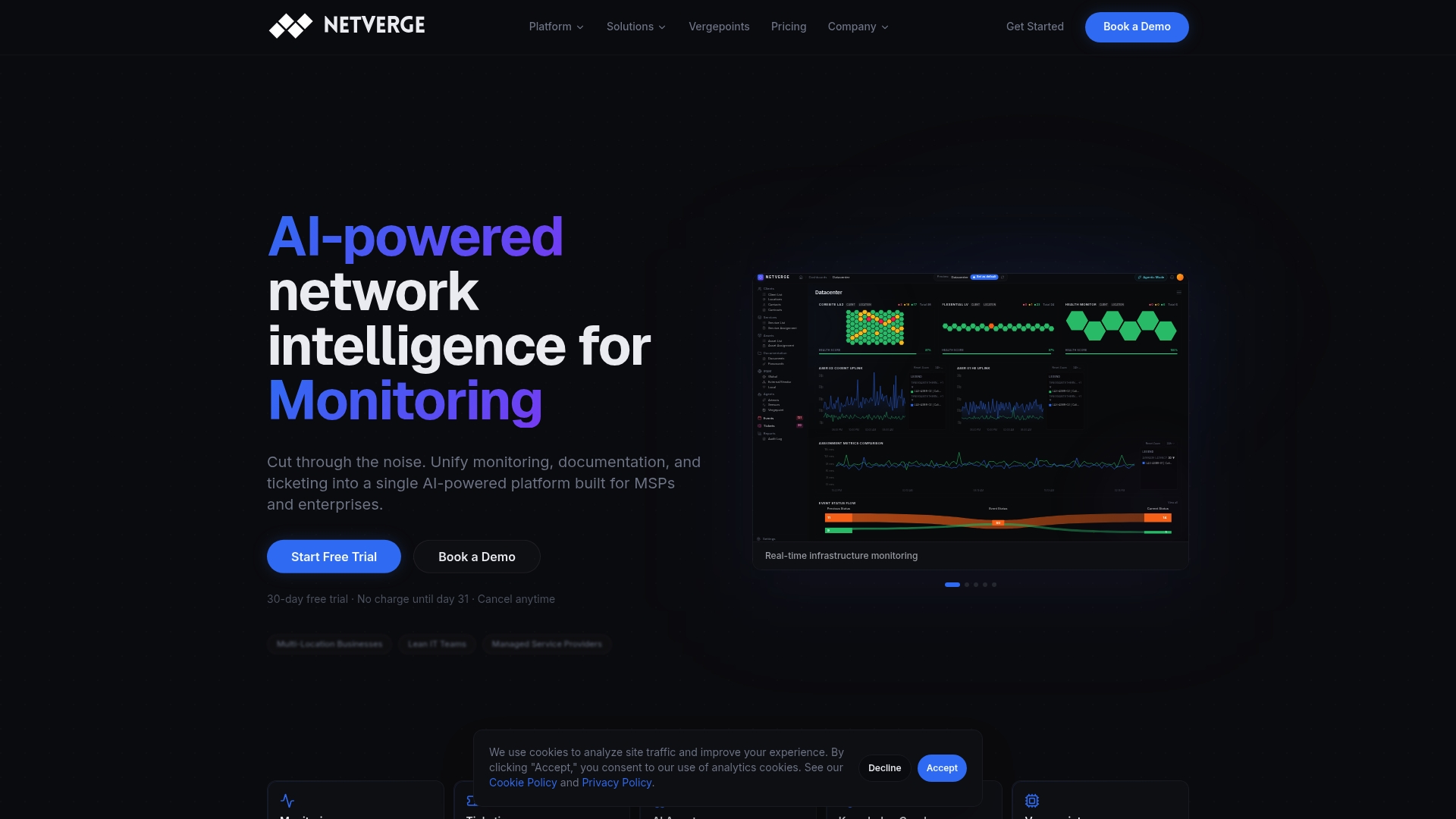
Netverge's autonomous AI agents diagnose issues, generate remediation plans, and route tickets with full context attached, reducing the manual overhead that slows most NOC teams. The platform's AI ticketing and service desk module closes the loop between detection and resolution without requiring operators to switch between tools. If you manage distributed networks and need AI that works within your existing workflows, Netverge is built for exactly that environment.
FAQ
What are the best examples of AI-powered network management?
Hughes AIOps, netAI, Cisco intent-based networking, and the Incident-Triage agentic framework are the most documented examples, each demonstrating AI-driven telemetry analysis, automated triage, and predictive failure detection in production environments.
How does AI improve network incident triage?
AI condenses hundreds or thousands of raw alerts into a single incident summary with a probable root cause and ranked remediation steps, reducing triage time from hours to minutes while keeping human operators in control of high-risk actions.
What is the hallucination risk in AI network management tools?
Hallucination occurs when an AI model generates plausible but incorrect remediation advice. Sanitize-before-LLM processing and deterministic post-generation validation, as used in netlog-ai and Incident-Triage, are the primary technical controls that prevent this in production deployments.
Which AI network management tools support multi-vendor environments?
netAI supports eight vendors with multi-protocol integration, making it the strongest option for heterogeneous networks. Vendor-specific platforms like Cisco and Juniper intent-based networking deliver deeper automation but require a standardized infrastructure to function effectively.
Is human oversight still necessary with AI network automation?
Human oversight remains critical. Deterministic pre-verification and tiered approval workflows are the industry standard, with low-risk actions automated and high-risk configuration changes requiring operator approval before execution.