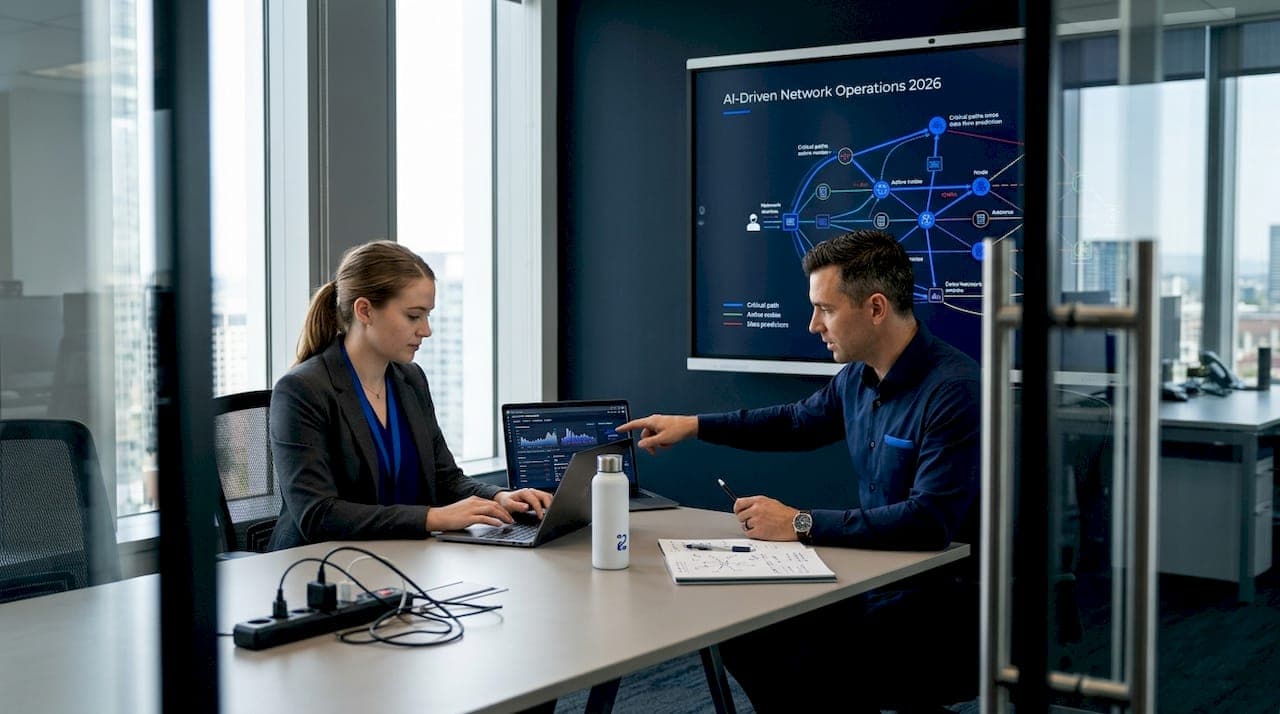
Managing a distributed enterprise network in 2026 means operating under constant pressure. More locations, more devices, more data, and rising expectations for near-zero downtime. IT managers are no longer just asked to keep the lights on. They are expected to prove ROI on every tool, reduce operational costs, and deliver measurable service improvements. The challenge is not a shortage of AI and automation options. It is knowing which trends actually move the needle for your organization and which ones add complexity without adding value. This article gives you a clear, structured view of the trends that matter most and the frameworks to act on them.
Table of Contents
- How to evaluate emerging network operations trends
- Closed-loop automation: The keystone trend for 2026
- AI-driven telemetry and accelerated incident response
- Outcome-focused workflow platforms: Moving beyond assistive AI
- Why simplifying network operations beats chasing 'AI hype'
- Explore next-generation network automation with Netverge
- Frequently asked questions
Key Takeaways
| Point | Details |
|---|---|
| Automation Drives ROI | Closed-loop automation directly cuts costs and improves network resilience for enterprises. |
| AI Slashes Downtime | AI-powered telemetry and incident analysis reduce mean time to repair by over a third in real-world deployments. |
| Governance Is Essential | Outcome-focused platforms with strong control-plane governance are replacing basic assistive AI tools. |
| Benchmark for Success | Rely on data and benchmarking to set realistic expectations and measure transformation benefits. |
How to evaluate emerging network operations trends
With the importance of addressing complexity established, it is crucial to clarify the criteria IT leaders should use to judge which trends deserve attention and resources. Not every innovation that surfaces in vendor briefings or industry reports is worth your team's time. The key is building a consistent evaluation framework before you commit budget or staff.
When assessing any emerging trend, apply these criteria:
- ROI potential: Can you quantify the expected reduction in downtime, labor hours, or incident response time within 12 to 18 months?
- Risk profile: Does the trend introduce new attack surfaces or require significant changes to your security posture?
- Security impact: Especially relevant for agentic and autonomous systems, where expanded permissions can create new vulnerabilities.
- Staff adaptability: Does your team have the skills to operate and govern the new capability, or will you need significant retraining?
- Platform compatibility: Can the trend integrate with your existing monitoring, ticketing, and documentation stack, or does it require replacing core infrastructure?
One of the most important shifts in 2026 is the move away from AI tools that simply assist humans toward platforms that execute operational workflows and deliver outcomes. Gartner expects most enterprises to abandon assistive AI for outcome-focused workflow by 2028. This is not a distant forecast. It is already influencing procurement decisions today. Operational control-plane governance is increasingly viewed as mandatory for agentic approaches, with humans shifting to supervising outcomes rather than executing tasks manually.
This is why unified IT management matters so much. Fragmented tools create fragmented governance. When your monitoring platform does not talk to your ticketing system, and your documentation lives in a separate silo, agentic automation cannot function reliably. Platform consolidation is not just an efficiency play. It is a prerequisite for safe, scalable automation.
Pro Tip: Before evaluating any new AI tool, audit your current stack for integration gaps. If a new platform cannot connect to your existing data sources via API, it will create more work, not less.
Closed-loop automation: The keystone trend for 2026
Armed with evaluation criteria, you can now identify which operational trends stand out as most transformative. Closed-loop automation is at the top of that list for 2026.

Closed-loop operations refer to systems that can detect a fault, diagnose the root cause, execute a remediation action, and then verify that the resolution was successful, all without requiring human intervention at each step. The "loop" is closed when the system confirms the outcome and feeds that data back into its models to improve future responses.
Here is how the process works in practice:
- Detection: Telemetry sensors identify an anomaly, such as a link going down or latency spiking beyond threshold.
- Diagnosis: AI correlates the event with historical data and topology maps to isolate the root cause.
- Remediation: An automated workflow executes the fix, whether that is rerouting traffic, restarting a service, or escalating to a human with full context.
- Verification: The system confirms the fix resolved the issue and logs the outcome for future reference.
- Feedback: The incident data updates the model, improving detection accuracy and response speed over time.
Autonomous networking for CSPs in 2026 is being implemented via benchmarks and closed-loop operational automation aimed at reducing O&M (Operations and Maintenance) costs and improving fault detection and resolution. This is not limited to telecommunications providers. The same principles apply directly to multi-location enterprise networks where manual troubleshooting across dozens or hundreds of sites is simply not scalable.
"Closed-loop automation is not about removing humans from the equation. It is about removing humans from the tasks that machines can handle faster and more consistently, so your team can focus on strategic decisions."
The benefits are concrete and measurable:
- Faster issue resolution, often reducing response time from hours to minutes
- Lower error rates compared to manual remediation processes
- Real-time response to incidents that occur outside business hours
- Reduced O&M costs as fewer staff hours are consumed by routine fault management
Security and risk are real considerations here. As autonomy expands, agent-to-agent communication introduces new attack vectors. Any closed-loop system must operate within clearly defined policy boundaries. Governance frameworks need to specify what actions an automated system can take independently and what requires human approval.
Pro Tip: Use benchmarking data from your current environment to set realistic baselines before deploying closed-loop automation. Measure your existing mean time to detect (MTTD) and mean time to repair (MTTR), then set specific improvement targets. This gives you a clear ROI story for leadership and a feedback mechanism for tuning the system post-deployment.
Explore how AI automation workflows are already transforming operations at scale to see specific implementation patterns relevant to your environment.
AI-driven telemetry and accelerated incident response
With automation as an anchor, the next critical trend is leveraging AI for intelligent data collection, incident analysis, and rapid response. Telemetry, the continuous collection of performance and health data from across your network, is the fuel that makes AI-driven operations possible.
The gap between distributed data collection and actionable insight has historically been the biggest barrier to fast incident response. AI closes that gap by correlating events across sites, devices, and time windows simultaneously. A benchmarked pattern for 2026's network-ops modernization is closing gaps between distributed data and telemetry and faster MTTR via AI-driven correlation and automation. CMC Networks achieved a 38% reduction in MTTR by applying these principles at enterprise scale.
That 38% figure is significant. For a network operations team managing 50 or more locations, a 38% reduction in repair time translates directly into fewer hours of productivity loss, lower SLA penalty exposure, and reduced after-hours staff burden.
Key advances in AI-driven telemetry include:
- Cross-site visibility: Single-pane monitoring across all locations, with normalized data from heterogeneous device types
- Live event correlation: AI links related alerts from different network layers to surface the actual root cause rather than flooding your team with symptoms
- Predictive alerting: Models trained on historical patterns flag degradation before it becomes an outage
- Automated context packaging: When escalation is required, AI assembles a full incident brief so engineers start troubleshooting with complete information
The business impact of faster incident response extends beyond IT metrics. Downtime at a retail location, warehouse, or branch office has direct revenue implications. Every minute of reduced MTTR has a calculable dollar value when mapped to affected business processes.
| Metric | Pre-AI deployment | Post-AI deployment | Improvement |
|---|---|---|---|
| Mean time to detect (MTTD) | 18 minutes | 6 minutes | 67% faster |
| Mean time to repair (MTTR) | 94 minutes | 58 minutes | 38% faster |
| False positive alert rate | 34% | 11% | 68% reduction |
| After-hours escalations | 22 per month | 9 per month | 59% reduction |
These numbers reflect patterns reported across enterprise deployments and illustrate the scale of operational improvement available when AI-driven telemetry is properly implemented.
For a closer look at how AI triage specifically handles network outages, the AI triage for network outages resource provides detailed operational context. You can also review network monitoring case studies to see how these improvements translate across different enterprise configurations.
Outcome-focused workflow platforms: Moving beyond assistive AI
Once AI data ingestion and automation are in place, the final evolution is a holistic move toward platforms that deliver and verify outcomes, not just insights or recommendations.
The distinction between assistive AI and outcome-focused platforms is more than semantic. Assistive AI, often called a "copilot," gives your team recommendations. It flags anomalies, suggests actions, and generates reports. Your engineers still make every decision and execute every fix. Outcome-focused platforms, by contrast, are accountable for results. They execute workflows, enforce policies, and confirm that the desired operational state has been achieved.
Gartner predicts that by 2028, over half of enterprises will stop paying for assistive intelligence and instead prefer platforms that commit to workflow results, shifting humans toward supervising intelligent systems executing on their behalf. This shift is already visible in how enterprise IT procurement is evolving in 2026.
The practical advantages of outcome-focused platforms include:
- Clear accountability: The platform is responsible for delivering the defined operational result, not just providing data.
- Built-in policy enforcement: Actions taken by the system operate within pre-approved boundaries, reducing compliance and security risk.
- Strategic supervision model: IT managers shift from task execution to outcome oversight, freeing capacity for higher-value work.
- Measurable service commitments: Platforms can report on whether outcomes were achieved, giving you audit-ready performance data.
| Decision factor | Assistive AI | Outcome-focused platform |
|---|---|---|
| Human involvement | High, executes every action | Low, supervises and approves policies |
| Accountability | Human team | Platform with defined SLAs |
| Policy enforcement | Manual | Automated and auditable |
| Scalability | Limited by staff capacity | Scales independently of headcount |
| ROI visibility | Indirect, based on recommendations | Direct, based on verified outcomes |
| Risk management | Dependent on human judgment | Governed by pre-set policy boundaries |
For IT managers at multi-location enterprises, the scalability row in that table is often the deciding factor. Your team cannot grow linearly with your network footprint. Outcome-focused platforms allow you to extend operational coverage without proportionally increasing headcount.
Review industry perspectives on workflow platforms to understand how this shift is being positioned across the network operations sector and what it means for long-term vendor selection.
Why simplifying network operations beats chasing 'AI hype'
Having compared each trend and their business impact, it is worth stepping back and asking what genuinely moves the needle for IT teams managing real-world enterprise networks.
The honest answer is that most organizations do not have an AI problem. They have a complexity problem. Too many tools, too many data sources, too many manual handoffs between systems that were never designed to work together. Adding more AI on top of that complexity does not solve it. It amplifies it.
The IT leaders who will see the strongest results from 2026's network operations trends are not the ones who adopt the most AI tools. They are the ones who commit to fewer, better-integrated platforms that can actually deliver on the promises of automation and outcome accountability. This is a harder organizational decision than it sounds. Consolidating tools means retiring systems that teams are comfortable with. It means negotiating with vendors and managing change across your organization. But the cost of fragmented, poorly integrated tools is not always visible on a single budget line. It shows up in engineer burnout, inconsistent incident response, audit failures, and the slow accumulation of technical debt.
Governance is the other underrated factor. Agentic systems and closed-loop automation only operate safely when they have clear policy boundaries. Without governance frameworks, expanded autonomy creates expanded risk. The organizations that treat governance as a foundational requirement, not an afterthought, are the ones that can safely delegate more to automated systems over time.
Cost transparency is also part of this picture. When evaluating any platform shift, total cost of ownership needs to include the hidden costs of integration, retraining, and ongoing management. A platform that costs more upfront but eliminates three separate tools and their associated overhead is almost always the better financial decision.
The bottom line: focus on ROI-driving trends, measurable outcomes, and real-world compatibility with your enterprise environment. That discipline will serve you better than any single technology trend.
Explore next-generation network automation with Netverge
The trends covered in this article, closed-loop automation, AI-driven telemetry, and outcome-focused platforms, are not theoretical. They are being implemented by enterprise IT teams right now, and the operational gap between early adopters and those still managing fragmented tools is widening.
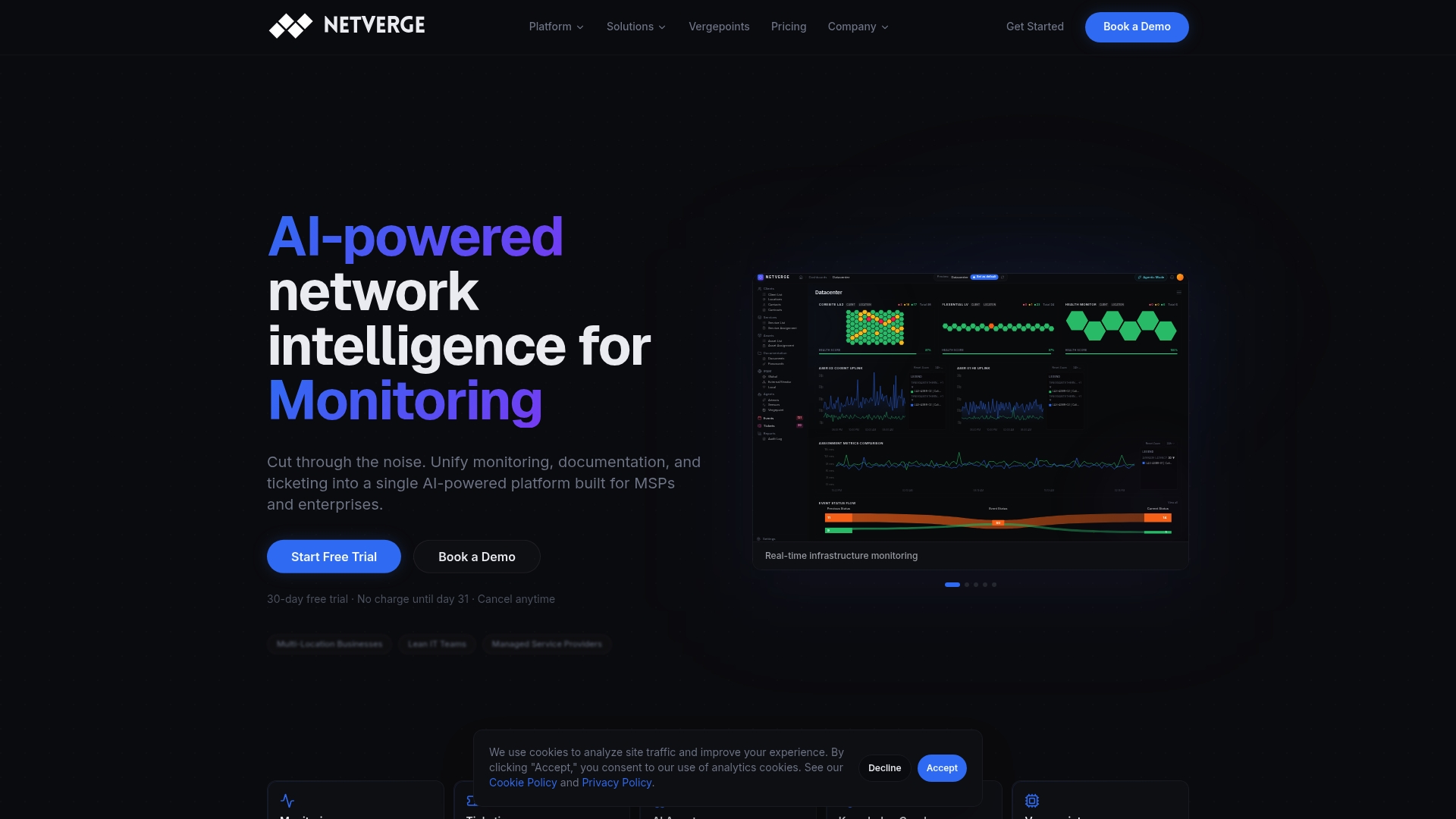
Netverge is built specifically to address these challenges for multi-location enterprises and MSPs. The platform unifies AI-powered monitoring, automated troubleshooting, intelligent ticket triage, and documentation into a single interface. Autonomous AI agents diagnose and resolve issues without requiring manual intervention at every step. If you are ready to move from reactive network management to outcome-driven operations, enterprise network automation with Netverge gives you the infrastructure to do it. Request a demo to see how the platform maps to your specific environment and modernization goals.
Frequently asked questions
What is closed-loop automation in network operations?
Closed-loop automation means networks can detect faults automatically and resolve them without manual intervention, reducing O&M costs and improving uptime across distributed environments.
How does AI reduce mean time to repair (MTTR) in modern networks?
AI ingests network telemetry, correlates events across sites in real time, and automates troubleshooting steps, with MTTR reductions of 38% reported in enterprise benchmarks using AI-driven correlation.
What is the difference between assistive AI and outcome-focused platforms?
Assistive AI provides recommendations while your team executes every action. Outcome-focused platforms commit to workflow results and shift IT teams into a supervisory role over automated systems.
Are there new security or risk considerations with autonomous networking?
Yes. As agent-to-agent and autonomous operations expand, security governance and safe delegation policies become essential to prevent new attack vectors introduced by expanded system permissions.