NIST 800-53 Monitoring: Controls, Evidence and Automation
Published
- nist 800-53 monitoring
NIST SP 800-53 monitoring comes down to two things: SI-4 (System Monitoring), which defines what you watch and detect, and CA-7 (Continuous Monitoring), which defines the strategy that keeps the monitoring effective over time. Meeting both across many sites takes one view of the network, alerts that reach named people, and records you can show an assessor. Fragmented tools make that hard. A single platform that combines monitoring, ticketing and documentation, such as Netverge, gives MSPs and multi-site IT teams one place where detections, responses and evidence line up.
TL;DR
- SI-4 covers detecting attacks, unauthorized connections and unauthorized use, then analyzing events and reporting them to defined roles. CA-7 covers the continuous monitoring strategy itself.
- Monitoring is an organization-wide responsibility first and a system-level one second. Every site's monitoring must fit the same strategy.
- Assessors look for evidence: policies, working tooling, monitoring activity and the people involved. Alerts, tickets and documentation are that evidence.
- Automated response is covered by SI-4(07). You decide which actions run alone and which need human approval.
- Netverge brings monitoring, ticketing, documentation and AI agents into one platform for MSPs and multi-location enterprises.
Table of Contents
- What NIST 800-53 requires you to monitor
- SI-4 enhancements that matter for network operations
- Release status: what applies today
- Build the program organization-first, then system by system
- Evidence: what an assessor will want to see
- Practical automation workflows, with human approval
- How Netverge supports a monitoring program
- What it costs to cover a distributed estate
- Start with the monitoring that evidence depends on
- FAQ
- Sources
What NIST 800-53 requires you to monitor
NIST SP 800-53 Revision 5 is the catalog of security and privacy controls for federal information systems. It requires continuous monitoring to determine three things: whether controls remain effective, what is changing in the system and its environment, and the security and privacy state of the whole organization.
Two controls carry most of the weight for network teams.
SI-4, System Monitoring. The control asks you to monitor the system to detect attacks and indicators of potential attacks, plus unauthorized local, network and remote connections. It also asks you to identify unauthorized use, deploy monitoring devices strategically and at ad hoc locations, analyze events and anomalies, adjust monitoring when risk changes, and report monitoring information to defined roles. Its discussion text separates external monitoring (events at external interfaces) from internal monitoring (events within the system).

CA-7, Continuous Monitoring. CA-7 is the program wrapper. It requires a strategy with defined metrics, defined frequencies for monitoring and for assessing control effectiveness, ongoing assessments, correlation and analysis of the results, response actions, and regular reporting of security and privacy status to defined personnel. FedRAMP's Rev5 control guidance lays these elements out for cloud service providers.
Revision 5 also added an organization-level control, PM-31, which requires an organization-wide continuous monitoring strategy. In practice that means the monitoring for each site or customer environment cannot be improvised locally.
SI-4 enhancements that matter for network operations
The base SI-4 control is broad. The enhancements are where tooling decisions get specific. FedRAMP's 2026 control reference lists the ones that apply to its baselines. The ones network teams meet most often:
| Enhancement | What it asks for | What it means in operations |
|---|---|---|
| SI-4(01) | System-wide intrusion detection | One detection view across all segments, not per-site islands |
| SI-4(02) | Automated tools for near real-time analysis | Correlation that does not wait for a person to read logs |
| SI-4(04) | Monitoring inbound and outbound traffic at a defined frequency | Traffic visibility at every egress point, including branch sites |
| SI-4(05) | System-generated alerts on compromise indicators | Alerts routed to defined personnel |
| SI-4(07) | Automated response to suspicious events | Scripted or agent-driven actions with limits you define |
| SI-4(09) | Testing of intrusion-monitoring tools at a defined frequency | A recurring test, with a record |
| SI-4(13) | Analyzing traffic and event patterns to tune monitoring | Regular threshold and rule tuning |
| SI-4(14) | Wireless intrusion detection | Wireless coverage at physical locations |
Which of these are required depends on your baseline and on your organization's own selections. The catalog is mandatory for federal information systems under FISMA and for FedRAMP cloud services, and voluntary elsewhere. Many MSPs and enterprises adopt it anyway because customers or contracts ask for it.
Release status: what applies today
SP 800-53 is at Revision 5. NIST released Release 5.2.0 in August 2025, and FedRAMP's RFC-0030 states that these updates flow into the FedRAMP Security Control Baseline. The consolidated FedRAMP rules for 2026 that came out of that RFC remain valid through December 31, 2028. For a monitoring program, the SI-4 and CA-7 requirements described above are the stable core. Check NIST's controls download page for the current published version before you write control statements, and report discrepancies between formats to NIST at the address it lists.
Build the program organization-first, then system by system
NIST SP 800-137A describes information security continuous monitoring (ISCM) as an organization-wide responsibility before it is a system-level one. Leadership defines the strategy, then the program: metrics, status monitoring frequencies, control assessment frequencies and a technical architecture. The program then collects security-related information, analyzes and reports findings, responds, and reviews itself. System-level strategies must be consistent with the organization-wide one.
For a distributed environment, this translates into a workable sequence.
- Inventory what is in scope. List sites, devices, links, cloud connections and customers. Monitoring that does not know an asset exists cannot detect anything on it.
- Set the metrics and frequencies once. Decide how often each class of device or link is checked and how often control effectiveness is reviewed. Write the values down, because SI-4 and CA-7 both use organization-defined values and an assessor will ask what yours are.
- Place monitoring deliberately. SI-4 calls for monitoring devices at strategic points and at ad hoc locations. At a multi-site company, that means every site egress and key internal segments, not just headquarters.
- Define who is alerted. SI-4(05) and the SI-4 reporting requirement both name roles. Map each alert class to a role, an escalation path and a ticket queue.
- Correlate and analyze. Raw alerts from separate tools do not make an analysis. You need events from different sources compared in one place.
- Respond and record. Every response action should leave a ticket or log entry linked to the detection that triggered it.
- Review and tune. SI-4(13) asks you to analyze patterns and tune monitoring devices. Schedule it and keep the output.
NIST 800-137A also notes that automated support tools can make continuous monitoring more consistent, efficient, accurate and cost-effective, while manual processes must be verified to be repeatable. That is the case for consolidating tooling: each manual hand-off between systems is a step you have to prove is repeatable.
Where distributed networks make this hard
A single data center can run one monitoring stack. An MSP with dozens of customers, or an enterprise with hundreds of branches, has to apply the same strategy to very different environments. The usual failure points are:
- Sites with no on-premises visibility, so SI-4(04) traffic monitoring has a blind spot.
- Alerts that go to a shared inbox instead of a defined role.
- Documentation in a separate system that does not match what is actually deployed.
- Alert noise so high that real indicators are buried. Netverge's guide to reducing false positives without missing real incidents covers how to approach this.
Evidence: what an assessor will want to see
Monitoring that works but cannot be shown to work does not pass an assessment. NIST's assessment guidance, SP 800-53A, supplies the assessment procedures for Revision 5. The long-standing structure of that guidance defines assessment objects (specifications, mechanisms, activities and individuals) and three methods: examine, interview and test. Mapped to monitoring, that looks like this:
| Assessment object | Monitoring example | Evidence to keep |
|---|---|---|
| Specification | Monitoring policy, strategy, alert-to-role mapping | Versioned documents with review dates |
| Mechanism | Sensors, probes, correlation engine, ticketing | Configuration exports, coverage list by site |
| Activity | Alert review, triage, response, tuning | Tickets with timestamps, owner and outcome |
| Individual | On-call analysts, network operations lead | Role assignments, interview-ready runbooks |
Three habits make the evidence much easier to produce.
Tie every alert to a record. When a detection becomes a ticket automatically, the chain from alert to triage to resolution already exists. Netverge's explanation of the difference between an alert and an incident is a useful model for deciding which detections get a ticket.
Test your tools on a schedule. SI-4(09) requires testing intrusion-monitoring tools at a defined frequency. Pick the frequency, run the test, and save the result with a date.
Show tuning. SI-4(13) expects pattern analysis. A log of threshold changes, with the reason for each, shows the program is active rather than set and forgotten.
NIST's ISCM program assessment guidance, IR 8212, adds a program-level view. It includes elements for monitoring tool procedures and for using ISCM metrics to inform decisions about whether systems continue to operate. SP 800-137A is explicit that a program assessment evaluates the structure and governance of the program, not the technology results alone.
Practical automation workflows, with human approval
SI-4(02) points toward automated analysis and SI-4(07) toward automated response. Automation helps in both places. It also needs boundaries, because an automated action on a production network is a change, and an unreviewed change is a risk of its own.
A sound approach separates actions by consequence.
- Run automatically: read-only diagnostics, collecting interface counters, running traceroutes, gathering configuration state, opening and enriching tickets, notifying the defined role.
- Require human approval: anything that changes configuration, blocks traffic, disables a port or account, or restarts a device that serves users.
- Never automate without a design review: actions at sites where a wrong decision removes the only remote path back in.
Write these categories into the monitoring strategy so the SI-4(07) answer is a documented rule, not an assumption. Record who approved each change-making action and when. That approval record is itself evidence for CA-7 response activity.
Two workflows are worth building first.
Detection to enriched ticket. An anomaly is detected, the system gathers context (affected site, device, recent changes, related alerts), opens a ticket assigned to the defined role, and notes the control it relates to. The analyst starts with a diagnosis rather than a bare alarm. Netverge's examples of network anomaly detection show the kinds of events that qualify.
Diagnosis to proposed action. Automation runs the read-only checks, summarizes likely cause, and proposes a fix. A human approves or rejects it, and the outcome is logged. This keeps response fast while keeping accountability with a named person.
How Netverge supports a monitoring program
Netverge is built for MSPs and multi-location enterprises. It unifies network visibility, documentation, ticketing and automation in one platform, and that structure matters for the evidence problem above. Its real-time infrastructure monitoring and anomaly detection cover the detection side. AI-powered ticket triage and autonomous AI agents that diagnose issues handle the analysis and response side. Network documentation and knowledge graphs keep the record of what is deployed next to what is being monitored.
On the physical side, Vergepoints are edge hardware that give on-site visibility at a location, and the platform offers 28+ intelligent sensors. Multi-tenant management and role-based access fit the SI-4 requirement to report to defined roles, since people see the environments that belong to them. Netverge's pages on real-time alerting and alert types describe how alerts are structured and routed.
NIST 800-53 compliance is an outcome of your program, your documented values and your assessor's judgment. A platform supplies the monitoring, tickets and records that the program is built from. For details of the platform's security posture, see the Netverge security and trust page.
What it costs to cover a distributed estate
Netverge publishes its pricing. The Starter Package is $299 per month. Hardware Vergepoints are $49 per month per device, and a software Vergepoint is $29 per month. Capacity add-ons are $100 per month for each additional 100 monitoring sensors, 100 clients or 100 sites, for each additional 10 AI agents, and for each 500GB of storage. The pricing guide lists every item, and the pricing calculator estimates a monthly total for your site and sensor counts.
For a multi-site design, a practical split is hardware Vergepoints where you want a physical presence at a site and software Vergepoints where a virtual agent is enough. Choose per site based on the SI-4 placement decision you made in the program design.
Start with the monitoring that evidence depends on
If your SI-4 and CA-7 evidence is spread across monitoring tools, a ticketing system and separate documentation, consolidating it is the quickest way to make the chain from detection to response visible. Netverge's AI-powered network monitoring is built for that, and the free trial lets you see it on your own network.
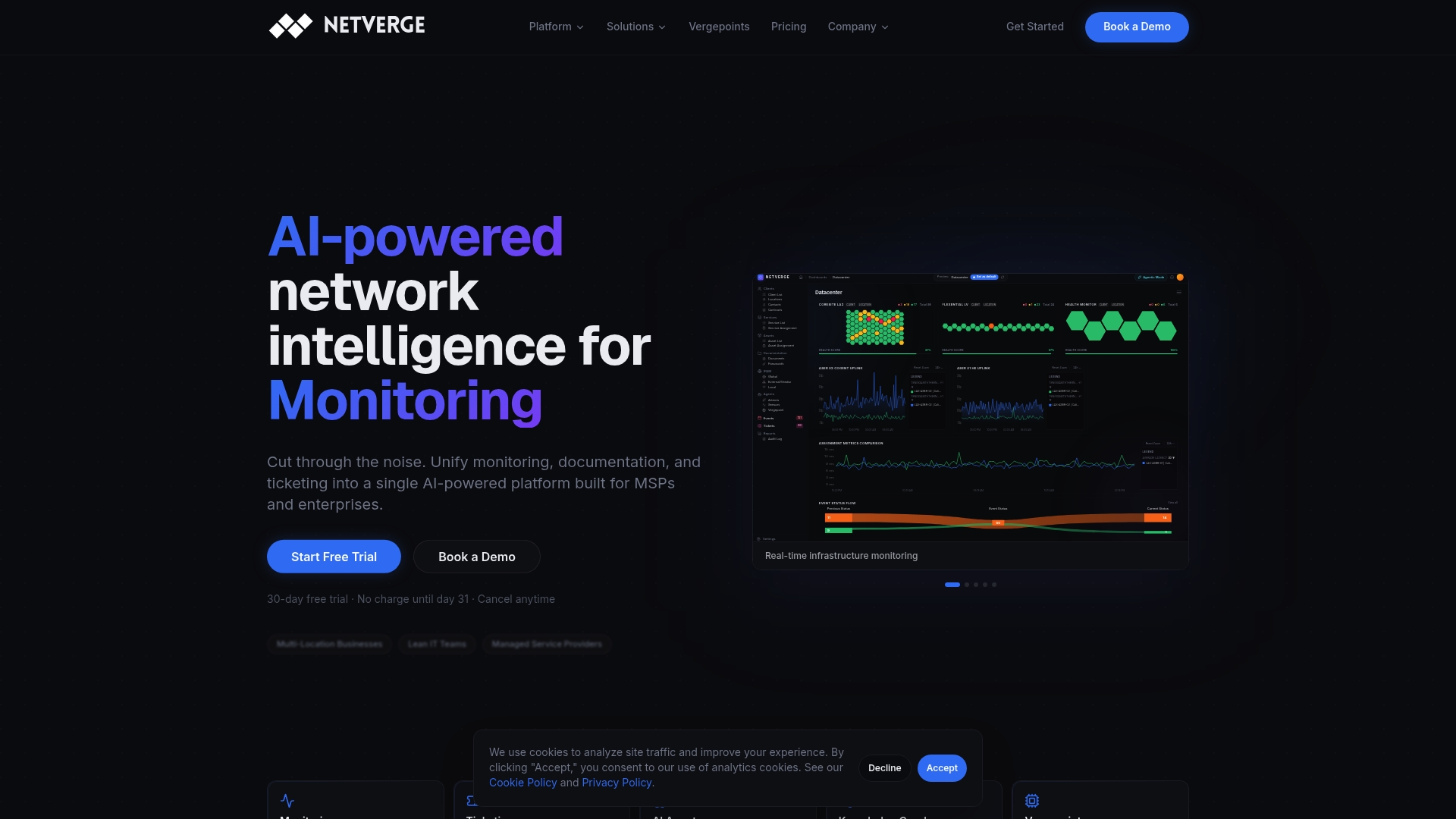
The Starter Package is the entry point at $299 per month, with Vergepoints and capacity added as your sites grow.
FAQ
Which NIST 800-53 control covers network monitoring?
SI-4, System Monitoring, is the main one. It covers detecting attacks, unauthorized connections and unauthorized use, analyzing events, and reporting to defined roles. CA-7 sets the continuous monitoring strategy that surrounds it, and AU-family controls cover the audit records that monitoring depends on.
Is NIST 800-53 mandatory for private companies?
It is mandatory for federal information systems under FISMA and for cloud services under FedRAMP. Elsewhere it is voluntary, though contracts, customers and other frameworks often reference it. If you serve federal agencies or their contractors, check your contract for the baseline that applies.
Can automated response satisfy SI-4(07)?
SI-4(07) addresses automated response to suspicious events, and you define what those responses are. Document which actions run automatically and which need approval from a named person. Keep the approval records, since they show the response is controlled.
What evidence shows monitoring is operating effectively?
Keep the monitoring strategy and its defined frequencies, a list of monitored assets by site, alerts mapped to roles, tickets showing triage and resolution, records of tool tests under SI-4(09), and logs of tuning under SI-4(13). Together they let an assessor examine documents, test mechanisms and interview the people involved.
How does 800-53 monitoring relate to SP 800-137?
SP 800-137 and its companion 800-137A describe how to build and assess an information security continuous monitoring program. SP 800-53 supplies the controls, mainly CA-7, PM-31 and SI-4, that the program puts into practice.
Sources
- NIST SP 800-53 Revision 5, Security and Privacy Controls
- FedRAMP: System and Information Integrity controls
- FedRAMP Rev5 Control Guidance
- FedRAMP RFC-0030, Rev5 Security Controls Baseline Update
- NIST SP 800-137A, Assessing ISCM Programs
- NIST IR 8212, ISCMA
- NIST CSRC, SP 800-53 controls downloads