
Network operations automation uses software, pipelines, and policy to make routine network tasks repeatable and self-healing. The core outcome is faster mean time to resolution and less manual toil across provisioning, monitoring, and remediation. This guide covers the architecture, approaches, and rollout sequence teams use to automate safely, along with the governance controls that keep automated changes from becoming a liability.
TL;DR:
- Automation needs a complete architecture, including a single inventory source, telemetry, orchestration, policy enforcement, and CI/CD pipelines, to ensure reliable operation.
- Starting with low-risk tasks like backups and compliance checks before moving to closed-loop remediation and ensuring strong telemetry improves safety and success rates.
- Data quality and consolidated telemetry significantly influence automation outcomes, with better results achieved through centralized visibility and advanced anomaly detection tools.
- Implementing governance measures such as role-based access, approval gates, audit logs, and rollback strategies prevents unsafe automated actions and maintains control.
- A phased, low-risk rollout is critical, expanding automation gradually across sites, and tracking coverage as a proportion of total changes to reliably measure progress.
Table of Contents
- What network operations automation covers and why teams adopt it
- Core architecture and components needed for reliable automation
- Types and approaches: choosing the right automation model
- Practical implementation roadmap and checklist
- Use cases and business outcomes with concrete KPIs
- Security, governance, and common pitfalls to avoid
- Netverge in practice: an illustrative implementation example
- Balancing risk and speed in automation adoption
- Getting started with Netverge for network operations automation
- Sources
- FAQ
What network operations automation covers and why teams adopt it
Network operations automation replaces manual, repetitive tasks with software-driven workflows across the full device lifecycle: provisioning, configuration management, monitoring, and remediation. Instead of an engineer logging into a switch to push a config change, a pipeline validates the change, applies it, and confirms the result.
Teams adopt automation for measurable operational gains rather than novelty. Consistency improves because the same validated logic runs every time, removing the variation that comes from different engineers making the same change differently. Scale improves because one automated workflow can apply to thousands of devices as easily as ten. Response time improves because detection and remediation steps that once required a human to notice, diagnose, and act now execute in a pipeline.
Common adoption drivers include:
- Reducing MTTR by connecting monitoring alerts directly to remediation workflows instead of a manual ticket queue.
- Cutting configuration drift by treating network state as code that gets audited and enforced, not assumed.
- Freeing engineering time from repetitive provisioning and patching so teams can focus on architecture and incident response.
- Supporting growth across multi-site or multi-tenant environments without a proportional increase in headcount.
AI and NetDevOps practices are extending what automation can safely handle. Where scripted automation once covered narrow, predictable tasks, AI-assisted anomaly detection and ticket triage now help identify issues that do not match a known pattern, while NetDevOps pipelines apply the same peer review and testing discipline that software teams use for code.
Core architecture and components needed for reliable automation
Reliable automation depends on a stack of connected layers, not a single tool. Skipping any layer tends to produce automation that works in testing and fails in production.
- Inventory and single source of truth (SSOT). Every device, its role, and its intended configuration need one authoritative record. Configuration as code, version controlled the same way application code is, makes that record enforceable rather than aspirational.
- Telemetry and analytics. Automation decisions are only as good as the data feeding them. Streaming telemetry, logs, and metrics give the system the visibility needed to detect drift or degradation before it becomes an outage.
- Orchestration and policy engines. Orchestration coordinates multi-step workflows across devices and domains, while policy decision points (PDP) and enforcement points (PEP) determine what an automated action is allowed to do. Security orchestration, automation, and response (SOAR) platforms extend this into incident handling, and integrations with SIEM, IAM, and ticketing systems keep automation aligned with existing operational records.
- CI/CD pipelines. Every change moves through pre-change validation, automated tests, a peer review or approval gate, and post-change validation before it is considered complete.
NIST's preliminary practice guide on Zero Trust implementation demonstrates this architecture directly, using Ansible and Terraform to show controller-driven provisioning, infrastructure as code, and post-change validation working together in operational examples.
Pro Tip: Build your telemetry pipeline before your remediation pipeline. Automation that acts on incomplete data creates new incidents instead of resolving them.
Types and approaches: choosing the right automation model
Not every task needs the same automation approach, and matching the method to the risk level of the task is the difference between automation that scales and automation that causes outages.
- Single-task scripting handles narrow, repeatable jobs like backing up a configuration or pulling an inventory report, with minimal orchestration overhead.
- Orchestration coordinates multiple tasks across multiple devices or systems, such as provisioning a new site end to end rather than configuring one device at a time.
- Script-driven automation relies on procedural logic written for a specific outcome, while intent-based or model-driven automation defines the desired end state and lets the system determine how to get there, adapting as conditions change.
- Closed-loop automation connects monitoring directly to remediation: the system detects a problem, applies a fix, and verifies the result without waiting for a human trigger. This is the highest-value and highest-risk category, and it depends entirely on the CI/CD and validation discipline described in the architecture above.
- Security automation, often built on SOAR platforms and policy-driven playbooks, applies the same closed-loop principle to threat response: detect, decide against policy, act, and log.
Defense and security guidance is consistent on one point: automation speeds response in ways manual processes cannot match, but NSA and CISA guidance on automation and orchestration stresses that speed must be bounded by predefined policies, decision points, and monitoring to avoid unsafe automated actions.
Practical implementation roadmap and checklist
A defensible rollout sequence reduces risk by earning trust in the automation before expanding its authority. Skipping steps to reach closed-loop remediation early is the most common cause of automation projects that get rolled back.
- Build the inventory and SSOT. Document every device, its configuration, and its intended state before automating anything.
- Define desired state and policy. Decide what "correct" looks like for each device class and what actions are permitted without human approval.
- Connect telemetry, logs, tickets, and configuration sources. Automation needs a complete data picture, not a partial one, to make sound decisions.
- Automate low-risk tasks first. Configuration backups, compliance checks, and reporting are good starting points because a failure has limited blast radius.
- Add CI/CD and validation gates. Every change, even a low-risk one, should pass through pre-change validation, a peer review or approval step, and post-change verification.
- Pilot closed-loop remediation. Start with a narrow set of well-understood failure modes, paired with health checks and an automatic rollback path if the fix does not resolve the issue.
- Measure and expand. Track change success rate, MTTR, and automation coverage, then widen scope only as those metrics hold steady.
This sequence mirrors the approach outlined in NIST's Zero Trust implementation guide, which recommends moving from inventory to desired state to telemetry to low-risk automation before attempting CI/CD-validated closed-loop remediation. It also aligns with engineering practice described in Cisco Live's closed-loop automation sessions, which trace a pipeline from telemetry through analytics to automated deployment, built on small, peer-reviewed changes rather than sweeping manual updates.
Ticketing integration deserves particular attention during rollout, since connecting ticketing systems to automation workflows closes the loop between detection and documented resolution. For teams operating across multiple sites, a phased rollout approach that expands automation site by site tends to surface integration gaps before they affect the whole network.
Pro Tip: Track automation coverage as a percentage of total change volume, not just as a count of automated tasks. It tells you how much manual toil you have actually removed.
Use cases and business outcomes with concrete KPIs
The clearest automation wins come from tasks that are frequent, well understood, and costly to do manually. A few examples show the pattern:
- Device onboarding, where a new site or device is provisioned from a template instead of a manual build.
- Automatic upgrades, applying patches and firmware updates on a schedule with automated rollback if a health check fails.
- Incident triage, where AI-assisted classification routes tickets to the right team or resolves known issues without escalation.
- Closed-loop healing, detecting a degraded link or interface and applying a known fix automatically.
- Policy enforcement, continuously checking device configurations against a compliance baseline and flagging or correcting drift.
Data readiness strongly correlates with automation success. Industry research on AI-driven NetOps adoption finds that organizations with centralized telemetry and consolidated tooling see better outcomes from AI-driven automation than those with fragmented data sources. The pattern holds across the KPIs teams track most: change success rate, MTTR, and automation coverage all move in the same direction as data quality.
AI adds the most value in the detection and triage stages, where anomaly detection surfaces issues that do not match a scripted rule and ticket triage reduces the manual sorting that used to precede every incident response.

Security, governance, and common pitfalls to avoid
Automation that moves fast without guardrails tends to fail loudly. CISA's Zero Trust Maturity Model treats automation and orchestration as a capability that cuts across identity, devices, networks, applications, and data, and it ties higher automation maturity to stronger governance, not looser oversight.
Effective governance includes:
- Role-based access control limiting which teams or systems can trigger which classes of automated action.
- Approval gates for changes above a defined risk threshold, even when the workflow itself is automated.
- Audit logs covering every automated action, so any change can be traced to its trigger and its outcome.
- Canary and rollback strategies that test a change on a small subset before wide deployment and automatically revert if health checks fail.
The most common failure modes are predictable: automating on top of a poor or incomplete inventory, running remediation without adequate telemetry to confirm success, and jumping straight to high-risk automated actions before building trust with low-risk ones.
Pro Tip: Treat every automated action as if it needs to be explained to an auditor after the fact. If you cannot trace why it fired, it needs a policy check before it runs again.
Netverge in practice: an illustrative implementation example
Netverge's platform maps directly to the architecture layers described above. Hardware Vergepoints and the Software Vergepoint module provide the telemetry layer, feeding real-time infrastructure data into a knowledge graph that supports orchestration and diagnostic decisions. AI agents built on that data handle anomaly detection and automated troubleshooting, while ticketing and documentation stay unified rather than fragmented across separate tools.
A typical deployment sequence follows the same low-risk-first pattern outlined earlier:
- Deploy Vergepoints for physical visibility across sites before enabling automated remediation.
- Connect monitoring, ticketing, and documentation into one dashboard to remove data silos.
- Enable AI agents for anomaly detection and ticket triage first, then expand toward closed-loop remediation as confidence builds.
- Manage multi-tenant environments through role-based access, keeping client or site data separated within one platform.
Netverge's own product materials describe response time improvements for teams that consolidate monitoring and automation this way, though results vary by environment and rollout scope.
Balancing risk and speed in automation adoption
Readiness for closed-loop automation shows up as clean telemetry, a tested rollback path, and a change success rate that has held steady through smaller automations first. Push too early and you automate your way into new incidents. Go slow when inventory or observability gaps still exist, and align network, security, and platform teams around one pipeline before scaling NetDevOps practices further.
— Jim
Getting started with Netverge for network operations automation
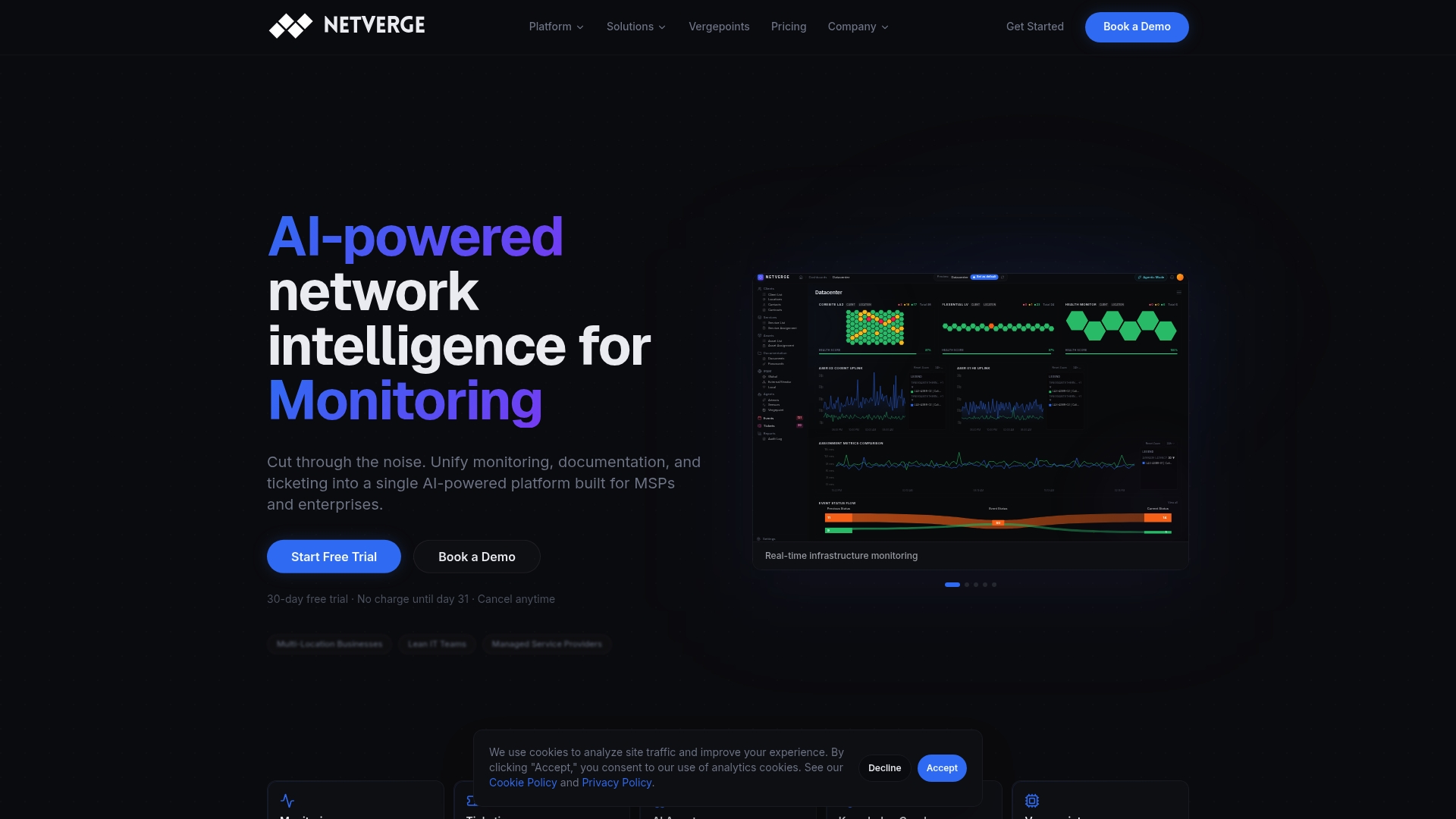
Netverge brings the architecture in this guide into one platform instead of requiring you to assemble telemetry, orchestration, ticketing, and AI triage from separate tools. Hardware Vergepoints handle physical visibility, the knowledge graph connects documentation to live infrastructure data, and AI agents handle the anomaly detection and triage work that typically consumes the most engineering time.
For MSPs and multi-site enterprises evaluating where to start, the Starter Package at $299 per month provides a practical entry point, with Hardware Vergepoints available at $49 per month per device for teams that need on-site telemetry. Teams running managed security operations alongside automation may also want to review managed cybersecurity services as a complementary layer. Visit the pricing guide for full plan details or start a free trial to see the platform against your own network.
Sources
- NIST SP 1800-35 (preliminary draft) — Implementing a Zero Trust Architecture: IaC and automation examples
- CISA Zero Trust Maturity Model v2.0
- Automation and Orchestration pillar (CSI-ZT Automation/Orchestration) — U.S. defense cybersecurity materials
- Cisco Live: Closed-Loop Automation using CI/CD pipelines with AI insights
FAQ
What does network automation do?
Network automation uses software and predefined logic to perform routine network tasks, such as provisioning, configuration, monitoring, and remediation, without manual intervention for each occurrence. It typically reduces the time between detecting a problem and resolving it while making configuration changes more consistent across devices.
Is AI replacing network engineers?
AI is taking over repetitive detection and triage work, such as flagging anomalies and sorting tickets, but engineers still define the policies, approve higher-risk changes, and handle issues automation was not designed to catch. Guidance from NSA and CISA treats automation as a capability that requires human-defined policy and oversight rather than a replacement for engineering judgment.
What are some examples of network automation?
Common examples include automated device onboarding, scheduled firmware and patch upgrades with rollback, AI-assisted incident triage, closed-loop remediation for known failure patterns, and continuous compliance checks against a configuration baseline. Each of these typically starts as a low-risk, scripted task before expanding into a fuller closed-loop workflow.
What are the four types of automation?
Definitions vary across sources, but a common grouping includes single-task scripting, orchestration across multiple systems, intent-based or model-driven automation, and closed-loop automation that connects detection directly to remediation. Security automation, often built on SOAR platforms, is sometimes treated as a fifth category focused specifically on threat response.