
AI in IT management now covers six distinct operational areas: real-time anomaly detection, automated ticket triage, intent-based network control, predictive maintenance, AI-driven cybersecurity, and workflow automation. These aren't experimental pilots. MSPs and enterprise IT teams are running them in production today, with measurable results in resolution time, alert accuracy, and technician capacity.
Key AI applications active in IT infrastructure management right now:
- AI-powered monitoring and anomaly detection: Machine learning models build behavioral baselines from telemetry, logs, and traffic flows, then flag deviations before they become outages.
- Automated troubleshooting and ticket triage: AI categorizes, routes, and summarizes incidents automatically, cutting mean time to resolution and reducing escalations.
- Intent-based network management (IBN): AI translates business objectives into automated network policies, replacing device-by-device configuration with policy-driven enforcement.
- Predictive maintenance: AI analyzes interface errors, device temperature, link utilization, and configuration drift to predict hardware failure before it affects users.
- AI in cybersecurity: Correlation engines detect suspicious authentication patterns, unusual east-west traffic, and shadow AI tool usage across the environment.
- Workflow automation and reporting: AI builds integrations, generates runbooks, and produces real-time operational reports without requiring deep platform expertise.
Netverge unifies these functions into a single platform. Vergepoints provide physical-layer visibility, while AI agents, knowledge graphs, and dashboards handle detection, diagnosis, and documentation across distributed networks.
Table of Contents
- How AI powers monitoring and anomaly detection in IT infrastructure
- Automated troubleshooting and intelligent ticketing workflows
- Intent-based network management: how AI aligns automation with business goals
- Best practices for deploying AI reliably in IT environments
- How AI is reshaping MSP and large-scale network operations
- ROI from AI implementation: what the case studies show
- Integration challenges and how IT teams are solving them
- Netverge gives MSPs unified AI visibility from day one
- Key Takeaways
How AI powers monitoring and anomaly detection in IT infrastructure
AI-powered network monitoring works by applying machine learning to continuous telemetry streams rather than static thresholds. The system learns what normal looks like for each device, user, application, and traffic flow, then scores deviations in real time. Traditional monitoring tells you a link is saturated. AI tells you why, and which upstream change caused it.
Streaming telemetry protocols like gNMI and OpenTelemetry give AI models higher-frequency data than polling-based systems, which directly improves detection accuracy and predictive lead time. The richer the data pipeline, the earlier the model catches a developing fault.
Anomaly types AI detects across network infrastructure:
- Sudden traffic spikes on specific interfaces or paths
- Unusual DNS query behavior or abnormal east-west traffic
- Packet loss outside established baseline patterns
- Unexpected configuration changes or configuration drift
- Suspicious authentication patterns and access anomalies
- Performance degradation on specific application paths
One technical approach worth understanding: Graph Neural Networks applied to high-fidelity digital twins of the network can distinguish between a single chaotic router and a sub-graph structural failure. That distinction matters because it directly cuts false positive alert volume. Netverge's unified observability layer, backed by Vergepoints for physical visibility, gives AI agents the topology context they need to make that call accurately.
Automated troubleshooting and intelligent ticketing workflows
AI-driven ticket triage automates categorization and routing of incoming service desk requests, freeing technicians to focus on work that actually requires their expertise. The system reads the ticket, identifies the issue type, routes it to the right queue, and in many cases resolves it before a human touches it.

Kevin Damghani, CEO of ITPartners+, requires all engineers to hold a Microsoft Copilot license. His team uses Copilot to investigate incidents, troubleshoot networking problems, and document resolutions. "When they're closing a ticket, it'll recap it really nicely and automatically close out the ticket," he said. That's a direct reduction in documentation overhead per incident.
Benefits of AI-assisted troubleshooting and ticketing:
- Fewer escalations through early-stage automated resolution
- Faster incident closure with AI-generated root-cause summaries
- Improved documentation quality with auto-generated ticket recaps
- Reduced technician context-switching between monitoring tools and ITSM platforms
- Consistent triage quality regardless of technician experience level
"Orchestration isn't a human chasing tickets anymore. It's a workflow that processes, validates, and only escalates when something genuinely weird shows up." — John Douglass, President, Pileus Technologies
Pileus Technologies connected AI agents across Ninja RMM, Datto RMM, and Halo PSA to move patch management through a workflow with minimal human intervention. Agents cross-reference asset criticality, vendor advisories, and client-specific maintenance agreements before generating tailored maintenance plans. That's AI-powered infrastructure troubleshooting operating at scale.
Intent-based network management: how AI aligns automation with business goals
Intent-based networking (IBN) shifts operations from device-by-device configuration to policy-driven enforcement. You define the business objective. The AI translates it into network policy, deploys it, and continuously validates that actual network behavior matches the intent. When it doesn't, the system remediates automatically.
| IBN Capability | What It Does |
|---|---|
| Automated policy deployment | Pushes configuration changes aligned to business intent across the network |
| Continuous validation | Monitors live behavior against defined intent and flags deviations |
| Dynamic adaptation | Adjusts network behavior as application, user, or business requirements change |
| Governance and compliance | Reduces configuration errors and enforces policy consistency at scale |
| Autonomous remediation | Executes corrective actions within defined guardrails without manual intervention |
IBN reduces configuration errors by aligning automated changes with strategic business intent, improving both resilience and compliance. NetOps teams shift from manual configuration work to supervising AI-driven recommendations, establishing governance policies, and managing exception handling. The operational model changes from reactive to predictive.
Pro Tip: Start IBN adoption with a single, well-defined policy domain such as QoS or VLAN segmentation. Validate AI behavior in that scope before expanding to routing or security policy automation. Phased rollout limits blast radius and builds team confidence in the system's decision logic.
Best practices for deploying AI reliably in IT environments
Reliable AI in network operations depends less on the model itself and more on the operational framework surrounding it. Governance, auditability, rollback capability, and human oversight are what separate a production-ready AI deployment from a fragile one.
Deployment guidelines for IT teams and MSPs:
- Phased autonomy: Start with AI-assisted recommendations, then AI-augmented correlation, before enabling closed-loop autonomous remediation.
- Sandboxed evaluation: Test AI-proposed changes in replay environments before applying them to live infrastructure.
- Canary trials: Roll out AI-driven changes to a subset of devices or sites first, with rollback-aware scoring.
- Audit trails: Every AI action must be logged, traceable, and reviewable. This is non-optional in regulated environments.
- Human oversight gates: Critical decisions require human approval, even when the AI recommendation is high-confidence.
Pro Tip: Use digital twin models combined with Graph Machine Learning to reduce false positive alerts. A GNN-based model that understands network topology can differentiate a local transient fault from a structural failure, which prevents unnecessary remediation actions and alert fatigue.
A governed multi-agent framework, like the one an MSP deployed for BGP change management using the Itential platform, demonstrates what this looks like in practice. Validation gates, conflict detection, and rollback procedures ran as purpose-built agents inside a deterministic workflow. The system blocked a flawed configuration change even after a human had already approved it upstream.
How AI is reshaping MSP and large-scale network operations
MSPs are using AI across every layer of their operations, from service desk triage to governance to predictive analytics. The common thread is replacing manual, repetitive work with AI-driven workflows that scale without adding headcount.
AI-driven capabilities MSPs are deploying in 2026:
- AI voice receptionists: Natural language call handling that routes customers, qualifies tickets, and resolves simple issues before a technician picks up.
- Shadow AI detection: Visibility across all AI tools in use across a customer environment. One MSP reports finding 30 to 40 AI tools in use at a typical customer, most of them ungoverned.
- Predictive analytics and custom tooling: MSPs like 3rd Element Consulting are building proprietary AI-driven platforms for quarterly business reviews, trend modeling, and user behavior analysis.
- AI-driven marketing: Avtek Solutions used AI to rewrite campaign messaging for specific industry verticals. Open rates increased 233% and click-through engagement jumped from 6 to 47 people on the same campaign.
Multi-agent orchestration lets MSPs handle complex workflows, onboarding, compliance, documentation, and project coordination, without requiring senior engineers at every step. Enitech in Raleigh, NC, built an AI orchestration layer where a less experienced team member now manages multiple client projects using AI agents as the primary coordinator.
ROI from AI implementation: what the case studies show
Swisscom, Switzerland's leading telecommunications provider, built a network assistant on Amazon Bedrock that combines generative AI with a multi-agent architecture. Network engineers are projected to see a 10% reduction in time spent on routine data retrieval and analysis, translating to nearly 200 hours saved per engineer annually. Operational costs for the solution run at less than 1% of the total value generated.
The BGP change management deployment at a global MSP using the Itential platform produced a different kind of ROI: a demonstrated safety override where an AI agent blocked a flawed configuration change after human approval had already been granted. That's risk reduction that doesn't show up in a time-savings calculation but directly protects service continuity for regulated customers.
Nanites, in a controlled trial, simulated an interface outage across a Cisco IS-IS network. The AI agent analyzed the alert, identified root cause through reasoning rather than static playbooks, and remediated in 3 minutes. A skilled engineer typically takes 30 or more minutes on the same task.
Integration challenges and how IT teams are solving them
Integrating AI tools into existing IT systems surfaces three consistent friction points: data quality, tool fragmentation, and governance gaps. AI models are only as accurate as the telemetry they ingest. Fragmented monitoring stacks produce inconsistent data formats, which degrades model performance and increases false positive rates.
The practical solution is to build a unified observability layer first. AI operations require comprehensive, high-quality telemetry across on-premises, cloud, and remote platforms before any AI model can deliver reliable results. Streaming telemetry via gNMI and OpenTelemetry, combined with time-series databases, gives AI models the data density they need.
Tool fragmentation is the second barrier. MSPs managing multiple customer environments need AI that integrates with existing ITSM, RMM, and PSA platforms through native APIs rather than requiring a full stack replacement. The Itential deployment succeeded partly because it integrated with ServiceNow bidirectionally and exposed every integration as a tool available to AI agents. Governance is the third challenge. Without policy enforcement, access controls, and audit logging applied to every AI action, regulated customers cannot accept AI-driven changes. The answer is treating autonomy as a constrained operational control problem, where every AI output is auditable and every action is bounded by defined permissions.
Netverge gives MSPs unified AI visibility from day one
MSPs managing distributed networks don't need another point tool. They need a platform where monitoring, documentation, ticketing, and AI-driven diagnosis work from the same data model.
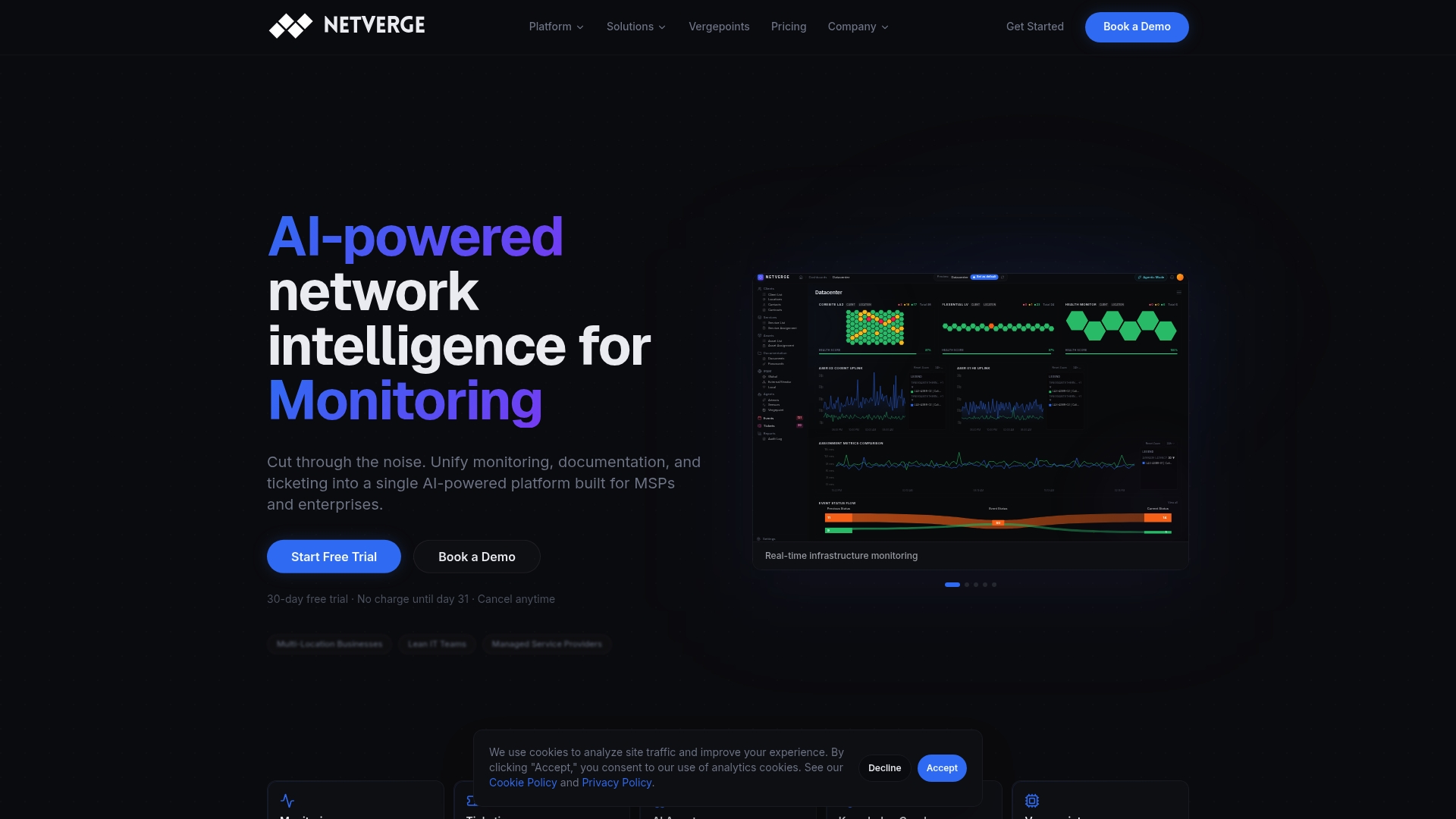
Netverge was built for exactly that. Vergepoints provide physical-layer telemetry from every site, feeding AI agents that detect anomalies, correlate events, and generate tickets automatically. The knowledge graph keeps network documentation current without manual updates. Technicians get context-rich alerts, not raw event floods. For MSPs tired of stitching together fragmented tools, Netverge consolidates AI-powered monitoring and intelligent ticketing into one interface, with no disconnected documentation systems and no alert fatigue from uncorrelated noise. See what Netverge can do for your network operations by requesting a demo at netverge.com.
Key Takeaways
AI in IT management delivers the most value when monitoring, ticketing, and remediation run from a unified, governed data model rather than disconnected point tools.
| Point | Details |
|---|---|
| Anomaly detection accuracy | Graph Neural Networks on digital twins distinguish local faults from structural failures, cutting false positive alerts. |
| Ticket triage at scale | AI categorizes, routes, and auto-closes tickets, reducing documentation overhead and escalation rates across the service desk. |
| IBN policy enforcement | Intent-based networking aligns automated network changes with business objectives, reducing configuration errors and improving compliance. |
| MSP productivity gains | Avtek Solutions saw a 233% increase in marketing open rates; Swisscom projects 200 hours saved per engineer annually from AI-assisted operations. |
| Netverge for MSPs | Netverge unifies AI monitoring, anomaly detection, and intelligent ticketing with Vergepoints hardware for physical-layer visibility across distributed networks. |