
IT operations efficiency is defined as the ability to maximize IT output, reduce waste, and deliver reliable services by applying structured process management across people, tools, and workflows. This it operations efficiency guide covers the techniques, tools, and frameworks that produce measurable results: BPM for IT teams can cut request-to-delivery times by up to 70%, and automation of repetitive tasks reduces operational costs by 15–30%. The industry terms for this discipline are IT operations management and IT service delivery optimization. Both describe the same goal: fewer manual steps, faster resolution, and higher service quality. This guide covers process mapping, Infrastructure as Code (IaC), and AIOps so you can apply each where it creates the most impact.
What prerequisites does an IT operations efficiency guide require?
Before you redesign any workflow, you need organizational readiness. That means leadership buy-in, a clear process owner for each workflow, and a shared definition of what "efficient" looks like in measurable terms. Without those three elements, even the best tools produce inconsistent results.
The foundational tools for IT process optimization fall into three categories:
- Business process management (BPM) software: Maps, automates, and monitors end-to-end IT workflows. BPM platforms track SLA compliance and generate audit trails that support continuous improvement.
- IaC pipelines: Tools like Terraform and Ansible codify infrastructure configuration so deployments are repeatable and version-controlled. IaC pipelines reduce deployment cycle times from 6 hours to 2 hours, tripling throughput.
- AI assistants and AIOps platforms: Automate alert triage, anomaly detection, and root cause correlation across distributed infrastructure.
Process mapping techniques are equally critical. SIPOC and value stream mapping expose hidden waiting times that automation tools alone cannot detect. A SIPOC diagram (Suppliers, Inputs, Process, Outputs, Customers) gives you a one-page view of any IT workflow. Value stream mapping goes deeper, showing where time is lost between steps.
| Tool category | Primary role | Key metric improved |
|---|---|---|
| BPM software | Workflow automation and SLA tracking | Request-to-delivery time |
| IaC pipelines | Repeatable infrastructure provisioning | Deployment cycle time |
| Process mapping (SIPOC, VSM) | Bottleneck identification | Cycle time, wait time |
| AIOps platforms | Anomaly detection and alert correlation | Mean time to restore service |
| AI assistants | Cognitive load reduction and ticket triage | First-contact resolution rate |

The cost of tool sprawl compounds quickly when teams use five separate platforms to do what one integrated system could handle. Consolidating visibility into a single interface is a prerequisite, not a nice-to-have.
How to apply IT process optimization techniques to increase efficiency
IT process optimization improves speed, quality, and error rates by replacing ad hoc workflows with documented, measurable processes. The starting point is always measurement, not action. You cannot fix what you have not mapped.
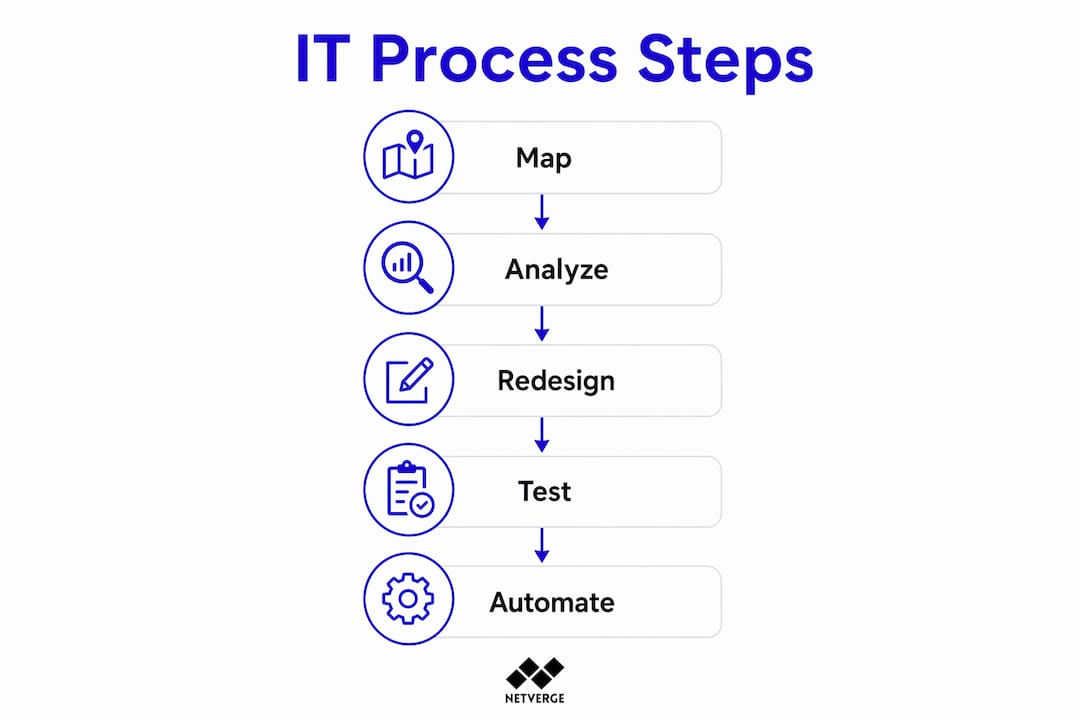
Follow these steps to redesign IT workflows effectively:
- Map the current state. Use SIPOC for a high-level view, then value stream mapping to capture every handoff, wait time, and decision point. Document cycle time and mean time to restore service as your baseline metrics.
- Identify root causes. Apply the Five Whys or Fishbone (Ishikawa) analysis to each bottleneck. Six Sigma Black Belt principles require you to distinguish between special-cause variation (a one-time incident) and common-cause variation (a systemic flaw).
- Redesign the workflow. Remove non-value-adding steps. Reduce handoffs. Set clear ownership for each task. Document the new process before touching any tooling.
- Pilot and measure. Run the redesigned process in a controlled environment. Track defect rates, SLA compliance, and first-contact resolution against your baseline.
- Scale and standardize. Once the pilot confirms improvement, codify the new process in your BPM platform and train the team. Rapid process improvement workshops compress this entire cycle from months to days.
Pro Tip: Never skip step 3 before moving to automation. Automating a flawed process accelerates errors, not efficiency. Map and fix first, then automate.
Common mistakes at this stage include measuring only ticket volume instead of cycle time, and treating process redesign as a one-time project rather than a continuous practice. IT workflow best practices treat every process as a living document that gets reviewed quarterly.
What role do automation and IaC play in improving IT operations efficiency?
Automation removes human error from repetitive tasks and frees your team for work that requires judgment. The efficiency gains are concrete: BPM automation saves an average of 280 staff hours annually while improving task completion rates and SLA tracking accuracy. That is roughly seven full work weeks returned to your team each year.
The three highest-value automation targets in IT operations are:
- Service desk: Automate ticket classification, routing, and first-response acknowledgment. Service desk automation cuts mean time to acknowledge and reduces the manual triage burden on Level 1 staff.
- Infrastructure provisioning: IaC pipelines replace manual server and network configuration with version-controlled code. This eliminates configuration drift and makes rollbacks straightforward.
- Deployments and patching: Scheduled automation handles patch cycles and deployment pipelines without requiring an engineer on call at 2:00 AM.
IaC adoption is not purely a coding project. IaC success depends on cultural change and data governance, not just writing Terraform scripts. Teams that skip governance early face scaling vulnerabilities: inconsistent state files, undocumented modules, and security gaps that grow with the infrastructure.
| Automation approach | Best for | Governance requirement |
|---|---|---|
| BPM workflow automation | Service desk, approvals, SLA tracking | Process ownership, audit trails |
| IaC pipelines | Server and network provisioning | Version control, state management |
| Scheduled job automation | Patching, backups, deployments | Change management policy |
| AI-driven alert automation | Anomaly detection, incident triage | Correlation rules, escalation paths |
Pro Tip: Before automating any process, confirm it produces the correct output manually at least 95% of the time. Automating a broken process does not fix it. It scales the problem.
IT automation also reduces labor and infrastructure costs when governed properly, improving autoscaling efficiency and cutting incidents caused by human error. The governance piece is what separates teams that save money from teams that create new categories of failure. Review the AI automation checklist for operations managers to verify your readiness before scaling any automation program.
How can AIOps enhance IT operational efficiency and resilience?
AIOps (Artificial Intelligence for IT Operations) applies machine learning to correlate telemetry, detect anomalies, and trigger automated remediation across complex infrastructure. The core benefit is speed: AIOps reduces disruption time and saves thousands of engineering hours by automating network issue detection and remediation that would otherwise require manual investigation.
Microsoft's 2026 IT operations guidance recommends integrating AI assistants directly into workflows to reduce cognitive load and operational risk. The key word is "integrating." Dropping an AI tool into a siloed workflow produces marginal gains. Embedding it across the full incident lifecycle, from detection through resolution and post-incident review, produces resilience.
AIOps delivers measurable advantages across several operational areas:
- Predictive issue remediation: Machine learning models identify patterns that precede failures, allowing teams to act before users are affected.
- Alert correlation: AIOps platforms group related alerts into a single incident, cutting alert noise by collapsing hundreds of individual notifications into one actionable event.
- Automated diagnostics: AI agents run initial diagnostics and gather context automatically, so engineers receive a pre-analyzed incident rather than a raw alert.
- Compliance and governance: Automated governance rules apply policy checks continuously, reducing the risk of configuration drift triggering a compliance violation.
- Cognitive load reduction: Engineers focus on complex problems rather than routine triage, which improves both job satisfaction and decision quality.
Practical AIOps applications in network management include real-time correlation of interface errors, latency spikes, and BGP route changes into a single root cause event. Without AIOps, that correlation requires an experienced engineer and 20–40 minutes. With it, the correlation happens in seconds. Explore AI-powered network management examples to see how these patterns apply to real infrastructure environments.
What I've learned about IT efficiency that most guides skip
Most IT efficiency discussions focus on tools. The harder problem is culture. I have watched teams deploy BPM platforms, IaC pipelines, and AIOps solutions, only to see efficiency stall because no one owned the process after go-live. Tools do not sustain improvement. People with clear accountability do.
The insight that changed how I approach this work: automation without process repair is the fastest way to scale a problem. Teams under pressure to show quick wins often automate the current broken process because redesigning it takes longer. The result is a faster, more consistent version of the wrong outcome.
The second thing most guides miss is the value of a single source of truth for network data. Fragmented tools create fragmented visibility. When your monitoring, ticketing, and documentation live in separate systems, your team spends time reconciling data instead of resolving issues. Unified platforms that connect telemetry, knowledge graphs, and automated diagnostics change the economics of IT operations management fundamentally.
My honest recommendation: start with process mapping before you buy anything. A two-day value stream mapping exercise will tell you more about where your efficiency losses live than any vendor demo. Then buy the tools that fix the specific gaps you found.
— Jim
How Netverge supports your IT efficiency goals
Netverge brings network monitoring, documentation, ticketing, and AI-driven automation into one platform, giving IT teams and MSPs a single interface for all critical infrastructure data.
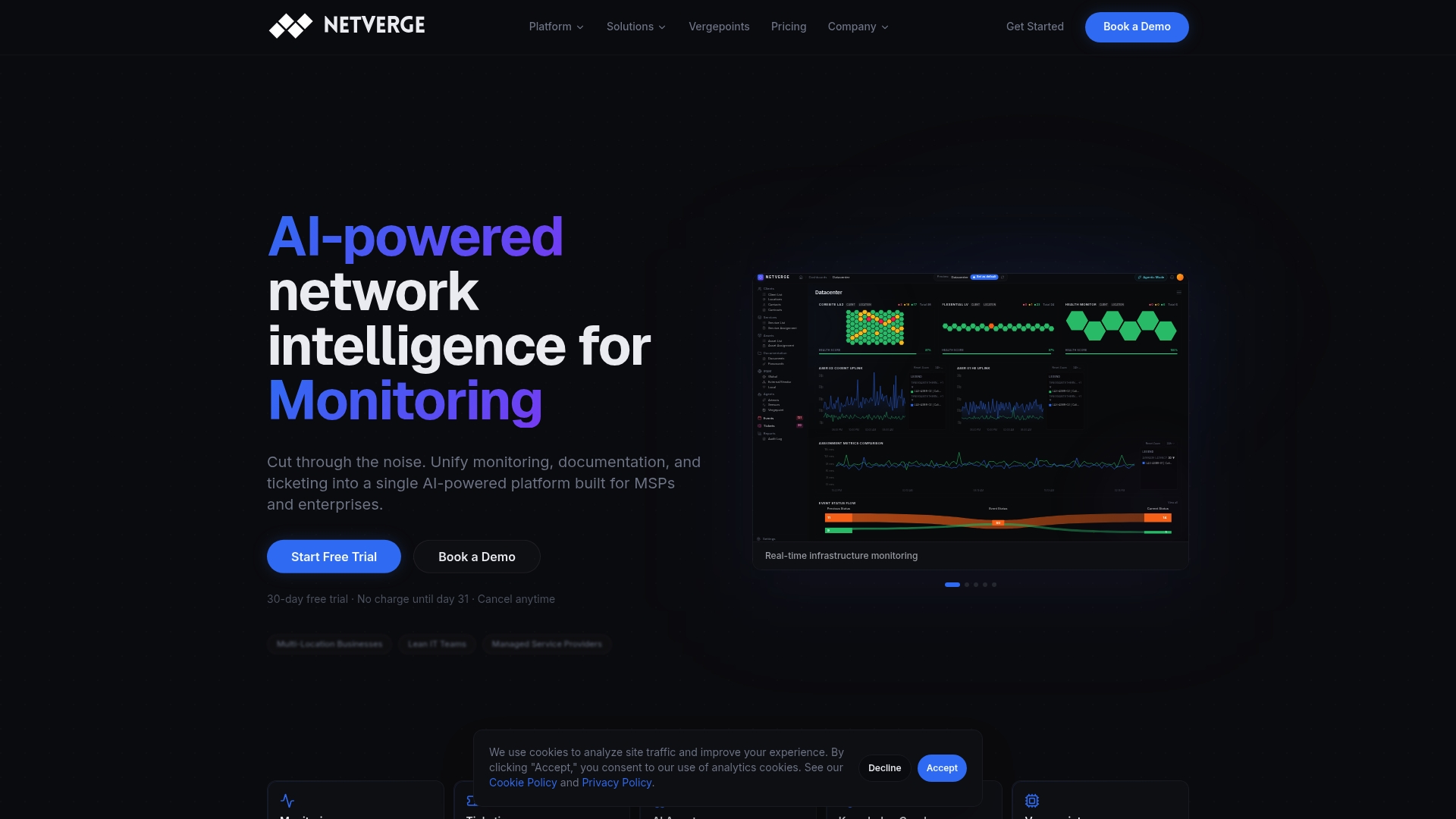
The platform's AI agents run automated diagnostics, correlate anomalies across distributed networks, and triage tickets without manual intervention. Vergepoints provide physical visibility at each site, while the knowledge graph connects infrastructure relationships so your team always has context before they act. For teams managing multi-location environments, Netverge's AI-powered monitoring replaces the fragmented tool stacks that slow incident response and inflate operational costs. MSPs can explore dedicated MSP network management capabilities built specifically for managing multiple client environments at scale.
Key Takeaways
Improving IT operations efficiency requires fixing processes before automating them, then applying AIOps and IaC to sustain gains at scale.
| Point | Details |
|---|---|
| Map before you automate | Use SIPOC and value stream mapping to identify bottlenecks before touching any tooling. |
| BPM delivers measurable ROI | Structured BPM cuts request-to-delivery times by up to 70% and saves 280 staff hours annually. |
| IaC requires governance, not just code | Cultural change and state management determine whether IaC scales safely or creates new vulnerabilities. |
| AIOps reduces disruption time | Machine learning correlates alerts and automates diagnostics, saving thousands of engineering hours per year. |
| Unified visibility is a prerequisite | Fragmented tools create fragmented data; a single platform for monitoring and ticketing is foundational. |
FAQ
What is IT operations efficiency?
IT operations efficiency is the ability to deliver IT services with minimal waste, faster cycle times, and consistent quality by applying structured process management, automation, and continuous measurement.
What is the fastest way to improve IT process optimization?
Rapid process improvement workshops compress the optimization cycle from months to days by moving directly from bottleneck identification to redesign and implementation in a structured sprint format.
How does IaC improve IT workflow best practices?
IaC codifies infrastructure configuration into version-controlled scripts, reducing deployment cycle times from 6 hours to 2 hours and eliminating configuration drift that causes incidents.
What metrics should IT teams track for operational efficiency?
Track defect rates, SLA compliance, first-contact resolution rate, cycle time, and mean time to restore service. These metrics provide the data foundation for continuous improvement decisions.
How does AIOps differ from standard IT automation?
Standard automation executes predefined rules. AIOps applies machine learning to detect patterns, correlate events across systems, and trigger context-aware remediation that static rules cannot anticipate.