
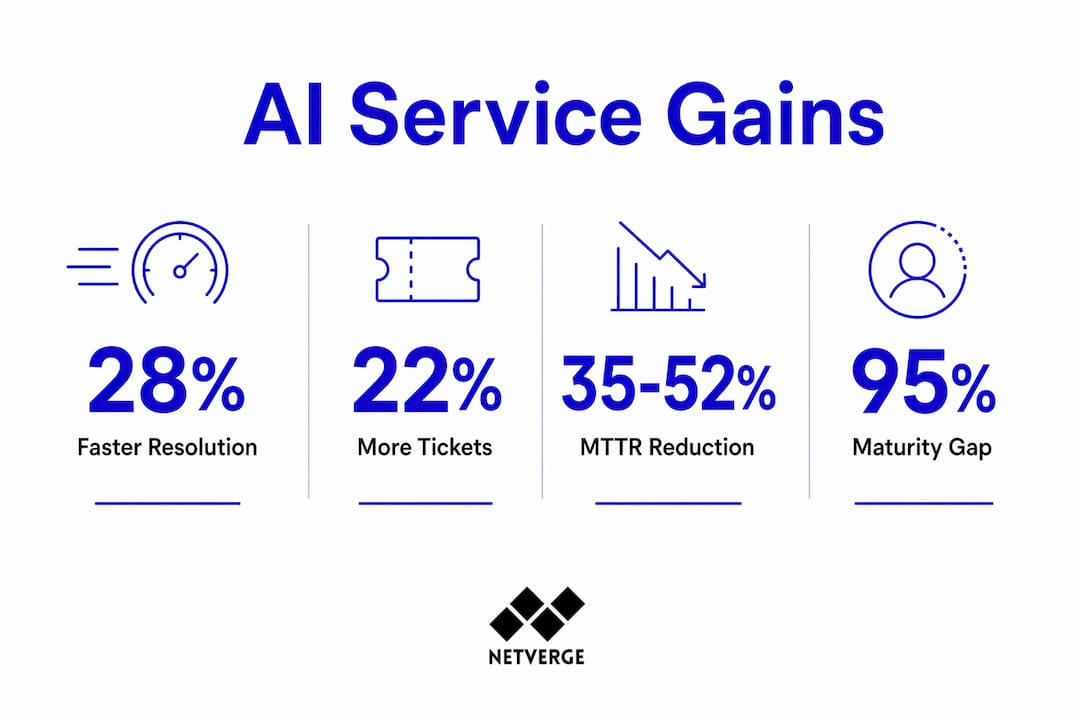
The role of AI in service efficiency is to automate routine tasks, accelerate incident resolution, and shift IT operations from reactive to proactive. AI-powered IT service desks now achieve 40–60% ticket auto-resolution rates, cutting cost-per-ticket by 38–52%. Mean time to resolution (MTTR) falls by 35–52% when AI triage and automation handle first-line classification. For IT decision-makers and operations managers, these are not projections. They are 2026 benchmarks that define what modern service management looks like when artificial intelligence for service enhancement is deployed correctly.
How does AI improve service efficiency in IT operations?
AI improves service efficiency by removing the manual bottlenecks that slow down ticket handling, incident triage, and knowledge routing. Traditional IT service management (ITSM) depends on agents reading, categorizing, and assigning tickets by hand. AI replaces that process with automated classification, priority scoring, and resolution suggestions delivered in seconds.
The productivity gains are concrete. AI pre-processing reduces resolution time by 28% and enables IT agents to handle 22% more tickets daily. That means a team of ten agents effectively performs the work of twelve or thirteen without adding headcount. The efficiency gain compounds over time as the AI model learns from resolved tickets and refines its suggestions.

AI also powers self-service portals that deflect tickets before they reach an agent. When a user submits a request, AI matches it against a governed knowledge base and returns a resolution instantly. Strong knowledge base governance correlates with up to 63% higher employee satisfaction and measurably faster resolution speed. The knowledge base is not a passive library. It is the engine that determines how well AI performs.
The four core mechanisms driving AI-powered ITSM efficiency are:
- Automated triage and classification: AI reads incoming tickets, assigns categories, and routes them to the correct queue without human input.
- Resolution suggestions: AI surfaces relevant knowledge base articles and past resolutions before an agent opens the ticket.
- Self-service deflection: AI handles password resets, access requests, and common software issues directly, with no agent involvement.
- Incident correlation: AI links related tickets to a single root cause, preventing duplicate work across the team.
Pro Tip: Before deploying AI triage, audit your ticket taxonomy. Inconsistent category labels are the single fastest way to degrade AI classification accuracy. Clean data in means accurate routing out.
What is the impact of AI on network operations?
AI's impact on network operations goes beyond ticket handling. In network management, AI agents perform autonomous triage and remediation, diagnosing faults and executing fixes without waiting for a human engineer to respond. Telco and network operators deploying AI agents reduce network problem-solving times by 50–80%, shifting operational expenses from manual labor to AI orchestration.
That shift matters for MSPs and multi-location enterprises managing distributed infrastructure. When a link degrades at 2:00 AM, an AI agent detects the anomaly through telemetry correlation, isolates the affected segment, and initiates a remediation workflow. A human engineer reviews the outcome in the morning rather than being paged in the middle of the night. For more on how this works in practice, see autonomous network management and the operational models it enables.
The key capabilities AI brings to network operations include:
- Anomaly detection: AI monitors telemetry streams continuously and flags deviations from baseline behavior before they cause outages.
- Root cause analysis: AI correlates events across multiple network layers to identify the source of a fault, not just its symptoms.
- Automated remediation: AI agents execute predefined playbooks to resolve known fault types without human intervention.
- Capacity forecasting: AI analyzes traffic patterns to predict congestion and recommend configuration changes proactively.
One design principle separates effective AI network agents from unreliable ones. The "glass box" approach combines autonomous AI decision-making with human oversight. AI agents explain their conclusions and the reasoning behind each action, unlike traditional machine learning models that produce outputs with no visible logic. That transparency increases trust and makes it easier for engineers to validate or override AI decisions.
"The shift to AI-driven operations replaces manual triage with autonomous agents but keeps human oversight to retain trust and visibility. Transparency in AI decision-making is not optional. It is the condition that makes autonomous operations acceptable to the teams responsible for uptime."
What challenges limit AI's efficiency gains in service operations?
AI does not automatically produce efficiency gains. The maturity gap in ITSM is significant: 95% of organizations use AI in some form, but only 12% have fully mature, proactive operations. That gap explains why many teams deploy AI and see modest results. The technology is not the constraint. The underlying processes are.
AI amplifies poor workflows rather than correcting them. If incident categories are inconsistent, AI will classify tickets inconsistently at scale. If escalation paths are undocumented, AI cannot route tickets correctly. The organizations that see the strongest AI ROI are those that formalized their ITSM processes before deploying AI, not after.
Data quality creates a second barrier. Stale configuration data and poor data governance cause AI to generate "hallucinated" resolutions. Those false resolutions create new support tickets, which erases the efficiency gains AI was supposed to deliver. Monitoring AI inference costs and output accuracy is not a post-deployment task. It must be built into the operating model from day one.
The most common barriers to AI efficiency in service operations are:
- Undocumented or tribal knowledge that AI cannot access or learn from
- Fragmented data across disconnected monitoring tools and ticketing systems
- No defined ownership of AI performance metrics or governance processes
- Leadership expectations that outpace the organization's actual process maturity
- Absence of clear ROI metrics, making it impossible to evaluate whether AI is working
Pro Tip: Run an ITSM process audit before selecting an AI tool. Document your top 20 ticket categories, their resolution steps, and their owners. That documentation becomes the training foundation your AI depends on.
Best practices for implementing AI to drive service efficiency
Effective AI deployment in service operations follows a sequence. Organizations that skip steps in that sequence consistently underperform. The practices below reflect what separates teams that achieve measurable efficiency gains from those that stall after initial deployment.
- Govern your knowledge base first. AI self-service and triage both depend on accurate, current knowledge articles. Assign ownership to each article, set review cycles, and retire outdated content before AI touches it.
- Start with a controlled pilot. Iterative AI deployment in isolated environments reduces risk. Pick one ticket category or one network segment, measure results, and expand only after the model performs reliably.
- Build audit trails for AI decisions. AI agents require documented reasoning trails that capture not just what the AI did but why. Those trails are essential for compliance, debugging, and engineer trust.
- Keep humans in the loop for high-risk actions. Automate password resets and low-risk ticket resolutions fully. Require human approval for changes to production network configurations or security policies.
- Track the right metrics from day one. Efficiency without measurement is assumption. Monitor cost-per-ticket, MTTR, customer satisfaction (CSAT), and AI deflection rate weekly.
The table below shows how to evaluate AI deployment maturity across three operational stages:
| Stage | Characteristics | Primary focus |
|---|---|---|
| Early (reactive) | Manual triage, no AI automation | Process documentation, data cleanup |
| Developing (assisted) | AI suggests, humans decide | Ticket classification accuracy, MTTR reduction |
| Mature (autonomous) | AI resolves and routes independently | Deflection rate, CSAT, cost-per-ticket |
For a detailed look at how these practices apply to service desk operations specifically, the service desk best practices guide covers 2026 workflows in depth. Teams managing network infrastructure can also benefit from reviewing AI triage in network outages to understand how autonomous agents handle fault detection in real environments. For broader context on AI-driven managed services and cost-per-ticket reductions, the outcomes across the technology sector are consistent with the benchmarks above.
Key Takeaways
AI delivers measurable service efficiency gains only when deployed on a foundation of documented processes, governed data, and clearly defined metrics.
| Point | Details |
|---|---|
| AI reduces MTTR significantly | AI triage and automation cut mean time to resolution by 35–52% in production ITSM environments. |
| Maturity gap limits most deployments | Only 12% of organizations have fully mature AI operations; process discipline determines AI ROI. |
| Network AI cuts problem-solving time | AI agents reduce network fault resolution time by 50–80%, replacing manual overnight triage. |
| Knowledge base quality is the foundation | AI self-service accuracy depends directly on governed, current knowledge articles with clear ownership. |
| Audit trails are non-negotiable | AI agents must document their reasoning, not just their actions, to maintain engineer trust and compliance. |
Why I think most AI deployments underperform for the wrong reasons
I have watched organizations spend significant budget on AI-powered ITSM tools and then report disappointing results six months later. The pattern is almost always the same. The technology worked. The processes underneath it did not.
The uncomfortable truth about AI in service operations is that it is a process accelerator, not a process fixer. If your incident categories are a mess, AI will categorize tickets messily at high speed. If your knowledge base has articles from three years ago that no one has reviewed, AI will confidently serve outdated resolutions to users. The speed AI adds makes bad process more visible, not less.
What I have found actually works is treating AI deployment as a process improvement project that happens to use AI, rather than an AI project that will improve your processes. That means doing the unglamorous work first: auditing ticket categories, assigning knowledge base owners, documenting escalation paths, and defining what "resolved" actually means in your environment.
The organizations I have seen get real results from AI-driven service operations share one trait. They were already running disciplined ITSM before they added AI. The AI did not create their efficiency. It multiplied efficiency they had already built. That is a harder message to sell to a leadership team looking for a quick win, but it is the accurate one.
— Jim
Netverge's AI-powered platform for service and network efficiency
Netverge unifies network monitoring, ticketing, and AI-driven automation into a single platform built for MSPs and multi-location enterprises. Its autonomous AI agents handle anomaly detection, incident triage, and remediation across distributed infrastructure, reducing the manual workload that slows down operations teams.
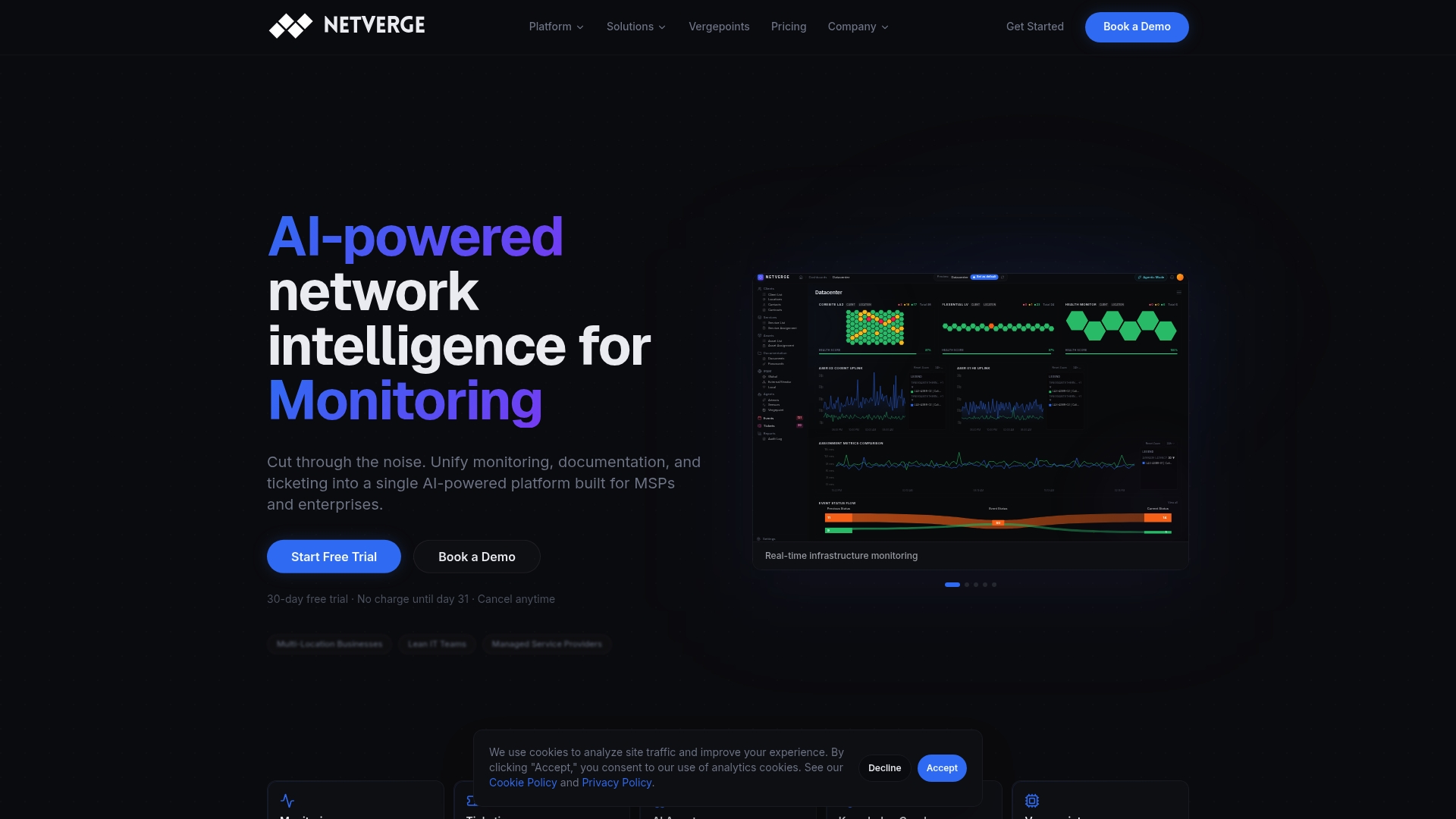
The platform's AI-powered network monitoring delivers real-time telemetry correlation, automated fault isolation, and proactive alerting before issues affect users. The AI ticketing and service desk module applies intelligent triage and resolution suggestions to every incoming ticket, cutting resolution time and freeing agents for complex work. If your team is ready to move from reactive to proactive operations, Netverge gives you the infrastructure to do it.
FAQ
What is the role of AI in service efficiency?
AI automates ticket triage, classification, and resolution to reduce manual workload and cut MTTR by 35–52%. It shifts IT operations from reactive incident response to proactive, data-driven service management.
How much can AI reduce ticket resolution time?
AI pre-processing reduces resolution time by 28% and enables agents to handle 22% more tickets daily, according to 2026 ITSM benchmarks.
Why do most AI ITSM deployments underperform?
Only 12% of organizations have fully mature AI operations. Most deployments stall because underlying processes are undocumented, data quality is poor, or governance structures are missing.
What is the "glass box" approach in AI network management?
The glass box approach combines autonomous AI decision-making with human oversight by requiring AI agents to explain their reasoning. This transparency builds engineer trust and supports compliance in production network environments.
What metrics should I track to measure AI service efficiency?
Track cost-per-ticket, MTTR, AI deflection rate, and CSAT weekly. These four metrics together show whether AI is delivering real efficiency or simply shifting work between queues.