
AI-powered infrastructure troubleshooting is the practice of using AI models, structured telemetry, and automated remediation to diagnose and resolve network issues faster than any manual process allows. The industry term for this discipline is AIOps, and it covers the full incident lifecycle from detection through postmortem. Triage time drops from 15–30 minutes to seconds when AI surfaces ranked causal hypotheses with provenance data. For IT professionals and network engineers managing multi-site environments, that speed difference is the gap between a contained incident and a full outage. This ai-powered infrastructure troubleshooting guide covers prerequisites, lifecycle stages, safety controls, and multi-site scaling in a practical sequence you can follow today.
What prerequisites are vital for AI-powered infrastructure troubleshooting?
Effective AI troubleshooting starts with clean, consistent telemetry. AI models cannot reason accurately over fragmented or inconsistently labeled data. Fixing telemetry with OpenTelemetry and semantic conventions is the required first step before you introduce any AI-assisted triage or autonomous remediation.
Telemetry and tooling essentials

| Category | Requirement | Why it matters |
|---|---|---|
| Metrics | OpenTelemetry SDK instrumentation | Provides consistent, vendor-neutral metric collection |
| Traces | Distributed tracing with service metadata | Enables cross-service root-cause correlation |
| Logs | Structured JSON Lines schema | Prevents AI hallucinations during diagnostic reasoning |
| Alerts | Deduplication and topology-based grouping | Reduces noise so AI agents see signal, not clutter |
| Inventory | Consistent service and site metadata | Allows AI to map alerts to affected topology accurately |
Alert correlation is not optional. Without topology-aware grouping, a single upstream failure at one site generates dozens of dependent alerts. Your AI agent then treats each alert as a separate incident, producing redundant work instead of a single correlated diagnosis. Intelligent alerting tools that deduplicate and group by dependency graph are the foundation of any real-time alerting process worth building on.
- Adopt OpenTelemetry for metrics, traces, and logs across all sites
- Define semantic conventions for service names, environments, and regions
- Standardize a universal JSON Lines schema at every telemetry ingestion point
- Configure alert deduplication and suppression rules before enabling AI agents
- Tag all assets with consistent site and role metadata
Pro Tip: Never skip the schema standardization step. A universal ingestion schema at the telemetry layer is what separates AI models that reason correctly from models that hallucinate plausible-sounding but wrong diagnoses.
How does the AI troubleshooting lifecycle work in multi-site environments?
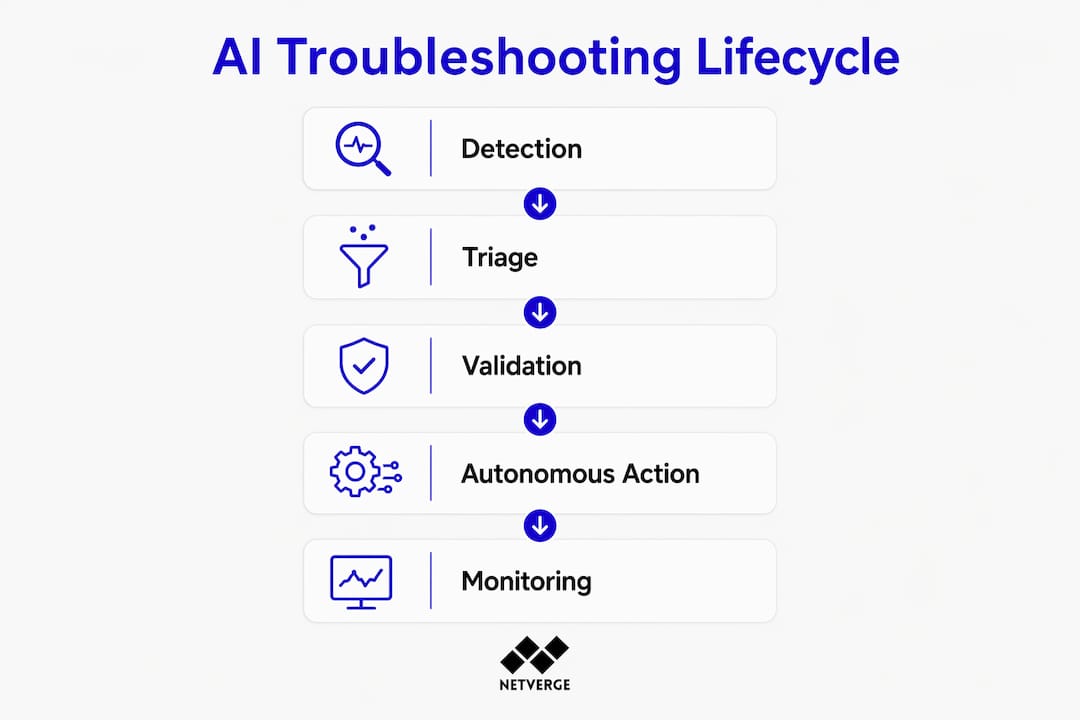
The AI incident lifecycle has six distinct phases. Each phase replaces a manual step that traditionally required an on-call engineer to act. Understanding the sequence helps you identify where to automate first and where to keep humans in the loop.
- Detection. AI agents monitor telemetry continuously and flag anomalies the moment thresholds or learned baselines are crossed. No waiting for a human to notice a dashboard spike.
- Triage. The agent acknowledges the incident, correlates related alerts, and ranks causal hypotheses with provenance data. Ranked causal hypotheses give the on-call engineer immediate context rather than a raw alert dump.
- Diagnosis. The agent queries topology graphs, traces, and logs to isolate the root cause. Research shows that separating evidence acquisition from hypothesis commitment improves root-cause accuracy by up to 37 percentage points compared to free-form large language model methods.
- Remediation. The agent executes a fix within a policy envelope defined by human-authored runbooks. YAML-encoded runbooks act as guardrails, preventing the agent from taking actions outside approved boundaries.
- Verification. The agent confirms the fix resolved the anomaly by checking telemetry post-action. If the anomaly persists, the agent triggers rollback automatically.
- Postmortem. The agent logs the full action trail with timestamps and decision rationale, giving your team an audit record without manual documentation effort.
Pro Tip: Deploy your AI agent in read-only diagnosis mode first. Typical time-to-value for read-only diagnosis is approximately one week, and it lets you validate model accuracy before you grant any remediation permissions.
A phased rollout follows naturally from the lifecycle. Start with detection and triage only. Validate accuracy over two to four weeks. Then enable remediation for low-risk, high-frequency tasks like pod restarts and certificate renewals. AI achieves 60–80% automation for nightly routine tasks once telemetry and runbooks are properly configured. That figure represents real toil reduction, not theoretical capacity.
What best practices ensure safe autonomous remediation via AI?
Autonomous remediation carries real risk. A misconfigured policy envelope can turn a fix attempt into an outage. The safest approach is to treat autonomy as something you earn through demonstrated accuracy, not something you grant at deployment.
- Set a confidence threshold of 95% or higher before enabling automatic execution on any action class
- Define blast-radius caps that limit how many hosts, services, or sites a single automated action can affect
- Require automatic rollback if post-action telemetry does not confirm resolution within a defined window
- Restrict the agent's initial scope to a single site or service category
- Increase autonomy incrementally as trust scores improve over time
The top misconception is treating AI as a replacement for human runbooks. Human-authored runbooks are the policy layer that keeps autonomous agents within safe operational boundaries. Remove them and you remove the guardrails. AI incident response puts an agent in the responder seat first, but always within the policy envelopes set by engineers.
Measure what matters. Meaningful metrics include auto-resolution rate, rollback rate on autonomous actions, mean time to resolution (MTTR), 3 AM page volume, and toil hours saved. Vanity metrics like total AI actions taken skew perception and hide problems. A high action count with a high rollback rate signals a misconfigured agent, not a productive one.
Pro Tip: Track rollback rate weekly during the first 90 days. A rollback rate above 5% on any action class is a signal to pause autonomy for that class and review the runbook logic before re-enabling.
How to integrate and scale AI troubleshooting across multiple sites?
Multi-site infrastructure introduces challenges that single-site deployments never face. Latency between sites, inconsistent asset tagging, and siloed telemetry pipelines all degrade AI diagnostic accuracy. Centralized telemetry pipelines with consistent service metadata and policy management are the architectural requirement for safe cross-site orchestration.
- Centralize telemetry ingestion. Route all site telemetry through a single pipeline with a shared schema. Fragmented pipelines produce fragmented context.
- Apply topology-aware correlation. Configure suppression rules so dependent site failures generate one correlated alert, not dozens of independent ones.
- Use declarative policy management. Store remediation policies as version-controlled YAML files. This gives you auditability and makes cross-site policy updates a single commit.
- Assign site-level blast-radius caps. A remediation action at a hub site carries more risk than the same action at a branch. Caps should reflect that asymmetry.
- Monitor cross-site consistency. Audit service metadata and schema compliance across sites monthly. Drift in tagging conventions degrades AI accuracy over time.
| Scaling challenge | Recommended control |
|---|---|
| Inconsistent asset metadata across sites | Enforce schema validation at ingestion |
| Alert storms from dependent failures | Topology-aware suppression and grouping |
| Policy drift between sites | Declarative, version-controlled YAML policies |
| Uneven AI accuracy across sites | Per-site accuracy audits before enabling autonomy |
AI-powered network management at scale requires treating policy management as code. Engineers who manage policies through UI forms instead of version-controlled files lose auditability fast. That loss becomes a compliance problem when an autonomous action causes an incident and you cannot reconstruct the decision chain. For teams building out data center infrastructure, power and resilience planning is an equally critical layer to address before scaling autonomous remediation across sites.
Key Takeaways
AI-powered infrastructure troubleshooting requires clean telemetry, human-authored policy guardrails, and a phased autonomy rollout to deliver reliable, safe incident resolution across multi-site environments.
| Point | Details |
|---|---|
| Fix telemetry first | Adopt OpenTelemetry and a universal JSON Lines schema before deploying any AI agent. |
| Phase your autonomy rollout | Start read-only, validate 95%+ accuracy, then enable remediation with blast-radius caps. |
| Runbooks are guardrails | Human-authored YAML runbooks define the policy envelope that keeps AI agents safe. |
| Measure resolution, not activity | Track MTTR, auto-resolution rate, and rollback rate. Ignore total action counts. |
| Centralize for multi-site scale | Unified telemetry pipelines and declarative policies are required for cross-site AI orchestration. |
What I've learned after years of watching AI troubleshooting rollouts fail
Most rollouts I've seen fail at the same point: teams grant remediation permissions before they trust the model's diagnosis. They see the demo, the accuracy looks good in staging, and they flip the switch in production. Then a blast-radius misconfiguration takes down three sites instead of restarting one pod, and the entire AI program gets shelved for six months while trust is rebuilt.
The teams that succeed treat the first 90 days as a trust-building exercise, not a deployment. They run the agent in read-only mode, review its ranked hypotheses daily, and correct the runbooks where the agent's reasoning diverges from what an experienced engineer would do. By the time they enable autonomous remediation, the agent has already proven itself on hundreds of real incidents.
Human expertise does not become less valuable when AI handles routine triage. It becomes more focused. Engineers stop spending cognitive energy on 3 AM pod restarts and spend it on the architectural decisions that prevent incidents in the first place. That shift is the real return on investment, and it shows up in toil hours saved, not in action counts. If you want a practical starting point, the infrastructure performance optimization guide from Netverge lays out the adoption phases clearly.
The uncomfortable truth is that AI troubleshooting is only as good as the runbooks behind it. Engineers who treat runbooks as a one-time setup task will have an agent that drifts out of alignment with operational reality within months. Treat runbooks as living documents, review them after every rollback, and your AI agent gets better over time instead of worse.
— Jim
Netverge's AI-powered monitoring for multi-site infrastructure teams
Netverge unifies network visibility, telemetry, ticketing, and autonomous AI agents into a single platform built for MSPs and multi-location enterprises.
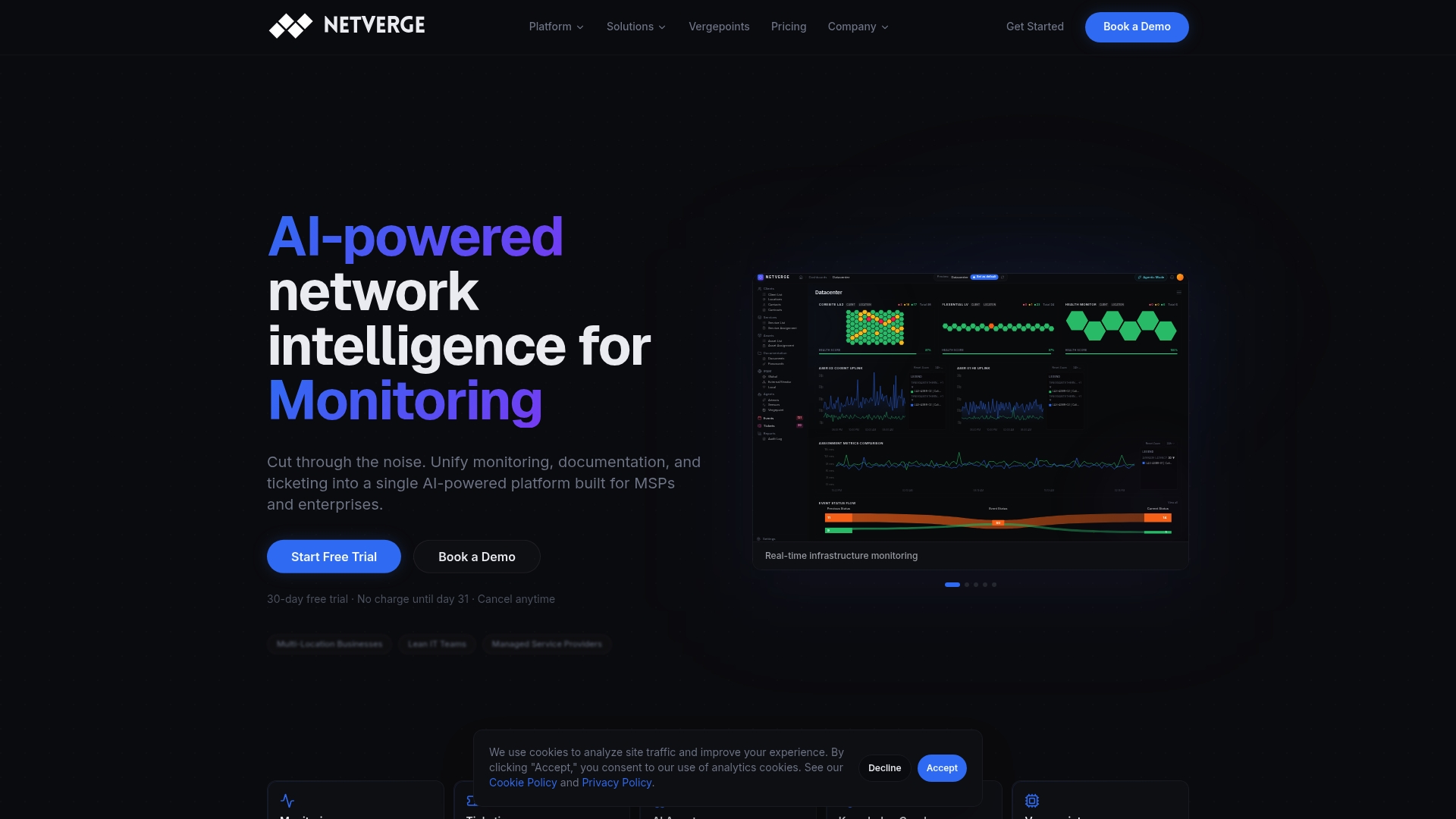
The platform connects directly to your existing telemetry and alerting infrastructure, so you do not need to rip and replace your current stack. Netverge's AI-powered network monitoring delivers real-time anomaly detection, intelligent ticket triage, and automated remediation with full audit trails. Its no-code AI agent designer lets your team build and modify remediation workflows without writing custom code. For teams ready to move from fragmented monitoring tools to a unified, AI-driven operations platform, Netverge is the direct path forward. Request a demo to see the platform in action across a multi-site environment.
FAQ
What is AI-powered infrastructure troubleshooting?
AI-powered infrastructure troubleshooting, also called AIOps, uses AI models and structured telemetry to detect, diagnose, and remediate network and infrastructure incidents automatically. It reduces manual triage time from 15–30 minutes to seconds by surfacing ranked causal hypotheses with supporting evidence.
What telemetry standard should I adopt first?
OpenTelemetry is the required foundation. It provides vendor-neutral instrumentation for metrics, traces, and logs, and its semantic conventions give AI agents the consistent data labels they need for accurate diagnosis.
How do I keep autonomous remediation safe?
Set a confidence threshold of 95% or higher, define blast-radius caps per action class, and require automatic rollback if post-action telemetry does not confirm resolution. Start with advisory-only mode and increase autonomy incrementally as accuracy is validated.
What metrics actually measure AI troubleshooting success?
Track auto-resolution rate, rollback rate, MTTR, 3 AM page volume, and toil hours saved. Total AI actions taken is a vanity metric that can mask a poorly configured agent with a high rollback rate.
How does multi-site infrastructure change AI troubleshooting requirements?
Multi-site environments require centralized telemetry pipelines, topology-aware alert correlation, and version-controlled declarative policies. Without these controls, dependent site failures generate alert storms and AI agents lose the context needed for accurate cross-site diagnosis.