
Zero touch provisioning automates a device's initial setup so it becomes operational without manual configuration, cutting deployment time and reducing configuration errors across every site. Modern implementations lean on security standards like RFC 8572 and FIDO Device Onboard to keep that automation trustworthy, and platforms such as Netverge extend the same automation into ongoing monitoring once devices come online.
TL;DR:
- A 2025 evaluation found bare metal deployment fell by up to 94%, from about two hours to nine minutes, while virtual machine deployment fell 60%.
- MSPs should start with high volume, lower risk branch routers and edge switches, then expand after a single site pilot and tested rollback.
- RFC 8572 treats DNS and DHCP as untrusted, so use signed artifacts, mutual authentication, scheduled trust anchor rotation, and redirect limits before production rollout.
- Route report progress events into existing alerting, and verify configuration, connectivity, and registration with smoke tests to catch stalled onboarding before support calls.
Table of Contents
- Why ZTP Matters: Scale, Speed, and Error Reduction
- How ZTP Works: The Bootstrapping Workflow
- Standards and Security: RFC 8572, FDO, and Trust Controls
- Benefits: Measurable Wins and Secondary Gains
- Implementation Checklist for Safe ZTP Rollouts
- How MSPs and Multi-Site Teams Should Prioritize ZTP
- The Real Priority in ZTP Rollouts
- Supporting ZTP Rollouts With Unified Monitoring
- FAQ
- Sources
Why ZTP Matters: Scale, Speed, and Error Reduction
Rolling out network hardware the traditional way means flights to branch offices, manual CLI sessions, and configuration drift the moment one technician deviates from the runbook. Every manual touchpoint is a chance for a typo, a missed VLAN, or a skipped firmware update.
A 2025 evaluation recorded up to a 94% reduction in bare metal deployment time (from roughly two hours to about nine minutes), and a 60% reduction for virtual machine deployments, when comparing automated zero touch provisioning against manual methods, according to research published in Open Research Europe. That gap compounds fast across a multi-site estate.
ZTP delivers the highest return in a few specific settings:
- Branch and WAN rollouts, where dozens of identical sites need identical configurations without a technician on-site.
- Edge and IoT deployments, where device counts are high and per-unit labor cost has to stay near zero.
- Data center rack builds, where consistency between racks matters more than any single device's configuration.
How ZTP Works: The Bootstrapping Workflow
Despite vendor differences, most zero touch provisioning flows follow the same sequence from unboxing to a fully managed device.
- The device boots from factory defaults with no stored configuration.
- It attaches to the network and requests addressing and bootstrap details, typically through DHCP or PXE.
- The network redirects it, either to a vendor-hosted redirect service or directly to a trusted bootstrap server.
- The device fetches its configuration image, firmware, and onboarding artifacts from that server.
- Pre-configuration scripts run to apply baseline settings, certificates, and policies.
- The device commits the configuration and registers itself with the management or orchestration platform.
Three architectural variants cover most real deployments:
- PXE-based bare metal provisioning, common for servers and appliances that boot a full image over the network.
- VM and container cloud-native onboarding, where cloud-init or similar tooling applies configuration after the instance spins up.
- Vendor redirect versus trusted bootstrap server, where some vendors route devices through a hosted redirect step before handing off to the operator's own bootstrap infrastructure.
During each step, the device and the bootstrap server exchange status information. A well-built workflow logs network attach, redirect acceptance, artifact download, and commit confirmation, so a failure at any stage is visible rather than silent. Common failure modes include DHCP scope exhaustion, expired or mismatched trust anchors, unreachable bootstrap servers behind firewalls, and devices that stall on a corrupted image fetch. Decentralized architectures that pair a central coordinator with local agents running MAAS and cloud-init avoid opening inbound access to remote sites while still supporting both bare metal and VM provisioning paths, which matters for teams managing fragmented or air-gapped networks.
Standards and Security: RFC 8572, FDO, and Trust Controls
Automated provisioning only works at scale when the device can verify that what it is receiving actually came from the owner, not from whoever answered the DHCP request first. RFC 8572 defines Secure Zero Touch Provisioning (SZTP), specifying onboarding information, ownership vouchers, bootstrap server behavior, and a trust-state algorithm that governs which onboarding artifacts a device is allowed to process. The RFC treats DNS and DHCP as untrusted sources by default, and it caps the number of recursive redirects a device will follow during discovery, since an unbounded redirect chain is an easy attack vector. It also defines a report-progress RPC so bootstrap servers get visibility into exactly where a device sits in the onboarding process.

FIDO Device Onboard (FDO) complements this with device identity flows built around mutual authentication, letting a device prove who it is to the server and the server prove it to the device before any configuration changes hands.
Practical controls worth building into any ZTP rollout:
- Signed onboarding artifacts, never plaintext configuration files.
- TLS with mutual authentication between device and bootstrap server.
- A defined trust anchor list, rotated on a schedule.
- Redirect limits to prevent chained handoffs from masking a compromised intermediary.
- Report-progress telemetry wired into a central monitoring system.
Benefits: Measurable Wins and Secondary Gains
The time savings are the headline, but they are not the only payoff. Beyond the 94% bare metal and 60% VM deployment time reductions, consistent automated provisioning removes the variation that comes from different technicians interpreting the same runbook differently.
Secondary benefits tend to matter just as much over a year of operations:
- Inventory accuracy improves because every device registers itself at commit time instead of waiting for a manual asset update.
- License activation happens automatically as part of the onboarding script, removing a common post-install follow-up task.
- Patching and firmware updates ship faster because the same pipeline that provisions new devices can push updates to existing ones.
Implementation Checklist for Safe ZTP Rollouts
A rollout succeeds or fails based on what happens before the first device ever boots. Work through these phases in order.
- Map your device inventory and site list, including which devices support SZTP or FDO natively.
- Define a trust anchor and certificate plan before touching production DHCP scopes.
- Stand up bootstrap server architecture, deciding between a vendor redirect and a fully trusted in-house server.
- Prepare DHCP and PXE infrastructure, including scope sizing for peak rollout windows.
- Run staged canary deployments on a small device subset before a full site rollout.
- Build automated smoke tests that verify configuration, connectivity, and registration post-provisioning.
- Wire report-progress telemetry into your observability stack so failures surface immediately.
- Define rollback procedures and blast-radius containment before the first large batch ships.
- Establish ongoing operations: certificate rotation schedules, lifecycle update windows, and change control sign-off.
Pro Tip: Run your first production ZTP batch at a single site with a rollback plan already tested, not theorized, before scaling to a second site.
Monitoring doesn't stop once a device commits its configuration. Feeding bootstrap events into the same operational workflow that handles day-two troubleshooting keeps governance consistent from first boot onward.
How MSPs and Multi-Site Teams Should Prioritize ZTP
MSPs managing dozens of client networks get the most value automating the highest-volume, lowest-risk device types first: branch routers and edge switches, not core infrastructure. Bootstrap telemetry from the SZTP report-progress RPC should route straight into whatever system already handles alerting, so a stalled provisioning job triggers a ticket instead of a support call three days later.

That data pipeline is also where AI-driven network management earns its place, turning raw bootstrap events into pattern detection across sites. Governance should lag automation by one step: lock down trust anchors and change control before scaling beyond pilot sites, not after. Teams evaluating platform support for this can look at Netverge's Starter Package and Vergepoints hardware for site-level visibility.
The Real Priority in ZTP Rollouts
Most ZTP advice fixates on the bootstrap sequence itself: DHCP, PXE, redirect, commit. That sequence is well understood and rarely where rollouts actually fail. The failures we should be more worried about happen in governance: expired trust anchors nobody rotated, a bootstrap server left reachable from the open internet, or a canary test that passed without exercising the rollback path.
Teams that treat ZTP purely as a speed project tend to underinvest in report-progress observability, which is the piece that turns a silent failure into a page at 2 AM for someone, or a quiet ticket the next morning instead.
Prioritize trust anchor management and telemetry before you prioritize shaving more minutes off the bootstrap sequence. The minutes matter less than whether you can trust what just got provisioned.
— Jim
Supporting ZTP Rollouts With Unified Monitoring
Zero touch provisioning gets devices online fast, but someone still has to watch what happens after commit. Some platforms are designed to pick up exactly there: real-time infrastructure monitoring, anomaly detection, and AI-powered ticket triage that catches a misconfigured device before it becomes a client-facing outage.
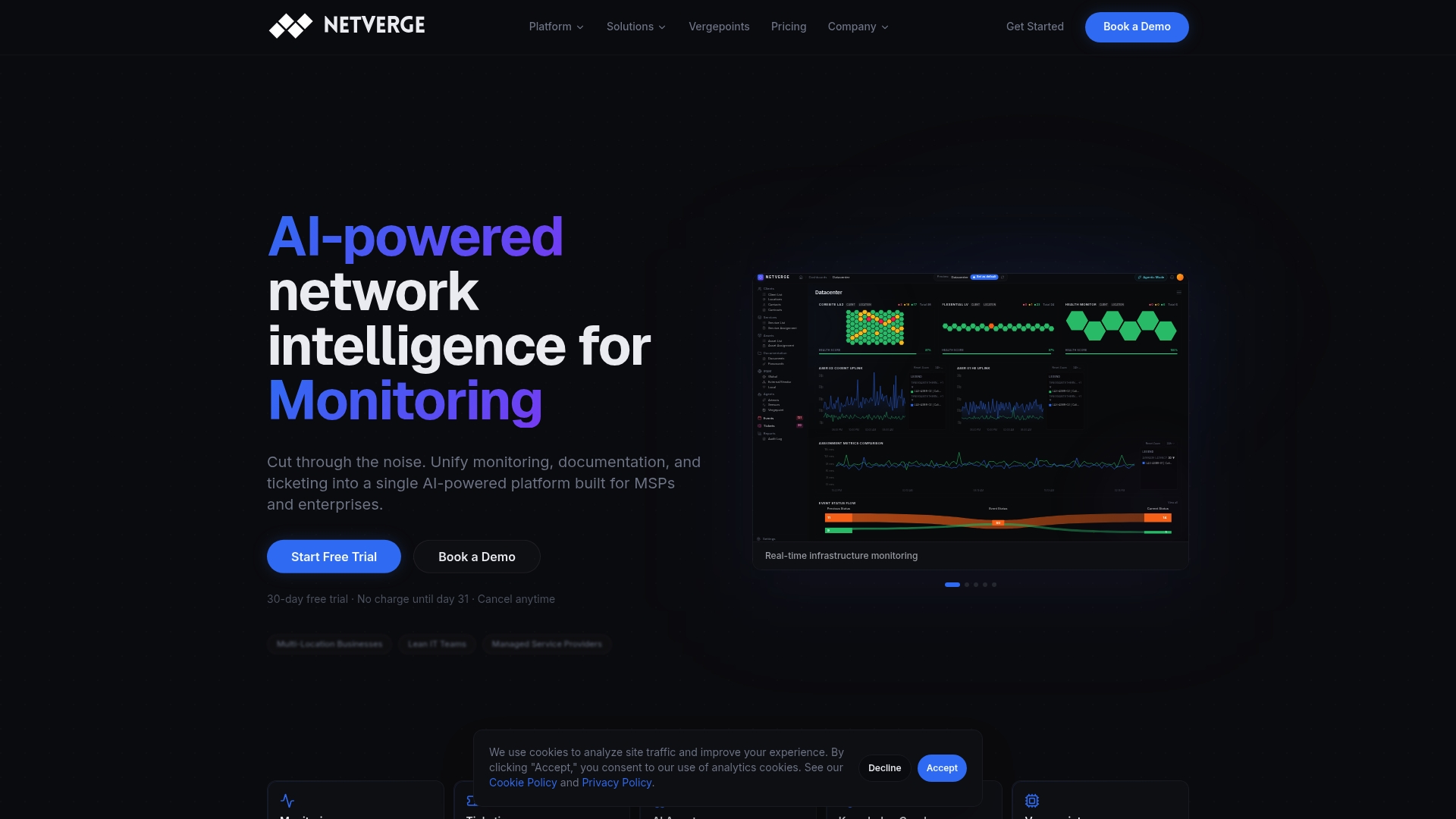
For on-site visibility during and after provisioning, our Vergepoints hardware gives physical-layer insight that pure software monitoring misses. Teams sizing a rollout can check our Starter Package pricing or run numbers through our pricing calculator to estimate costs across sensors, sites, and agents.
FAQ
What is zero touch provisioning?
Zero touch provisioning is the automated process of configuring a network device for operation without manual intervention, using discovery protocols like DHCP or PXE to fetch configuration and firmware from a bootstrap server. It follows standards such as RFC 8572 to verify the device is receiving trusted onboarding data before committing any changes.
How do I turn off zero touch provisioning on a switch?
Disabling ZTP on a managed switch typically involves accessing the device's local console or management interface and disabling the ZTP agent or boot behavior before it reaches out for a bootstrap server. The exact command set and menu path vary by vendor firmware version, so check your specific switch's configuration guide for the precise steps.
What does zero touch deployment mean?
Zero touch deployment refers to the same automated onboarding process as zero touch provisioning: a device ships with no manual setup required, discovers its configuration source on the network, and becomes fully operational after an automated bootstrap sequence. The term is used interchangeably with zero touch provisioning across most vendor documentation.
What is ZTP in Cisco environments?
In Cisco environments, ZTP lets a switch or router boot with no configuration, then automatically request a configuration file and image over the network through DHCP options pointing to a provisioning server. This follows the same discovery and bootstrap pattern defined more broadly in RFC 8572, though Cisco's specific implementation details depend on the platform and operating system version.
Does distributed AI improve zero touch provisioning for edge networks?
Distributed AI integration is an active research direction for edge network provisioning, aiming to make post-provisioning management more autonomous, according to research on distributed AI and ZTP. The same research notes this approach introduces coordination and privacy challenges that require careful governance before deploying at scale.
Sources
- A decentralized zero-touch provisioning framework (Open Research Europe)
- RFC 8572 - Secure Zero Touch Provisioning (SZTP)
- Distributed AI in Zero-touch Provisioning for Edge Networks: Challenges and Research Directions (ArXiv)