
Autonomous network management is defined as the use of AI, machine learning, and closed-loop automation to self-configure, optimize, secure, and heal networks with minimal human intervention. The industry standard framework, established by TM Forum, defines six maturity levels of autonomy, where Level 4 achieves predictive, intent-driven, closed-loop service management. Vendors including Ericsson and Ciena have built product architectures directly around this model. For IT professionals managing distributed, cloud-connected, or 5G infrastructure, understanding what autonomous network management means operationally is the difference between reactive firefighting and proactive control.
What is autonomous network management and how does it work?
Autonomous network management operates through four core functions: sense, decide, act, and verify. This closed-loop control cycle converts real-time telemetry into decisions and executes them without waiting for a human to open a ticket. The loop then verifies outcomes and feeds results back into the model, enabling continuous learning.
Real-time telemetry is the foundation. Sensors and agents continuously collect performance data, topology changes, traffic patterns, and fault signals across every network segment. That data feeds AI models that detect anomalies, predict failures, and calculate the optimal corrective action. The speed of this cycle is what separates autonomous systems from scripted automation, which only responds to conditions its rules were written to handle.

Intent-driven lifecycle management is the operational philosophy that makes this work at scale. Instead of configuring devices manually, network engineers define high-level business goals, such as "maintain 99.99% uptime for VoIP traffic." The system translates that intent into specific configuration changes, routing decisions, and resource allocations executed in real time. Ericsson's autonomous network model describes this as converting business intent into network updates with continuous verification and learning.
Autonomous network architectures are layered and domain-oriented rather than monolithic. A layered domain architecture separates the network into manageable autonomous domains, each with its own AI control loop, coordinated by an orchestration layer above. This prevents a single AI decision from cascading across the entire infrastructure unchecked.
Pro Tip: Before evaluating any autonomous network platform, map your network into logical domains first. Trying to apply autonomy to an undocumented, flat network topology is the fastest path to unpredictable AI behavior.
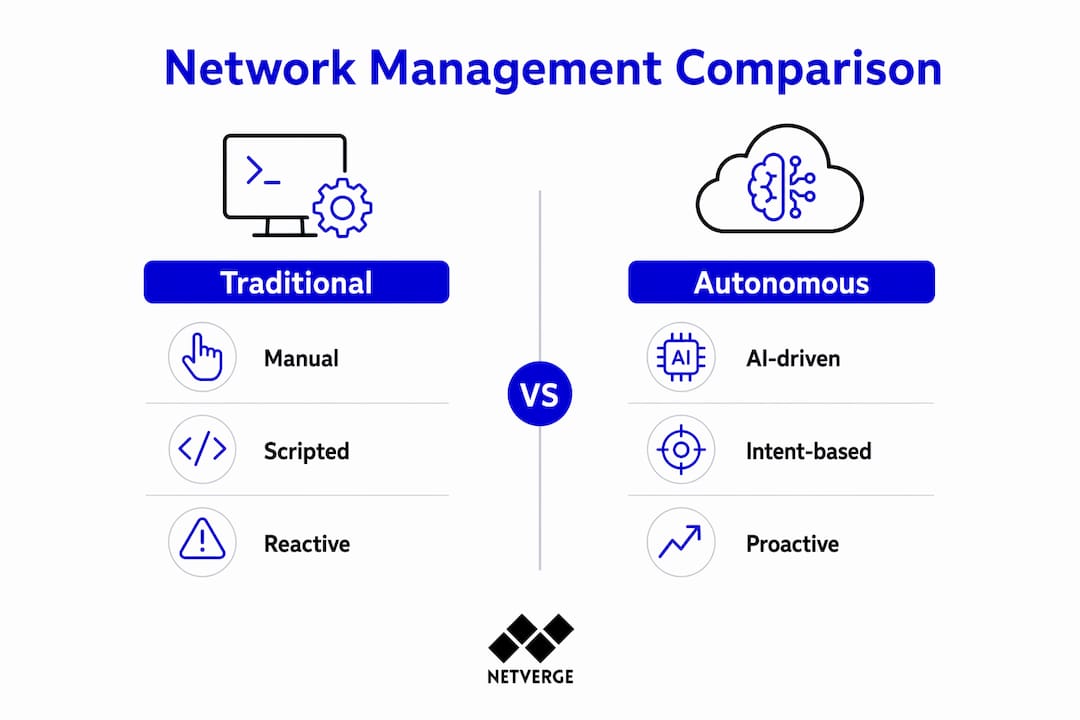
The table below contrasts traditional network management with autonomous management across key operational dimensions.
| Dimension | Traditional management | Autonomous management |
|---|---|---|
| Configuration | Manual, CLI-driven | Intent-driven, AI-executed |
| Fault response | Reactive, ticket-based | Predictive, self-healing |
| Optimization | Scheduled maintenance windows | Continuous, real-time adjustment |
| Learning | Static rule sets | Machine learning from outcomes |
| Human role | Task execution | Policy definition and oversight |
For a deeper look at how AI powers network examples in practice, Netverge has documented real-world scenarios across MSP and enterprise environments.
What are the benefits of autonomous network management?
Autonomous network management delivers measurable operational and business outcomes across four primary areas.
- Faster incident response. AI-driven detection and automated remediation reduce manual work and error rates by identifying and resolving faults before users report them. A network segment that previously required a 30-minute triage process can self-correct in seconds.
- Improved uptime and resilience. Proactive self-healing means the network reroutes traffic, adjusts configurations, and isolates failures without waiting for human input. This directly reduces mean time to repair (MTTR) across complex, multi-site environments.
- Scalability across cloud, edge, and 5G. Manual network management systems cannot scale to the density of modern distributed infrastructure. Autonomous systems handle thousands of simultaneous configuration decisions that no team could execute manually.
- Business alignment through intent-driven policies. When network behavior is governed by business intent rather than device-level rules, IT operations align directly with service-level agreements and organizational priorities. The network becomes a business tool, not just a technical asset.
- Reduced operational overhead. Automation replaces repetitive monitoring and configuration tasks, freeing engineers to focus on architecture and strategy. This shift is not about reducing headcount. It is about redirecting skilled labor toward higher-value work.
The key features of network management that support these outcomes include real-time telemetry, anomaly detection, and automated orchestration working together as a unified system.
What challenges do organizations face adopting autonomous networks?
Adoption failure most commonly traces back to one root cause: organizations automate existing inefficient processes instead of standardizing their network intent first. Clear intent and service model standardization are prerequisites for any successful autonomous deployment. Automating a poorly defined process at machine speed produces errors at machine speed.
The most common pitfalls include:
- Incomplete intent definition. If business goals are not translated into precise, measurable network policies, the AI has no reliable target to optimize toward.
- Poor data quality and fragmented telemetry. A high-fidelity digital twin built on graph-based dependency mapping is required for deterministic AI reasoning. Without it, the system makes decisions based on incomplete or stale data.
- Monolithic AI control architectures. Deploying a single AI controller across an entire network creates a single point of failure and makes it nearly impossible to validate decisions before they propagate.
- Skipping phased adoption. Attempting full-scale autonomy from day one is the most common cause of implementation failure. Segmenting networks into autonomous domains allows safe, incremental adoption with coordinated orchestration.
- Cultural resistance to reduced manual control. Engineers accustomed to direct device management often resist handing decisions to an AI. This is a governance and change management challenge, not a technical one.
Pro Tip: Run your first autonomous domain pilot on a non-critical network segment, such as a guest Wi-Fi network or a lab environment. Validate the closed-loop behavior thoroughly before expanding to production infrastructure.
For MSPs managing distributed client networks, the tips for managing distributed networks published by Netverge address these adoption challenges with practical, environment-specific guidance.
How to implement autonomous network management effectively
Effective implementation follows a structured progression rather than a single deployment event. The steps below reflect best practices aligned with TM Forum's autonomy maturity model and real-world deployment patterns.
Assess your current autonomy maturity level. TM Forum's six-level framework provides a clear benchmark. Most organizations start at Level 1 or 2, relying on manual processes with some scripted automation. Knowing your baseline determines your realistic next step.
Define business intent before touching technology. Document the service-level outcomes your network must deliver. Translate those into measurable policies: latency thresholds, availability targets, security posture requirements. This intent becomes the governing input for your autonomous system.
Build or validate your digital twin. A graph-based digital twin maps physical and logical dependencies across your infrastructure. Without this, AI decisions lack the contextual accuracy needed for safe autonomous operation.
Start with a single autonomous domain. Select a bounded, well-documented network segment. Deploy AI monitoring, closed-loop automation, and intent-based policies within that domain. Measure outcomes against your defined intent before expanding.
Integrate AI monitoring and orchestration tools. Autonomous management requires platforms that unify telemetry collection, anomaly detection, and automated response. Fragmented tools that do not share data cannot support a true closed-loop cycle.
Shift engineer roles toward intent-based steering. Network engineers evolve from executing manual configurations to defining policies, reviewing AI decisions, and managing exceptions. Training and role clarity are as important as the technology itself.
Implement continuous validation and learning loops. Every autonomous action should be logged, verified against intent, and fed back into the model. This is how the system improves over time beyond static scripted automation. Machine learning enables cognitive autonomy that static rule sets cannot replicate.
The table below maps network segment types to their suitability for early autonomous domain deployment.
| Network segment | Autonomy suitability | Primary use case |
|---|---|---|
| Guest Wi-Fi | High | Low-risk pilot environment |
| Branch WAN links | High | Traffic optimization and failover |
| Data center fabric | Medium | Workload-driven configuration |
| Core routing infrastructure | Low | Requires extensive validation first |
| Security perimeter | Low | Human oversight remains critical |
Understanding network automation fundamentals is a practical prerequisite before deploying intent-driven autonomous systems. The AI agents that power autonomous decisions require well-structured data inputs and clear operational boundaries to function reliably.
Key Takeaways
Autonomous network management requires intent-driven policies, closed-loop AI automation, and phased domain adoption to deliver reliable, self-managing infrastructure.
| Point | Details |
|---|---|
| Define intent first | Standardize business goals into measurable network policies before deploying any automation. |
| Use a layered domain architecture | Segment networks into autonomous domains to prevent cascading AI errors and enable safe scaling. |
| Build a high-fidelity digital twin | Graph-based dependency maps give AI the contextual accuracy needed for deterministic decisions. |
| Phase your adoption | Start with low-risk network segments and expand only after validating closed-loop behavior. |
| Redefine engineer roles | Shift your team from manual configuration to policy definition, exception handling, and AI oversight. |
Why the hardest part of autonomous networking is not the technology
I have watched organizations invest heavily in AI-powered network platforms and still fail to achieve meaningful autonomy. The technology worked. The intent definitions did not. Engineers wrote policies that reflected how the network had always been configured, not what the business actually needed. The AI optimized faithfully toward the wrong target.
The shift from manual troubleshooting to strategic oversight is genuinely difficult. Engineers who have spent years mastering CLI commands and device-level configurations do not naturally think in terms of business intent. That is a learned skill, and it requires deliberate investment in training and process redesign alongside the technology deployment.
Human oversight remains essential even at high autonomy maturity levels. The goal is not to remove humans from the loop. It is to move them upstream, where their judgment shapes policy rather than reacts to alerts. That is a more valuable position, but it requires a different mindset.
The 2026 trends reshaping network operations point clearly toward broader AI integration across IT infrastructure. Organizations that treat autonomous networking as a phased operational transformation, rather than a one-time technology purchase, are the ones building durable competitive advantage. Start small, validate rigorously, and expand with evidence.
— Jim
How Netverge supports autonomous network management
Netverge is built for exactly the operational model autonomous network management demands. The platform unifies real-time telemetry, AI-powered anomaly detection, automated troubleshooting, and intelligent ticket triage into a single interface designed for MSPs and multi-location enterprises.
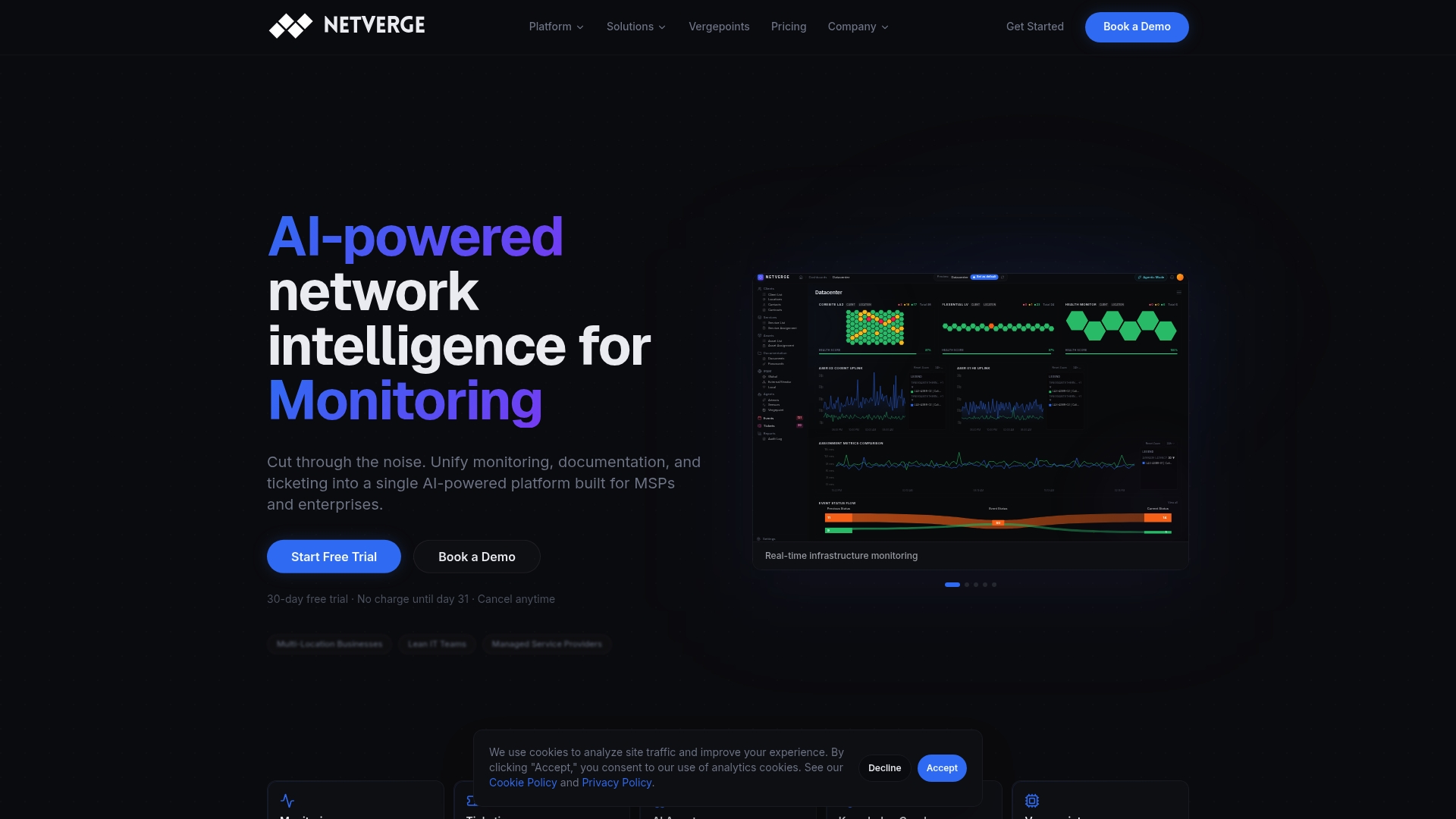
Netverge's enterprise network monitoring platform provides the closed-loop visibility and AI orchestration that autonomous management requires. Vergepoints deliver physical network telemetry, while the knowledge graph maps logical and physical dependencies for accurate AI decision-making. The AI-powered ticketing module closes the loop between detection and resolution, reducing manual escalation and accelerating response times. If you are building toward autonomous network operations, Netverge gives your team the infrastructure to get there without replacing every tool you already rely on.
FAQ
What is autonomous network management in simple terms?
Autonomous network management is a system where AI and machine learning handle network configuration, optimization, and fault resolution automatically. It uses real-time telemetry and closed-loop automation to manage networks with minimal human intervention.
How does autonomous network management differ from traditional automation?
Traditional automation executes predefined scripts in response to known conditions. Autonomous management uses machine learning to make decisions, learn from outcomes, and adapt to conditions its rules were never explicitly written to handle.
What is the TM Forum autonomy maturity model?
TM Forum defines six levels of network autonomy, from fully manual operations at Level 0 to fully autonomous, intent-driven management at Level 5. Level 4 achieves predictive, closed-loop service management with minimal human input.
What role do engineers play in an autonomous network?
Engineers shift from executing manual configurations to defining high-level intent policies and overseeing AI decisions. Human oversight remains critical for handling exceptions and validating that the system optimizes toward the correct business outcomes.
What is a digital twin and why does it matter for autonomous networks?
A digital twin is a real-time model of your network's physical and logical dependencies. Autonomous AI systems require this high-fidelity map to make accurate decisions. Without it, the AI acts on incomplete data and produces unreliable results.