
Automation benefits for MSPs are now measurable, documented, and significant enough to separate growing practices from stagnant ones. MSPs using AI-driven automation have achieved up to 80% faster response times and a 25–30% increase in SLA compliance. Those gains translate directly into higher client retention and stronger margins. This article covers the top operational, financial, and client-facing advantages that automation delivers, along with the strategic approach required to capture them.
1. Automation benefits for MSPs: faster response times and SLA compliance
Speed is the most visible automation benefit, and the data is clear. AI-driven ticket triage cuts response times by up to 80% by routing, categorizing, and prioritizing tickets without human intervention. That speed directly lifts SLA compliance rates by 25–30%. Higher compliance means fewer penalty clauses, fewer client escalations, and a stronger reputation for reliability.
The mechanism is straightforward. Automated systems read incoming tickets, match them against predefined rules, assign priority levels, and route them to the right technician or resolution workflow. No queue-scanning, no manual sorting, no delays caused by shift changes. The result is a consistent response cadence that manual processes cannot replicate.
Key operational gains from response automation include:
- Tickets routed and prioritized within seconds of submission
- SLA breach alerts triggered before deadlines, not after
- After-hours coverage maintained without additional staffing
- Escalation paths triggered automatically when thresholds are crossed
Pro Tip: Track mean time to first response and SLA compliance rate as separate KPIs. Conflating them hides where your process actually breaks down.
2. Reduced labor costs and improved profitability
Automation reduces labor costs by 15–20% in affected workflows through ticket routing, patch management, and repetitive administrative tasks. That reduction does not require layoffs. It means your existing technicians handle more clients without burning out.

Roughly 51% of tickets fall into automatable Tier-1 categories: password resets, connectivity checks, software restarts, and standard patch confirmations. When automation handles those, senior technicians focus on complex issues that actually require their expertise. That shift improves technician profitability per hour worked.
Scaling without adding headcount is the core financial argument for automation. A practice that manually handles 200 endpoints per technician can often reach 350 or more with the right automated workflows in place. That ratio improvement goes directly to margin.
Pro Tip: Never automate a broken process. If your ticket categorization is inconsistent today, automation will amplify that inconsistency at scale. Audit and standardize first.
3. Improved client satisfaction and NPS scores
Client satisfaction rises when clients receive consistent, proactive communication. Client communication automation triples the volume of updates sent to clients while reducing technician time spent on communication by 64%. Clients feel informed without technicians spending hours writing status emails.
The NPS impact is concrete. One documented case shows NPS lifting from 38 to 71 after implementing automated proactive status updates. That is not a marginal improvement. It reflects a fundamental shift in how clients perceive service quality.
"Client-facing automation that proactively updates ticket status drives higher NPS and retention than simply speeding resolution times. Clients do not just want fast fixes. They want to know what is happening and when."
Predictable communication builds trust. A client who receives an automated update at ticket open, at each status change, and at resolution feels attended to even when no technician is actively working their issue. That perception of attentiveness is what drives contract renewals.
4. Consistent execution of critical processes
Automated workflows apply backup verification, cybersecurity checks, and billing processes with zero variation. Human technicians make errors under pressure or when fatigued. Automation does not. Every client gets the same process executed the same way, every time.
This consistency matters most in cybersecurity and compliance contexts. Patch cycles run on schedule regardless of technician availability. Backup jobs are verified and logged automatically. Billing triggers fire when contract conditions are met, not when someone remembers to check. The administrative burden drops, and audit trails become complete by default.
For MSPs managing distributed networks, consistent execution across dozens of client sites is the difference between a defensible service model and one that relies on individual technician memory.
5. Reduced alert fatigue and smarter monitoring
Alert fatigue is a direct threat to MSP margins. When technicians receive hundreds of low-priority alerts daily, critical signals get buried. Automated alert correlation filters noise, groups related events, and surfaces only the alerts that require human attention.
The result is a smaller, higher-quality alert queue. Technicians respond to meaningful events instead of chasing false positives. Mean time to detect genuine incidents drops, and the risk of missing a critical failure decreases significantly.
Netverge addresses this directly through AI-powered anomaly detection that correlates telemetry across the network in real time. The platform suppresses redundant alerts and escalates only confirmed anomalies, keeping technician focus where it belongs.
6. Scalable service delivery without proportional headcount growth
Automation is now essential for MSP growth because it breaks the linear relationship between client count and staff count. Without automation, adding 50 new endpoints typically requires adding technician hours. With automation, the same team absorbs that growth by offloading routine tasks to workflows.
This scalability changes the economics of MSP growth. Sales cycles become less constrained by hiring timelines. Onboarding new clients becomes a workflow trigger rather than a project. The practice can grow revenue faster than it grows costs.
The MSP tools that enable this scale share a common architecture: they connect monitoring, ticketing, and communication into a single automated loop rather than requiring technicians to manually transfer information between systems.
7. Strategic implementation: how to get automation right
Rushing automation before organizational readiness leads to complexity and failure. The MSPs that capture the most value treat automation as a business initiative, not a technical project. That distinction changes how they plan, measure, and phase their rollout.
A structured implementation approach looks like this:
- Audit current workflows. Document every recurring process, identify manual steps, and flag inconsistencies before writing a single automation rule.
- Standardize before automating. Fix broken processes first. Automation amplifies whatever it touches, good or bad.
- Start with high-volume, low-complexity tasks. Tier-1 ticket routing and patch scheduling deliver fast ROI with low risk.
- Define outcome metrics. Track cost per workflow, SLA compliance, technician profitability, and client retention. Ticket volume alone is a vanity metric.
- Phase expansion. Add complexity only after simpler automations are stable and measured.
Pro Tip: Avoid "dashboard theater." If your automation reporting shows only ticket counts and closure rates, you are measuring activity, not business impact. Add cost per resolution and client retention rate to your dashboard.
8. Key automation features and their impact on service delivery
Different automation functions address different operational problems. The table below maps common automation capabilities to their primary service delivery impact.
| Automation feature | Primary impact | Key metric affected |
|---|---|---|
| Ticket routing and prioritization | Faster first response, fewer missed SLAs | Mean time to first response, SLA compliance rate |
| Client communication automation | Higher NPS, reduced technician communication load | NPS score, technician hours on communication |
| Patch management automation | Consistent security posture, reduced manual scheduling | Patch compliance rate, vulnerability exposure window |
| Performance monitoring and alerting | Earlier incident detection, reduced alert fatigue | Mean time to detect, false positive rate |
| Workflow orchestration | Consistent process execution across all clients | Error rate, process adherence score |
Each feature addresses a distinct failure point in manual MSP operations. Ticket routing solves the speed problem. Communication automation solves the perception problem. Patch management solves the consistency problem. Monitoring solves the detection problem. Orchestration solves the execution problem. Deploying all five creates a compounding effect on service quality.
For AI automation workflows that connect these functions into a unified operational loop, the gains multiply beyond what any single feature delivers alone.
Key takeaways
Automation delivers its strongest results when MSPs treat it as a business initiative tied to measurable outcomes, not a technical add-on applied to existing workflows.
| Point | Details |
|---|---|
| Response time and SLA gains | AI-driven triage cuts response times by up to 80% and lifts SLA compliance by 25–30%. |
| Labor cost reduction | Automating Tier-1 tasks reduces labor costs by 15–20% without requiring headcount cuts. |
| Client satisfaction lift | Proactive communication automation lifted NPS from 38 to 71 in documented cases. |
| Audit before automating | Standardize workflows before deploying automation or inefficiencies will scale with it. |
| Measure outcome metrics | Track cost per workflow and client retention, not just ticket volume, to prove real ROI. |
Where I stand on MSP automation in 2026
The conversation I keep having with MSP leaders is about sequencing. Everyone wants to deploy AI and see the numbers move. The leaders who actually see the numbers move are the ones who spent six weeks auditing their workflows before touching an automation tool.
The shift from reactive to proactive service delivery is real, but it does not happen automatically when you buy a platform. It happens when your team understands which processes are worth automating and which ones are broken in ways that automation will only make worse.
My honest view is that most MSPs underinvest in the measurement side. They deploy automation, watch ticket volume drop, and call it a win. The practices that build durable competitive advantage are the ones tracking technician profitability per client, cost per resolved workflow, and client retention quarter over quarter. Those numbers tell you whether automation is actually building your business or just making your dashboard look cleaner.
The future of this space is a genuine partnership between human expertise and automated execution. Technicians stop being ticket processors and start being advisors. Automation handles the predictable work. Humans handle the judgment calls. That division of labor is where the real margin lives.
— Jim
Netverge brings AI automation to your MSP operations
MSPs that want measurable gains in response time, SLA compliance, and client satisfaction need a platform built for that outcome, not a collection of disconnected tools.
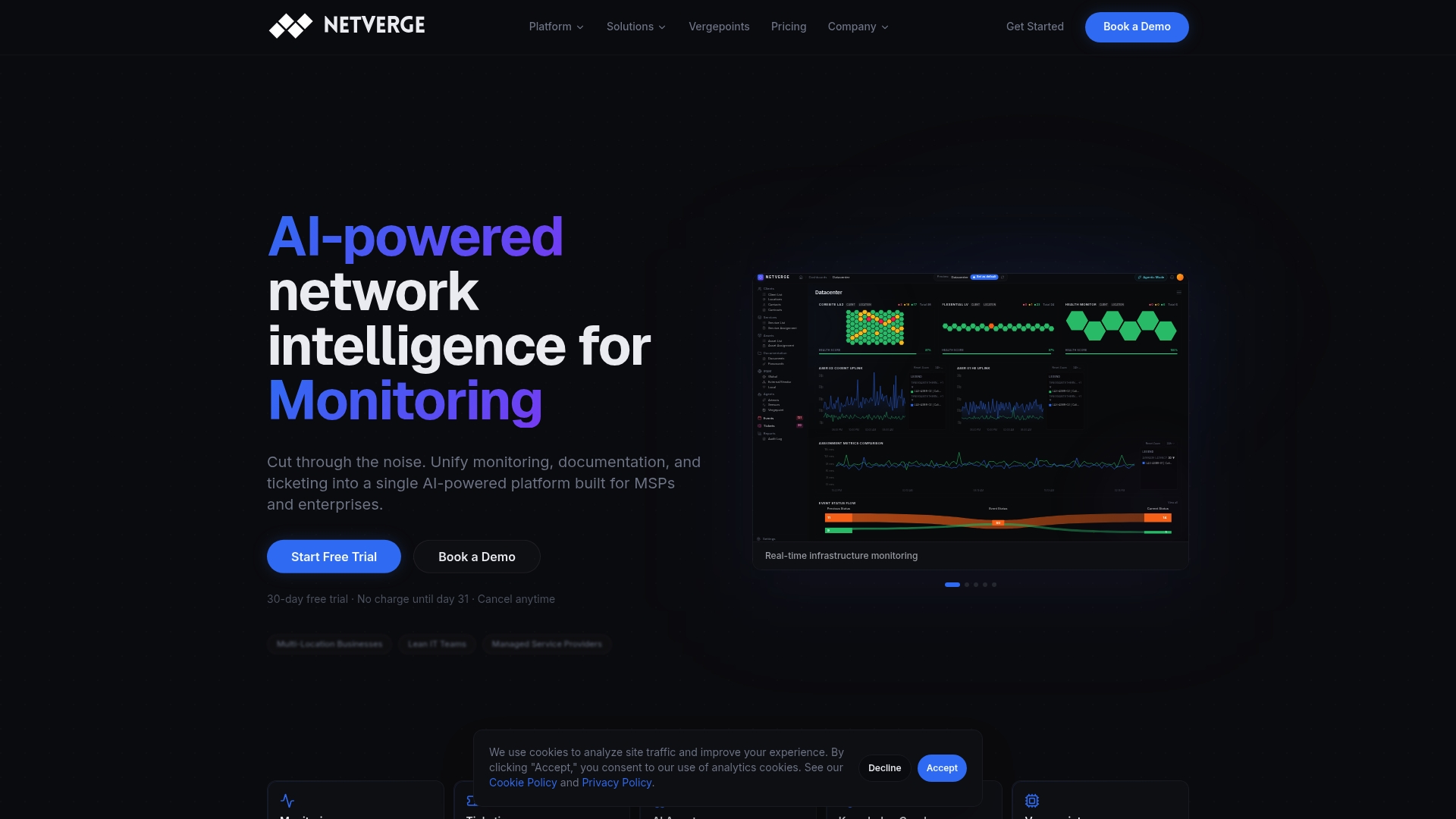
Netverge unifies AI-powered network monitoring, automated ticket triage, anomaly detection, and client communication into a single platform. The Netverge no-code workflow builder lets your team build and deploy automation without writing a line of code. Real-time telemetry feeds directly into automated alert correlation, so your technicians see only what matters. If you are ready to move from manual operations to a fully automated service model, Netverge gives you the infrastructure to do it.
FAQ
What are the top automation benefits for MSPs?
The top automation benefits for MSPs include up to 80% faster response times, 25–30% higher SLA compliance, 15–20% lower labor costs, and significantly improved client NPS scores through proactive communication.
How does automation improve MSP profitability?
Automation reduces labor costs by handling Tier-1 tickets, patch scheduling, and routine workflows, allowing MSPs to serve more clients with the same team and improve margin per technician.
Does automation replace MSP technicians?
Automation handles predictable, repetitive tasks so technicians can focus on complex issues that require judgment. It increases technician output per hour rather than replacing the role.
What metrics should MSPs track to measure automation success?
Track cost per workflow, SLA compliance rate, technician profitability, and client retention. Ticket volume alone does not reflect the business impact of automation KPIs.
How should MSPs start implementing automation?
Audit and standardize existing workflows first, then automate high-volume Tier-1 tasks before expanding to complex processes. Strategic planning before deployment is the single strongest predictor of automation success.