
An MSP onboarding checklist is a structured sequence of tasks that guides managed service providers through every stage of client integration, from initial discovery to post-go-live review. Poor onboarding causes 23% of SME client churn for MSPs, and manual client setup routinely consumes 40–80 hours per engagement. That time and revenue loss is preventable. A well-built checklist for IT service providers covers client data gathering, security risk assessment, technical configuration, and relationship management. Skipping any phase creates gaps that surface as support tickets, security incidents, or lost contracts. The industry term for this process is "client onboarding," and the checklist is the operational backbone that makes it repeatable and scalable.
What an MSP onboarding checklist must cover phase by phase
The managed service provider onboarding process breaks into four distinct phases: pre-onboarding, technical implementation, go-live, and post-go-live review. Each phase has defined deliverables. Treating them as a continuous sequence prevents tasks from falling through the cracks.
Phase 1: Pre-onboarding

Pre-onboarding establishes the foundation. Send the client a discovery questionnaire covering their current IT environment, business goals, compliance requirements, and key contacts. Conduct a risk assessment before touching any system. Identify existing vendors, contracts, and support agreements that will transfer to your management.
Phase 2: Technical implementation
This phase covers the actual configuration work. Deploy your Professional Services Automation (PSA) tool and Remote Monitoring and Management (RMM) agent across all endpoints. Configure security baselines, set up backup verification, and document every credential in your password manager. Assign a named technician to own each task.
Phase 3: Go-live
Go-live is not just flipping a switch. Run a kickoff meeting with the client's key stakeholders to confirm scope, service level agreements (SLAs), and escalation paths. Conduct user training on your ticketing portal and communication channels. Test all monitored systems before declaring the environment live.
Phase 4: Post-go-live review
The onboarding process extends well beyond go-live. Trust and relationship health are the real measures of onboarding success, not just technical completion. Schedule a 30-day review meeting, deliver a documentation handoff package, and establish a regular cadence of check-ins to maintain alignment.
Pro Tip: Build a shared project tracker that both your team and the client can view. Visibility into task progress reduces client anxiety and cuts inbound status calls by a significant margin.
How to gather and audit client information effectively
Accurate client data is the single most important input to a successful onboarding process for MSPs. Errors in this phase compound through every subsequent step, from misconfigured monitoring to missed security gaps.
The key data points to collect during discovery include:
- User roles and counts: Active users, admin accounts, and any shared or service accounts
- Device inventory: Workstations, servers, printers, network hardware, and mobile devices
- Applications and licenses: Business-critical software, SaaS subscriptions, and license expiration dates
- Vendors and contracts: ISPs, cloud providers, hardware vendors, and existing support agreements
- Backup and recovery tools: Current backup solutions, retention policies, and last verified restore date
- Security tools: Antivirus, endpoint detection and response (EDR), firewall vendor, and patch management status
Relying solely on what the client tells you produces incomplete inventories. Automated network discovery tools replace manual inventories and improve data accuracy. Tools like Domotz scan the network and surface devices the client did not know existed, including forgotten IoT devices and unmanaged switches.
Questionnaire design also matters. Balance exhaustive data gathering with client engagement to avoid overwhelming new clients at first contact. A phased questionnaire, starting with five to ten high-priority questions and following up with deeper technical questions after the initial call, keeps clients engaged without creating friction.
Pro Tip: Run your automated discovery scan before the kickoff meeting. Walking into that meeting with a pre-built asset list demonstrates technical competence and saves 30 to 60 minutes of discussion.
Credential collection requires a documented, secure process. Use a dedicated password manager with role-based access. Never collect credentials over email. Document the handoff method in your onboarding record so any team member can audit it later.
Why security risk assessment is non-negotiable during onboarding
Security assessment is not a separate workstream. It belongs inside the onboarding checklist, not after it. 35.5% of cybersecurity breaches in 2024 involved third-party vulnerabilities. That statistic means your new client's environment is a potential entry point into your own infrastructure if you do not assess it before connecting your tools.
A security baseline review during onboarding covers:
- Privileged access audit: Identify all admin accounts, review who holds them, and disable stale accounts immediately
- Firewall rule review: Check for overly permissive inbound rules, outdated NAT configurations, and any rules without documented business justification
- Antivirus and EDR status: Confirm coverage across all endpoints, check definition update dates, and verify that alerts route to your monitoring platform
- Multi-factor authentication (MFA) enforcement: Confirm MFA is active on Microsoft 365, Google Workspace, VPN, and any remote access tools
- Password policy review: Check minimum length, complexity requirements, and whether any accounts use default or shared passwords
- Dark web credential scan: Run a scan against the client's domain to identify compromised credentials before they become an active threat
Each of these checks produces a finding. Document every finding in your PSA as a ticket, assign a severity level, and set a remediation deadline. This creates an auditable record that protects both the client and your organization. Linking your security baseline directly to your MSP network security practices documentation gives technicians a repeatable reference for every new engagement.
How to standardize and automate the onboarding process for scale
Static checklists create technical debt. A checklist that never changes cannot account for new client types, new compliance requirements, or new tools in your stack. The goal is adaptable standards, not rigid templates.
The table below shows the difference between a static checklist approach and a standards-based approach:
| Approach | Characteristics | Outcome |
|---|---|---|
| Static checklist | Fixed task list, no ownership, manual execution | Inconsistent results, missed steps, technical debt |
| Standards-based | Adaptable tasks, assigned ownership, automated triggers | Consistent delivery, faster onboarding, fewer errors |
Automation reduces the 40–80 hours of manual setup by handling repeatable tasks. Your PSA tool should auto-generate onboarding tickets from a template the moment a new client contract is signed. Your RMM platform should deploy agents and apply configuration policies without manual intervention on each device. Reviewing must-have MSP tools for your stack helps identify where automation gaps exist.
Assign clear ownership for each onboarding phase. A project manager owns the timeline. A lead technician owns the technical implementation. An account manager owns client communication. Without named owners, tasks stall and accountability disappears.
Testing workflows with dummy data before go-live prevents misconfigurations and security risks. Create a test user account, run it through your ticketing, monitoring, and access workflows, and verify that permissions, alerts, and escalations behave correctly. This single step catches the majority of configuration errors before they affect a live environment.
Understanding how back-office workflows can be automated helps MSPs identify which onboarding tasks are the best candidates for automation first, particularly data entry, ticket creation, and status notifications.
What client communication practices improve onboarding outcomes
Technical execution alone does not retain clients. Clear communication and realistic SLA expectations during onboarding directly reduce support issues and increase client satisfaction. The relationship you build in the first 90 days sets the tone for the entire contract.
Effective communication practices during the onboarding process for MSPs include:
- Sales-to-service handoff: Document every commitment made during the sales process and brief the delivery team before the first client call. Surprises at kickoff destroy trust immediately.
- Scope confirmation in writing: Send a written scope summary after the kickoff meeting. Verbal agreements create disputes. Written confirmations create alignment.
- Welcome kit delivery: Provide a one-page document with your helpdesk number, ticketing portal URL, escalation contacts, and expected response times. Clients should never have to search for how to reach you.
- SLA transparency: State your response and resolution time targets clearly. Do not overpromise. A client who expects four-hour response and receives two-hour response is satisfied. A client who expects one-hour response and receives two-hour response files a complaint.
- Regular post-go-live check-ins: Schedule calls at 30, 60, and 90 days after go-live. These calls surface issues before they become churn events and demonstrate that your team is proactive, not reactive.
The transition from sales to service delivery is the highest-risk communication moment in managed service provider onboarding. A structured handoff document that captures client preferences, pain points, and expectations closes the gap between what was promised and what gets delivered. Reviewing MSP network management fundamentals gives your team a shared technical vocabulary that improves client-facing communication.
Key Takeaways
A structured onboarding process is the single most effective way MSPs reduce churn, cut setup time, and build client trust from day one.
| Point | Details |
|---|---|
| Four-phase structure | Pre-onboarding, technical setup, go-live, and post-go-live review each require defined deliverables. |
| Automate discovery | Automated network scans replace manual inventories and cut 40–80 hours of setup time per client. |
| Security first | Assess privileged access, MFA, firewall rules, and dark web exposure before connecting any MSP tools. |
| Adaptable standards | Treat your checklist as a living standard with named owners, not a static task list. |
| Communication drives retention | Structured handoffs, written scope confirmations, and 30/60/90-day check-ins reduce churn and support volume. |
The checklist is the floor, not the ceiling
After working with MSP teams across a range of client sizes, one pattern stands out: the teams that struggle with onboarding are not missing a checklist. They have one. What they are missing is the discipline to treat it as a minimum standard rather than a maximum effort.
The most common mistake I see is treating checklist completion as the finish line. A technician closes the last ticket, marks the project done, and moves to the next client. Three months later, the client calls frustrated because nobody followed up, a stale admin account was never disabled, or the backup job has been failing silently. The checklist was completed. The client was not retained.
The second mistake is building a checklist that never changes. Client environments evolve. Compliance requirements shift. New attack vectors emerge. A checklist written in 2023 that has not been updated is a liability, not an asset. The MSPs that scale well treat their onboarding process as a product. They review it quarterly, gather feedback from technicians and clients, and update it based on what actually happened, not what was supposed to happen.
Automation is where the real efficiency gains live. Manually executing a 60-step checklist for every new client is not a process. It is a bottleneck. The goal is to automate every repeatable task so your technicians spend their time on judgment calls, not data entry. That shift is what separates MSPs that grow from MSPs that grind.
— Jim
How Netverge supports MSP onboarding and ongoing client management
Netverge gives MSP teams a unified platform for AI-powered network monitoring that reduces the manual effort onboarding demands. Real-time infrastructure visibility, anomaly detection, and automated ticket triage mean your team spends less time configuring alerts and more time delivering value to new clients.
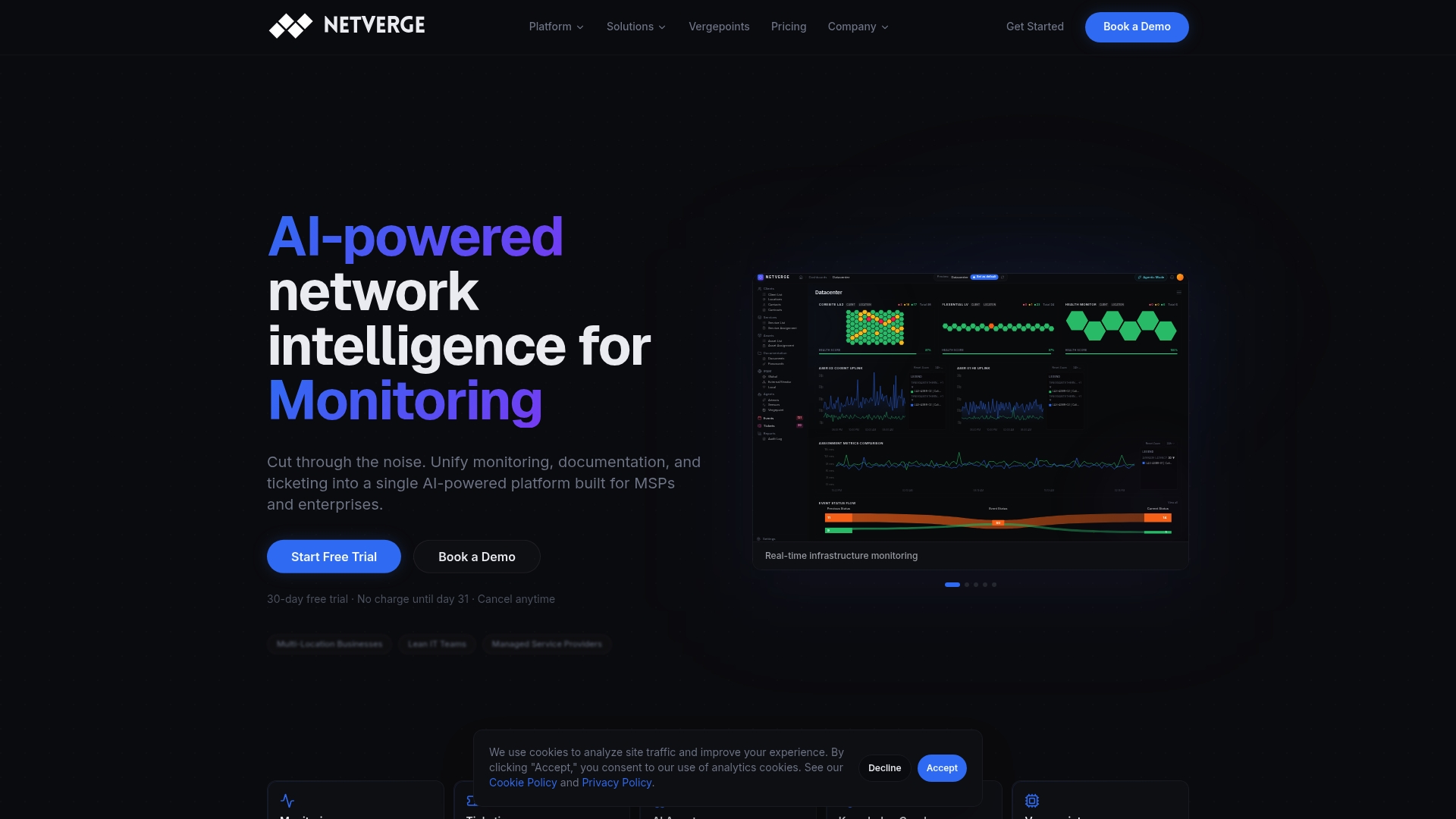
Netverge's AI-powered ticketing and service desk integrates directly with your onboarding workflow, auto-generating tasks, routing escalations, and tracking resolution times from day one. Vergepoints hardware provides physical network visibility at client sites without complex configuration. For MSPs managing multiple clients across distributed locations, Netverge consolidates telemetry, documentation, and event management into a single interface that scales with your client base.
FAQ
What is an MSP onboarding checklist?
An MSP onboarding checklist is a structured task list that guides managed service providers through client integration, covering discovery, security assessment, technical setup, and post-go-live review. It ensures consistent service delivery and reduces the risk of missed configurations or security gaps.
How long does MSP client onboarding typically take?
Manual onboarding data gathering alone takes 40–80 hours per client. Automation tools and standardized processes reduce that time significantly, with well-optimized MSPs completing full technical onboarding in one to two weeks.
Why does security assessment belong in the onboarding checklist?
Third-party vulnerabilities account for 35.5% of cybersecurity breaches, making a security baseline review at onboarding a direct risk-reduction measure for both the client and the MSP.
How do you prevent onboarding checklists from becoming outdated?
Treat the checklist as an adaptable standard rather than a fixed document. Review it quarterly, assign ownership for each phase, and update it based on real onboarding outcomes and new compliance or security requirements.
What is the most common reason MSP onboarding fails?
Poor communication and unrealistic expectations cause more onboarding failures than technical errors. Structured handoffs from sales to delivery, written scope confirmations, and scheduled post-go-live check-ins address the root causes of early client churn.