
Integrated network documentation is defined as a centralized, continuously updated record of all network assets, configurations, and dependencies that serves as the operational foundation for every IT decision your team makes. When this record is fragmented across spreadsheets, Visio diagrams, and tribal knowledge, the cost shows up in extended outages, failed audits, and security gaps. The case for why integrated network documentation belongs at the center of your network management strategy comes down to speed, accuracy, and control. Tools like NetBox, Auvik, and Lansweeper, combined with automation protocols such as SNMP and LLDP, now make it practical to maintain a living, queryable record rather than a static document that decays the moment it is saved.
What are the key benefits of integrated network documentation?
Integrated documentation delivers measurable operational advantages across troubleshooting, security, compliance, and vendor management.
Faster troubleshooting is the most immediate payoff. Network documentation reduces latency from symptom to action by eliminating information scavenger hunts during outages. That means when a switch fails at 2 a.m., your on-call engineer finds the affected device, its upstream dependencies, and the relevant runbook in one place rather than chasing down three colleagues.

Security incident response depends directly on documentation accuracy. Over 60% of security incidents in isolated networks are worsened by outdated or poor documentation, according to SANS Institute research from early 2026. Accurate configuration records let your security team identify affected assets, trace lateral movement paths, and contain threats without guessing which devices are in scope.
Compliance and audit readiness become repeatable processes rather than fire drills. Clear ownership records, access control logs, and change histories give auditors exactly what they need. Organizations subject to frameworks like PCI DSS, HIPAA, or SOC 2 reduce audit preparation time significantly when asset and policy documentation is already current.
Additional benefits include:
- Vendor and contract management: Tracking device lifecycle status, warranty expiration, and service agreements prevents surprise end-of-life events.
- Change management confidence: Engineers can assess the blast radius of a proposed change before executing it, reducing unplanned outages.
- Onboarding acceleration: New team members reach productivity faster when network context is documented and searchable rather than locked in senior engineers' heads.
- Cost visibility: Accurate asset inventories expose redundant licenses, underused hardware, and shadow IT that inflate operational budgets.
Documentation improves troubleshooting, compliance, vendor management, and operational risk reduction across large enterprises. Each of these benefits compounds when the documentation is integrated into daily workflows rather than maintained as a separate project.
How does integrated documentation differ from traditional approaches?
Traditional network documentation is a point-in-time artifact. Integrated documentation is a live operational system. That distinction determines whether your records help or mislead during an incident.
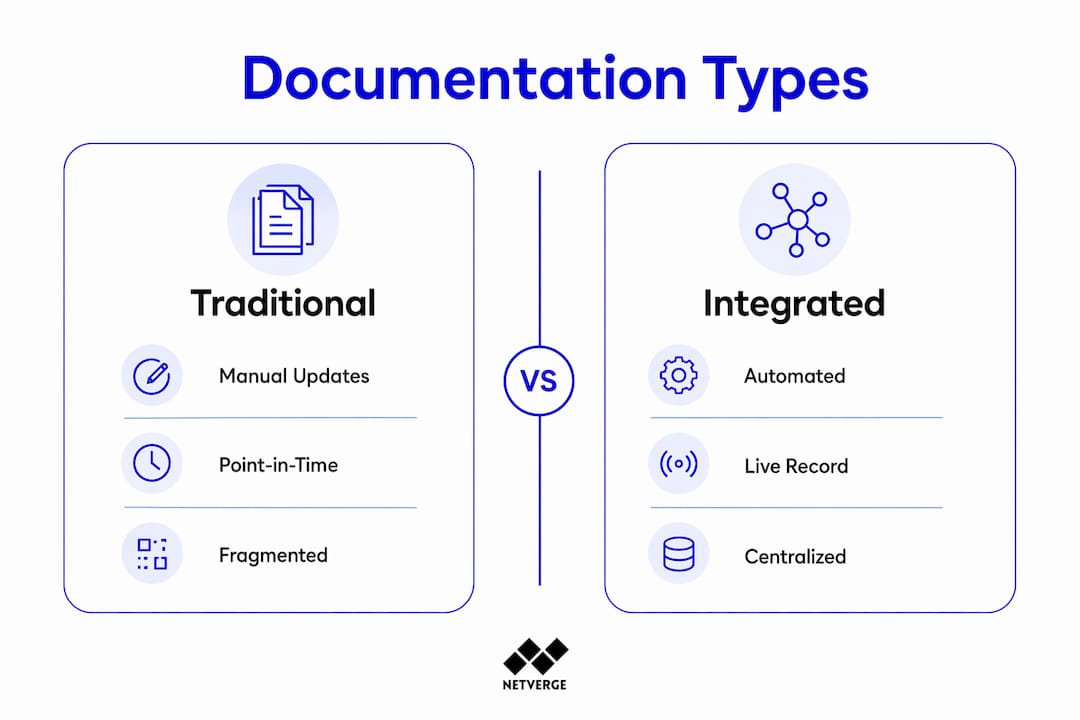
| Dimension | Manual / Fragmented | Integrated / Automated |
|---|---|---|
| Update frequency | Ad hoc, after major changes | Continuous, protocol-driven |
| Accuracy risk | High data decay between updates | Low, reflects real-time state |
| Discovery method | Engineer-driven, error-prone | SNMP, LLDP, ARP automated probes |
| Usability | Static diagrams, spreadsheets | Queryable, API-accessible records |
| Maintenance burden | High manual effort | Low, automation handles topology updates |
| Incident response value | Often unreliable | High confidence, fast lookup |
The core problem with manual documentation is what practitioners call "documentation graveyards." These are wikis and shared drives full of diagrams that were accurate 18 months ago and have not been touched since. Engineers stop trusting them, so they stop updating them, and the decay accelerates.
Automated network documentation using SNMP, LLDP, and ARP protocols replaces outdated manual diagrams with always-accurate topologies. SNMP polls device metrics and configuration data. LLDP maps physical neighbor relationships. ARP probes resolve IP-to-MAC mappings. Together, these protocols give you a topology that updates itself on a schedule rather than waiting for an engineer to remember.
The "source of truth" concept is central here. A source of truth is a single authoritative record that all other systems reference. When your monitoring platform, ticketing system, and configuration management database all pull from the same documentation layer, discrepancies disappear and automation becomes reliable.
Pro Tip: Start with read-only automated discovery before granting any write access to documentation tools. This prevents accidental overwrites and gives you a clean baseline to validate against your existing records.
What are best practices for implementing integrated network documentation?
Effective implementation follows a sequence. Skipping steps creates the same fragmentation you are trying to eliminate.
Run automated read-only discovery first. Implementing read-only automated discovery first to populate documentation reduces manual errors and accelerates accuracy. Use tools like Auvik or Lansweeper to generate an initial inventory before any human edits the record.
Embed live data blocks. Embedding live data blocks ensures documentation reflects real-time network states without manual edits. Link your documentation pages directly to telemetry feeds so device status, interface utilization, and configuration snapshots update automatically.
Define ownership for every asset class. Assign a named owner to each documentation domain: core routing, edge switching, wireless, security appliances, and cloud connectivity. Ownership without accountability produces the same decay as no ownership at all.
Integrate documentation into change management. Every change request should require a documentation update as a completion criterion. If a change closes without updating the record, the record is already wrong.
Schedule structured reviews every 30–90 days. Treat documentation as an operational asset integrated into configuration and change management, reviewed every 30–90 days. Quarterly reviews catch drift that automation misses, such as decommissioned devices that were never removed from records.
Combine diagrams, runbooks, and inventories. A topology diagram shows relationships. A runbook explains procedures. An inventory tracks assets. All three are required for a complete operational picture. Storing them in the same platform, such as NetBox or a documentation-aware ITSM tool, keeps them cross-referenced.
Avoid common pitfalls. The biggest failure mode is over-engineering the initial structure. Start with a flat, accurate inventory and add hierarchy as your team's needs clarify. A simple accurate record beats a complex inaccurate one every time.
Pro Tip: Treat your documentation platform the same way you treat your monitoring platform. Set alerts for records that have not been updated within your review window. Stale records are as dangerous as a failed sensor.
For MSPs managing multiple client environments, the network visibility benefits of centralized documentation multiply across every client site you support.
What tools and technologies support integrated network documentation?
The right tool depends on your scale, existing stack, and automation maturity. Several platforms have established strong track records.
- NetBox (by NetBox Labs): An open-source IP address management and data center infrastructure management platform. NetBox functions as a source of truth for network infrastructure and supports API-driven integrations with monitoring and automation tools. NetBox Labs describes it as a living, queryable library rather than static data sheets.
- Auvik: A cloud-based network management platform built for MSPs. Auvik performs continuous automated discovery using SNMP and LLDP, generates topology maps, and integrates with PSA tools like ConnectWise and Datto Autotask.
- Lansweeper: An IT asset discovery and inventory platform that scans networks to catalog hardware, software, and user data. Lansweeper works well for enterprises needing broad asset visibility across mixed environments.
- NinjaRMM (NinjaOne): A remote monitoring and management platform that combines device management with documentation capabilities, particularly useful for MSPs managing distributed endpoints.
- SNMP, LLDP, and ARP protocols: These are the discovery engine behind most automated tools. Automated documentation tools provide continuous network topology updates scheduled at varying intervals, from minutes to hours depending on network size and change frequency.
When evaluating tools, prioritize API availability. A documentation platform that cannot export or receive data via API will become an island. Your documentation layer needs to feed your monitoring platform, your ticketing system, and your configuration management database. Without API connectivity, you recreate the fragmentation you are trying to solve.
For organizations managing distributed network operations, tool selection also needs to account for multi-site topology discovery and the ability to correlate documentation across locations.
How does integrated documentation improve incident response and audits?
Integrated documentation changes the economics of both incidents and audits by converting unknown variables into known quantities before the pressure starts.
During an outage, the symptom-to-action timeline is the metric that matters. Without accurate documentation, engineers spend the first 20–40 minutes of an incident just establishing what is connected to what. With integrated documentation, that phase collapses to seconds. The engineer queries the documentation layer, identifies the affected segment, pulls the relevant runbook, and begins remediation. That time difference translates directly into reduced mean time to resolution (MTTR) and lower business impact.
Security audits follow the same pattern. Auditors request asset inventories, access control records, patch status reports, and network diagrams. Organizations with integrated documentation produce these on demand. Organizations without it spend days assembling records from multiple sources, often discovering gaps in the process.
"Documentation as a source of truth enables automation, security, and faster new service deployment." The Network Intelligence Blueprint by network architect Chris Grundemann.
Specific scenarios where integrated documentation delivers measurable value:
- Ransomware containment: Accurate network segmentation records let security teams identify blast radius and isolate affected segments within minutes rather than hours.
- Firewall rule audits: A queryable inventory of all firewall policies, with ownership and last-review dates, satisfies auditor requests without manual reconstruction.
- Hardware refresh planning: Complete asset records with purchase dates and warranty status let procurement teams plan refresh cycles proactively rather than reactively.
The security responsibility dimension of documentation is often underestimated until an incident occurs. Accurate records are a security control, not just an operational convenience.
Key takeaways
Integrated network documentation is the single most effective way to reduce incident response time, pass audits confidently, and maintain security posture across distributed infrastructure.
| Point | Details |
|---|---|
| Documentation as a live asset | Treat records as continuously updated operational data, not one-time project deliverables. |
| Automation reduces decay | SNMP, LLDP, and ARP-driven tools keep topology records accurate without manual intervention. |
| Ownership prevents drift | Assign named owners to each asset class and enforce documentation updates within change management. |
| Incident response speed | Accurate documentation eliminates the information-gathering phase during outages, cutting MTTR directly. |
| Tool selection matters | Prioritize API-connected platforms like NetBox or Auvik to keep documentation integrated with monitoring and ticketing systems. |
Documentation is the foundation, not the afterthought
I have worked with IT teams that spent weeks rebuilding network diagrams after a major incident because no one had updated the documentation since the last infrastructure refresh. The engineers knew the network. The documentation did not. That gap cost them two extra hours during the outage and a failed compliance audit three months later.
The shift that actually works is treating documentation as the driver of configuration, not its byproduct. Network architect Chris Grundemann frames this precisely: documentation must stop being a record of what was done and start being the authoritative input for what gets done next. When your automation scripts, your monitoring alerts, and your change management workflows all reference the same documentation layer, the network becomes predictable.
The cultural challenge is real. Engineers resist updating documentation because it feels like overhead. The fix is removing friction, not adding mandates. Automated discovery handles 80% of the updates. The remaining 20% requires discipline, but that discipline is far easier to maintain when engineers trust the records because they are mostly accurate already.
The teams I have seen get this right share one habit: they treat a stale documentation record with the same urgency as a failed monitoring sensor. Both represent a gap in operational visibility. Both carry risk. That mindset shift is what separates teams that use documentation from teams that benefit from it.
— Jim
See your network clearly with Netverge
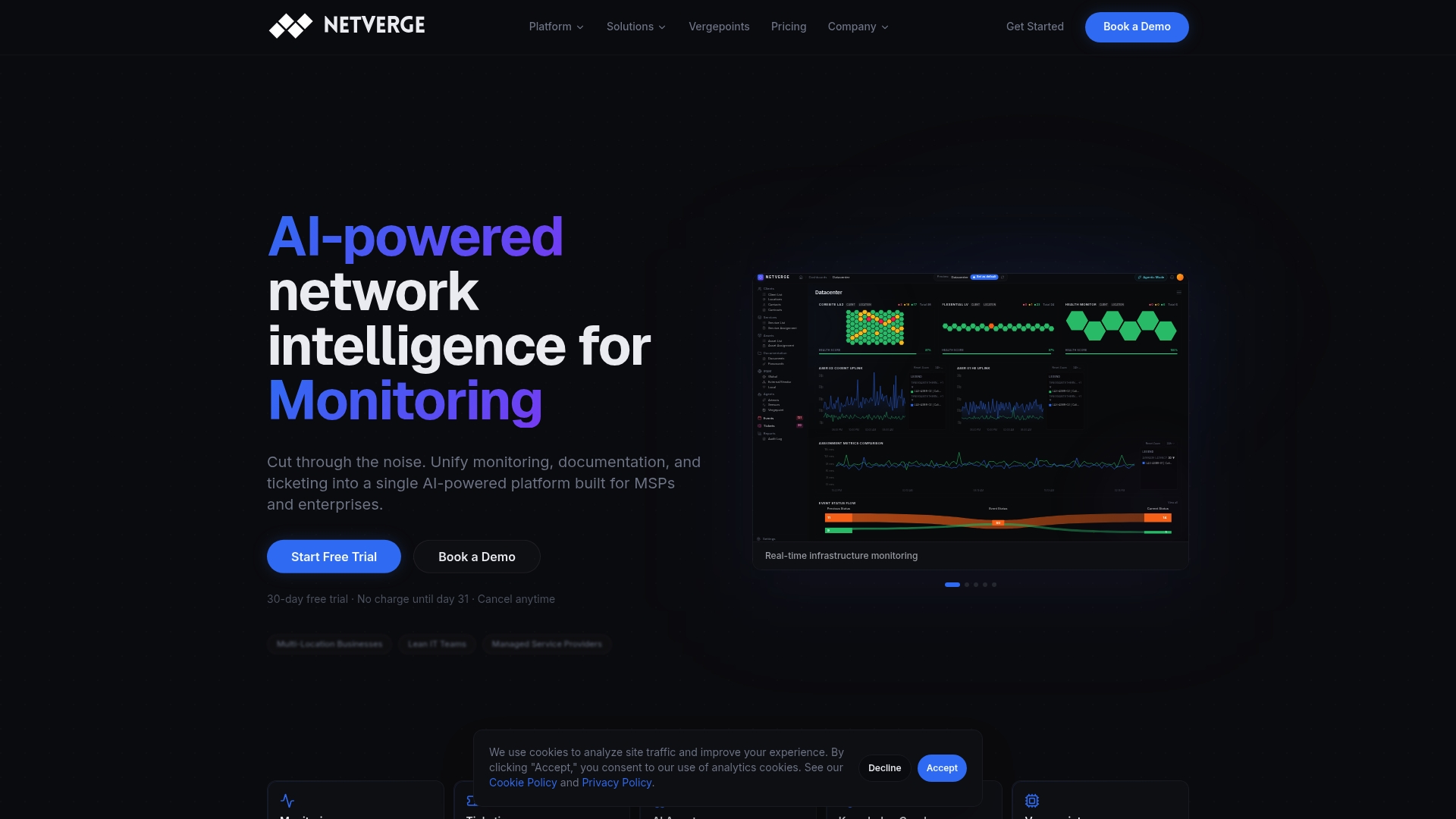
Netverge brings together real-time network monitoring, AI-powered anomaly detection, and automated topology visibility in a single platform built for MSPs and multi-location enterprises. Its Vergepoints hardware delivers physical layer telemetry, while the platform's knowledge graphs and AI agents correlate live data across your entire infrastructure. When your documentation layer is connected to AI-powered network monitoring, every alert carries context, every incident response starts with accurate data, and every audit request is answered in minutes. Explore how Netverge integrates with your existing workflows to give your team the operational visibility your network demands.
FAQ
What is integrated network documentation?
Integrated network documentation is a centralized, continuously updated record of all network assets, configurations, and dependencies that connects directly to monitoring, ticketing, and change management systems. It functions as a live source of truth rather than a static reference file.
How does integrated documentation reduce downtime?
Documentation reduces latency from symptom to action by giving engineers immediate access to accurate topology and configuration data during incidents. This eliminates the information-gathering phase that extends mean time to resolution.
What are common examples of network documentation?
Examples of network documentation include IP address management records, physical and logical topology diagrams, device configuration backups, firewall rule sets, runbooks for common procedures, and asset inventories with warranty and lifecycle data.
Which tools are best for automated network documentation?
NetBox, Auvik, and Lansweeper are the most widely adopted platforms for automated network documentation. Each uses SNMP, LLDP, and ARP protocols to discover and continuously update network topology records.
How often should network documentation be reviewed?
Documentation should be reviewed every 30–90 days as a structured operational review, in addition to automated continuous updates. Quarterly reviews catch configuration drift and decommissioned assets that automated discovery may not flag.