
Network infrastructure documentation is the organized, accurate record of network topology, device inventory, configurations, and operational procedures that forms the authoritative source of truth for every IT environment. Without it, your team operates on memory and assumption, two resources that fail precisely when you need them most. For MSPs and multi-location enterprises, undocumented networks translate directly into longer outages, failed audits, and compounding security gaps. Tools like CMDB platforms, Microsoft Visio, Scanopy, and AI-driven automation have made documentation faster and more accurate than ever, yet many organizations still treat it as an afterthought.
Why document network infrastructure: the operational case
The most direct answer to why you should document network infrastructure is this: recovery time drops from 4 hours to 45 minutes when accurate documentation exists. That reduction represents more than 80% faster incident response, and it happens because engineers stop manually rediscovering topology during an outage and start executing against a known map. Every minute of downtime carries financial and reputational cost, so that gap is not a minor convenience. It is a measurable business outcome.
Beyond outage recovery, documentation prevents the knowledge loss that accelerates during staff turnover. Tribal knowledge loss is one of the most underestimated operational risks in IT, particularly in hybrid and multi-site environments where no single engineer holds the full picture. When a senior network engineer leaves, undocumented networks leave the next team member starting from zero.
The financial risks compound quickly:
- Incident response latency increases when engineers must manually trace connections before diagnosing a fault.
- Change failures multiply when dependencies are invisible, causing unexpected ripple effects across services.
- Onboarding time for new staff extends by weeks when no authoritative reference exists.
- Audit failures become probable when ownership and change history cannot be traced.
Viewing network documentation as a latency reducer reframes it from compliance busywork to a core operational capability that saves thousands per downtime minute. That reframe is the starting point for organizations that want to treat documentation seriously.
What does network documentation actually include?

Network documentation covers more ground than a single topology diagram. The following table maps the primary documentation types to their operational purpose, which clarifies exactly what to prioritize when building or auditing your records.
| Documentation type | Content | Primary operational use |
|---|---|---|
| Physical topology diagrams | Rack layouts, cabling, hardware locations | Physical fault isolation and hardware replacement |
| Logical topology diagrams | VLANs, subnets, routing paths, overlay networks | Traffic analysis, segmentation review, change planning |
| Device inventory and configurations | Hostnames, IPs, firmware versions, running configs | Patch management, configuration audits, replacement |
| Security policies and firewall rules | ACLs, firewall rule sets, access control lists | Security audits, incident investigation, compliance |
| Operational runbooks | Step-by-step procedures for common tasks | Consistent execution, onboarding, incident response |
| Disaster recovery plans | RTO/RPO targets, failover procedures, contacts | Business continuity, regulatory compliance |
| Dependency and service maps | Application-to-infrastructure relationships | Change impact analysis, root cause analysis |
The distinction between physical and logical network topology matters operationally. A physical diagram tells you where a cable runs. A logical diagram tells you what traffic flows across it and why. Both are necessary, and neither substitutes for the other.
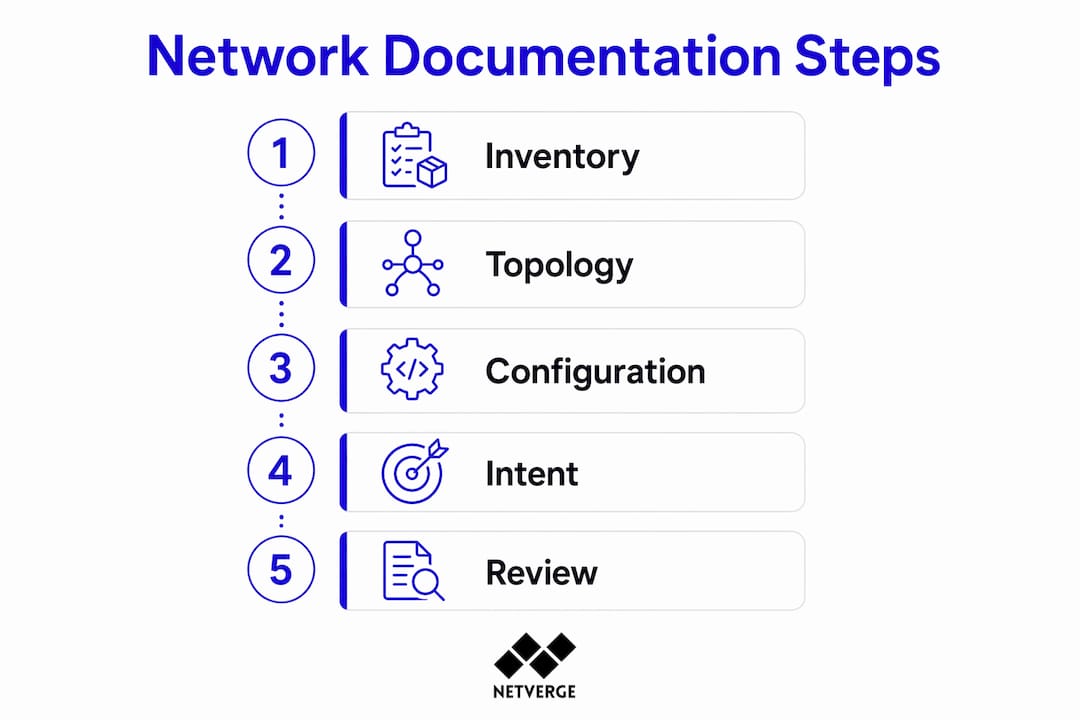
One often-overlooked component is intent mapping. Documenting why firewall rules exist is more operationally valuable than recording only the current settings, because intent mapping prevents engineers from accidentally breaking hidden dependencies during changes. A rule that blocks port 445 may look redundant until someone removes it and discovers it was protecting a legacy application with no other control.
Network documentation best practices for sustained accuracy
Documentation that is accurate on day one but stale by month three is worse than no documentation in some scenarios. It provides false confidence. The following practices keep records synchronized with the actual network state over time.
Assign clear ownership. Every documentation artifact needs a named owner responsible for accuracy and update cycles. Treating documentation as an operational asset with defined governance mirrors how you manage patching or monitoring processes. Without ownership, updates happen inconsistently or not at all.
Integrate automated discovery. Centralized systems with automated discovery keep documentation synchronized with live network state by continuously pulling telemetry, configuration data, and topology changes via API. A Network Source of Truth (NSoT) platform, such as NetBox, provides the authoritative inventory layer that other tools reference.
Apply version control. Documentation should be treated like source code. Every change needs a timestamp, author attribution, and a rollback path. This practice supports both audit trails and incident post-mortems.
Avoid the template trap. Manual templates decay quickly in dynamic environments because they rely on human discipline to stay current. Static spreadsheets and Visio files work for design documentation and process guides, but they fail for live device inventories. Automation tools and APIs provide the accuracy that manual templates cannot sustain.
Integrate documentation into change management. Every change ticket should require a documentation update as part of the closure criteria. This single process change prevents the gradual drift that makes documentation unreliable.
Pro Tip: Set a quarterly documentation review cadence tied to your change management calendar. Any network segment that received more than five changes in a quarter should trigger a full documentation audit for that segment, not just incremental updates.
Successful enterprise documentation requires defined governance, change management integration, and continuous updates rather than periodic one-off projects. Organizations that treat documentation as a project complete it once and watch it decay. Organizations that treat it as a process maintain it indefinitely.
How documentation supports risk management, compliance, and security
Network documentation is a direct input to risk management, not a byproduct of it. The connection operates across several dimensions that IT leaders and compliance officers both need to understand.
RTO and RPO validity. Lack of documentation invalidates RTO and RPO objectives because recovery procedures become theoretical rather than executable. If your disaster recovery plan references systems that no longer exist in their documented form, your recovery time estimates are fiction.
Single point of failure identification. Dependency maps reveal where one device or link failure cascades into a service outage. Without documentation, these vulnerabilities remain invisible until they trigger an incident.
Change failure rate reduction. Accurate documentation lowers change failure rates by making dependencies visible before changes execute, enabling controlled rollbacks when outcomes deviate from expectations. This is particularly relevant for organizations operating under ITIL or similar change management frameworks.
Audit readiness. Frameworks including SOC 2, ISO 27001, PCI DSS, and HIPAA require traceable ownership and change history for network controls. Documentation that captures who made a change, when, and why satisfies auditor requests that would otherwise require days of manual reconstruction.
Security posture mapping. Documented network segmentation, VLAN assignments, and access controls give security teams a baseline to detect unauthorized changes. When a new device appears on a segment where it should not exist, documented baselines make the anomaly detectable. Reviewing your IT infrastructure optimization strategy alongside your documentation practice reinforces both disciplines simultaneously.
The IT infrastructure components that carry the highest risk are often the least documented, because they were deployed quickly under pressure and never formally recorded. Identifying those gaps is itself a risk management activity.
Key Takeaways
Accurate, maintained network documentation is the single most effective tool for reducing incident response time, managing change risk, and satisfying compliance requirements across distributed IT environments.
| Point | Details |
|---|---|
| Documentation cuts recovery time | Proper records reduce system recovery from 4 hours to 45 minutes by eliminating manual discovery. |
| Intent mapping prevents change failures | Recording why policies exist stops engineers from breaking hidden dependencies during updates. |
| Automation prevents documentation drift | Centralized NSoT platforms with API-driven discovery keep records synchronized with live network state. |
| Ownership and governance are non-negotiable | Every documentation artifact needs a named owner and a defined update cycle to remain reliable. |
| Documentation validates compliance and DR plans | Without accurate records, RTO/RPO targets and audit responses become unexecutable and unverifiable. |
What I've learned from watching documentation practices evolve
I have watched organizations spend six figures on monitoring platforms while their network documentation lived in a shared drive full of outdated Visio files nobody trusted. The monitoring tool fired alerts. The engineers ignored the documentation. Incidents took hours to resolve because the alert told them something was broken but the documentation could not tell them what depended on what.
The shift I find most significant in recent years is not the tooling. It is the mindset change from documentation as a deliverable to documentation as an operational discipline. Teams that made this shift stopped asking "when do we update the docs?" and started asking "how do we prevent the docs from ever being wrong?" That question leads directly to automation, version control, and integration with change management.
The organizations I have seen handle major incidents most effectively share one trait: their documentation is boring. It is not impressive or elaborate. It is accurate, current, and accessible at 2 a.m. when the person on call has never seen that part of the network before. That is the standard worth targeting.
One caution I would offer to IT leaders: do not let the perfect be the enemy of the good. A partially documented network with clear ownership and an update process will outperform a perfectly designed documentation framework that nobody maintains. Start with your highest-risk segments, assign owners, and build the habit before you build the system.
— Jim
How Netverge keeps your documentation accurate and current
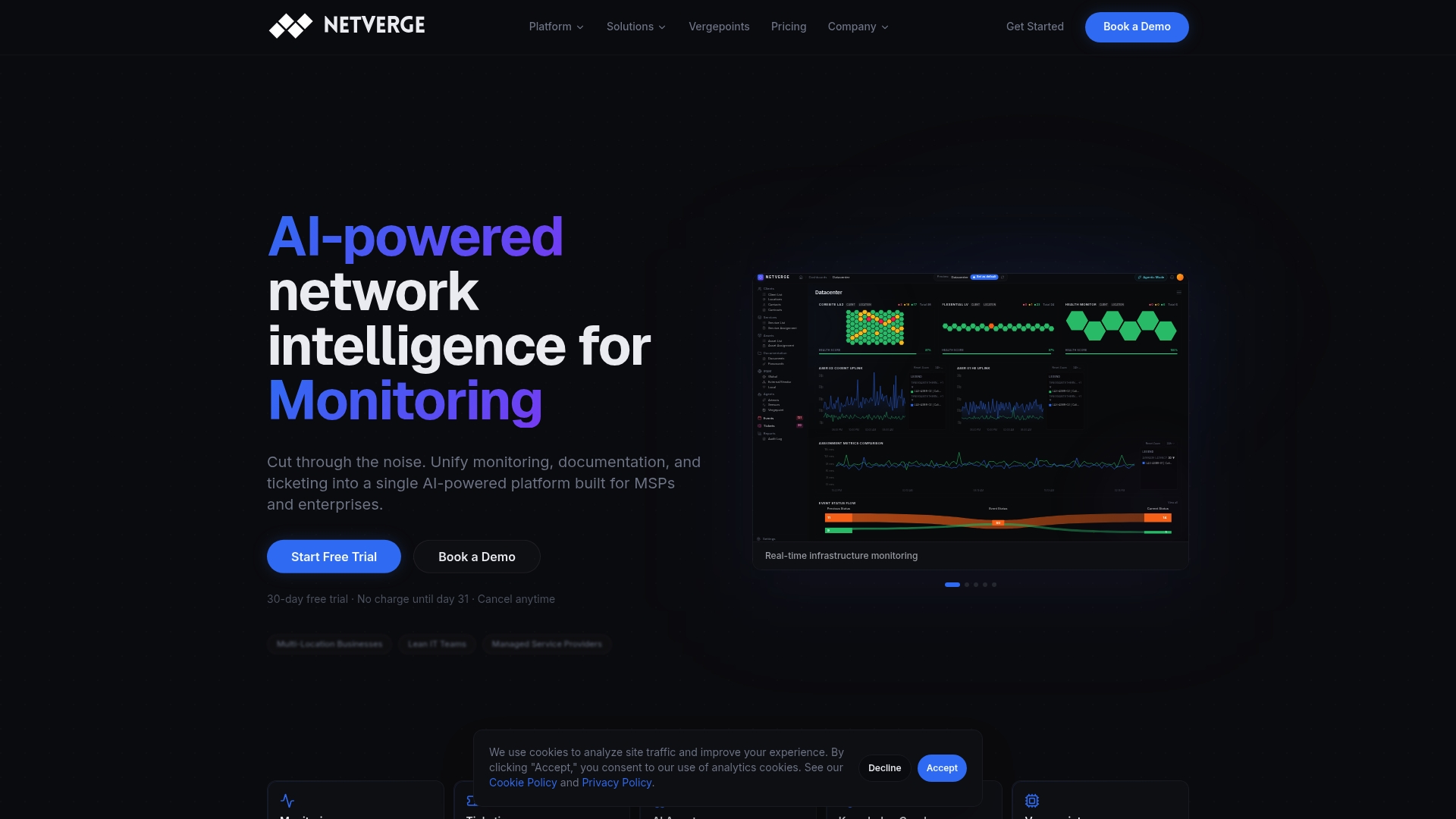
Netverge unifies AI-powered network monitoring with automated documentation, eliminating the gap between your live network state and your records. The platform's knowledge graph continuously maps device relationships, configurations, and dependencies, so your documentation reflects reality rather than a snapshot from last quarter. Vergepoints hardware feeds real-time telemetry directly into the platform, while AI agents detect anomalies and correlate events against documented baselines. For MSPs and multi-location enterprises managing distributed infrastructure, Netverge replaces fragmented spreadsheets and disconnected tools with a single, always-current source of truth. Explore enterprise network automation to see how Netverge fits your environment.
FAQ
What is network documentation?
Network documentation is the structured record of a network's topology, device inventory, configurations, security policies, and operational procedures. It serves as the authoritative reference for troubleshooting, change management, and compliance activities.
How does documentation reduce network downtime?
Accurate documentation eliminates manual discovery during outages, cutting recovery time from hours to minutes. Organizations with maintained documentation resolve incidents faster because engineers execute against a known map rather than rediscovering the environment under pressure.
What tools are used for network documentation?
Common tools include CMDB platforms, NetBox as a Network Source of Truth, Microsoft Visio for topology diagrams, Scanopy for automated discovery, and AI-driven platforms like Netverge that continuously synchronize documentation with live network state via telemetry and API integration.
How often should network documentation be updated?
Documentation should update automatically through integrated discovery tools for live inventory data, and manually as part of every change management closure. A quarterly audit of high-change network segments catches drift that automated tools may not capture.
Why does stale documentation cause more harm than no documentation?
Outdated documentation creates false confidence during incidents. Engineers act on incorrect information, misdiagnose faults, and execute changes against a topology that no longer exists, extending outage duration and increasing the risk of compounding failures.