
IT service delivery is defined as the tactical execution of providing IT services to end users while meeting agreed performance, quality, and availability standards. The industry term for the broader discipline is IT service management (ITSM), but service delivery specifically refers to the "how" of getting services into users' hands. Key performance indicators like mean time to resolution (MTTR) and customer satisfaction (CSAT) scores measure whether delivery is working. IT service delivery is distinct from both ITSM and IT Operations Management (ITOM), each serving a different scope and purpose. Understanding that distinction is the foundation for improving organizational efficiency.
What is IT service delivery and how does it work?
IT service delivery is the process of fulfilling a user's request for an IT service, from the moment the request is made to the moment the user has what they need. It sits inside the larger ITSM framework but focuses on execution, not design or governance. Think of ITSM as the rulebook and service delivery as the play on the field.
ITIL 5 outlines three primary modalities for how IT services reach users: providing access to resources, transferring physical goods, and performing service actions such as consulting or configuration. Each modality follows a structured workflow: assess commitments, confirm resources, execute delivery, and report outcomes. That four-step sequence applies whether you are provisioning a software license, shipping a laptop, or configuring a firewall.

| Modality | Example | Typical KPI |
|---|---|---|
| Access to resources | Software license provisioning | Time to provision |
| Transfer of goods | Laptop deployment | Fulfillment cycle time |
| Service actions | Network configuration, consulting | MTTR, CSAT score |
Delivery effectiveness is measured against SLA expectations covering quality, availability, and response time. SLA management is not a back-office formality. It is the contract between IT and the business, and missing it consistently erodes trust faster than any outage.
- Service Request Management defines the catalog of available services and the workflows behind each one.
- SLA targets set the performance bar for every delivery type.
- Reporting closes the loop, giving teams data to improve future delivery cycles.
Pro Tip: Map every service request type to a specific SLA target before you automate anything. Automation applied to an undefined process just produces errors faster.
How does IT service delivery differ from ITSM and ITOM?
The three disciplines share overlapping vocabulary, which causes real confusion in practice. Defining each precisely prevents teams from misaligning resources and accountability.
IT service delivery is the tactical layer. It answers the question: "Did the user get the service, and did it meet the agreed standard?" Its scope is the fulfillment lifecycle, and its primary metrics are MTTR and CSAT.
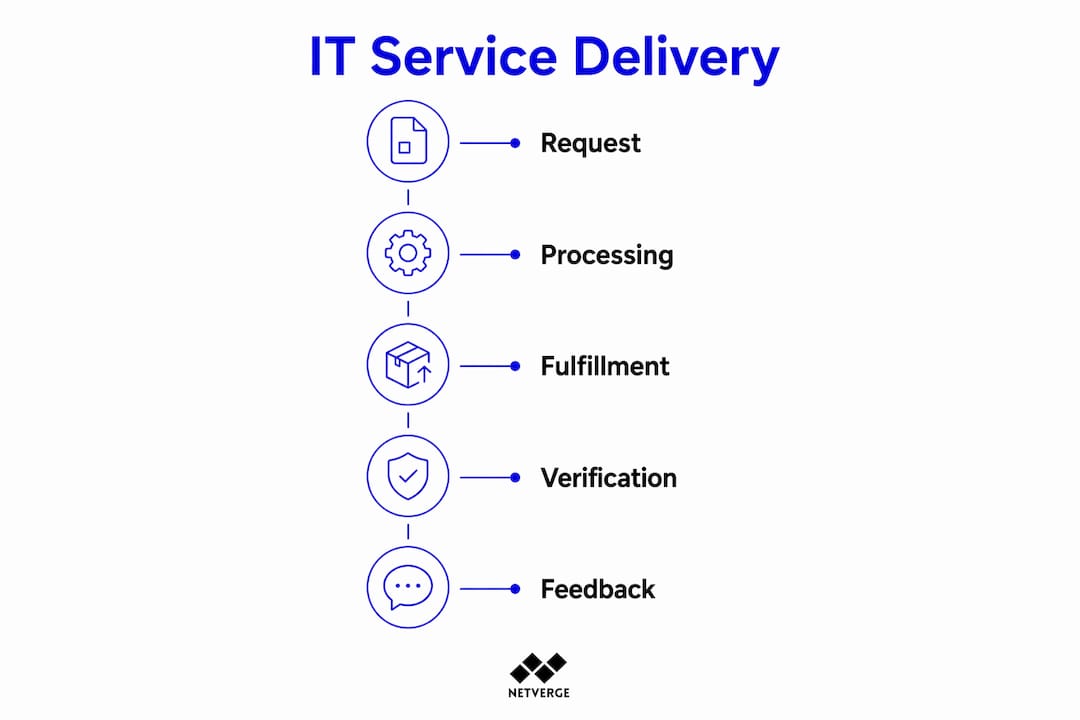
ITSM is the full framework. It covers service design, transition, operation, and continual improvement. ITSM sets the policies, processes, and governance structures that service delivery operates within. ITSM is the overall framework that includes design, transition, and improvement, while delivery is the execution arm.
ITOM is the backend. It manages the infrastructure, networks, and systems that IT services run on. ITOM answers: "Is the infrastructure healthy?" Service delivery answers: "Did the user get what they needed from that infrastructure?"
| Discipline | Scope | Primary Focus | Key Goal |
|---|---|---|---|
| IT service delivery | Fulfillment lifecycle | Tactical execution | SLA compliance, user satisfaction |
| ITSM | End-to-end service lifecycle | Framework and governance | Service quality and continual improvement |
| ITOM | Infrastructure and operations | Backend systems health | Uptime, capacity, performance |
Pro Tip: When an incident occurs, ITOM detects the infrastructure failure, ITSM governs the response process, and service delivery measures whether the user's service was restored within the SLA window. All three are active simultaneously.
Understanding this separation helps IT managers assign ownership correctly. Blurring the lines between ITOM and service delivery is one of the most common causes of accountability gaps in enterprise IT.
What are best practices and common challenges in IT service delivery?
The single most cited reason for poor IT service delivery is not bad technology. A service culture emphasizing accountability and transparency is more critical to success than any tool investment. Technology amplifies a good process. It exposes a bad one.
Mature organizations measure beyond uptime. ITIL 4 and 5 frameworks recommend tracking Time to Value and user sentiment alongside traditional availability metrics. Time to Value measures how quickly a user can actually use a delivered service, not just when the ticket was closed. That distinction matters because a provisioned account with incorrect permissions has a closed ticket but zero delivered value.
Common challenges IT teams face include:
- Tool sprawl: Multiple disconnected platforms create data silos and slow fulfillment. The cost of tool sprawl compounds over time as teams spend more effort reconciling data than delivering services.
- Inadequate process design: Automating a broken workflow produces faster failures, not better outcomes.
- Prioritizing technology over people and process: New platforms do not fix unclear ownership or missing SLA definitions.
- Reactive posture: Teams that only respond to failures never build the proactive delivery capability that drives business agility.
- Lifecycle gaps: Onboarding and offboarding are high-risk delivery events that basic ticketing systems consistently underserve.
Automation for lifecycle management at onboarding and offboarding points reduces security risk and administrative overhead more than simple ticket routing ever will. When a new employee joins, the delivery chain involves account creation, device provisioning, application access, and network permissions. Each step is a failure point without automation.
Pro Tip: Build a real-time alerting process into your delivery workflow so that SLA breaches are flagged before they happen, not after the user complains.
The benefits of managed IT services include access to structured delivery processes that many internal teams have not yet formalized. For organizations building delivery capability from scratch, that external reference point is worth studying.
How does IT service delivery impact organizational efficiency?
IT service delivery is a value-creation function, not a cost center. Organizations that treat delivery as strategic report higher agility and better alignment with digital transformation goals. The shift from reactive support to proactive delivery is what separates high-performing IT teams from those perpetually fighting fires.
The average office user interacts with IT service desks three times per month. That frequency means delivery quality directly affects user productivity every week, not just during major incidents. A two-hour delay in software provisioning multiplied across hundreds of users is a measurable productivity loss.
The business impact of strong IT service delivery shows up in several areas:
- User productivity: Faster fulfillment means less time lost waiting for tools, access, or fixes.
- Employee experience: Reliable IT services correlate with higher employee satisfaction scores.
- Risk reduction: Consistent SLA adherence reduces the frequency and severity of compliance gaps.
- Cost control: Proactive delivery and lifecycle automation reduce the volume of reactive incidents.
Integrating service delivery with continual improvement processes creates a feedback loop. Delivery data, specifically MTTR, CSAT, and Time to Value, feeds back into service design, which improves the next delivery cycle. That loop is how IT organizations build compounding efficiency over time.
A structured network performance workflow underpins delivery quality at the infrastructure level. When network performance degrades, service delivery degrades with it. The two are inseparable in practice.
Customer service automation principles apply directly to IT service delivery workflows. Structured automation at defined handoff points reduces human error and speeds fulfillment without sacrificing quality control.
Key Takeaways
Effective IT service delivery requires clear process ownership, SLA-aligned workflows, and a service culture that prioritizes people and accountability over technology alone.
| Point | Details |
|---|---|
| Define delivery separately from ITSM | IT service delivery is tactical execution; ITSM is the governing framework around it. |
| Use ITIL 5 modalities as your structure | Map every request type to access, goods transfer, or service action before building workflows. |
| Measure Time to Value, not just uptime | A closed ticket with no usable service is a delivery failure, regardless of SLA clock status. |
| Automate lifecycle events first | Onboarding and offboarding carry the highest risk and benefit most from structured automation. |
| Build a service culture before buying tools | Accountability and transparency drive delivery outcomes more reliably than platform investments. |
Why most IT teams are measuring the wrong things
After working with IT organizations across different maturity levels, the pattern I see most often is this: teams optimize for ticket closure rates and uptime percentages, then wonder why user satisfaction scores stay flat. The metrics are real, but they measure the wrong moment in the delivery chain.
Time to Value is the metric that actually reflects whether delivery worked. A user who receives a provisioned laptop with a misconfigured VPN client has a closed ticket and zero productive value. That gap between "delivered" and "usable" is where most IT service delivery fails, and it rarely shows up in standard dashboards.
The other mistake I see consistently is treating ITIL as a compliance exercise rather than a design tool. ITIL 4 and 5 are built to be adapted to organizational context. Teams that implement every process verbatim without adapting to their environment end up with documentation that nobody follows. The framework works when you use it to answer real operational questions, not to pass an audit.
The teams that get IT service delivery right share one trait: they treat it as a cross-functional capability, not a single department's responsibility. Delivery touches network operations, security, procurement, and HR. When those teams operate in silos, delivery suffers at every handoff point. Fixing that requires organizational design, not a new ticketing platform.
— Jim
How Netverge supports IT service delivery quality
Reliable IT service delivery depends on knowing what is happening across your infrastructure before users notice a problem.
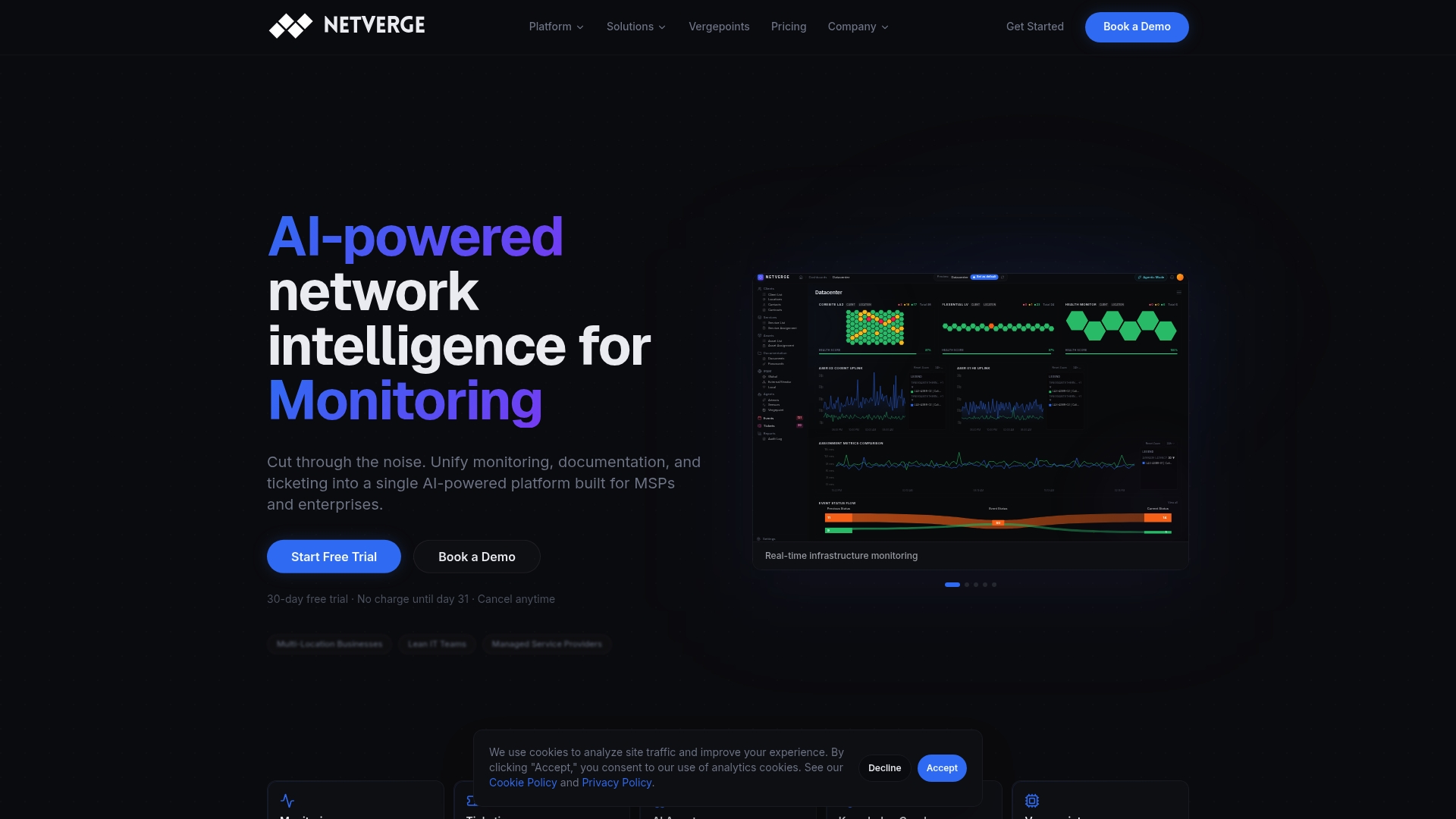
Netverge gives MSPs and enterprise IT teams AI-powered network monitoring that detects anomalies, correlates events, and triggers automated responses before service quality degrades. The platform unifies visibility, ticketing, and documentation into a single interface, eliminating the tool sprawl that slows fulfillment cycles. Netverge's autonomous AI agents diagnose issues and route them to the right team without manual triage, directly supporting SLA adherence and MTTR targets. If your delivery workflows depend on network performance data, Netverge provides the observability layer that makes proactive delivery possible. Request a demo to see how it fits your environment.
FAQ
What is IT service delivery in simple terms?
IT service delivery is the process of getting IT services to end users in a way that meets agreed quality and performance standards. It covers everything from software provisioning to hardware deployment and technical support actions.
How does IT service delivery differ from ITSM?
ITSM is the full framework governing how IT services are designed, managed, and improved. IT service delivery is the tactical execution layer within that framework, focused specifically on fulfilling user requests and meeting SLA targets.
What are the three ITIL 5 delivery modalities?
ITIL 5 defines three modalities: providing access to resources, transferring physical goods, and performing service actions such as configuration or consulting. Each modality has its own workflow and KPIs.
Why does IT service delivery matter for business outcomes?
The average office user interacts with IT service desks three times per month, making delivery quality a direct factor in user productivity and employee satisfaction. Poor delivery creates compounding productivity losses across the organization.
What is the most common IT service delivery failure?
The most common failure is measuring ticket closure instead of Time to Value. A fulfilled request that does not result in a usable service is a delivery failure, even if the SLA clock shows compliance.