
Networks have never been more complex. You are managing distributed infrastructure, cloud-connected devices, and hybrid environments where a single misconfiguration can cascade into a critical outage. Understanding the key features of network management is no longer optional. It determines how fast you detect faults, how confidently you enforce policy, and whether your team spends time on real problems or drowning in noise. This article breaks down the core features, the criteria that matter, and how modern AI is changing what "good" network management actually looks like in practice.
Table of Contents
- Key takeaways
- 1. How to evaluate network management features and capabilities
- 2. Fault management
- 3. Configuration management and desired state enforcement
- 4. Accounting and security management
- 5. Performance management and AI-driven automation
- 6. FCAPS as an integrated framework, not isolated silos
- 7. Comparing the core network management features
- My honest take on network management in 2026
- See how Netverge unifies these features in one platform
- FAQ
Key takeaways
| Point | Details |
|---|---|
| FCAPS is the foundational model | Fault, configuration, accounting, performance, and security management are the five pillars every network management practice should address. |
| Drift detection beats backup-only approaches | Configuration management must include real-time drift detection, not just periodic backups, to prevent outages proactively. |
| AI reduces operational noise | AI-driven tools shift team focus from routine alert triage to high-impact incidents, improving response times significantly. |
| Telemetry enrichment improves security | Enriching flow data with identity, geolocation, and threat intelligence dramatically improves security investigation quality. |
| Performance metrics must tie to SLOs | Tracking latency, jitter, and packet loss is only useful when thresholds are mapped directly to service-level objectives. |
1. How to evaluate network management features and capabilities
Before you assess any tool or platform, you need a consistent framework. Not all network management solutions are built to the same standard, and the gaps become visible fast when you are troubleshooting a production outage at 2 a.m.
When evaluating the key components of network management, focus on these criteria:
- Reliability: Does the platform deliver accurate, real-time telemetry without gaps in coverage?
- Automation capability: Can it detect, classify, and respond to incidents without manual intervention?
- Scalability: Will it handle your network at 2x or 5x current size without architectural changes?
- Security posture: Does it enforce policy, log all changes, and support compliance workflows?
- Integration depth: Can it connect to your existing ticketing, CMDB, and observability stack via API?
Essential network management must accomplish more than uptime monitoring. It needs to give you control, visibility, and the ability to act decisively. Platforms that score poorly on automation and integration tend to become bottlenecks as your infrastructure grows.
Pro Tip: Build a scoring matrix before you evaluate any network management platform. Weight automation and integration twice as heavily as features like reporting, since they directly impact how your team responds to incidents.
2. Fault management
Fault management is the discipline of detecting, classifying, correlating, and resolving failures across your infrastructure. It is arguably the most operationally visible of the key features of network management, because its failures are felt immediately.
A solid fault management workflow follows these steps:
- Detection: Receive alerts from SNMP traps, syslog, or synthetic monitoring when a device or link degrades or fails.
- Classification: Categorize faults by severity, affected layer, and impacted service.
- Correlation: Group related alerts into a single incident. A fiber cut should produce one ticket, not 300 alerts.
- Root cause analysis: Identify the originating fault, not just the downstream symptoms.
- Resolution and documentation: Close the incident with a clear record of what happened and what was changed.
62% plan AI-driven management adoption specifically because manual fault triage at scale is unsustainable. AI-driven correlation engines reduce alert fatigue significantly by identifying patterns across thousands of events in real time. Platforms like Netverge use autonomous AI agents to detect anomalies and initiate automated network diagnostics without waiting for a human to investigate.
Pro Tip: Set your alert thresholds based on baseline performance data collected over at least 30 days. Thresholds set on vendor defaults generate chronic noise that trains your team to ignore alerts entirely.
3. Configuration management and desired state enforcement
Configuration management goes far beyond keeping a backup of your device configs. The best practice in 2026 is to define a desired state for every device and continuously verify that the live state matches.
Here is how a mature configuration management practice is structured:
- Define desired state: Document the exact intended configuration for each device class, including ACLs, routing protocols, NTP sources, and SNMP community strings.
- Automate config push: Use tools that push configuration updates via API or SSH at scale, reducing human error during change windows.
- Enable drift detection: Monitor continuously for any deviation from the desired state, not just at scheduled backup intervals.
- Version control all changes: Store every config version in a versioned repository so you can roll back in seconds.
- Trigger alerts on unauthorized changes: Any config modification outside of a change window should generate an immediate alert.
Configuration management must include drift detection and desired-state tracking to proactively prevent outages. A common failure pattern is organizations that back up configs nightly but never detect when a technician manually changes an access list. That undocumented change sits silently until it causes an outage during a routing update three weeks later.
Zero-touch device discovery automates OID mapping and device onboarding, saving hours of manual setup. When your platform can discover and document devices automatically, your configuration baseline stays current without ongoing manual effort.
4. Accounting and security management
These two disciplines are often treated separately, but they share a common dependency: complete, accurate data about who did what, when, and from where.
Accounting management
Accounting management tracks resource usage across your infrastructure. For network administrators, this means capturing flow data, bandwidth consumption per user or application, and CLI session logs. The practical uses go beyond billing. When a circuit saturates unexpectedly, accounting data tells you which application or endpoint generated the traffic spike.
Security management
Security management covers policy enforcement, access control, segmentation, and continuous verification of your security posture. In 2026, this means zero-trust principles applied at the network layer, not just at the perimeter.
Telemetry enrichment with identity and threat intel significantly improves security incident investigations by mapping raw flow data to actual users, devices, and known threat indicators. Without enrichment, you have IP addresses. With enrichment, you have context.
| Category | Key data sources | Primary tools | Primary use cases |
|---|---|---|---|
| Accounting | NetFlow, sFlow, RADIUS logs | Flow collectors, SIEM | Bandwidth auditing, fair use, troubleshooting |
| Security | Firewall logs, IDS alerts, AAA | SIEM, NAC, identity platforms | Incident investigation, compliance, access control |
| Combined | Enriched telemetry with identity | AI correlation engines | Attribution, threat hunting, forensic analysis |
5. Performance management and AI-driven automation
Performance management means maintaining and measuring the quality of your network against defined service-level objectives. The metrics you track here are the same ones your end users experience directly.
Critical performance metrics to monitor continuously include:
- Latency: Round-trip time between endpoints, measured per path and per application
- Jitter: Variance in packet delivery timing, critical for voice and video workloads
- Throughput: Actual data transfer rate versus available bandwidth
- Packet loss: Percentage of dropped packets, often the first indicator of hardware issues or congestion
- Queue drops: Counter-level visibility into buffer exhaustion on specific interfaces
Performance metrics tied to service-level objectives give your monitoring real operational meaning. A latency spike only matters if it crosses a threshold that impacts a defined application class. Without that mapping, you are collecting data but not making decisions with it.
79% of IT professionals prioritize Day 2 network operations automation because AI-driven anomaly detection changes how performance management works operationally. Instead of reviewing dashboards manually, AI models learn your baseline and alert only when genuine deviations occur. AI-driven operations address understaffing by redirecting engineer attention from routine alerts to incidents that genuinely require human judgment.
Pro Tip: Do not set performance alert thresholds at 100% utilization. Set them at 70-80% for critical links so you have time to act before users notice degradation. Pair those thresholds with capacity trend reports reviewed weekly.
6. FCAPS as an integrated framework, not isolated silos
The FCAPS model, covering Fault, Configuration, Accounting, Performance, and Security management, remains foundational for organizing network management in 2026. The common mistake is treating each discipline as an isolated function with its own team, tools, and workflows.
Experienced network administrators recognize that a single incident frequently touches multiple FCAPS domains simultaneously. A port flapping due to a misconfigured duplex setting is simultaneously a fault event, a configuration deviation, and a performance degradation. Treating FCAPS as overlapping lenses rather than silos enables multi-angle troubleshooting that resolves incidents faster and more completely.
Platforms that correlate data across all five domains give you a materially better picture of what is happening than those that silo fault alerts away from configuration history and performance baselines.
7. Comparing the core network management features
| Feature | Key capability | Modern enhancement | Primary challenge |
|---|---|---|---|
| Fault management | Alert correlation and root cause analysis | AI-driven incident grouping | Alert fatigue from poor threshold tuning |
| Configuration management | Drift detection and version control | Zero-touch discovery and auto-remediation | Undocumented manual changes |
| Accounting management | Flow data collection and usage auditing | Identity-enriched telemetry | Data volume and storage costs |
| Performance management | SLO-mapped metric tracking | AI baseline learning and anomaly detection | Threshold calibration complexity |
| Security management | Policy enforcement and access control | Continuous verification and zero-trust segmentation | Coverage gaps in hybrid environments |
The global network operations market is projected to reach $23 billion by 2030, driven largely by AI and autonomous network operations. The organizations capturing that value are the ones treating these five features as an integrated system, not a checklist.
My honest take on network management in 2026
I have spent years watching organizations buy monitoring tools and then wonder why nothing improved. The honest answer is usually that the tools were not the problem. The practice was.
FCAPS gave us a clear organizing philosophy decades ago and it still works. What has changed is the volume, velocity, and complexity of the environments it needs to describe. When I work with teams managing hybrid infrastructure, I consistently find they are applying the framework correctly in theory but operating each domain in isolation in practice. Fault data never reaches the team reviewing configuration history. Performance baselines are never shared with the security analysts investigating lateral movement.
My view is that automation adoption challenges are real and underappreciated. Skills gaps, risk aversion, and tool fragmentation all slow down what should be straightforward automation wins. I tell teams: start with correlation, not remediation. Get your platform to group related alerts correctly before you let it close tickets automatically. That sequence builds confidence in automation without exposing you to automated mistakes in production.
The teams I see excelling in 2026 are not the ones with the most tools. They are the ones who have unified their visibility layer and taught their AI what "normal" looks like for their specific infrastructure. That takes time and discipline. But it is the work that actually reduces your mean time to resolution.
— Jim
See how Netverge unifies these features in one platform
If managing five separate disciplines across fragmented tools sounds familiar, you are not alone. Netverge was built specifically to consolidate fault, configuration, accounting, performance, and security management into a single AI-powered platform.
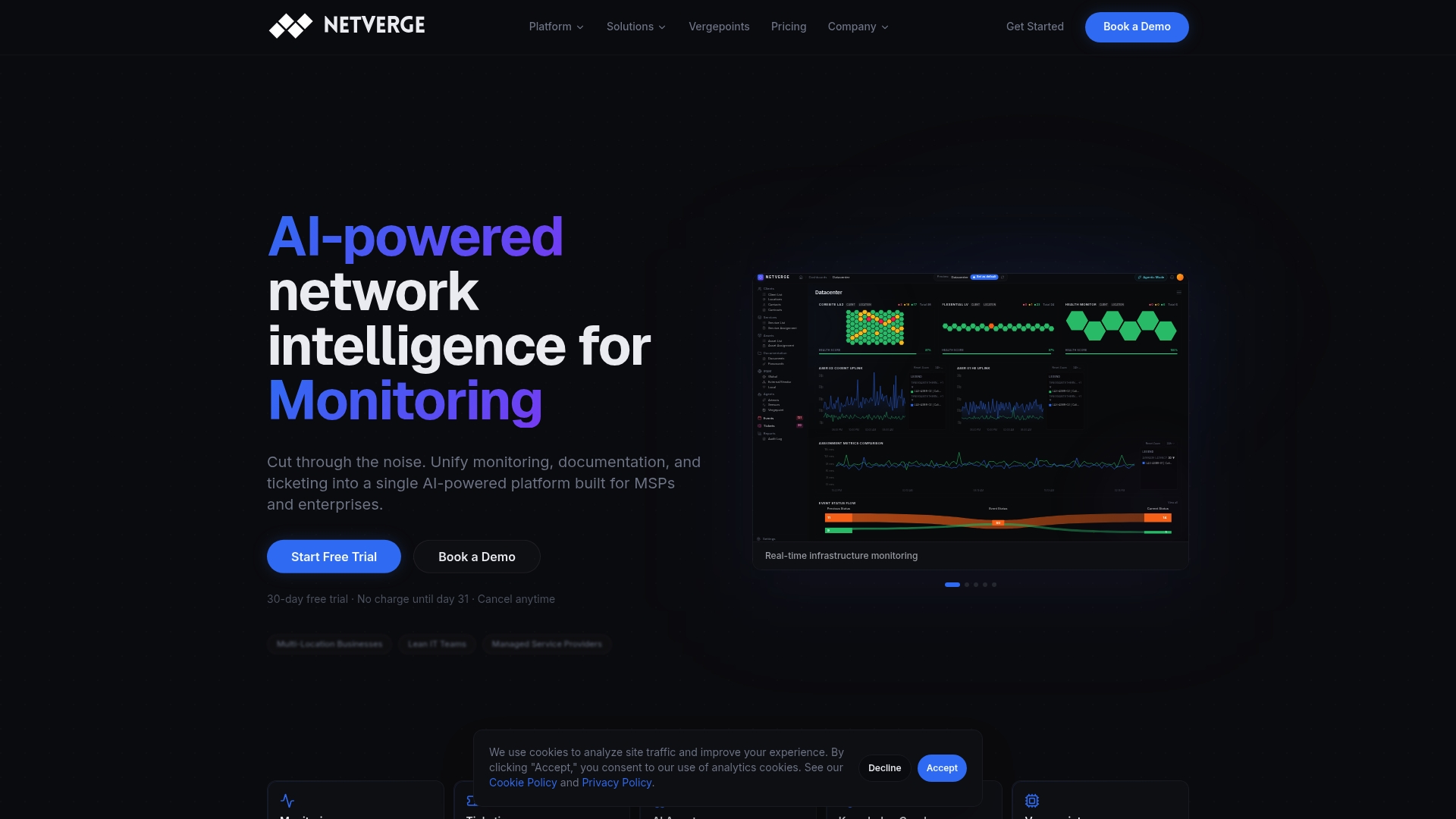
With Netverge's AI-powered monitoring platform, you get real-time anomaly detection, zero-touch device discovery, automated alert correlation, and intelligent ticket triage working together from day one. Vergepoints hardware provides physical visibility at every location, while AI agents handle diagnostics and escalation automatically. Whether you are an MSP managing dozens of client networks or an enterprise with distributed infrastructure, Netverge for MSPs and enterprise teams gives you the control and clarity these five features require without the fragmentation.
FAQ
What are the key features of network management?
The key features of network management are organized under the FCAPS model: Fault, Configuration, Accounting, Performance, and Security management. Each discipline addresses a distinct operational need, from detecting failures to enforcing security policy.
What is the importance of network management for IT teams?
Network management gives IT teams the visibility and control to detect problems early, maintain consistent configuration, and enforce security policy across distributed infrastructure. Without it, troubleshooting relies on guesswork and reactive responses.
How does AI improve network management?
AI improves network management by learning baseline behavior, correlating related alerts into single incidents, and automating routine diagnostic steps. This lets engineers focus on high-priority issues rather than manually triaging hundreds of low-value alerts.
What is drift detection in configuration management?
Drift detection continuously compares the live configuration of a device against its defined desired state and alerts you when a deviation is found. It prevents undocumented manual changes from causing outages days or weeks after the fact.
What metrics matter most for performance management?
The most critical performance metrics are latency, jitter, throughput, packet loss, and queue drops. These should be tracked against service-level objectives so threshold alerts have direct operational meaning.