
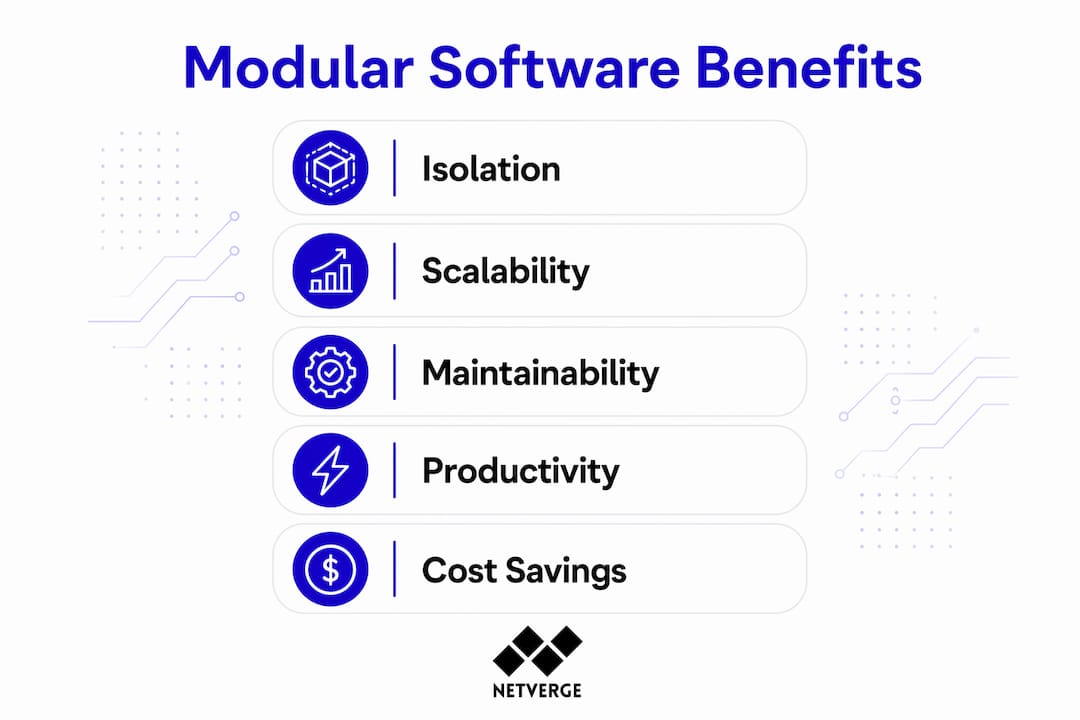
Software modules are defined as self-contained units of code that expose a fixed interface and hide their internal implementation. The role of software modules in IT is to isolate functionality so that each unit can be built, tested, and replaced without touching the rest of the system. This design principle, formally called modular architecture, is the foundation behind scalable network management, maintainable codebases, and efficient distributed operations. Modular systems enforce loose coupling and strong cohesion, meaning each module does one job well and communicates only through defined contracts. For IT professionals managing distributed infrastructure, that discipline translates directly into faster incident resolution, lower maintenance costs, and systems that can grow without breaking.
What is the role of software modules in IT architecture?
Modular architecture decomposes a complex system into independently manageable units. Each module owns a specific domain, whether that is authentication, telemetry collection, or ticket routing, and exposes its capabilities through a defined API. No other module reaches inside it. This boundary enforcement is not just a coding convention. Modules communicate only through defined interfaces, which prevents direct internal access and keeps dependencies predictable.
The practical impact on IT teams is significant. When a bug surfaces in a telemetry module, the fault stays contained. Engineers do not need to trace side effects across the entire codebase. Onboarding a new team member to a single module takes days, not weeks, because the scope is bounded. Parallel development becomes realistic: two teams can work on separate modules simultaneously without stepping on each other's changes.

The importance of software modules also shows up in long-term system health. Modularity flattens the cost of change over time, enabling sustainable evolution that monolithic designs cannot support past a certain scale. For decision-makers, that means fewer emergency rewrites and more predictable delivery timelines.
How does modular design reduce technical debt and improve productivity?
Technical debt accumulates when engineers patch around existing code instead of changing it cleanly. Modular design attacks that problem at the root. Developers reclaim approximately 33% of their time by isolating changes to specific modules, reducing hours lost to legacy maintenance and rework. That is roughly one full day per week returned to productive development.
The mechanism behind this gain is cohesion and loose coupling. A cohesive module handles one responsibility. A loosely coupled module depends on as few other modules as possible. Together, these properties mean a change in one module rarely forces changes elsewhere. Contrast that with a monolithic codebase where a single database schema change can ripple through dozens of files.
Key practices that protect against cascading technical debt include:
- Enforced API contracts: Every module publishes a versioned interface. Internal changes stay internal.
- Boundary testing: Tests run at the module boundary, not deep inside implementation details.
- Isolated deployment: A module can be updated and redeployed without touching adjacent components.
- Focused onboarding: New engineers learn one module at a time, reducing ramp-up risk.
Pro Tip: Define your API contracts before writing implementation code. Teams that lock the interface first spend far less time renegotiating dependencies later.
Success in modular architectures depends more on stable API contracts than on the quality of internal code. Debugging shifts from reading implementation logic to inspecting what crosses the interface boundary. That shift makes troubleshooting faster and more systematic.
How do software modules accelerate network automation?
Network automation is where the benefits of software modules become measurable in seconds, not just developer hours. Traditional CLI-based configuration is sequential, error-prone, and difficult to audit. Modular automation tools using NETCONF and structured YANG data models change that equation entirely. NETCONF and YANG achieve configuration performance up to 10.3x faster than MD-CLI and up to 11x faster than traditional CLI. That speed difference matters when you are pushing configuration changes across hundreds of network devices simultaneously.
The reason modular automation scales where CLI cannot comes down to structure. YANG models define network state as typed, hierarchical data. NETCONF transports that data over a reliable session with transaction semantics. Each automation module consumes or produces YANG-structured data through a defined interface, which means modules can be tested in isolation before touching production infrastructure. For IT teams managing key features of network management, that testability is the difference between a confident rollout and a change-freeze.
Modular automation also enables consistent configuration management at scale:
- Idempotent operations: A module applies the same configuration repeatedly without producing different results.
- Automated validation: Module-level tests confirm state before and after each change.
- Rollback isolation: A failed module rolls back its own changes without affecting adjacent modules.
- Audit trails: Each module logs its inputs and outputs through a structured interface, simplifying compliance reviews.
Pro Tip: Integrate structured YANG data models early in your automation design. Teams that treat network state as typed data from the start avoid the brittle string-parsing that breaks traditional scripts at scale.
What cost and scalability benefits come from distributed modular systems?
Distributed, agent-based architectures take software module integration to its logical conclusion. Instead of one large management process, the system deploys specialized agents, each responsible for a specific network management domain such as fault detection, performance telemetry, or configuration compliance. Selective scaling of independent modules leads to 20–30% infrastructure cost savings by avoiding platform-wide over-provisioning. You scale the telemetry agent when telemetry load increases, not the entire platform.
Modular multi-agent orchestration allows specialized components to manage complex network operations at machine speed. An orchestration layer coordinates the agents, routing tasks and aggregating results without any single agent needing full system awareness. This mirrors how effective IT teams organize: specialists handle their domain, and a coordinator manages the workflow. For distributed network operations, this structure reduces mean time to resolution because the relevant agent already owns the context for its domain.
Fault isolation is the other major benefit. When a telemetry agent fails, the configuration compliance agent keeps running. The system degrades gracefully rather than going dark. That continuity is critical for MSPs managing multi-location enterprises where a full platform outage has direct service-level consequences.
| Benefit | Mechanism | Outcome |
|---|---|---|
| Cost reduction | Scale only the modules under load | 20–30% infrastructure savings |
| Fault isolation | Module failures stay contained | Continued operation during partial failures |
| Parallel development | Teams own separate agents | Faster feature delivery |
| Domain specialization | Each agent owns one responsibility | Faster, more accurate incident resolution |
What are the best practices for designing and maintaining software modules?
Most teams that struggle with modular design make the same mistakes: they start too granular, create circular dependencies, or skip API versioning until it becomes painful. The following practices prevent those outcomes.
- Start with coarse boundaries. Define large modules first and split them only when a clear second responsibility emerges. Premature splitting creates coordination overhead without delivering isolation benefits.
- Enforce unidirectional dependencies. Module A may depend on Module B, but Module B must never depend on Module A. Circular dependencies eliminate the isolation that makes modularity valuable.
- Version every API. When an interface changes, increment the version. Consumers pin to a version and migrate on their own schedule. This prevents forced upgrades from breaking unrelated systems.
- Write module-level automated tests. Granular module-level testing with contracts and structured logging prevents the distributed spaghetti that plagues poorly designed modular systems. End-to-end tests alone cannot catch interface regressions.
- Document the interface, not the implementation. Consumers need to know what a module accepts and returns. They do not need to know how it works internally.
Pro Tip: If you cannot describe a module's responsibility in one sentence, it has too many responsibilities. Split it before the codebase forces you to.
One architectural pattern deserves more attention than it typically receives: the modular monolith. Modular monolith architectures deliver modularity benefits without microservices operational overhead, making them a practical fit for teams under 50 developers. Premature adoption of microservices without adequate platform engineering creates unnecessary complexity. A modular monolith gives you clean boundaries, independent team ownership, and a single deployment artifact. It is a legitimate production architecture, not a stepping stone.
Key Takeaways
Software modules are the most reliable mechanism IT teams have for controlling complexity, reducing cost, and maintaining system stability at scale.
| Point | Details |
|---|---|
| Defined interfaces reduce debt | Isolating changes to modules reclaims roughly 33% of developer time lost to legacy maintenance. |
| NETCONF and YANG accelerate automation | Modular automation using these standards runs up to 11x faster than traditional CLI configuration. |
| Distributed agents cut infrastructure costs | Selective module scaling delivers 20–30% infrastructure cost savings in agent-based systems. |
| Modular monolith is a valid choice | Teams under 50 developers gain modularity benefits without microservices complexity. |
| API contracts are the real foundation | Stable, versioned interfaces matter more than internal code quality for long-term system health. |
Why I think most teams underestimate the modular monolith
After years of watching IT organizations chase architectural trends, the pattern I see most often is this: a team adopts microservices because the industry says to, then spends the next 18 months building the platform engineering capability they needed before making that move. The modular monolith gets dismissed as a compromise. It is not. It is frequently the right answer.
The teams that get the most out of modular architecture are not the ones with the most services. They are the ones with the clearest contracts. They know exactly what each module accepts, what it returns, and what it guarantees. That discipline, not the deployment model, is what makes a system maintainable five years from now.
For network management specifically, I think modularity is about to become non-negotiable. As AI-driven anomaly detection and automated remediation move from experimental to production, the systems running them need clean module boundaries to stay auditable. You cannot explain an AI decision if the detection logic, the correlation engine, and the ticketing system are all tangled together. Modularity is what makes AI-powered network operations trustworthy, not just fast.
My honest recommendation: build organizational fluency with contracts and boundaries before you worry about whether you have the right number of services. The architecture will follow naturally.
— Jim
How Netverge applies modular architecture to network management
Netverge is built on the same modular principles this article describes. Its platform separates AI-driven anomaly detection, automated ticketing, knowledge graphs, and infrastructure monitoring into distinct functional modules, each operating through defined interfaces. That separation means you can get value from AI-powered network monitoring without overhauling your entire operational workflow.
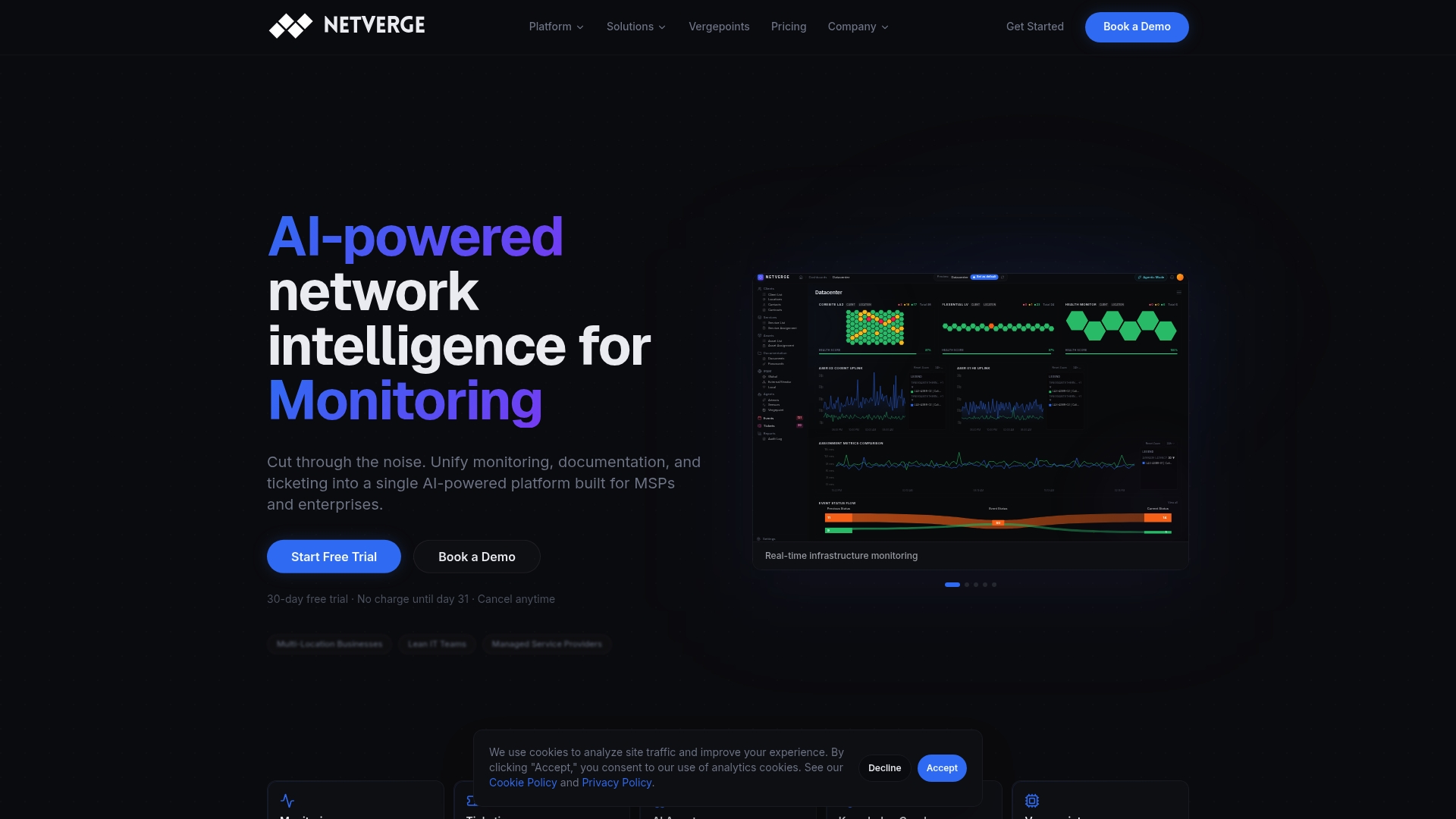
Netverge's autonomous AI agents diagnose and resolve incidents at machine speed, coordinated by an orchestration layer that mirrors the distributed agent model described above. For MSPs and multi-location enterprises managing complex infrastructure, that translates to faster resolution times and fewer manual escalations. Visit netverge.com to see how modular network management works in practice, or use the pricing calculator to estimate your monthly cost.
FAQ
What is a software module in IT?
A software module is a self-contained unit of code with a defined interface that hides its internal implementation. It handles one specific responsibility and communicates with other modules only through that interface.
Why does modular architecture reduce technical debt?
Modular architecture confines changes to individual modules, preventing modifications from cascading across the codebase. Developers reclaim roughly 33% of time previously lost to legacy maintenance by isolating work within module boundaries.
How do software modules improve network automation?
Modules using standards like NETCONF and YANG enable structured, testable, and repeatable configuration management. This approach delivers configuration performance up to 11x faster than traditional CLI methods.
What is a modular monolith?
A modular monolith is a single deployable application organized into clearly bounded internal modules. It delivers the isolation benefits of modular design without the operational complexity of running separate services.
How does Netverge use software modules?
Netverge separates monitoring, anomaly detection, ticketing, and AI agent functions into distinct modules coordinated by an orchestration layer. This structure allows each capability to scale and update independently without disrupting the broader platform.