
Most IT managers assume their standard network cards are doing the job. They move packets, they connect servers, and for years that was enough. But multi-location enterprises and MSPs now manage traffic volumes, telemetry streams, and distributed infrastructure that standard NICs were never designed to handle efficiently. Intelligent network interfaces are changing that equation, offloading critical processing from host CPUs, enabling real-time observability, and giving IT teams the granular visibility they need to manage modern networks without burning through compute resources.
Table of Contents
- What is an intelligent network interface?
- How intelligent network interfaces improve performance and monitoring
- Deployment considerations: ROI, costs, and real-world adoption trade-offs
- The future of intelligent network interfaces and managed networking
- Why most enterprises underutilize intelligent network interfaces (and what to do differently)
- Take the next step: Smarter network observability with Netverge
- Frequently asked questions
Key Takeaways
| Point | Details |
|---|---|
| Offloads network processing | Intelligent NICs reduce CPU load by handling advanced networking tasks directly on the card. |
| Enables deep monitoring | Built-in telemetry and flow analysis make real-time network visibility possible without extra host overhead. |
| Delivers measurable ROI | Enterprises see core savings and up to a 350 percent application throughput boost when deploying SmartNICs. |
| Requires strategic planning | The higher cost and power use of INIs mean that phased adoption with clear goals is essential. |
What is an intelligent network interface?
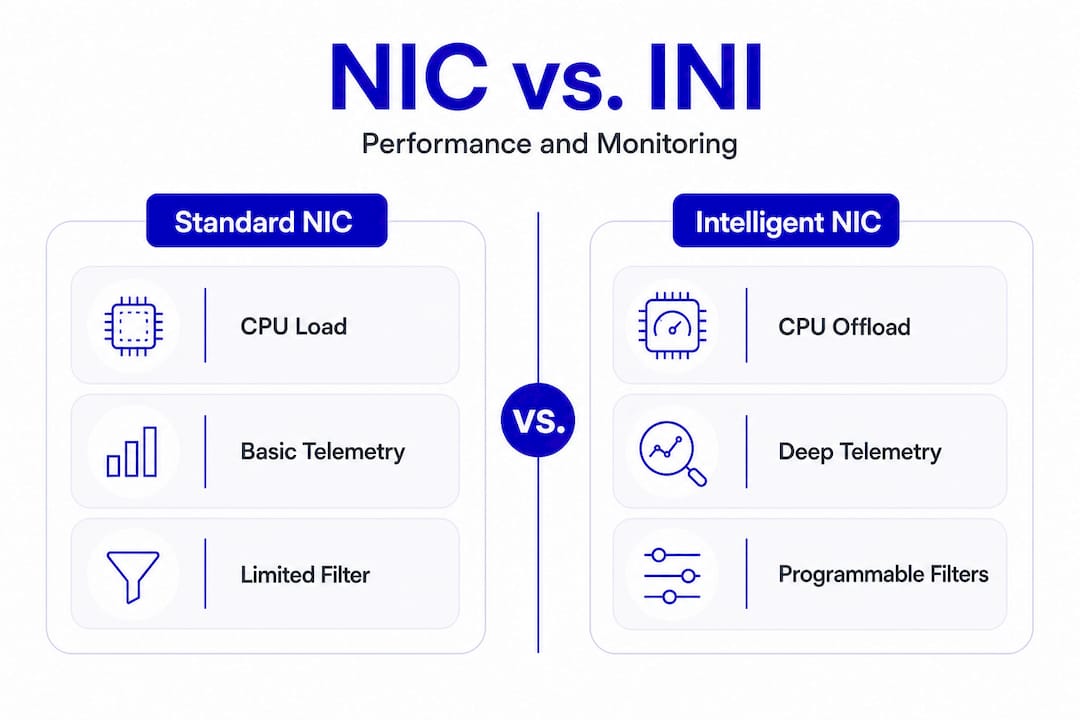
Standard NICs handle one job: moving data between a server and the network. They operate at the hardware level, passing packets to the host CPU for any meaningful processing. That model worked when networks ran at 1 Gbps and monitoring was an afterthought. It does not scale when you are running 100 Gbps links across a distributed data center overview with dozens of virtual machines per host.
An intelligent network interface.html) refers to an advanced NIC capable of offloading network processing tasks from the host CPU to improve server throughput and performance, particularly in storage and multimedia distribution scenarios. The key difference is onboard intelligence. An INI carries its own processor, memory, and programmable logic. It can filter packets, collect flow telemetry, enforce policies, and run virtual switch functions, all without touching the host CPU.
Intelligent network interface (INI/INIC): An advanced NIC with onboard compute that offloads processing tasks from the host CPU, enabling telemetry collection, packet filtering, and policy enforcement at line rate, without consuming host resources.
Standard NIC vs. intelligent network interface
| Feature | Standard NIC | Intelligent network interface |
|---|---|---|
| Packet processing | Host CPU | Onboard processor |
| Telemetry collection | Minimal or none | Built-in, at line rate |
| Packet filtering | Host CPU | Hardware-accelerated |
| Virtual switch support | Software (host) | Hardware offload |
| Flow statistics | Limited | Granular, continuous |
| CPU cores freed | 0 | 8 to 16 per host |
| Programmable pipeline | No | Yes (P4, DPDK) |
Typical use cases for INIs in enterprise environments
- Distributed monitoring: Collect flow telemetry and packet statistics across all locations without adding CPU load to production servers.
- Storage acceleration: Offload NVMe-over-Fabrics or iSCSI processing to improve storage throughput and latency.
- Security enforcement: Run packet filtering, access control lists, and DDoS mitigation at the NIC level, before traffic reaches the host.
- Virtualized environments: Accelerate virtual switch functions for hypervisor hosts running dozens of VMs.
- Edge computing: Process and filter data at remote sites before sending aggregated telemetry to central monitoring platforms.
For IT leaders pursuing complete network visibility, the INI is not just a hardware upgrade. It is a foundational shift in where intelligence lives in your infrastructure.
How intelligent network interfaces improve performance and monitoring
The performance case for INIs is built on concrete, measurable outcomes, not theoretical gains. Understanding the specific improvements helps IT leaders justify the investment and prioritize where to deploy first.
CPU offloading and throughput gains
SmartNIC benchmarks show that offloading to SmartNICs saves 8 to 16 host CPU cores per server for tasks like RPC handling and memory management. The same research documents up to 350% RocksDB throughput improvement in storage-intensive workloads. There is a nuance here: the benchmarks also show 1.1% to 7.4% performance degradation compared to running identical workloads entirely on a high-end host CPU. That tradeoff is acceptable in almost every real-world deployment because the freed cores are put to productive use running application workloads rather than network processing.
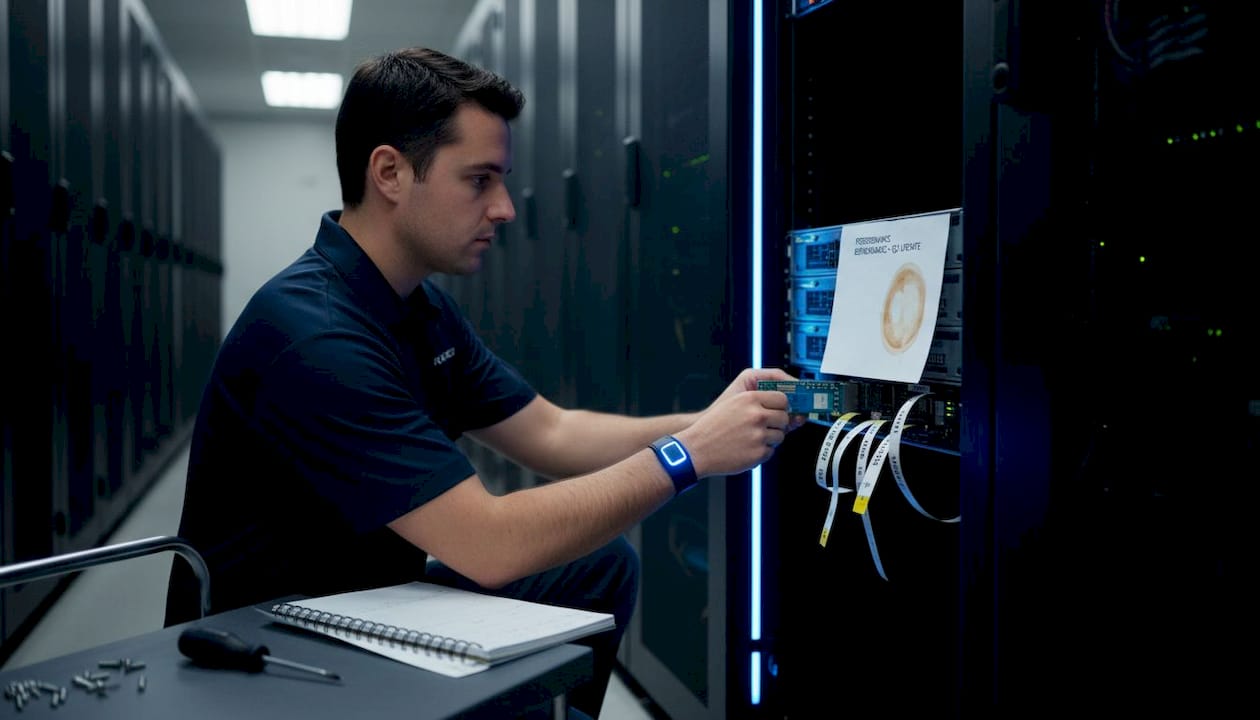
For MSPs managing hundreds of client endpoints, this math compounds quickly. Freeing 10 cores per server across 50 managed hosts means 500 cores redirected to revenue-generating workloads.
Monitoring capabilities unlocked by INIs
SmartNICs enable telemetry, packet filtering, flow statistics, and sampling/mirroring at line rate. They support SDN and NFV workloads along with virtual switches, making them ideal for multi-location enterprises. Here is what that means operationally:
- Line-rate telemetry collection: Gather flow statistics at 100 Gbps or 400 Gbps without sampling gaps, giving you a complete picture of traffic behavior.
- Packet mirroring at scale: Mirror specific traffic flows to monitoring systems without impacting production throughput.
- Embedded QoS enforcement: Apply quality-of-service policies at the NIC before traffic enters the host stack, reducing latency for priority applications.
- Active flow monitoring: Track connection state, detect anomalies in traffic patterns, and feed that data to AI triage for network outages platforms in real time.
- SDN integration: Program forwarding behavior dynamically via controller APIs, enabling automated response to network events.
- Virtual switch offload: Run Open vSwitch or equivalent in hardware, eliminating the CPU overhead that makes software-based switching a bottleneck in dense VM environments.
Performance comparison: Standard NIC vs. INI for monitoring workloads
| Workload | Standard NIC | INI/SmartNIC |
|---|---|---|
| Telemetry collection | Sampled, lossy | Full line rate |
| Flow statistics | Periodic polling | Continuous streaming |
| Packet filtering | Host CPU (high load) | Hardware accelerated |
| Virtual switch | Software, high CPU | Hardware offload |
| Monitoring overhead | 20 to 40% CPU | Under 5% CPU |
| 100G link support | Partial | Full |
Pro Tip: When planning resource allocation for INI deployments, calculate your current CPU utilization on network-facing hosts during peak traffic. If you are regularly seeing over 60% utilization, the core savings from SmartNICs will deliver immediate, measurable relief. Use that baseline as your ROI anchor when presenting to stakeholders.
The network monitoring benefits extend beyond raw throughput. Distributed enterprises gain consistent telemetry across all sites without deploying dedicated probe hardware at each location. For network tools for MSPs, this means a leaner hardware footprint with richer data output.
To understand how these enterprise network tools compare in practice, performance validation at the application layer is key before committing to full deployment.
Deployment considerations: ROI, costs, and real-world adoption trade-offs
Benefits are only half the picture. IT decision-makers need a clear-eyed view of the costs and constraints before committing budget to an INI rollout.
ROI drivers
The financial case for INIs rests on three pillars. First, server consolidation: when you free 8 to 16 cores per host, you can run more workloads on existing hardware, deferring server purchases. Second, reduced downtime: hardware-level monitoring catches anomalies earlier and feeds richer data to incident response systems, shortening mean time to resolution. Third, simplified monitoring infrastructure: INIs reduce or eliminate the need for dedicated network probes at each location, which carry their own hardware, licensing, and management costs.
For colocation and INI value, the combination of dense compute and high-bandwidth networking makes SmartNICs particularly attractive in co-lo environments where rack space and power are priced by the unit.
Adoption challenges
Key challenges include high power consumption compared to standard NICs, upfront costs running 3 to 5 times higher than conventional cards, and limited open software ecosystems. These are real constraints that require mitigation strategies:
- Power consumption: Map INI power draw against the power cost of running equivalent CPU workloads. In most deployments, offloading to the NIC is net-neutral or slightly better on power because you are running fewer cores at high utilization.
- Upfront cost: Prioritize deployment on the highest-density hosts first. A SmartNIC on a server running 30 VMs delivers far more value than one on a lightly loaded host.
- Software ecosystem gaps: Evaluate vendor support for P4, DPDK, and RDMA before purchasing. Open-source toolchains exist but require engineering investment. Factor that into your total cost of ownership.
- Skill gap: Your existing network team may not have experience with programmable NICs. Build a training plan before deployment, not after.
- Vendor lock-in: Some SmartNIC platforms use proprietary APIs. Favor vendors with strong open ecosystem commitments if long-term flexibility is a priority.
The SmartNIC market is growing rapidly. Addressing the major MSP challenges that come with fragmented tooling and limited visibility is a core driver of that growth. As adoption increases, software ecosystems will mature and costs will come down, which is reason to invest in skills now rather than waiting.
Pro Tip: Start with offload NICs (RDMA-capable, basic hardware acceleration) before moving to full programmable SmartNICs. Offload NICs deliver immediate CPU relief at lower cost and complexity. Once your team understands the operational model, scaling to full SmartNIC deployments with P4 pipelines becomes far less disruptive.
See SmartNIC pricing guide options to compare upfront investment against projected operational savings for your environment.
The future of intelligent network interfaces and managed networking
INI technology is moving fast. What is available today at the high end of the market will be mainstream within three to five years. IT leaders who understand the trajectory now will be better positioned to architect infrastructure that stays ahead of demand.
Programmable pipelines and DPU integration
The most significant shift is toward fully programmable data planes. Using P4, a domain-specific language for network processing, engineers can define exactly how a NIC processes packets at line rate. This means custom telemetry schemas, bespoke filtering logic, and application-aware forwarding, all running in hardware. DPDK (Data Plane Development Kit) complements this by enabling fast-path packet processing in software where hardware flexibility is needed.
Data Processing Units (DPUs) represent the next step beyond SmartNICs. They add security isolation, independent compute, and the ability to run full OS instances on the NIC itself. Not all SmartNICs are DPUs, but the line is blurring as vendors add more onboard compute.
Market trajectory: The programmable NIC space is converging around P4, DPDK, and DPU architectures. Enterprises investing in SmartNIC skills and infrastructure today are building the foundation for AI-assisted, hardware-accelerated network operations within the next five years.
What IT teams should prepare for in the next 3 to 5 years
For MSPs and multi-location enterprises, SmartNICs enhance monitoring via built-in telemetry and QoS without host overhead, making them ideal for distributed edge management, with implementation via P4 and DPDK for custom pipelines. Here is what to put on your roadmap:
- Standardize on P4-capable hardware for all new server purchases, even if you are not using advanced features immediately.
- Train your network engineering team on DPDK and P4 basics. Vendor certifications are emerging and worth the investment.
- Integrate INI telemetry with your observability platform early. The value compounds when hardware telemetry feeds into AI-driven analysis.
- Evaluate DPU use cases for environments with strict security isolation requirements, such as multi-tenant managed services.
- Plan for AI-driven automation at the NIC level, where anomaly detection and response logic runs in hardware before reaching the host stack.
- Assess edge deployments where INIs can process and filter data locally, reducing backhaul costs and improving latency for remote sites.
For IT leaders exploring enterprise AI automation, INIs and SmartNICs are the hardware layer that makes AI-driven network operations practical at scale. Explore future AI innovations shaping this space to stay ahead of the curve.
Why most enterprises underutilize intelligent network interfaces (and what to do differently)
Here is the uncomfortable reality: most organizations that deploy SmartNICs use them like expensive standard NICs. They enable the basic offloads, leave the advanced features unconfigured, and wonder why the ROI is underwhelming. This is a pattern we see consistently across enterprise environments.
The root cause is organizational, not technical. SmartNIC deployment typically lands in the server team's backlog. The network team is not involved, the observability team is not involved, and nobody configures the telemetry pipelines or programmable logic that deliver the real value. The hardware ships, gets installed, and runs at 20% of its capability.
The fix is straightforward but requires deliberate action. First, assign a cross-functional owner for the INI deployment. This person bridges server infrastructure, networking, and monitoring operations. Without that role, each team optimizes for their own priorities and the integration never happens.
Second, adopt plug-and-play observability hardware that is designed to work with INI telemetry out of the box. When your monitoring platform can ingest SmartNIC flow data natively, the barrier to enabling advanced features drops significantly.
Third, pilot advanced features on a single host before scaling. Pick one server, enable P4 or DPDK-based telemetry, connect it to your monitoring platform, and measure the operational difference. A two-week pilot with clear metrics will generate more internal support for full rollout than any business case document.
The organizations getting the most from INIs are not necessarily the ones with the biggest budgets. They are the ones that treated the deployment as an integration project, not a hardware refresh.
Take the next step: Smarter network observability with Netverge
Intelligent network interfaces give you the hardware foundation for real-time, distributed visibility. Netverge gives you the platform to act on it.
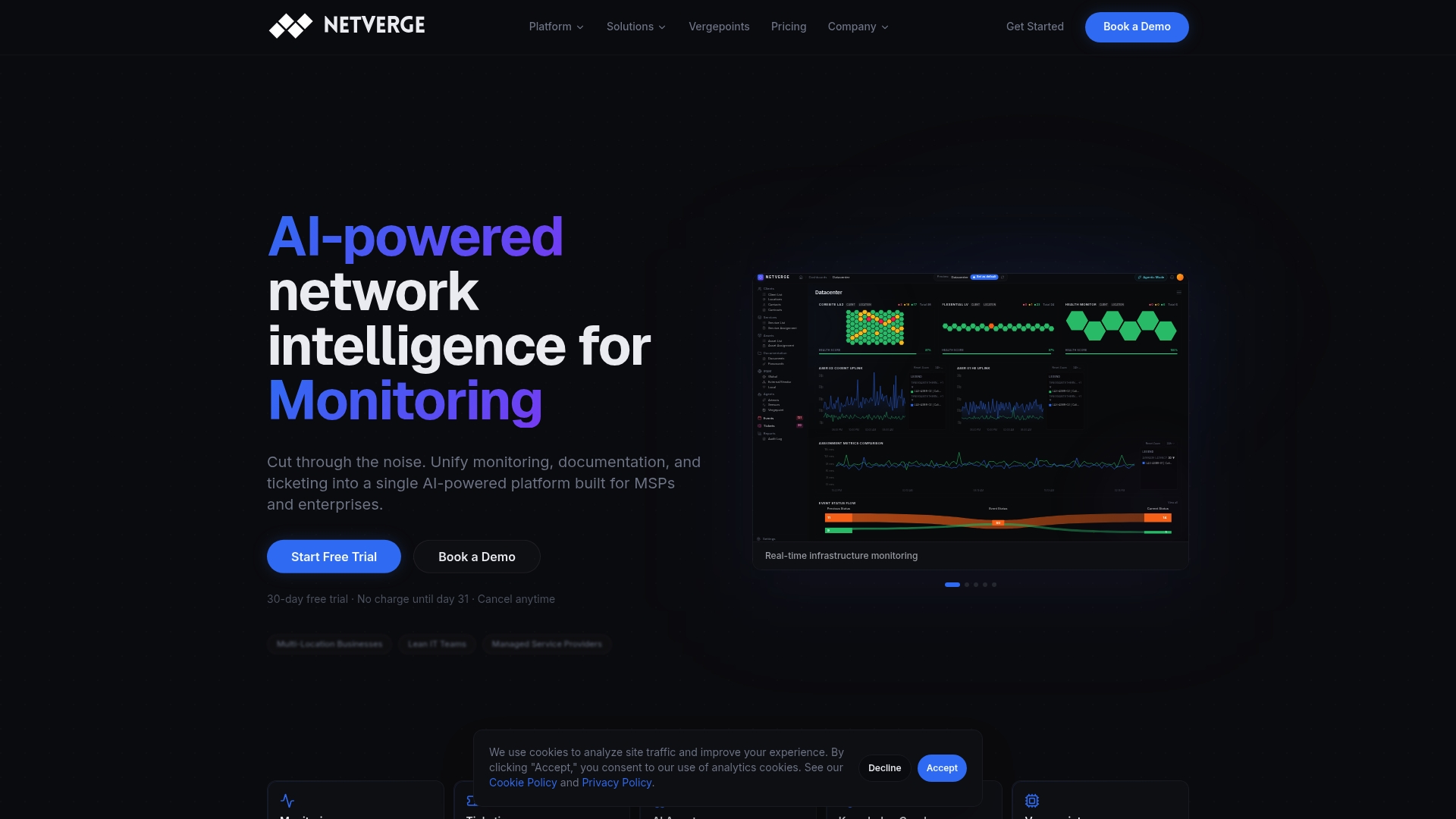
Netverge's AI-powered network monitoring platform is built to ingest telemetry from distributed infrastructure, including SmartNIC-enabled hosts, and correlate it into actionable insights. Our plug-and-play INI hardware through Vergepoints is designed for fast deployment across multi-location environments, without the integration complexity that slows most rollouts. For MSPs and enterprise IT teams ready to move from reactive to proactive operations, our enterprise network automation module delivers AI-driven triage and response that works with your existing hardware investments. Request a demo to see how Netverge accelerates your observability roadmap.
Frequently asked questions
How does an intelligent network interface differ from a traditional NIC?
An intelligent network interface offloads key processing tasks.html) from the host CPU, supports built-in telemetry, and enables advanced monitoring capabilities that a standard NIC simply cannot provide.
What are the main benefits of deploying SmartNICs in multi-location enterprises?
SmartNICs deliver enhanced monitoring and lower CPU usage by running telemetry, packet filtering, and virtual switching in hardware, enabling consistent visibility across distributed sites without adding host overhead.
What are the typical challenges when adopting intelligent network interfaces?
Higher power usage, upfront costs running 3 to 5 times standard NIC pricing, and limited open software ecosystems are the primary hurdles. Phased adoption and cross-functional deployment teams are the most effective mitigation strategies.
Are SmartNICs and DPUs the same?
No. SmartNICs focus on network offloads and monitoring, while DPUs are more capable devices designed for security isolation, independent compute, and advanced workload separation. Not every SmartNIC qualifies as a DPU.
What type of performance improvement can I expect from SmartNICs?
Benchmarks show savings of 8 to 16 host CPU cores per server, line-rate throughput at 100 to 400 Gbps, and up to 350% improvement in database throughput for storage-intensive workloads like RocksDB.