
Service desk best practices are defined as the proven methods IT teams use to deliver consistent, measurable support aligned with business outcomes. The industry standard framework, IT Service Management (ITSM), provides the structure most mature organizations follow. Internal IT help desks target CSAT scores averaging 75%, while B2B SaaS organizations aim for 82% on a 1–5 scale. Meeting those benchmarks requires more than good intentions. It demands clear SLAs, a maintained knowledge base, disciplined metrics, and automation applied in the right sequence.
1. Service desk best practices start with SLA design
SLAs are the contract between your team and the business. Most teams get them wrong by applying a single response window to every ticket type. SLA metrics should be tiered by request type and aligned with business impact, not complaint volume or ticket age.
Effective SLA design covers four elements:
- Request tiers: Separate critical outages, standard requests, and low-priority tasks into distinct SLA categories with different response and resolution targets.
- Clock rules: Define when the SLA clock starts, when it pauses (waiting on user response), and when it restarts. Ambiguous clock rules cause false compliance readings.
- Escalation triggers: Set automated alerts at 50% and 80% of SLA time elapsed so agents can act before a breach occurs.
- Business impact alignment: A password reset and a payment system outage should never share the same SLA tier.
SLA compliance rates of 90%+ are the industry benchmark. Real-time dashboards and automated escalations are necessary to sustain that level consistently.
Pro Tip: Publish your SLA tiers in plain language on your internal portal. Clear SLA communication reduces misrouted tickets and sets accurate expectations before users even submit a request.

2. Build your knowledge base before you automate anything
The knowledge base is the foundation every other improvement depends on. Automation built on a stale or incomplete knowledge base scales errors, not efficiency. Get the documentation right first.
A well-maintained knowledge base serves three audiences: agents resolving tickets, end users solving problems without submitting tickets, and AI tools that need accurate data to triage and route correctly.
- Write for search, not for experts: Articles should use the language users type, not internal technical terminology.
- Tag by symptom and resolution: Agents should find answers by searching what the user reported, not the root cause.
- Set review cycles: Assign ownership to each article and schedule quarterly reviews tied to incident data.
- Track deflection rates: Measure how often users resolve issues through self-service. Low deflection signals knowledge gaps.
Continuous updates driven by incident reviews keep the knowledge base accurate. Every closed ticket is a data point. If the same issue recurs without a knowledge article, that is a gap to close.
Pro Tip: Before deploying any AI triage tool, audit your knowledge base for articles older than 12 months. Outdated content fed into an AI model produces confidently wrong answers.
3. Track the right KPIs, not every KPI
Tracking too many metrics produces noise. Starting with 5–7 core KPIs gives teams focus and prevents decision paralysis. Expand the suite only after those metrics are stable and understood.
The five metrics every service desk should track first:
| KPI | Target | What it tells you |
|---|---|---|
| Mean Time to Resolution (MTTR) | Under 4 hours (critical), under 8 hours (standard) | Speed of resolution by severity |
| First Contact Resolution (FCR) | Above 80% | Knowledge and tooling maturity |
| SLA compliance | 90%+ | Process reliability |
| CSAT | 75%+ (internal), 82%+ (B2B SaaS) | User experience quality |
| Reopen rate | Below 5% | Resolution accuracy |
FCR rates above 80% indicate a mature service desk. Below 65% signals knowledge or tooling gaps that need immediate attention.
Reporting ticket volume without context hides quality problems. A team closing 500 tickets per week with a 20% reopen rate is performing worse than a team closing 300 with a 3% reopen rate. Volume alone misleads.
Translate KPIs into business language for leadership. "Our MTTR dropped from 6 hours to 3.5 hours" means little to a CFO. "Critical system outages now resolve twice as fast, reducing revenue-impacting downtime" lands differently. The biggest barrier to IT buy-in is technical jargon that does not connect to business outcomes.
Pro Tip: Review your help desk metrics monthly with both IT leads and a business stakeholder. That single habit forces the translation from technical data to operational impact.
4. Automate high-volume, low-variance workflows first
Automation delivers the most value when applied to tasks that are repetitive, well-defined, and high-frequency. Password resets, account unlocks, software provisioning requests, and ticket routing based on category are the right starting points. Complex, judgment-heavy workflows come later.
AI-powered ITSM platforms improve KPIs by automating ticket routing, escalation, and knowledge base integration, reducing MTTR and improving FCR. The gains are real, but only when the underlying data is clean.
Four rules for automation that actually works:
- Categorize before you automate: Accurate ticket categorization is the prerequisite for correct routing. Garbage categories produce misrouted tickets at scale.
- Automate SLA enforcement: Use automated alerts and escalation rules to flag at-risk tickets before they breach. Human review should be the exception, not the default.
- Govern AI with human escalation paths: Every AI-handled ticket needs a clear fallback to a human agent when confidence is low or the issue is novel.
- Monitor automation quality: Track the error rate on automated resolutions separately from agent resolutions. Automation errors compound faster than human errors.
For a deeper look at what service desk automation covers in practice, the sequencing of knowledge base maturity before automation deployment is the detail most teams skip and later regret.
Pro Tip: Run a 30-day pilot on one automated workflow before expanding. Measure FCR and reopen rates for that ticket category specifically. The data will tell you whether the automation is helping or hiding problems. See real-world IT automation examples for reference.
5. Use ITIL principles to align support with business outcomes
ITIL (Information Technology Infrastructure Library) is the most widely adopted ITSM framework for structuring service desk operations. ITIL 5 specifically emphasizes end-to-end user experience rather than focusing solely on closing tickets. That shift in emphasis changes how teams measure success.
Applying ITIL principles in practice means treating every ticket as part of a larger service chain. A resolved ticket that leaves the user confused or unable to work independently is not a success. The goal is restored productivity, not a closed status.
ITIL also defines incident management separately from request fulfillment and problem management. Keeping those categories distinct prevents teams from treating recurring incidents as one-off requests. When the same issue appears three times in a month, that is a problem record, not three separate incidents.
6. Build a culture of continuous improvement through blameless post-mortems
Post-mortems are structured reviews conducted after major incidents. Blameless post-mortems conducted promptly after incidents encourage honest reporting and create the learning culture needed for long-term reliability. Blame culture suppresses reporting and reduces reliability over time.
A structured post-mortem process follows these steps:
- Convene within 48 hours of incident resolution while details are fresh.
- Document the timeline of events, detection, response, and resolution without attributing fault to individuals.
- Identify contributing factors across process, tooling, knowledge, and communication.
- Assign corrective actions with owners and deadlines, not vague recommendations.
- Update the knowledge base with new runbooks or revised procedures before closing the post-mortem.
- Review SLA performance for the incident and adjust tier definitions if the classification was inaccurate.
The output of each post-mortem feeds directly into workflow updates, knowledge base revisions, and SLA recalibration. Teams that treat post-mortems as administrative tasks miss the compounding value of structured learning.
Key Takeaways
The most effective service desk operations combine tiered SLAs, a current knowledge base, disciplined KPI tracking, and automation applied in the correct sequence to deliver measurable business outcomes.
| Point | Details |
|---|---|
| Tier your SLAs | Set separate response targets by request type and align them with actual business impact. |
| Knowledge base first | Build and maintain accurate documentation before deploying any automation or AI triage. |
| Track 5–7 core KPIs | Start with MTTR, FCR, SLA compliance, CSAT, and reopen rate before expanding your metric suite. |
| Automate the right tasks | Apply automation to high-volume, low-variance workflows first and govern AI with human escalation paths. |
| Run blameless post-mortems | Conduct structured incident reviews within 48 hours and use findings to update processes and documentation. |
What I've learned about service desks after years of watching them fail and succeed
The teams that consistently hit their KPIs share one habit that struggling teams skip: they treat metrics as a conversation, not a report. Every number on a dashboard is a question waiting to be asked. A rising reopen rate is not a data point. It is a signal that something in the resolution process is broken, and someone needs to find out what.
The automation trap catches more teams than I expected. They deploy AI triage before their knowledge base is current, then wonder why the AI keeps routing tickets incorrectly. The sequence matters more than the technology. Fix the knowledge, then automate. Not the other way around.
The hardest part of service desk improvement is not technical. It is translating what IT does into language that earns budget and support from leadership. "We resolved 1,200 tickets this month" impresses no one in a board meeting. "We reduced unplanned downtime by 40% for the finance team during quarter-end close" gets attention. Learn to speak in business outcomes, and the resources follow.
One more thing: building an AI-powered helpdesk that actually works requires the same discipline as any other process improvement. Start narrow, measure carefully, and expand only when the data supports it.
— Jim
How Netverge supports service desk excellence
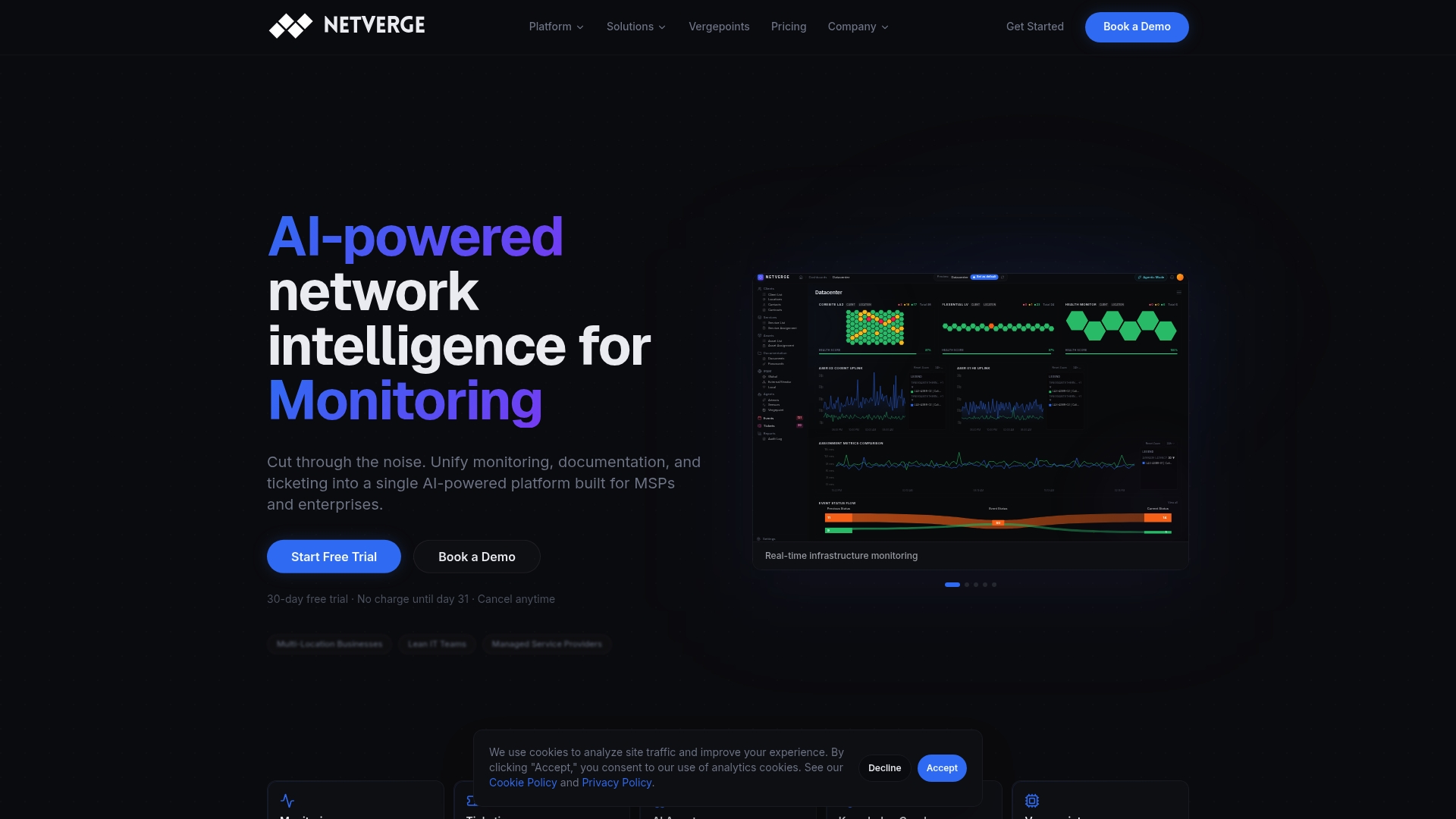
Netverge brings AI-driven ticket triage, automated escalation, and real-time KPI visibility into a single platform built for MSPs and multi-location enterprises. The platform's AI agents handle ticket routing and classification automatically, enforcing SLA timelines without manual intervention. Integrated knowledge graphs give agents instant context, reducing the time spent gathering information before resolving an issue. For IT teams ready to move from reactive support to proactive service delivery, Netverge's AI-powered ticketing platform connects incident management, knowledge management, and performance monitoring in one place. Request a demo to see how the platform fits your service desk environment.
FAQ
What are the most important service desk KPIs?
The five core KPIs are MTTR, FCR, SLA compliance, CSAT, and reopen rate. Start with these before expanding to a broader metric suite.
What is a good FCR rate for a service desk?
FCR above 80% indicates a mature service desk. Rates below 65% signal gaps in knowledge base quality or tooling that need immediate attention.
Why should automation come after knowledge base development?
Automation built on inaccurate or incomplete knowledge scales errors rather than efficiency. A current, well-structured knowledge base is the prerequisite for reliable AI triage and workflow automation.
What is a blameless post-mortem?
A blameless post-mortem is a structured incident review that focuses on process and system failures rather than individual fault. It encourages honest reporting and produces corrective actions that improve long-term reliability.
How do SLA tiers improve service desk performance?
Tiered SLAs align response targets with actual business impact, preventing low-priority requests from consuming resources needed for critical incidents. They also set accurate user expectations, which reduces escalation volume.