
AI for MSPs is defined as the application of artificial intelligence technologies to automate workflows, monitor networks in real time, and improve service delivery across managed client environments. The case for why use AI for MSPs comes down to one measurable reality: AI-powered automation accelerates ticket resolution and frees technician time that would otherwise go to repetitive, low-value tasks. MSPs that adopt AI report faster incident response, lower operational overhead, and stronger client satisfaction scores. The challenge is not whether to adopt AI. The challenge is how to do it without hitting the governance and integration walls that stop most teams cold.
What are the primary benefits of AI for MSP operations?
AI delivers measurable gains across four core areas of MSP operations: incident detection, workflow automation, service consistency, and cost control.
- Faster incident detection and resolution. AI correlates telemetry across endpoints, network devices, and user behavior to flag anomalies before clients notice them. This shifts MSPs from reactive firefighting to proactive management.
- Automation of routine workflows. Ticket triage, password resets, patch status checks, and alert categorization all run without technician input when AI handles them. That frees your senior engineers for work that actually requires human judgment.
- Consistent, scalable service delivery. AI applies the same logic to every client environment, every time. That consistency is nearly impossible to maintain manually across dozens of accounts.
- Cost reduction through operational efficiency. Fewer manual touchpoints per ticket means lower labor cost per resolution. Top MSPs achieve higher margins by how efficiently information flows through integrated tech stacks, not by adding headcount.
The benefits of AI for MSPs are not theoretical. They show up directly in utilization rates, mean time to resolution (MTTR), and client retention numbers.
Pro Tip: Track MTTR before and after deploying any AI tool. A 20% reduction in MTTR is a concrete, client-facing metric you can use in contract renewals.
What operational challenges do MSPs face when adopting AI?
Governance and compliance top the list of barriers. 51% of MSPs identify governance and compliance as the main barrier to AI adoption, outranking technical skill gaps. That finding comes from a survey of 333 MSPs, and it reflects a pattern that many IT leaders recognize once they move past the pilot phase.

Multi-tenant environments compound the problem. When you manage 50 clients, each with different configurations, security policies, and compliance requirements, building repeatable AI workflows becomes genuinely difficult. 40% of MSPs cite multi-tenant operational complexity as a key hurdle. Variability across client environments is the single biggest non-obvious barrier to scaling AI in MSP services.
Fragmented tech stacks make the situation worse. AI requires holistic data across endpoint health, tickets, security telemetry, and user behavior to function effectively. When that data lives in five separate tools with no shared API layer, AI cannot correlate signals across them. The result is limited, siloed automation that does not deliver the operational transformation MSPs expect.
"Deploying AI in isolated, siloed tools leads to limited value. An integrated data fabric is critical for correlating signals across endpoint, ticketing, security, and user data. MSPs that skip this step find their AI initiatives stall before delivering real operational value."
The barriers MSPs face when adopting AI break down into four categories:
- Governance gaps. No clear policy for how AI accesses, processes, or retains client data.
- Compliance complexity. Different regulatory requirements per client make uniform AI policies hard to enforce.
- Tech stack fragmentation. Disconnected tools prevent AI from seeing the full picture.
- Standardization deficits. Operational variability across client environments demands standardization first to enable scalable, repeatable AI workflows.
Understanding these barriers is the first step toward building an AI program that actually works at scale.
How can MSPs effectively integrate AI into their service delivery?
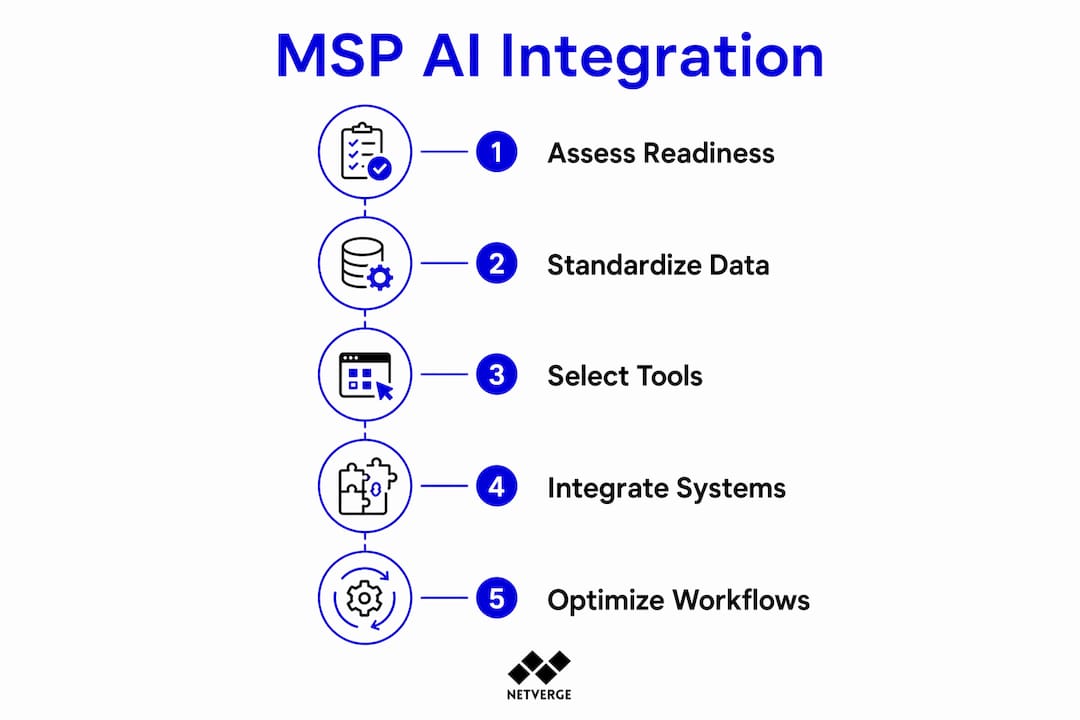
Effective AI integration follows a clear sequence. MSPs that skip steps end up with expensive tools that underperform.
- Start with assistive AI, not full automation. Ticket summarization and knowledge base searches reduce technician friction more effectively than fully autonomous AI at the outset. Assistive AI builds team confidence and surfaces data quality issues before they affect automated decisions.
- Invest in data hygiene and CMDB maturity. An accurate, cost-enriched CMDB lets MSPs automate delivery better and strengthens contract negotiation at renewal. Garbage data produces garbage AI outputs. Clean your environment discovery before you automate anything.
- Adopt a unified platform. 91% of MSPs say integrating backup, disaster recovery, and governance functions delivers stronger data governance than running separate tools. Nearly half (49%) actively seek fully integrated platforms for this reason.
- Apply a governance framework. Define how AI accesses client data, who reviews AI decisions, and how exceptions are escalated. This is not optional for MSPs operating in regulated industries.
- Measure and iterate. Set baseline metrics for ticket volume, MTTR, and technician utilization before deploying AI. Review them monthly and adjust automation rules based on real outcomes.
Pro Tip: Build your AI readiness assessment around data hygiene and governance, not tool selection. The platform you choose matters far less than the quality of the data you feed it.
The table below maps common MSP AI use cases to their integration maturity requirements.
| AI Use Case | Maturity Required | Primary Benefit |
|---|---|---|
| Ticket summarization | Low | Reduces technician read time per ticket |
| Anomaly detection | Medium | Catches network issues before client impact |
| Automated triage and routing | Medium | Cuts first-response time across accounts |
| Predictive capacity planning | High | Prevents outages through trend analysis |
| Autonomous remediation | High | Resolves issues without human intervention |
For MSPs managing distributed client networks, AI-powered network management provides a practical reference for what each maturity level looks like in production. Understanding AI risks alongside the benefits also matters. Resources covering AI threats and mitigation help MSPs build governance frameworks that hold up under client scrutiny.
What future trends will shape AI use in MSPs?
The MSP delivery model is shifting from labor-led to platform-led. AI adoption is moving MSPs toward outcome-based services that increase profitability and client value. That shift has direct implications for how MSPs price, contract, and deliver services over the next three years.
Key trends shaping AI use in managed services through 2026 and beyond:
- Outcome-based contracts replace time-and-materials billing. AI compresses the labor cost of delivering outcomes. MSPs that can guarantee uptime, resolution times, and security posture will command premium pricing.
- Platform-led delivery becomes the competitive baseline. MSPs running integrated platforms with shared data layers will outperform those stitching together point solutions. The margin gap between these two groups will widen.
- CMDB data becomes a negotiation asset. MSPs with mature CMDBs and deep environment discovery create a defensible data foundation that improves automation and strengthens contract renewal positioning. Clients increasingly ask for evidence of what you know about their environment.
- Client demand for AI governance grows. Enterprise clients and mid-market buyers are starting to ask MSPs how AI accesses their data, who audits AI decisions, and what happens when AI gets it wrong. MSPs without clear answers will lose deals.
- AI in IT service management (ITSM) matures. Integrations between AI agents, ITSM platforms, and network monitoring tools will become standard, not premium. MSPs that build these integrations now will have a head start.
The MSPs that will lead in 2026 are not the ones with the most AI tools. They are the ones with the cleanest data, the clearest governance policies, and the most integrated tech stacks.
Key Takeaways
AI for MSPs delivers the greatest value when governance, data quality, and platform integration come before automation.
| Point | Details |
|---|---|
| Start with assistive AI | Ticket summarization and triage build team confidence before full automation. |
| Governance is the top barrier | 51% of MSPs cite compliance and governance as their primary AI adoption challenge. |
| Fragmented stacks limit AI | Disconnected tools prevent AI from correlating signals across endpoint, ticket, and security data. |
| CMDB quality drives outcomes | An accurate, cost-enriched CMDB improves automation and strengthens contract renewal negotiations. |
| Platform-led delivery wins | MSPs with integrated platforms outperform those running separate point solutions on margin and client retention. |
Why governance matters more than the tools you pick
I have watched MSPs spend six figures on AI tooling and see almost no return. The pattern is consistent. They buy the platform, skip the data cleanup, and wonder why the AI keeps misfiring. The uncomfortable truth is that AI readiness is an organizational problem before it is a technology problem.
The MSPs I have seen succeed with AI share one trait: they treated standardization as a prerequisite, not an afterthought. They audited their CMDB, cleaned up their environment discovery, and defined governance policies before they turned on a single automation rule. That groundwork is unglamorous. It does not show up in vendor demos. But it is the difference between AI that compounds your operational advantage and AI that creates a new category of support ticket.
The cultural shift is just as real as the technical one. Technicians need to trust AI outputs before they act on them. That trust builds through transparency, not through mandates. Show your team where AI is right, where it is wrong, and how you are improving it. MSPs that skip this step end up with engineers who route around the AI entirely, which defeats the purpose.
My honest recommendation: treat your first AI deployment as a data audit with automation as a side effect. You will learn more about your operational gaps in three months than you have in the past three years.
— Jim
How Netverge supports MSP AI adoption
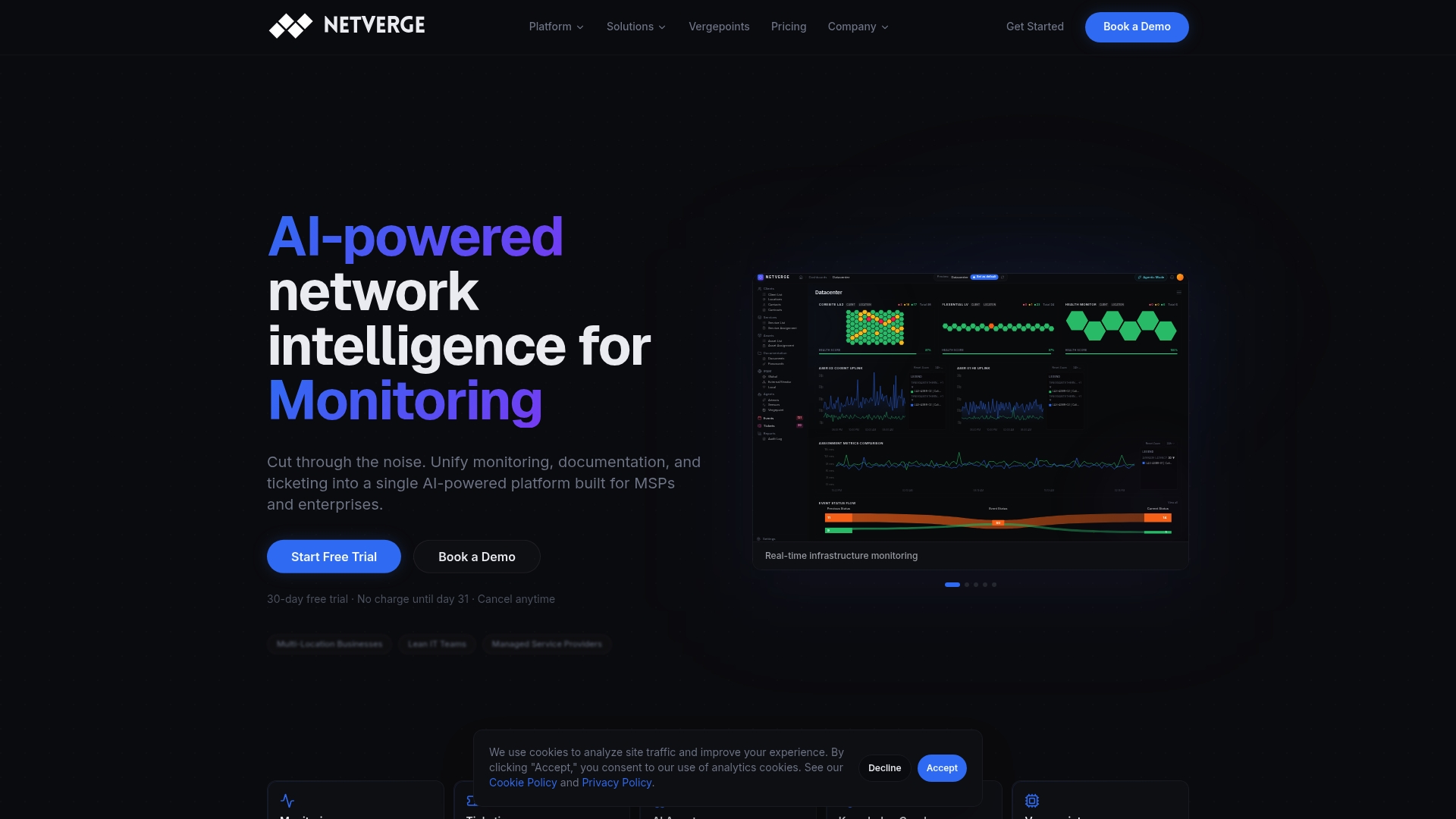
Netverge is built for MSPs that need AI to work across real, complex, multi-tenant environments. The platform unifies AI-powered network monitoring and observability with integrated ticketing, knowledge graphs, and autonomous AI agents that detect and resolve issues without manual escalation. Netverge's Vergepoints provide physical network visibility, while the software layer correlates telemetry across all client environments in a single interface. For MSPs moving toward platform-led delivery, Netverge replaces fragmented point solutions with one connected system. The AI-powered ticketing and service desk module handles triage, summarization, and routing automatically, cutting MTTR and freeing your engineers for higher-value work.
FAQ
Why should MSPs use AI in their operations?
AI automates repetitive tasks like ticket triage and anomaly detection, which reduces operational overhead and accelerates incident resolution. MSPs that adopt AI report faster response times and improved client satisfaction.
What is the biggest barrier to AI adoption for MSPs?
51% of MSPs identify governance and compliance as their primary barrier, ahead of technical skill gaps. Multi-tenant complexity and fragmented tech stacks are the next most common obstacles.
How does a fragmented tech stack affect AI performance?
AI needs data from endpoints, tickets, security tools, and user behavior to function effectively. When that data lives in disconnected systems, AI cannot correlate signals and delivers limited, siloed results.
What AI use cases should MSPs start with?
Assistive applications like ticket summarization and knowledge base searches are the best starting point. They reduce technician friction immediately without requiring the data maturity that full automation demands.
How does AI change the MSP service delivery model?
AI shifts MSPs from labor-led billing toward outcome-based contracts by compressing the cost of delivering results. MSPs with integrated platforms and clean data gain pricing power and stronger positions at contract renewal.