
Runbook automation converts documented operational procedures into safe, executable automations that reduce toil and shorten incident mean time to recovery (MTTR). Unlike static runbooks that require an operator to read and act step by step, automated runbooks trigger, execute, and log remediation actions with minimal or no human intervention. Both AWS Well-Architected and Azure Well-Architected treat this progression from text runbook to executable automation as a marker of operational maturity. Start with runbooks that are short, high-frequency, and low-risk: service restarts, log rotation, certificate checks, and similar repeatable remediation steps.
- Start here: Identify runbooks your on-call team executes more than twice per week.
- Automate first: Service restarts, pod recycling, disk-space cleanup, and backup verification.
- Keep manual: Runbooks with high blast radius, unclear decision criteria, or insufficient observability.
- Platform fit: Netverge's AI-powered monitoring and automation layer gives MSPs and multi-site enterprises a single control plane for triggers, execution, and audit.
Key Takeaways
Runbook automation reduces MTTR and operational toil when teams automate high-frequency, low-risk procedures first, enforce lifecycle hygiene, and maintain clear ownership of every automation in production.
| Point | Details |
|---|---|
| Start with high-frequency, low-risk runbooks | Service restarts, log cleanup, and health checks deliver the fastest ROI with the lowest blast radius. |
| Treat automations as versioned code | Store in version control, require PR reviews, and tie updates to change management records to prevent drift. |
| Separate orchestration from remediation | Workflow automation handles people and process; runbook automation executes technical steps. Keep them distinct. |
| Require approval gates before write operations | Gate any production-impacting step behind a human approval until the automation has proven reliable. |
| Netverge unifies monitoring and automation | Netverge connects anomaly detection, AI triage, and runbook execution in one platform for MSPs and enterprise teams. |
Table of Contents
- What operational outcomes does runbook automation actually deliver?
- What capabilities must a runbook automation solution provide?
- What are the most common runbook automation use cases?
- When should you automate a runbook, and when should you keep it manual?
- How does runbook automation fit into incident response and SRE workflows?
- How do you evaluate and choose a runbook automation solution?
- How do you roll out runbook automation and keep runbooks healthy?
- What security and governance controls do automations require?
- What causes runbook automation projects to fail?
- How Netverge supports runbook automation for MSPs and enterprises
- The part of runbook automation most teams get wrong
- Netverge gives MSPs and enterprise teams a production-ready starting point
- Sources
What operational outcomes does runbook automation actually deliver?
The clearest business case for automated runbooks is MTTR reduction. When a service restart that takes an on-call engineer eight minutes to execute manually runs automatically in under thirty seconds, that gap compounds across dozens of incidents per month. Consistency is the second major gain: an automated runbook executes the same steps in the same order every time, eliminating the variation that comes from different engineers interpreting the same text differently under pressure.
Key outcomes teams track after adopting automated runbooks:
- Reduced MTTR: Automated remediation fires before a human even acknowledges the alert.
- Fewer human errors: Scripted operational procedures remove the copy-paste and sequencing mistakes common in manual execution.
- Audit trails: Every execution is logged with timestamps, parameters, and outcomes, which matters for compliance reviews and post-incident analysis.
- Faster onboarding: New engineers can trigger a tested automation without needing deep system knowledge.
- Freed operational capacity: Engineers shift from repetitive toil to higher-value work like reliability improvements and capacity planning.
- Predictable change windows: Maintenance runbooks execute at scheduled times with consistent duration, making SLA commitments easier to honor.
Combining runbook automation with workflow automation supplies both technical execution and cross-team orchestration, which together reduce manual tasks and accelerate incident resolution. Track three core metrics to measure program health: automation success rate (executions that complete without human fallback), MTTR per incident category, and the percentage of eligible incidents handled by automation versus manually.
What capabilities must a runbook automation solution provide?
Not every tool marketed as "runbook management software" delivers what production operations actually requires. Before committing to a platform, verify these runtime and governance capabilities.
Runtime essentials:
- Safe orchestration with explicit step sequencing and dependency handling
- Branching logic so the automation takes different paths based on observed state
- Variable injection and parameterization for environment-specific execution
- Configurable timeouts and retries with deterministic escalation on failure
- Error handling that captures failure context and triggers a defined fallback
Integrations and triggers:
- Alert-driven triggers from monitoring platforms (SNMP, syslog, API webhooks)
- CI/CD pipeline hooks for deployment-gated runbooks
- Service catalog and CMDB lookups for target context
- Ticketing system integration for automatic incident creation and updates
- Execution targets across cloud VMs, on-premises servers, network devices, containers, and databases
AWS Systems Manager Automation provides a practical reference for converting text runbooks into executable automation documents using visual designers and YAML-based document templates. Rundeck's managed SaaS model illustrates another execution pattern: secure runners, plugin constraints, and hosted maintenance that remove infrastructure overhead from the operations team.
Safety, governance, and observability:
| Capability | Why it matters |
|---|---|
| Role-based access control (RBAC) | Limits who can create, modify, and execute automations |
| Approval gates | Requires human sign-off before high-risk steps execute |
| Secrets management | Credentials never appear in plain text in runbook definitions |
| Execution audit log | Full record of who triggered what, when, and with what result |
| Dry-run / simulation mode | Validates logic without touching production systems |
| Execution notifications | Alerts operators to completion, failure, or timeout |
What are the most common runbook automation use cases?
The use cases below represent the highest-frequency targets for automation across DevOps and SRE environments. Each follows a trigger-action-guardrail-outcome pattern.
Incident remediation: A monitoring alert fires when a web service returns HTTP 503. The automation checks the process state, restarts the service if it is stopped, waits for a health check to pass, and closes the incident ticket if the check succeeds. If the health check fails after two retries, the automation escalates to the on-call engineer with full execution context attached.
Routine maintenance: A nightly runbook patches OS packages on a defined host group, captures a pre-patch snapshot, runs the update, validates service health, and logs the result. Failed hosts are flagged in the next morning's operations report.
Disaster recovery steps: A DR runbook triggers on a primary database failure, promotes the replica, updates DNS, and notifies the incident commander. Each step has a timeout and a documented rollback path.
Cloud migrations: A migration runbook validates pre-conditions (network reachability, IAM permissions, disk space), executes the migration script, runs post-migration smoke tests, and records the outcome in the change management system.
Onboarding tasks: A new-device runbook provisions credentials, applies baseline configuration, runs compliance checks, and registers the device in the CMDB, all without requiring a senior engineer to supervise.
Community runbook repositories show practical formats for structuring these automations. A well-structured ops runbook typically includes the service description, step sequences with expected outputs, commands to run, logs to collect, and escalation paths. That structure translates directly into automation document sections.
Key insight: The runbooks most worth automating are not necessarily the most complex. They are the ones your team executes most often under pressure, where consistency matters most and cognitive load is highest. A service restart that takes three minutes manually but happens forty times a month is a better first automation target than a complex DR procedure that runs twice a year.
For real-world IT automation examples that map directly to these use cases, Netverge's blog covers concrete scenarios across network, cloud, and hybrid environments.
When should you automate a runbook, and when should you keep it manual?
The decision is not binary and should not be driven by tooling capability alone. Use these criteria to score each candidate runbook.
| Dimension | Automate | Keep manual |
|---|---|---|
| Frequency | Runs multiple times per week | Runs fewer than once per month |
| Repeatability | Same steps, same outcome every time | Requires judgment or context not in the system |
| Blast radius | Affects one service or a bounded scope | Could impact multiple systems or customers |
| Observability | Clear success/failure signal available | Outcome is ambiguous or hard to verify programmatically |
| Testability | Can be validated in a staging environment | No safe test environment exists |
| Operator experience | Experienced team, runbook is well-documented | Runbook is incomplete or rarely reviewed |
Azure Well-Architected guidance recommends automating repetitive operational tasks as part of operational excellence, with explicit guidance on when to move from manual to automated procedures. The framework's position: if a task is repeatable and well-understood, manual execution is a liability, not a safety net.

Pro Tip: Start with gated automation: require an approval step before the runbook executes any write operation. This gives your team confidence in the automation's logic while preserving a human checkpoint. Remove the approval gate only after the automation has run successfully at least ten times without intervention.
For a broader look at network operational workflows and how runbook automations fit into service catalogs and SRE processes, Netverge's operational workflow guide covers the full picture.
How does runbook automation fit into incident response and SRE workflows?
The most important architectural distinction in incident response is the separation between people/process orchestration and technical runbook automation. Incident draws this line clearly: workflow automation handles notifications, role assignments, status page updates, and escalation routing, while runbook automation executes the technical remediation steps. Conflating the two in a single tool often produces a system that does neither well.
A well-designed incident flow connects both layers:
- A monitoring alert fires and creates an incident ticket automatically.
- The workflow layer notifies the on-call engineer, assigns an incident commander, and opens a communication channel.
- The runbook automation layer runs a diagnostic sequence: checks service health, queries recent deployments, and collects relevant logs.
- Diagnostic output is posted to the incident channel, giving the incident commander immediate context.
- If the diagnostic identifies a known remediation pattern, the runbook automation executes the fix (with or without an approval gate, depending on risk level).
- Post-remediation, the automation verifies recovery, updates the ticket, and logs the full execution trace for the post-incident review.
For SRE teams, this separation also clarifies error budget impact. Automated remediations that resolve incidents before human acknowledgment reduce time-to-recovery without requiring on-call intervention, which directly improves SLO performance.
Operational suggestions for embedding automation in incident practice:
- Run automation-included incident drills quarterly. Deliberately trigger a known failure in a staging environment and let the full automated flow execute.
- Include automation execution logs in incident timelines. Post-incident reviews should show what the automation did, when, and whether it helped or delayed resolution.
- Define a "human takeover" protocol. When an automation fails or times out, the handoff to a human operator must be immediate and include full execution context.
For a detailed network incident response guide covering how automated runbooks standardize incident handling across MSP and enterprise environments, Netverge's incident response resource covers the end-to-end flow.
How do you evaluate and choose a runbook automation solution?
Procurement for runbook automation tools should start with technical requirements, not feature marketing. The following checklist covers the dimensions that matter most for production operations.
- Safety controls: Does the platform support configurable timeouts, retry limits, approval gates, and explicit rollback steps? A platform without these is not production-safe.
- Integration breadth: Verify native integrations with your monitoring stack, ticketing system, CMDB, and CI/CD pipeline. API-only integrations add maintenance overhead.
- Execution targets: Confirm support for your actual infrastructure: cloud VMs, on-premises servers, network devices, Kubernetes clusters, and databases. Gaps here mean manual steps remain.
- Observability: Every execution should produce a structured log with step-level detail, parameter values, and outcome status. Platforms that log only pass/fail are insufficient for troubleshooting.
- RBAC and SSO: Role-based access control and single sign-on integration are non-negotiable for enterprise and MSP environments with multiple teams and tenants.
- Secrets management: Credentials must be injected at runtime from a vault (HashiCorp Vault, AWS Secrets Manager, Azure Key Vault) and never stored in runbook definitions.
- Multi-tenant support: MSPs managing multiple customer environments need tenant isolation, separate RBAC policies, and consolidated reporting across accounts.
Pricing considerations for MSPs and multi-site enterprises:
- Agent-based licensing models charge per execution node. Understand how this scales across your managed estate before committing.
- API rate limits on SaaS platforms can become a bottleneck at high automation volume. Request documented limits during evaluation.
- Managed SaaS execution models, like those described in Rundeck's cloud documentation, offload runner infrastructure and patching to the vendor, which reduces operational overhead but requires trust in the vendor's availability SLA.
Proof points to request during vendor trials: run a sandbox test with a real automation, request example automations for your top three use cases, test failover behavior when a step times out, and review the audit log format for compliance readiness.
Tools worth evaluating include Rundeck (open-source and enterprise, strong job scheduling and plugin ecosystem), PagerDuty Process Automation (tight incident response integration), AWS Systems Manager Automation (native for AWS-heavy environments), Cutover (focused on complex change and DR orchestration), and GitLab (runbook documentation and CI/CD-triggered automation for teams already in the GitLab ecosystem).
How do you roll out runbook automation and keep runbooks healthy?
A phased rollout prevents the most common failure mode: automating too much too fast, then losing trust when an automation misbehaves in production.
- Inventory: Catalog all existing runbooks. Note frequency, owner, last-reviewed date, and estimated execution time. This surfaces the highest-value automation candidates immediately.
- Standardize: Before automating, standardize the text runbook. Every step must have a clear success criterion, a defined failure path, and an owner. Automate a well-understood procedure, not a vague one.
- Automate small, high-value runbooks first: Target the top three runbooks by execution frequency. Build them with approval gates and dry-run mode enabled.
- Validate in staging: Run each automation against a staging environment at least five times before promoting to production. Have a second engineer review the execution logs.
- Expand to complex flows: Once simple automations are stable and trusted, extend to multi-step flows with branching, conditional logic, and cross-system integrations.
- Continuous review: Schedule quarterly runbook reviews. Automations that have not run in ninety days should be validated or retired.
AWS Well-Architected recommends versioning runbooks, validating them, and keeping them current through change management as the organization matures toward full automation. Treat automation definitions as code artifacts: store them in version control, require pull request reviews for any change, and tag each version with the date and the engineer who approved it.
Lifecycle KPIs to track:
| KPI | What it tells you |
|---|---|
| Automation success rate | Percentage of executions that complete without human fallback |
| Human fallback rate | How often operators override or abandon an automation mid-run |
| Runbook drift incidents | Automations that fail because the underlying system changed |
| Time-to-first-automation | How long it takes a new runbook to go from text to production automation |
| Operator confidence score | Self-reported trust in automation outputs, surveyed quarterly |
For prescriptive guidance on IT operations efficiency and lifecycle KPIs, Netverge's operations guide covers measurement frameworks for both MSPs and enterprise teams.
What security and governance controls do automations require?
Automation execution carries real risk. A runbook that restarts a database or modifies firewall rules needs the same security rigor as any privileged access to production systems.
- Least privilege: Each automation runs with a service account scoped to exactly the permissions it needs. No shared admin credentials, no over-provisioned roles.
- Ephemeral credentials: Use short-lived tokens injected at runtime from a secrets vault. Rotate credentials automatically and revoke them immediately after execution.
- Vault integration: Integrate with HashiCorp Vault, AWS Secrets Manager, or Azure Key Vault. Credentials must never appear in runbook definitions, environment variables, or execution logs.
- Separation of duties: The engineer who writes an automation should not be the only one who approves it for production. Require a second reviewer for any automation that touches production systems.
- Audit logging: Log every execution with the triggering identity, input parameters, step-level outcomes, and final status. Logs must be tamper-evident and retained per your compliance policy.
- Change records: For US compliance frameworks (SOC 2, NIST 800-53), every automated change to a production system should generate a change record in your ITSM system. Automate this step within the runbook itself.
- RBAC enforcement: Define roles for runbook authors, reviewers, executors, and administrators. Enforce these at the platform level, not just by convention.
Netverge's security and trust documentation covers the platform's access controls and compliance posture for teams that need to document their automation governance for audit purposes.
What causes runbook automation projects to fail?
Most failures trace back to lifecycle hygiene, not tooling. The pitfalls below are consistent across organizations of all sizes.
- Runbook drift: The underlying system changes, but the automation is not updated. The automation runs, takes the wrong action, and causes an outage. Mitigation: tie runbook reviews to change management records. Any infrastructure change that affects an automated runbook must trigger a review of that automation.
- Skipping testing: Teams automate a runbook that was never properly validated as a text procedure. Mitigation: require a staging validation run and a second-engineer review before any automation reaches production.
- Inadequate error handling: Automations that fail silently or leave systems in a partial state are worse than no automation. Mitigation: every step must have an explicit failure path, a timeout, and a notification to the on-call engineer.
- Unclear ownership: No one knows who is responsible for a given automation when it breaks. Mitigation: assign an owner to every runbook at creation time. Ownerless automations get retired.
- Tooling-driven scope creep: Teams automate everything the tool can do, not everything that should be automated. Mitigation: use the decision criteria from the manual-vs-automated comparison above. Capability is not justification.
- No rollback path: An automation that cannot undo its actions is a liability in production. Mitigation: define a rollback step for every write operation before the automation goes live.
An operational audit checklist: review automation success rate monthly, validate all production automations against current system state quarterly, confirm owner assignments are current, and test rollback paths at least twice per year.
How Netverge supports runbook automation for MSPs and enterprises
Netverge is built for the operational reality that MSPs and multi-site enterprises face: distributed infrastructure, multiple tenants, and the need to correlate monitoring signals with automated action in a single platform.
Key capabilities that map directly to the runbook automation checklist:
- Integrated monitoring triggers: Netverge's 28+ intelligent sensors and real-time anomaly detection generate the alert signals that trigger automated runbooks, closing the loop between detection and remediation.
- AI-assisted triage: The platform's AI agents diagnose issues and recommend or execute remediation steps automatically, reducing the time between alert and action.
- Knowledge graphs: Netverge's knowledge graph provides the service context (dependencies, recent changes, affected assets) that runbook automations need to make safe decisions.
- Multi-tenant management: MSPs can manage separate runbook libraries and RBAC policies per customer tenant from a single interface.
- Vergepoints hardware: For physical network environments, Vergepoints edge devices provide on-site telemetry that feeds runbook triggers for network-specific automations.
- Integrated ticketing: Netverge's AI-powered ticketing creates, updates, and closes incident tickets as part of the automated runbook flow, eliminating manual ticket management.
For MSPs looking at the business case, Netverge's automation benefits guide covers ROI frameworks and growth outcomes from automation investment.
The part of runbook automation most teams get wrong
The conventional wisdom says the hard part of runbook automation is the tooling decision. Pick the right platform, configure the integrations, and the rest follows. That framing is wrong, and it explains why so many automation programs plateau after the first few runbooks.

The hard part is trust. Specifically, building and maintaining the team's trust that an automation will do the right thing when it fires at 2 AM on a Friday. That trust is not built by the tool. It is built by the process around the tool: rigorous staging validation, mandatory approval gates for anything that touches production, clear ownership, and a culture where a failed automation is treated as a process failure to fix, not an embarrassment to hide.
The teams that get this right treat their runbooks exactly as AWS Well-Architected recommends: as versioned, validated artifacts that go through change management like any other production code. They run their automations in incident drills before they need them in real incidents. They include automation execution logs in post-incident reviews, not as an afterthought, but as primary evidence. And they start small, deliberately, even when the tool could handle something more complex on day one.
One practical suggestion: before automating any runbook, have a second engineer execute the text version from scratch and document every ambiguity they encounter. Those ambiguities are exactly where an automation will fail. Resolve them in the text runbook first. Then automate a procedure you already trust.
Netverge gives MSPs and enterprise teams a production-ready starting point
MSPs and multi-site enterprises managing distributed networks need more than a standalone automation tool. They need monitoring, triage, and automated remediation connected in a single platform, with the multi-tenant controls and audit trails that production operations demand.
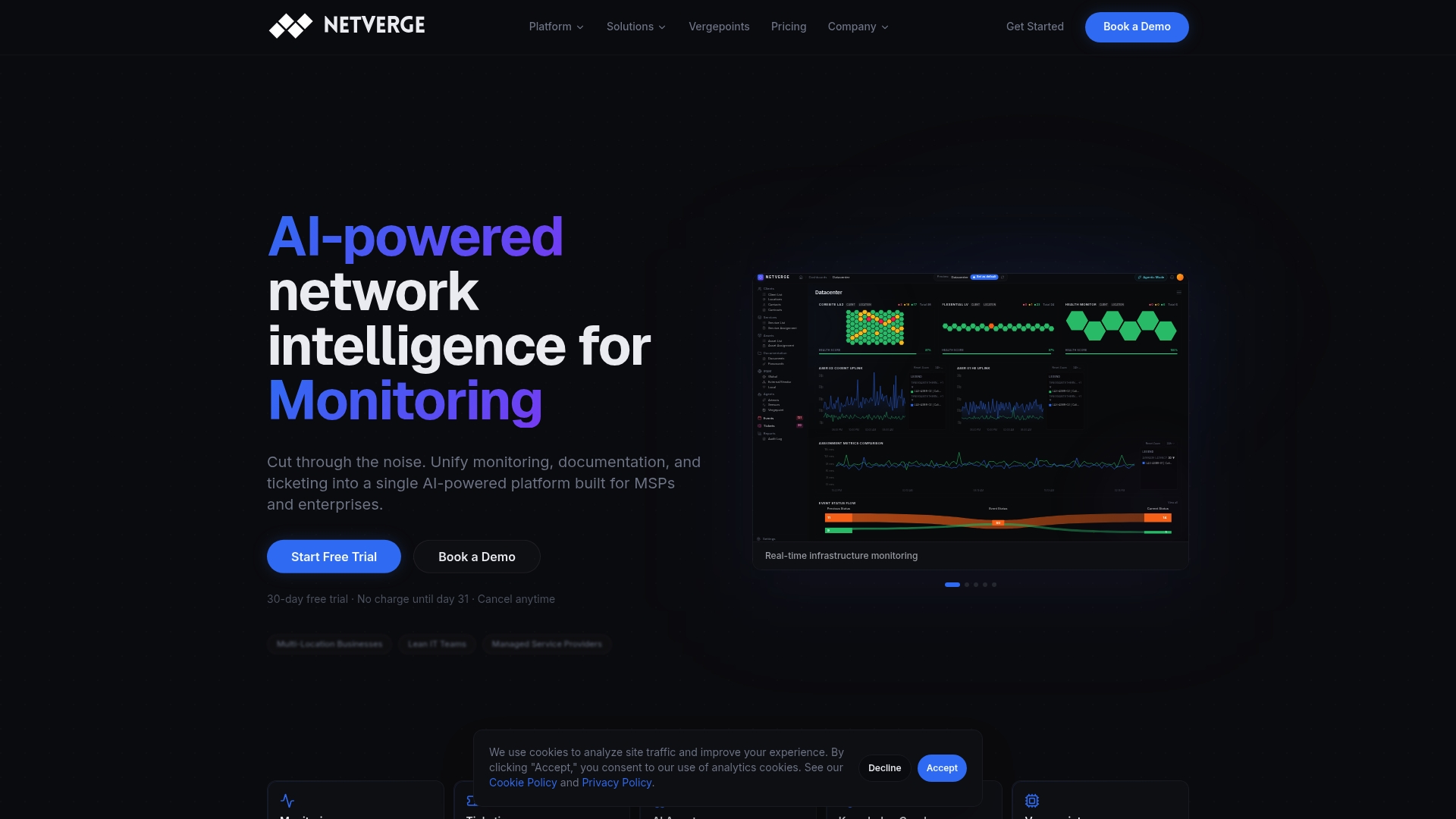
Netverge delivers that integration out of the box. The platform's AI-powered monitoring detects anomalies, the knowledge graph provides service context, and the automation layer executes remediation, all within one interface. Vergepoints hardware extends that visibility to physical network locations where agent-only monitoring falls short. For teams ready to move from fragmented tools to a unified operations platform, explore Netverge's enterprise monitoring capabilities or review the monitoring and observability platform to see how integrated automation fits your environment. Request a demo to walk through a live runbook automation scenario with your actual infrastructure in scope.
Sources
The sources below informed this guide and are worth bookmarking for teams building or maturing a runbook automation program.
- Use runbooks to perform procedures - AWS Well‑Architected
- Automate tasks - Azure Well‑Architected
- Incident
- Runbook Automation | Rundeck Docs
- Hoop
- ops_runbook - GitHub