
Smart network documentation is the automated process of capturing, organizing, and continuously updating accurate records of a network's physical and logical architecture. Unlike manual methods, which rely on spreadsheets and memory, intelligent network documentation keeps pace with infrastructure changes in real time. The result is a living record that IT teams can trust during troubleshooting, audits, and capacity planning. For network administrators managing distributed environments, this shift from static files to dynamic, searchable records is one of the highest-return operational changes available.
What is smart network documentation and how does it work?
Smart network documentation is defined as an automated, continuously updated system that records every component, connection, and configuration across a network. The industry term for this practice is "automated network documentation," though IT teams increasingly use "intelligent network documentation" to reflect the AI-driven capabilities now embedded in modern platforms like Netverge. Both terms describe the same core objective: replacing error-prone manual records with accurate, real-time data.
Traditional documentation relied on a technician manually logging device details after each change. That process breaks down fast. Inaccurate or missing documentation leads to prolonged outages and increased operational risk. Organizations without adequate records struggle during troubleshooting and audits. Smart documentation solves this by automating discovery and update cycles, so the record reflects the network as it actually exists, not as someone last remembered it.
Netverge approaches this through an AI-powered ecosystem that unifies monitoring, documentation, and ticketing into a single interface. Its Vergepoints hardware provides physical visibility, while software modules including knowledge graphs and autonomous AI agents keep logical records current. The platform continuously correlates telemetry data with documented infrastructure, flagging discrepancies before they cause incidents.

What components are included in smart network documentation?
Comprehensive network infrastructure documentation covers four distinct layers. Each layer serves a specific operational purpose, and gaps in any one of them create blind spots that slow down incident response.
Physical topology captures the tangible layer: devices, cabling runs, patch panel ports, floor maps, and rack layouts. This record tells a technician exactly where a cable runs and what it connects, without manual tracing.
Logical diagrams cover VLANs, IP subnets, routing tables, and firewall rules. These diagrams show how traffic flows, not just where hardware sits. Maintaining these records centrally reduces troubleshooting time, prevents IP conflicts, and supports business continuity.
Device inventory records serial numbers, firmware versions, hardware models, and configuration history for every managed device. This layer is critical for patch management and warranty tracking.
Change logs and configuration versioning track every modification: what changed, when it changed, and who made the change. Accurate change logs speed fault isolation and satisfy compliance auditors who need a clear audit trail.
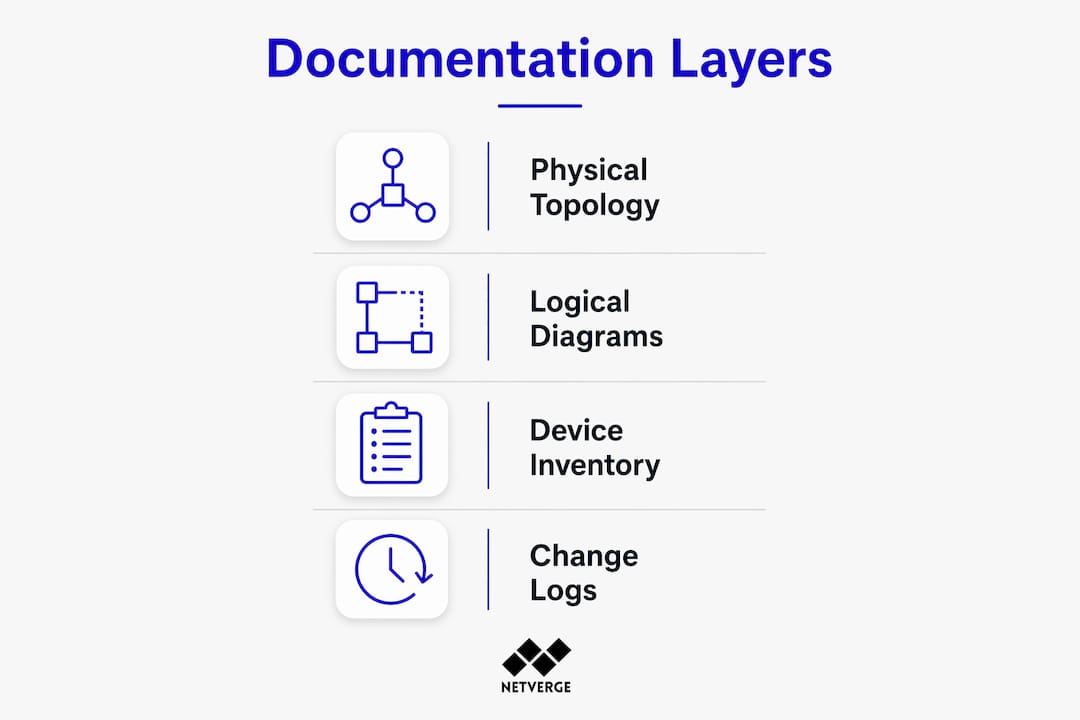
The table below summarizes each component and its primary operational value:
| Documentation Layer | Primary Operational Value |
|---|---|
| Physical topology | Eliminates manual cable tracing; speeds physical repairs |
| Logical diagrams | Clarifies traffic flow; prevents IP conflicts |
| Device inventory | Supports patch management and warranty tracking |
| Change logs | Speeds fault isolation; satisfies compliance audits |
| Configuration versioning | Enables rollback after failed changes |
Automated discovery tools tie all four layers together. They scan the network on a schedule or in real time, detect new devices, and update records without human input. Integrating documentation with monitoring tools ensures continuous updates and supports proactive management rather than reactive firefighting.
How does smart documentation improve network management over manual methods?
Manual documentation is a leading cause of inefficiency and network downtime. Outdated records send technicians to the wrong rack, create IP conflicts during provisioning, and produce audit failures that delay compliance certifications. The root problem is that manual entry depends on discipline, and discipline degrades under pressure.
Automated documentation removes human entry from the update cycle. The system detects changes through API polling, SNMP telemetry, or agent-based sensors and writes them to the record immediately. That accuracy translates into three measurable operational improvements:
Faster troubleshooting. When an alert fires, the on-call engineer sees the affected device's full context: its connections, recent changes, and dependencies. Proper documentation accelerates incident response by clarifying architecture and dependencies, which directly reduces mean time to repair and improves uptime.
Smoother audits. Compliance frameworks including SOC 2, ISO 27001, and HIPAA require evidence of access controls and configuration management. Automated change logs provide that evidence without manual report generation.
Reduced security exposure. Undocumented devices are unmanaged devices. Automated discovery surfaces shadow IT, rogue access points, and unauthorized configuration changes before they become security incidents. A cybersecurity documentation checklist approach applied to network records gives security teams the visibility they need for effective risk management.
Pro Tip: Schedule a documentation audit immediately after any major network change, such as a firewall replacement or VLAN restructure. Automated tools will catch most updates, but a manual review of logical diagrams after large changes catches edge cases that scanners miss.
The efficiency gain from automation is not incremental. Removing manual entry time eliminates the primary source of human error in network records, which means the documentation is accurate by default rather than by effort.
What practical tools and techniques enable smart network documentation?
The right toolset determines whether documentation stays current or drifts back toward the same stale state that manual methods produced. Effective intelligent network documentation relies on a combination of physical-layer tools and software-layer platforms.
At the physical layer, pre-labeled patch cords and handheld scanners capture physical connections accurately. These tools eliminate manual tracing and labeling errors, which speeds both audits and day-to-day maintenance. Digital floor maps linked to physical port records give remote teams a clear picture of what is installed where.
At the software layer, the core capabilities to look for include:
- Automated network scanning and discovery. The platform polls devices via SNMP, SSH, or REST APIs and updates the inventory without manual input.
- Configuration management integration. Changes pushed through a configuration management tool are logged automatically, creating a version history for every device.
- Centralized documentation repository. A single searchable system replaces scattered spreadsheets, Visio files, and wiki pages. Version control means you can roll back to any prior state.
- Monitoring platform integration. Linking documentation to a network monitoring platform means alerts carry full device context, not just an IP address.
- Continuous update triggers. The best platforms update records on change detection, not on a weekly scan schedule. Real-time updates are what separate smart documentation from scheduled snapshots.
Netverge combines these capabilities into one platform. Its AI agents correlate live telemetry with documented infrastructure, detect anomalies, and update records as the network evolves. That tight integration between monitoring and documentation is what makes the system genuinely proactive rather than reactive.
What are the strategic benefits of implementing smart network documentation?
The operational case for automated documentation is clear. The strategic case is equally strong, and it extends well beyond faster troubleshooting.
Reduced downtime. When documentation is accurate, engineers isolate faults faster. Every minute saved in fault isolation translates directly to reduced business impact.
Cybersecurity posture. Visibility is the foundation of security. Undocumented assets cannot be patched, monitored, or included in incident response plans. Cloud security best practices consistently identify complete asset inventory as a prerequisite for effective security controls.
Knowledge transfer and onboarding. Network documentation replaces tribal knowledge with persistent, searchable records. This shift prevents operational paralysis when a senior engineer leaves or when a junior technician is handed an unfamiliar site at 2 a.m. The core objective of smart documentation is converting individual knowledge into an accessible system that survives staff turnover.
Capacity planning. Accurate inventory data shows where bandwidth, port capacity, and hardware refresh cycles are approaching limits. Planning upgrades from real data avoids both over-provisioning and surprise failures.
Compliance readiness. Auditors want evidence, not assurances. Automated change logs and configuration histories provide that evidence on demand, reducing audit preparation time from weeks to hours.
Pro Tip: Treat your network documentation as a living asset with an owner. Assign a specific team member to review documentation completeness monthly. Automated tools handle updates, but human review catches gaps in scope, such as newly added sites or out-of-band management interfaces that scanners may not reach.
The foundational guide to network documentation for IT teams reinforces that documentation is not a one-time project. It is an ongoing operational discipline that compounds in value as the network grows.
Key takeaways
Smart network documentation is the single most effective way to convert fragmented infrastructure knowledge into a reliable, auditable, and continuously updated operational record that reduces downtime and supports compliance.
| Point | Details |
|---|---|
| Automate the update cycle | Manual entry is the primary source of documentation error; automation removes it entirely. |
| Cover all four layers | Physical topology, logical diagrams, device inventory, and change logs each serve a distinct operational purpose. |
| Integrate with monitoring | Linking documentation to a monitoring platform gives alerts full device context and speeds root cause analysis. |
| Protect against staff turnover | Documented records replace tribal knowledge and prevent operational paralysis when engineers leave. |
| Treat documentation as a strategic asset | Accurate records directly support compliance audits, security posture, and capacity planning decisions. |
The case for treating documentation as infrastructure
When I first moved from hands-on network engineering into advising IT teams on operations, I assumed documentation was the part everyone already understood but nobody bothered to do. What I found was different. Teams did not skip documentation because they were lazy. They skipped it because their tools made it painful. Updating a Visio diagram after a firewall change took longer than the change itself. So it did not get done.
The shift I have seen work consistently is treating documentation infrastructure the same way you treat network infrastructure: you build it once correctly, then you automate its maintenance. The teams that struggle are the ones who implement an automated discovery tool and then stop there. Discovery without integration into monitoring and ticketing just produces another silo. The teams that see real returns are the ones who connect their documentation layer to their alerting layer, so every incident ticket arrives with full device context already attached.
The ROI shows up in two places: reduced mean time to repair and audit preparation time. Both are measurable. Both improve significantly when documentation is accurate and current. The investment in getting there is real, but it is a one-time setup cost against an ongoing operational return.
— Jim
How Netverge supports intelligent network documentation
Netverge brings together the monitoring, documentation, and automation capabilities that IT teams need in a single AI-powered platform.
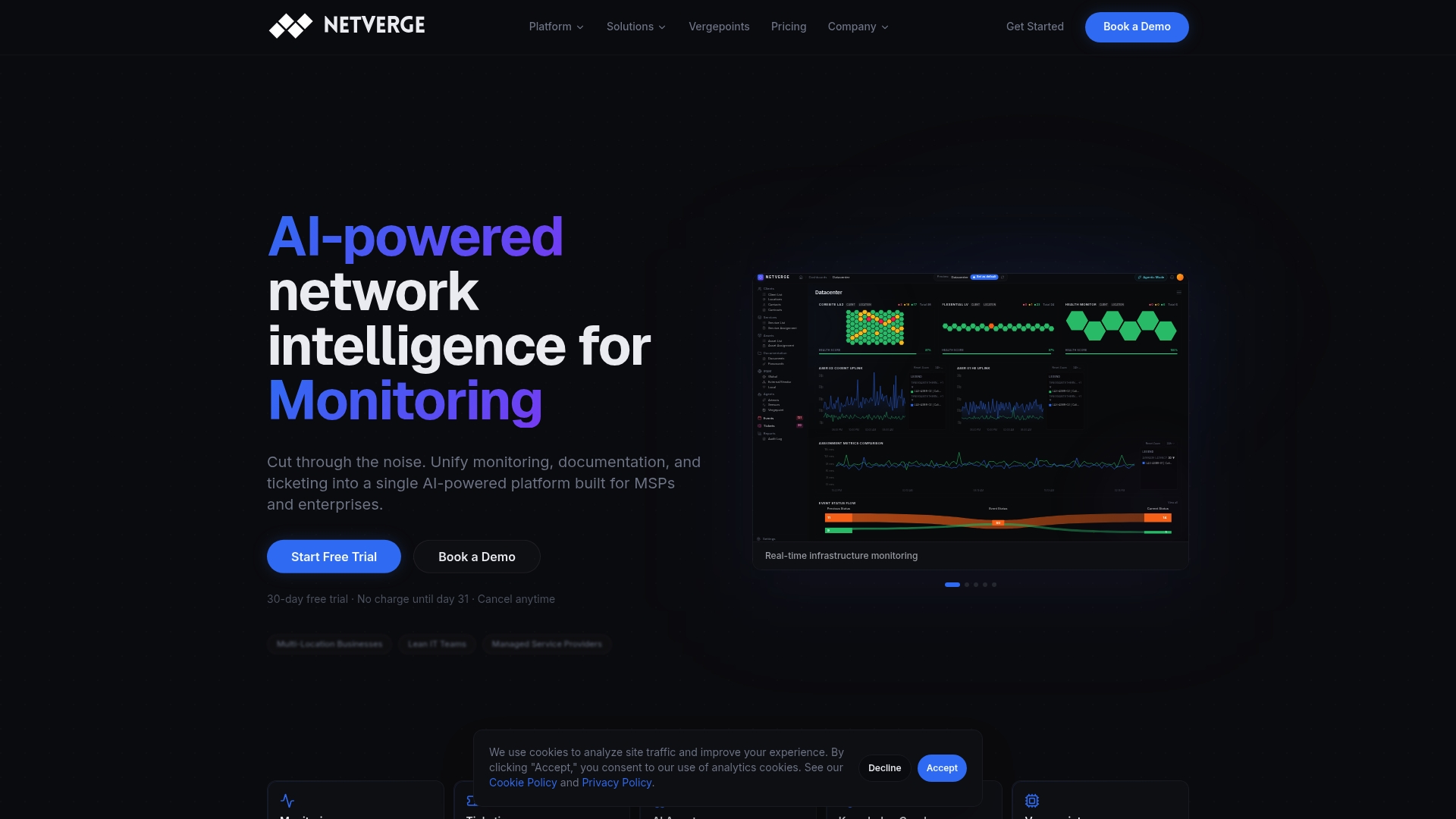
Netverge's AI-powered monitoring platform continuously scans your infrastructure, updates device records in real time, and correlates telemetry with documented topology to surface anomalies before they cause outages. Vergepoints hardware extends physical visibility to distributed sites, while knowledge graphs and autonomous AI agents keep logical records current without manual input. For MSPs and multi-location enterprises managing complex environments, Netverge replaces fragmented tools and disconnected documentation systems with one unified interface built for audit readiness, fast troubleshooting, and proactive network management.
FAQ
What is smart network documentation?
Smart network documentation is the automated process of capturing and continuously updating accurate records of a network's physical topology, logical diagrams, device inventory, and configuration history. It replaces manual, error-prone methods with real-time data collection.
How does automated documentation reduce network downtime?
Accurate, current documentation lets engineers identify affected devices and dependencies immediately when an incident occurs. This clarity reduces mean time to repair by eliminating the time spent tracing undocumented connections or guessing at configurations.
What is the difference between physical and logical network documentation?
Physical documentation covers hardware locations, cabling, and port connections. Logical documentation covers VLANs, IP addressing, routing, and firewall rules. Both layers are required for complete network infrastructure documentation.
How often should network documentation be updated?
Documentation should update automatically on change detection, not on a fixed schedule. Platforms that poll devices via SNMP or API triggers update records within minutes of a configuration change, keeping the record accurate at all times.
How does network documentation support compliance audits?
Automated change logs record what changed, when it changed, and who made the change. Auditors reviewing frameworks such as SOC 2 or ISO 27001 can access this history on demand, reducing audit preparation from weeks of manual report generation to a straightforward export.