
Automated remediation gives multi-site networks a way to detect, diagnose, and fix routine faults without waiting on a technician, cutting mean time to repair and freeing your team from repetitive ticket work. Done right, it runs as a closed loop: every action gets verified against fresh telemetry, with automatic rollback if the fix doesn't hold. Platforms like Netverge and standards efforts like the IETF governance draft are shaping how NETCONF and gNMI based systems make this safe at scale. The sections below cover the guardrails and rollout plan that make it work.
TL;DR:
- Automated remediation should only be triggered by high-confidence signals like real-time telemetry and synthetic tests, not solely by SNMP traps or user reports.
- Every fix must be validated against the current device state and a known-good baseline before execution to prevent applying outdated solutions.
- Safe playbooks require capturing pre-state configurations, limiting blast radius, and preferring least disruptive actions, with human approval for non-routine fixes.
- MSPs should start with observation mode, then move to supervised remediation, and finally expand to graduated autonomy over several weeks to build trust.
- Complete and auditable logs of all actions, triggers, and outcomes are essential for compliance, troubleshooting, and effective governance.
Table of Contents
- What Is Automated Remediation and How Does the Closed Loop Work?
- What Signals Should Trigger Automated Remediation?
- How Do You Design Safe Remediation Playbooks?
- How Should MSPs Roll Out Automated Remediation?
- What Governance and Logging Practices Keep Remediation Auditable?
- Lessons From Rolling Out Remediation Across Multi-Site Networks
- How Netverge Supports Closed-Loop Automated Remediation
- Sources
What Is Automated Remediation and How Does the Closed Loop Work?
This article covers infrastructure and network automated remediation: the self-healing correction of device faults, link failures, configuration drift, and performance degradation. It is not about security incident response or vulnerability patching, which is a related but separate discipline with its own tooling and risk profile.
The IETF's governance framework for AI-mediated network device management defines the lifecycle every safe remediation workflow should follow, and it maps cleanly onto how MSPs already triage tickets:
- Detection: a telemetry stream, synthetic test, or trap flags an anomaly.
- Analysis: correlation logic determines root cause and blast radius.
- Validation: the system checks the proposed fix against current device state, not a cached snapshot.
- Execution: the playbook runs, often starting with the least disruptive option.
- Verification: fresh telemetry confirms the fault actually cleared.
- Resolution or escalation: the ticket closes automatically, or a human takes over.
Each phase depends on the one before it. Skip validation and you risk applying yesterday's fix to today's problem. Skip verification and you risk marking a ticket resolved when the outage never actually cleared, a failure mode Juniper's own closed-loop remediation research flags as a top cause of repeat incidents.
What Signals Should Trigger Automated Remediation?
Not every alert deserves an automated response. The trigger logic matters as much as the fix itself, and getting it wrong means either missed problems or a flood of false-positive actions.
Reliable remediation workflows typically pull from four signal categories:
- Streaming telemetry: interface counters, CPU and memory thresholds, and BGP session state reported continuously rather than polled every five minutes.
- Synthetic active tests: scripted probes that measure real user-experience KPIs like latency and packet loss, not just device health.
- SNMP traps and syslog events: still the backbone of fault notification across most multi-site device fleets.
- Ticket and PSA triggers: a technician or client-reported issue that seeds an automated diagnostic run.
Raw signals need deduplication and correlation before they become an incident as described in workflow visibility best practices that actually work. A single fiber cut can generate hundreds of alerts across a dozen devices; correlation logic groups those into one incident tied to one root cause, which is the difference between one automated action and a hundred conflicting ones. Understanding what qualifies as a network anomaly helps set sane thresholds here.
Before remediation executes, the system should validate its target against a known-good baseline, sometimes called a golden intent or digital twin. This confirms the proposed fix matches the site's actual intended configuration, not just what looks broken on the surface.
How Do You Design Safe Remediation Playbooks?
Every playbook needs boundaries before it needs intelligence. The IETF draft's core insight is that automated remediation functions as a force multiplier, so a flawed playbook multiplies damage as fast as it multiplies fixes.
- Capture pre-state before touching anything. Pull a configuration snapshot via NETCONF or gNMI so you have a verified rollback point, not a guess.
- Run in dry-run mode first. Simulate the change and compare expected outcomes against the live topology before committing.
- Set blast-radius limits. Cap how many nodes or sites a single playbook can touch per time window, and hard-block certain domains (core routing, PCI-segmented VLANs) from autonomous changes entirely.
- Suppress convergence-sensitive metrics. A route flap during normal reconvergence looks like a failure to a naive monitor; suppression windows prevent the system from "fixing" something that was already healing itself.
- Prefer the least disruptive action first. Restart a process before rebooting a device; reroute traffic before reconfiguring a link.
- Gate anything outside the routine category behind human approval. Autonomous execution belongs to well-tested, low-risk fixes; anything novel gets a human in the loop.
- Define rollback triggers explicitly. If post-action verification fails twice, or fresh telemetry contradicts the "fixed" status, roll back automatically rather than escalate and hope.
Pro Tip: Never let rollback decisions rely on cached health indicators. The IETF draft specifically warns against this, since a device can report stale "healthy" status even after a fix has silently failed.
How Should MSPs Roll Out Automated Remediation?
Speed kills trust here faster than it builds it. The Mizo on MSP automation rollouts consistently shows the fastest path to ROI starts narrow and expands only after the data proves the system is accurate.
- Weeks 1 to 2: Observation mode. Deploy baseline telemetry and automated diagnostics across your sites, but let the system only recommend, not act. This is the quickest win available: automating diagnostic collection alone often cuts triage time before a single autonomous fix ever runs.
- Weeks 3 to 6: Supervised remediation. Turn on approval gates for a small set of routine categories, like interface flaps or DHCP scope exhaustion. Every action still needs a human click, but the diagnosis and proposed fix are automated.
- Weeks 7 to 12 and beyond: Graduated autonomy. Expand which categories run without approval, tune your confidence thresholds, and keep validating every autonomous action against fresh telemetry.
Track a small set of KPIs weekly at first, then monthly once the system stabilizes: mean time to detect and repair, the percentage of tickets resolved without a technician touching them, SLA breach rates, and technician hours freed up for higher-value work. MSPs that follow this phased path commonly reach a 40 to 60 percent autonomous resolution rate for routine ticket categories, a number that tends to climb as more categories graduate out of supervised mode.
What Governance and Logging Practices Keep Remediation Auditable?
Every automated action needs a paper trail detailed enough to reconstruct exactly what happened and why, both for internal review and for client audits. That means logging the trigger event, the timestamp, the diagnostic reasoning that led to the chosen fix, the pre and post configuration snapshots, the outcome, and whether a human approved the action.
Escalation needs its own explicit triggers, not vague judgment calls:
- Retry attempts exhausted without resolution.
- The system itself requests human review due to low confidence.
- A rollback occurred, regardless of whether the retry eventually succeeded.
- A rate limit or blast-radius cap was hit mid-remediation.
Tying these records into your ITSM and CMDB matters as much as generating them. A ticket that automatically attaches the topology diagram, the diagnostic output, and the change record gives a technician full context in seconds rather than minutes of digging. Run dry-run rehearsals periodically and manage your rate limits and exclusion rules as policy-as-code, so governance stays version-controlled rather than tribal knowledge that lives in one engineer's head.
Lessons From Rolling Out Remediation Across Multi-Site Networks
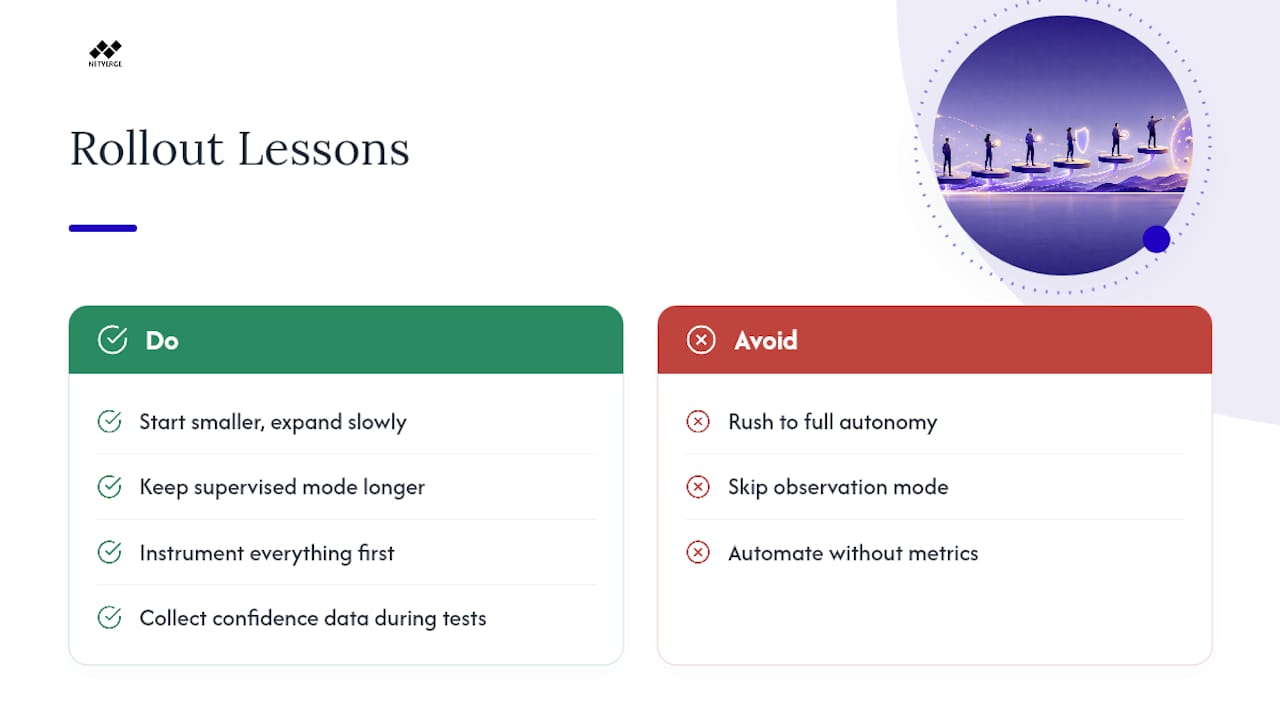
Start smaller than feels comfortable. Every rollout that stayed in supervised mode a few extra weeks outperformed those that rushed to full autonomy, because the confidence data simply wasn't there yet.
Instrument everything before you automate anything. The teams that struggle most are the ones that skip observation mode entirely.
— Jim
How Netverge Supports Closed-Loop Automated Remediation
Netverge is built for the exact lifecycle described above, not a generic alert dashboard bolted onto a ticketing system. Its monitoring and observability platform ingests streaming telemetry from Vergepoints hardware sensors deployed on-site, giving you the detection layer a closed loop depends on before a single automated action ever runs.
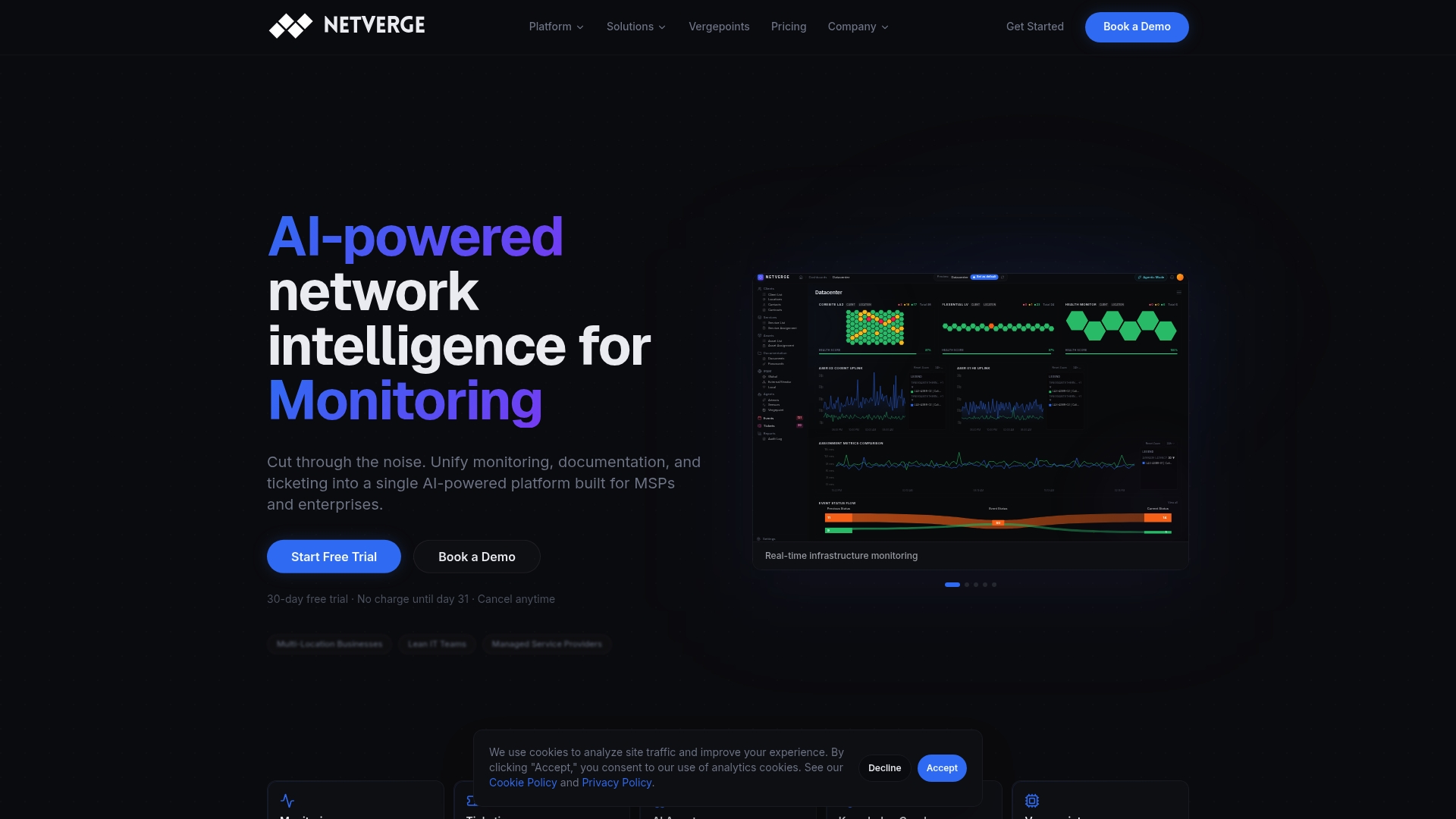
From there, Netverge's autonomous AI agents handle the analysis and validation phases, checking proposed fixes against a knowledge graph of your actual site topology rather than a static rulebook. Ticket triage happens automatically, with diagnostic context and topology data attached before a technician even opens the case. Multi-tenant support means an MSP managing dozens of client sites can run supervised remediation for one client and graduated autonomy for another, without one client's playbooks bleeding into another's environment. For teams running distributed infrastructure across many locations, the enterprise platform adds the role-based approval gates and audit logging this kind of rollout requires. Start with a monitoring trial and see what observation mode surfaces on your own network before you turn on a single autonomous action.
Sources
For deeper technical grounding, review the IETF's governance draft on AI-mediated device management, NetBrain's breakdown of the detection-to-verification sequence, and Netpicker's overview of concrete backup and rollback controls.
- Governance Framework for AI-Mediated Autonomous Network Device Management (IETF draft)
- Juniper Paragon Automation — closed-loop remediation benefits and capabilities