
Network security practices for MSPs are defined as the multi-layered, identity-centric processes and technical controls that managed service providers deploy to protect client infrastructure, enforce compliance, and contain threats across distributed environments. The industry term for this discipline is managed security services, and it spans zero trust architecture, continuous monitoring, endpoint protection, and automated incident response. Platforms like Microsoft Entra ID, Cloudflare Zero Trust, and frameworks like NIST 800-207 form the operational backbone of how leading MSPs structure client defense in 2026. The stakes are high: MSPs managing dozens of client networks simultaneously need security practices that scale without creating blind spots or alert fatigue.
1. Zero trust architecture: the foundation of MSP network security practices
Zero trust is defined as a security model that eliminates implicit trust from any network segment, user, or device, requiring continuous verification before granting access. NIST 800-207 outlines seven tenets that govern this model, including treating all data sources as resources, verifying all connections regardless of location, and granting least-privilege access per session.
For MSPs, implementing zero trust for SMB clients means replacing legacy VLAN-based segmentation with micro-segmentation and software-defined perimeters. Zero trust deployment for SMB clients typically follows a 12-month timeline, transitioning from flat network architectures to granular access controls enforced by ZTNA solutions. That timeline reflects the complexity of mapping existing data flows, classifying assets, and retraining client staff.
Key pillars MSPs address during zero trust rollout:
- Identity verification: Multi-factor authentication enforced through Microsoft Entra ID or Okta for every user and service account
- Device posture assessment: Continuous checks confirming endpoints meet compliance baselines before granting access
- Micro-segmentation: Isolating workloads so lateral movement between segments requires explicit policy approval
- Dynamic policy enforcement: Context-aware access controls that adjust permissions in real time based on user behavior and risk signals
- Session-level verification: Access is re-evaluated continuously during active sessions, not just at login
Pro Tip: When onboarding a new SMB client to zero trust, start with identity and MFA enforcement in week one. Trying to deploy micro-segmentation and ZTNA simultaneously before identity is locked down creates policy conflicts that delay the entire project.
2. Building a scalable MSP security stack
A unified security stack is the operational infrastructure that lets MSPs protect multiple clients without multiplying headcount. Unified security stacks integrating identity, endpoint, email, and cloud controls are the primary mechanism for MSPs to scale effectively while reducing alert fatigue. Fragmented tools from a dozen vendors create visibility gaps and slow response times.
The core layers of an effective MSP security stack include:
- Identity protection: Microsoft Entra ID, Duo Security, or similar platforms enforcing MFA and conditional access
- Endpoint detection and response (EDR): Tools like CrowdStrike Falcon or SentinelOne providing real-time telemetry and automated threat containment
- Email security: Platforms like Proofpoint or Microsoft Defender for Office 365 blocking phishing, BEC, and malware delivery
- Cloud data protection: CASB solutions monitoring SaaS usage and enforcing data loss prevention policies
- Centralized multi-tenant management: A single console providing policy enforcement and visibility across all client environments
| Layer | Function | Example Tools |
|---|---|---|
| Identity | MFA, conditional access, SSO | Microsoft Entra ID, Okta, Duo |
| Endpoint | EDR, posture checks, isolation | CrowdStrike, SentinelOne |
| Phishing, BEC, malware filtering | Proofpoint, Defender for O365 | |
| Cloud | SaaS visibility, DLP, CASB | Microsoft Defender for Cloud Apps |
| Automation | Alert triage, response playbooks | AI-based SIEM, SOAR platforms |
AI-based triage systems reduce alert fatigue by scoring incidents by severity and enriching them with context before a technician ever sees them. This matters because MSP security teams routinely manage alerts across 20 to 50 client environments simultaneously. Standardized onboarding with baseline security policies applied at client activation reduces setup errors and accelerates time-to-protection from days to hours.
3. Continuous monitoring and real-time asset discovery
Continuous monitoring is defined as the ongoing, automated process of identifying, classifying, and tracking all assets, connections, and data flows across client networks in real time. Automated asset discovery is more effective than quarterly audits because unmanaged devices, shadow SaaS tools, and untracked IP addresses create hidden attack surfaces that periodic reviews miss entirely.

MSPs moving from periodic audits to continuous identification align directly with the NIST Cybersecurity Framework's Identify and Protect pillars. This shift means knowing what is on the network at all times, not just when a scheduled scan runs. Network visibility across all client environments is what separates reactive MSPs from those delivering genuine protection.
Continuous monitoring delivers value across four specific areas:
- Asset inventory: Automated discovery of hardware, software, SaaS subscriptions, and third-party access points
- Data flow mapping: Identifying how sensitive data moves between systems to classify crown jewel assets
- Behavioral monitoring: Detecting anomalies in user and device behavior that indicate compromise or policy violation
- Log correlation: Centralizing logs from firewalls, endpoints, and cloud services for unified analysis in a SOC or MDR platform
Pro Tip: Map your client's crown jewel assets in the first 30 days of onboarding. Without knowing which systems hold the most sensitive data, you cannot prioritize monitoring thresholds or segment those assets correctly.
Security is continuous during sessions with on-the-fly risk evaluation, meaning a user who authenticates cleanly at 9 AM can still trigger a policy response at 2 PM if their device posture changes or their behavior deviates from baseline. This is the operational reality of effective MSP security in 2026.
4. Endpoint protection, firewall architecture, and network segmentation
Endpoint detection and response is the first line of defense against threats that bypass perimeter controls. EDR tools provide real-time telemetry from every managed device, enabling MSPs to detect malicious processes, isolate compromised endpoints, and initiate response workflows without manual intervention.
Firewall architecture for MSP-managed environments requires more than default rule sets. Manual penetration testing identifies firewall and DMZ weaknesses that automated scanners cannot detect, including complex logic flaws in rule ordering and misconfigured trust zones. Scanners find known vulnerabilities. Skilled testers find the gaps attackers actually exploit. Partnering with a cybersecurity penetration testing provider gives MSPs an objective view of firewall posture that internal reviews rarely surface.
Network segmentation strategies MSPs deploy in 2026:
- Micro-segmentation: Workload-level isolation enforced by software-defined policies, not physical hardware boundaries
- ZTNA replacing VPN: Zero Trust Network Access eliminates broad network access granted by legacy VPN tunnels
- Software-defined perimeters: SDP solutions make internal resources invisible to unauthorized users, reducing the attack surface
- DNS filtering: Blocking malicious domains at the resolver level before connections are established
- Secure web gateways: Inspecting and filtering outbound traffic to prevent data exfiltration and malware callbacks
Micro-segmentation contains east-west traffic, which is the primary mechanism ransomware uses to spread across a network after initial compromise. Containing lateral movement at the segment boundary is what turns a single infected endpoint into a contained incident rather than a full network compromise.
5. Incident response planning and security awareness training
An incident response plan for MSPs is defined as a documented, tested set of procedures that govern detection, containment, eradication, and recovery across all managed client environments. Without a structured plan, MSP technicians default to improvised responses that extend dwell time and increase breach impact.
Core elements of an MSP incident response plan:
- Defined roles and escalation paths for each client environment, including client-side contacts
- Automated alert prioritization using SIEM or SOAR platforms to surface critical incidents first
- Response playbooks for the most common threat scenarios: ransomware, credential compromise, and data exfiltration
- Communication templates for client notification that satisfy breach disclosure requirements
- Post-incident review processes that feed findings back into policy and control updates
Security awareness training addresses the human factor that technical controls cannot fully eliminate. Frequent phishing simulations with immediate feedback are more effective than annual checkbox training because they create behavioral conditioning rather than one-time knowledge transfer. Employees who receive immediate feedback after clicking a simulated phishing link are measurably less likely to repeat the behavior. MSPs that offer cybersecurity best practices training programs as part of their service catalog add measurable value to client contracts while reducing their own incident response burden.
Pro Tip: Run phishing simulations against client employees within the first 60 days of onboarding. The baseline click rate tells you exactly how much training investment that client needs and gives you a quantifiable metric to show improvement over time.
Documented incident management also produces compliance artifacts. Regulators under frameworks like HIPAA, SOC 2, and CMMC require evidence of incident detection, response, and remediation. MSPs with structured plans generate that evidence automatically rather than reconstructing it after the fact.
Key takeaways
Effective MSP security requires zero trust architecture, continuous monitoring, and unified tooling working together, not independently.
| Point | Details |
|---|---|
| Zero trust is the foundation | Deploy identity verification, device posture checks, and micro-segmentation before adding other controls. |
| Unified stacks reduce risk | Integrating identity, endpoint, email, and cloud tools into one stack cuts alert fatigue and visibility gaps. |
| Continuous monitoring beats audits | Automated asset discovery and behavioral monitoring catch threats that quarterly reviews miss entirely. |
| Manual pen testing is non-negotiable | Automated scanners miss firewall logic flaws that skilled testers find and attackers exploit. |
| Training must be continuous | Frequent phishing simulations with immediate feedback outperform annual security awareness programs. |
What I've learned about MSP security that most guides won't tell you
After years of working with MSPs across different client segments, the pattern I see most often is this: MSPs invest heavily in tools and almost nothing in process. They deploy EDR, SIEM, and MFA across client environments, then wonder why incidents still escalate. The tools are sound. The workflows connecting them are not.
Zero trust is the right framework, but client education is the real barrier to adoption. Most SMB clients still think of security as a firewall and an antivirus subscription. Convincing a 50-person accounting firm that their VPN needs to be replaced with ZTNA requires more than a technical argument. It requires translating risk into business language, and most MSP technicians are not trained to do that.
Automation is where I see the biggest operational leverage. MSPs that build response playbooks into their SOAR platforms and connect them to their MSP network management workflows handle twice the client load with the same headcount. The MSPs still triaging alerts manually are losing ground every quarter.
The future of MSP security is not more tools. It is tighter integration between the tools already in the stack, with AI handling the correlation and prioritization work that currently consumes analyst hours. MSPs that build that integration now will be positioned to take on larger, more complex clients in 2026 and beyond.
— Jim
How Netverge supports your MSP security operations
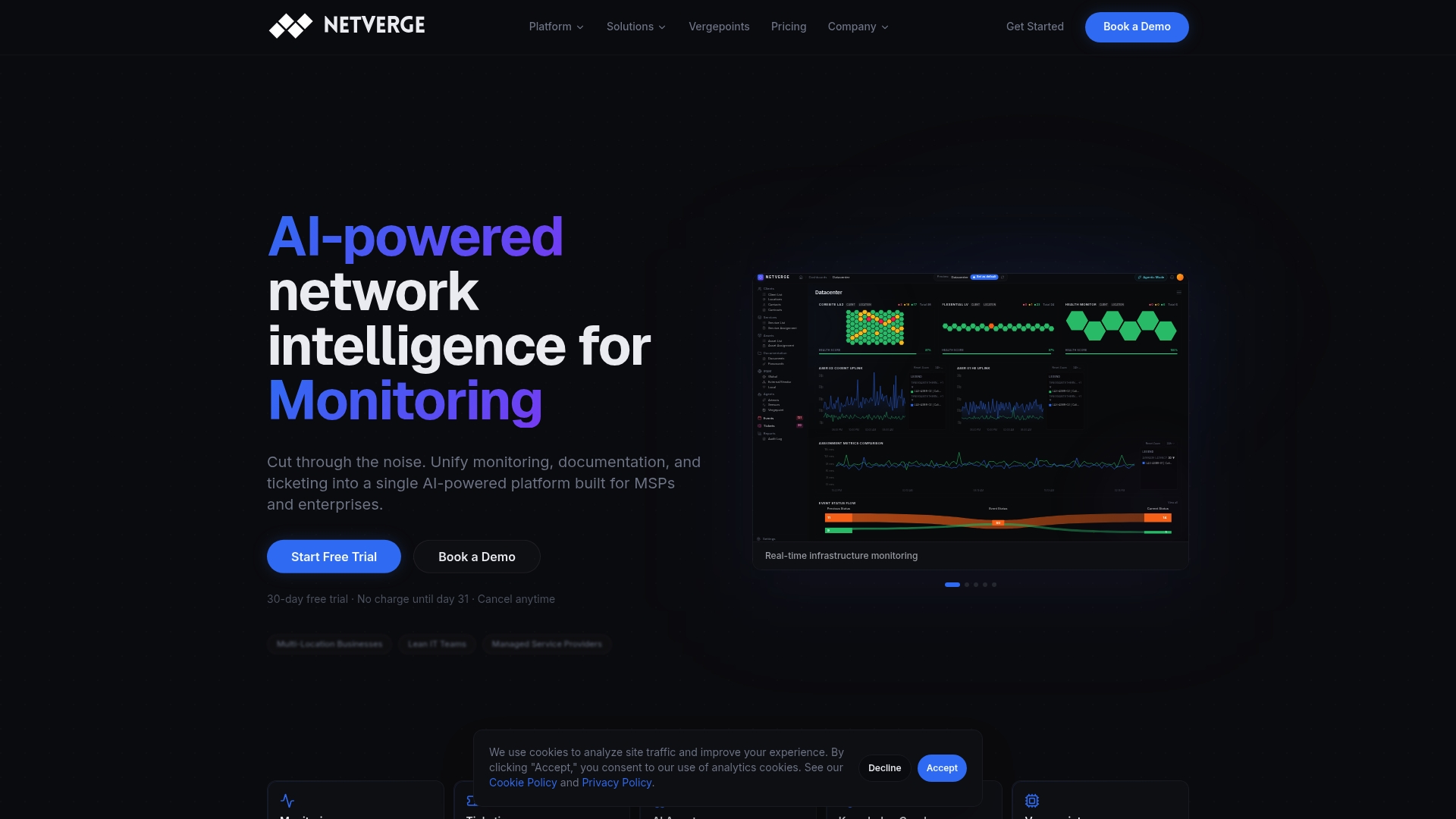
Netverge is built specifically for MSPs that need unified network visibility without the overhead of managing fragmented monitoring tools. The platform delivers AI-powered continuous monitoring with real-time asset mapping, anomaly detection, and automated alert triage across all client environments from a single multi-tenant interface. Vergepoints provide physical network visibility, while AI agents diagnose issues and initiate responses before tickets are manually created. For MSPs managing distributed client networks, Netverge consolidates telemetry, documentation, and ticketing into one platform, reducing response times and eliminating the blind spots that create security risk. Request a demo at netverge.com/monitoring.
FAQ
What is zero trust architecture for MSPs?
Zero trust architecture for MSPs is a security model requiring continuous identity verification, device posture checks, and least-privilege access enforcement across all client environments, replacing implicit trust granted by legacy VPN and VLAN-based designs.
How do MSPs manage security across multiple clients?
MSPs use centralized multi-tenant security platforms that apply standardized baseline policies at client onboarding and provide unified visibility across all environments, with AI-based triage prioritizing alerts by severity before technician review.
Why is manual penetration testing important for MSP clients?
Manual penetration testing identifies firewall and DMZ logic flaws that automated scanners cannot detect, giving MSPs an accurate picture of actual exploitable weaknesses rather than just known CVEs.
How often should MSPs run phishing simulations for clients?
Phishing simulations should run continuously throughout the year with immediate feedback delivered to employees who click, as frequent simulation with feedback produces measurably better behavioral outcomes than annual training exercises.
What tools belong in an MSP security stack?
An effective MSP security stack includes identity protection (Microsoft Entra ID or Okta), EDR (CrowdStrike or SentinelOne), email security (Proofpoint or Microsoft Defender), cloud access controls, and an AI-driven SIEM or SOAR platform for automated alert correlation and response.