
Ticketing systems are defined as the central incident management layer in a Network Operations Center (NOC), tracking every fault from first alert through final resolution. The role of ticketing in network ops extends far beyond simple logging. It governs how teams detect, prioritize, assign, and close network incidents while maintaining a full audit trail. Platforms like ServiceNow and Itential have demonstrated that when ticketing connects directly to automation engines, resolution times drop and operational costs follow. This guide covers what that integration looks like in practice, why it matters for compliance, and how to build a workflow that actually scales.
How does ticketing improve network operations efficiency?
Ticketing systems are the single most direct lever for reducing operational cost in a NOC. Manual help desk tickets cost $22 each in North America on average. That number adds up fast when your team handles hundreds of incidents per week.
Automation changes the math entirely. AI-driven triage can reduce resolution times by up to 75%, and roughly 22% of tickets resolve at zero marginal cost through automated workflows. That means a significant portion of your ticket volume never requires a human touch.

The mechanism behind this is alarm correlation. Instead of generating one ticket per alert, AI agents collapse multiple alarms into a single enriched ticket, complete with topology context, service impact data, and a shift-ready incident summary. One documented case shows agents collapsing 12 separate alarms into one ticket. That reduction in noise alone cuts triage time significantly.
Here is what an AI-assisted ticketing workflow handles automatically:
- Alert ingestion: Raw telemetry triggers ticket creation without manual input
- Alarm clustering: Related alerts group into a single incident record
- Metadata enrichment: Device role, history, and logs attach to the ticket before human review
- Runbook matching: The system proposes the most relevant remediation procedure
- Low-risk execution: Approved automated actions run within defined policy boundaries
Pro Tip: Set your automation thresholds conservatively at first. Start by automating only the lowest-risk, highest-frequency ticket types, such as interface flaps or routine threshold alerts, before expanding AI authority to more complex incident categories.
What is the governance role of ticketing in modern NetOps?
The governance function of ticketing is the part most IT managers underestimate. Ticketing systems now act as compliance and audit ledgers that gate every automated network action, ensuring full traceability and policy adherence before any change executes.
This matters because AI agents operating in a NOC need defined boundaries. The concept of behavior contracts formalizes exactly what actions an AI agent can execute autonomously and what requires human approval. Ticketing systems enforce these behavior contracts, making the ticket record the authoritative source of truth for every change, whether human or machine initiated.
Consider what this looks like in practice. Before an automated workflow executes a configuration change on a core router, the ticketing system checks:
- Does an approved change record exist for this action?
- Has the required approval tier signed off based on risk classification?
- Does the proposed action fall within the AI agent's defined authority scope?
- Is a rollback procedure documented and linked to this ticket?
- Has the maintenance window been validated against the current schedule?
Only when all gates pass does the automation engine receive the execution signal. This is not bureaucracy. It is the mechanism that makes governed self-service possible, allowing operators to trigger approved workflows directly from tickets without waiting on engineering.
"Network reliability improves most when network teams can convert insight to governed, accountable change through orchestration." — Faster, Safer Network Operations Guide
The closed-loop workflow depends entirely on this integration. When the automation engine completes an action, it writes the result back to the ticket. The ticket becomes the permanent record of what happened, when, and why. Auditors, compliance teams, and post-incident reviewers all work from the same source.
Traditional vs. ai-enabled ticketing: what changes?
The gap between legacy and modern ticketing workflows is not incremental. It represents a fundamentally different operational model. The table below shows where the differences are most significant.
| Dimension | Traditional Ticketing | AI-Enabled Ticketing |
|---|---|---|
| Ticket creation | Manual entry by NOC engineer | Automated alert ingestion from monitoring telemetry |
| Alarm handling | One ticket per alert, high noise | Clustered alarms, single enriched ticket per incident |
| Context at handoff | Minimal, engineer must investigate | Topology, history, and impact data pre-attached |
| Runbook matching | Engineer searches knowledge base | AI agent proposes best-fit runbook automatically |
| Status updates | Manual entry after each action | Automation engine writes updates via API in real time |
| Audit trail | Inconsistent, depends on engineer discipline | Complete, machine-generated, bidirectional |
| Resolution for low-risk issues | Requires human action | Executes autonomously within policy constraints |
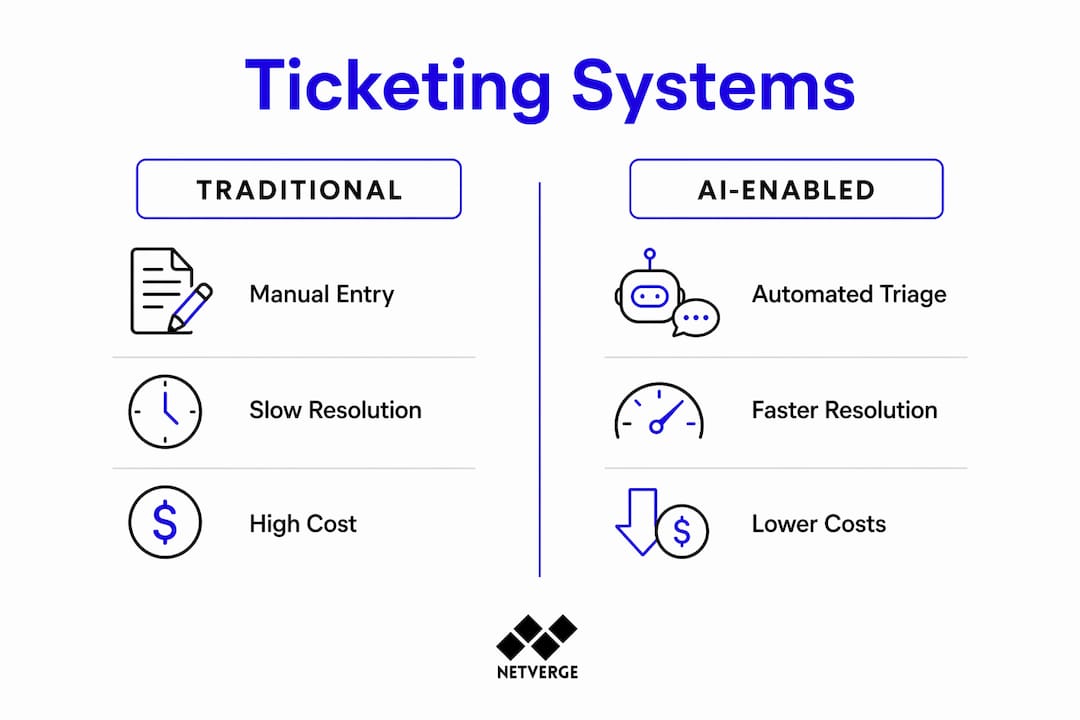
The most operationally significant column is the last one. Automation workflows updating tickets through APIs eliminate the manual data entry that consumes NOC engineer time and introduces documentation errors. When the system updates its own records, the audit trail is complete by default.
Ticket enrichment before AI intervention is the prerequisite that makes this work. Enriched ticket metadata gives AI agents the context they need to propose valid remediation steps, reducing false positives and the risk of an automated action making an incident worse. Topology data from a network topology architecture layer is particularly valuable here because it tells the agent which devices are upstream, which services depend on the affected node, and what the blast radius of any change would be.
Pro Tip: Before deploying AI triage, audit your existing ticket data quality. AI agents are only as accurate as the metadata they receive. Incomplete CMDB records or missing device roles will produce poor enrichment and unreliable remediation proposals.
How to optimize your ticketing workflow for network operations
Treating ticketing as a record-keeping obligation is the single biggest source of operational toil in a NOC. The biggest efficiency gains come from treating ticketing systems as workflow orchestration tools rather than passive logging repositories. Here is how to get there.
Establish bidirectional API integration first. Your ticketing platform and your network automation engine must exchange data in both directions. Bidirectional API integration preserves audit trails and enables real-time status updates without manual input. If your current setup requires an engineer to copy data between systems, that is the first gap to close.
Define governance tiers before enabling automation. Map every ticket category to a risk level and assign an automation authority tier to each. Low-risk, high-frequency tickets like interface resets or VLAN provisioning can run autonomously. Medium-risk changes require one approval. High-risk changes require two approvals and a maintenance window. Document this in your ticketing platform as policy gates, not just guidelines.
Build escalation logic into the ticket workflow. Automated escalation based on ticket age, severity, or SLA proximity removes the human dependency from a critical step. When a P1 ticket goes unacknowledged for five minutes, the system should escalate automatically, not wait for a supervisor to notice.
Additional best practices for network ops ticket management:
- Role-based access controls: Restrict which automation workflows each role can trigger from a ticket to prevent unauthorized changes
- Smart triage categories: Use AI classification to route tickets to the correct team or automation queue on creation, not after manual review
- Linked documentation: Attach runbooks, change records, and post-incident reports directly to ticket records for a complete operational history
- SLA visibility: Surface SLA timers on every open ticket so engineers prioritize by business impact, not by queue position
- Closed-loop verification: Require the automation engine to confirm remediation success before marking a ticket resolved, preventing premature closure
The 2026 AI trends reshaping network operations point consistently toward one outcome: teams that integrate ticketing with automation and monitoring into a single platform outperform those running fragmented tools. The operational gap between those two approaches will only widen.
Key takeaways
Ticketing systems are the governance and orchestration backbone of modern network operations, not just incident logs.
| Point | Details |
|---|---|
| Cost reduction is measurable | Manual tickets cost $22 each; AI automation resolves 22% at zero marginal cost. |
| Alarm clustering cuts noise | AI agents collapse multiple alerts into one enriched ticket, reducing triage time significantly. |
| Governance gates protect networks | Behavior contracts and policy checks in ticketing prevent unauthorized automated changes. |
| Enrichment precedes AI action | Topology, history, and device role data must attach to tickets before AI agents propose remediation. |
| Bidirectional APIs are non-negotiable | Real-time status updates and complete audit trails require two-way integration between ticketing and automation engines. |
Why ticketing strategy defines NOC performance
Most NOC teams I have worked with treat ticketing as a necessary administrative task. They configure it once, train engineers to fill in the required fields, and move on. That approach produces a system that records what happened but never helps prevent the next incident.
The shift I have seen in high-performing operations teams is treating the ticketing platform as the operational control plane. Every alert, every change, every automated action runs through it. The ticket is not the record of what the team did. It is the mechanism through which the team acts.
The governance angle is where I see the most resistance. Engineers often push back on policy gates and approval workflows because they feel like friction. In my experience, that friction is the point. When an AI agent can execute a configuration change on a production router, the only thing standing between a clean fix and a cascading outage is the policy logic embedded in the ticket workflow. That is not overhead. That is the defense layer.
The teams that will operate most effectively in 2026 and beyond are not the ones with the most monitoring dashboards. They are the ones that have closed the loop between detection, governed decision, and automated action. Ticketing is the connective tissue that makes that loop possible. If your current platform cannot enforce behavior contracts, trigger automation, and write back execution results, you are not running a modern NOC. You are running a very expensive spreadsheet.
The hybrid human-agent operations model is not a future concept. It is already the operational standard for teams managing distributed infrastructure at scale. The question is whether your ticketing architecture is built to support it.
— Jim
How Netverge handles ticketing and network operations
Netverge's AI-powered ticketing and service desk platform is built specifically for the workflows described in this article. It connects alert ingestion, AI triage, runbook matching, and automated execution into a single platform, with full bidirectional integration to your network automation engine.
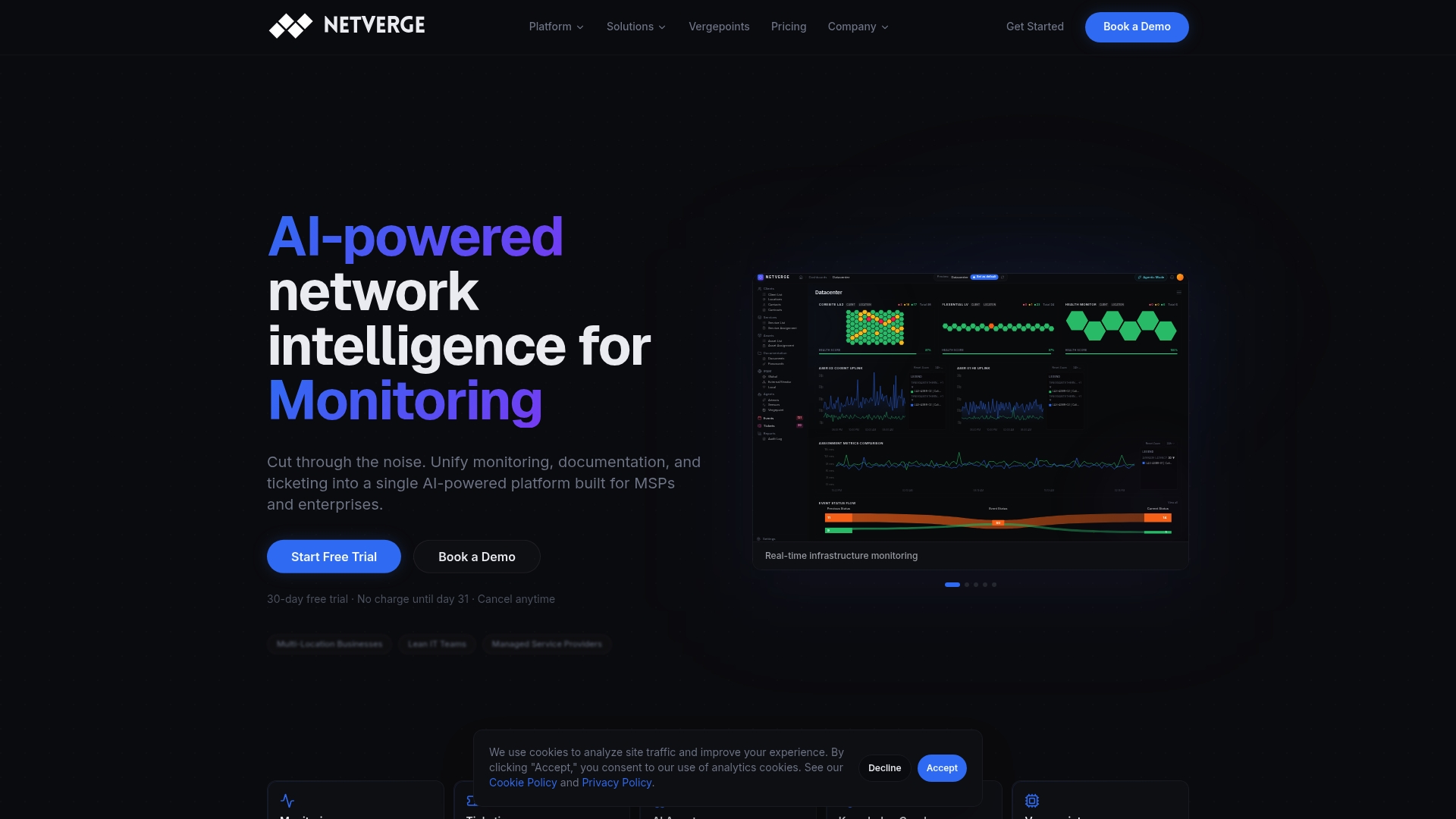
Every ticket Netverge creates carries enriched metadata from the platform's knowledge graph, including topology context, device history, and service impact data. Policy gates and behavior contracts are configurable at the team level, so you control exactly what AI agents can execute autonomously. The AI-powered monitoring layer feeds real-time telemetry directly into the ticketing workflow, closing the loop from detection to resolution without manual handoffs. If your NOC is still running fragmented tools, Netverge consolidates them into one governed, intelligent platform.
FAQ
What is the role of ticketing in network ops?
Ticketing systems serve as the central incident management layer in a NOC, tracking every fault from detection through resolution while enforcing governance, automation, and audit compliance. They connect monitoring telemetry, automation engines, and human operators into a single coordinated workflow.
How does AI improve incident management in networks?
AI-driven triage clusters related alarms into single enriched tickets, proposes runbook matches, and executes low-risk remediation autonomously within defined policy boundaries. This reduces resolution times by up to 75% and eliminates manual handling for a significant share of ticket volume.
What are behavior contracts in network ticketing?
Behavior contracts are policy definitions embedded in the ticketing system that specify which actions an AI agent can execute autonomously and which require human approval. They are the governance mechanism that makes safe automation possible in production network environments.
Why is bidirectional API integration important for ticketing?
Bidirectional API integration between your ticketing platform and automation engine ensures that ticket status updates automatically when workflows execute, maintaining a complete and accurate audit trail without manual data entry.
What is the best practice for enriching tickets before AI triage?
Attach device role, topology data, incident history, and current logs to every ticket before AI agents evaluate it. Enriched metadata reduces false positives and gives agents the context needed to propose accurate, safe remediation steps.