
The must-have MSP tools for 2026 are remote monitoring and management (RMM), professional services automation (PSA), advanced cybersecurity suites, and backup and disaster recovery (BDR) solutions, forming the minimum integrated foundation every managed service provider needs to operate competitively. Platforms like NinjaOne, ConnectWise PSA, SentinelOne, and Acronis anchor these four categories, while a new wave of AI-driven tools from vendors like Atera and SuperOps is redefining what operational efficiency looks like. The essential MSP tools in 2026 are no longer evaluated in isolation. Integration and automation are the real differentiators, and the MSPs that build tightly connected stacks will outperform those running fragmented point solutions.
1. What are the core MSP tools every provider needs in 2026?
The four foundational MSP categories are RMM, PSA, cybersecurity, and BDR, and each one supports a distinct operational layer that cannot be substituted. Removing any single layer creates gaps that affect both service quality and security posture. Understanding what each category delivers is the starting point for evaluating any modern MSP tech stack.
- RMM (Remote Monitoring and Management): Platforms like NinjaOne and ConnectWise Automate provide endpoint visibility, patch management, scripting, and alert generation across all managed devices. They are the operational nerve center of any MSP.
- PSA (Professional Services Automation): Tools like ConnectWise PSA and HaloPSA manage ticketing, billing, project tracking, and SLA enforcement. Without a PSA, service delivery becomes inconsistent and unscalable.
- Cybersecurity (EDR/XDR + SIEM): SentinelOne, CrowdStrike Falcon, and Microsoft Defender for Business provide endpoint detection, extended threat correlation, and event logging. These tools are the security backbone of client environments.
- BDR (Backup and Disaster Recovery): Acronis Cyber Protect Cloud and Datto BCDR protect client data with automated backups, immutable storage, and recovery testing. They are the last line of defense against ransomware and data loss.
Pro Tip: Prioritize integration capability over feature count when evaluating any new tool. A platform with 80% of the features that connects natively to your RMM and PSA will outperform a feature-rich tool that requires manual data transfer.
2. How integration between MSP tools boosts efficiency

Tightly connected stacks outperform large fragmented ones because operations, workflow, and security data must flow cohesively across every platform. This is not a preference for 2026. It is the primary architectural requirement for any MSP that wants to scale without proportionally increasing headcount.
The most critical integration point is the bi-directional sync between RMM and PSA. Here is how an optimized workflow operates:
- An RMM alert fires when a disk reaches 90% capacity on a client endpoint.
- The PSA automatically generates a ticket, assigns it to the correct queue, and starts the SLA clock.
- The technician receives a notification with full device context already attached.
- Resolution steps are logged back into the PSA, updating the client record without manual entry.
- The ticket closes automatically when the RMM confirms the condition is resolved.
Automated bi-directional syncing eliminates manual ticket creation from alerts, which is one of the most consistent sources of wasted technician time in MSP operations. The SLA clock starts immediately, which means compliance is built into the process rather than dependent on individual technician behavior.
"Automated ticket generation from RMM alerts is not a nice-to-have. It is a systems-design requirement for any MSP that wants to maintain SLA adherence during incident surges." — Medha Cloud, The Ultimate MSP Stack 2026
Pro Tip: When auditing your current stack, map every alert type in your RMM to its corresponding PSA action. Any alert that requires a technician to manually open a ticket is a process gap that costs you money and risks SLA violations.
3. Which cybersecurity tools are non-negotiable for MSPs
Cybersecurity is the fastest-evolving category in the MSP tool stack, and the minimum viable security posture for 2026 requires layered coverage across endpoints, networks, and identity. A single EDR product is no longer sufficient. MSPs need to deliver a defense-in-depth model to every client.
The key cybersecurity tool categories and their roles are:
- EDR (Endpoint Detection and Response): SentinelOne Singularity and CrowdStrike Falcon detect, contain, and remediate threats at the endpoint level using behavioral AI rather than signature-based detection.
- XDR (Extended Detection and Response): Microsoft Defender XDR correlates signals across endpoints, email, identity, and cloud workloads into a unified threat view, reducing investigation time significantly.
- SIEM (Security Information and Event Management): Platforms like Microsoft Sentinel and Devo aggregate log data across the environment, enabling compliance reporting and threat hunting at scale.
- DNS Filtering: Cisco Umbrella and DNSFilter block malicious domains before connections are established, providing a lightweight but high-impact security layer.
- Dark Web Monitoring: Tools like ID Agent Passly and SpyCloud alert MSPs when client credentials appear in breach databases, enabling proactive remediation before accounts are compromised.
The table below compares the three primary endpoint security approaches MSPs evaluate:
| Approach | Primary Function | Best For |
|---|---|---|
| EDR | Endpoint threat detection and response | Clients with high endpoint density |
| XDR | Cross-platform threat correlation | Multi-workload environments |
| MDR | Managed detection with human analysts | MSPs without in-house SOC capacity |
Network visibility is equally critical. Cybersecurity tools that do not feed alerts into your RMM or PSA create blind spots. Every security event should generate a correlated work item in your service desk.
4. What are the must-have backup and disaster recovery tools
BDR tools are now evaluated as operational service outcomes rather than purely technical specifications. Ransomware resilience, recovery speed, and client-facing reporting carry as much weight as backup frequency or storage capacity. This shift reflects how MSP clients now measure the value of data protection.
When selecting a BDR platform, the criteria that matter most are:
- Multitenant management: A single pane of glass for managing backups across all client environments without switching consoles.
- Broad workload coverage: Support for physical servers, virtual machines, Microsoft 365, Google Workspace, and cloud workloads from one platform.
- Immutable storage: Write-once backup targets that ransomware cannot encrypt or delete, protecting recovery points even after a breach.
- Ransomware resilience: Automated detection of backup anomalies and the ability to restore to a known-clean state without paying a ransom.
- Automated recovery testing: Scheduled verification that backups are actually recoverable, not just completed. This is the feature most MSPs underutilize.
- Client-ready reporting: Automated reports that demonstrate backup compliance and recovery readiness to clients without manual preparation.
Acronis Cyber Protect Cloud leads this category for MSPs because it combines backup, anti-malware, and vulnerability assessment in a single agent. Datto BCDR remains the benchmark for business continuity with its instant virtualization and cloud failover capabilities. Effective BDR criteria include automated alerts, ransomware protections, and client reporting as core requirements, not optional features.
Pro Tip: Run a quarterly recovery drill for at least 10% of your client backup environments. Documented recovery tests are increasingly required for cyber insurance compliance and give clients tangible proof of your service value.
5. How AI and automation tools are reshaping MSP operations
AI and agentic automation tools are the defining addition to the 2026 MSP stack, moving beyond traditional RMM and PSA capabilities to automate documentation, ticket triage, and resolution workflows at a level that was not practical two years ago. The productivity gains are measurable and the adoption curve is accelerating.
The most impactful AI tool categories for MSPs in 2026 include:
- AI-native documentation platforms: Tools like Lexful automate the creation and maintenance of network documentation by pulling data directly from RMM and monitoring platforms, eliminating the manual documentation burden that consumes technician hours.
- Agentic AI ticket resolution: Platforms like Atera Autonomous IT and Rallied AI Technician analyze incoming tickets, match them against knowledge base articles, and execute resolution scripts without human intervention for common issue types.
- AI-powered PSA assistants: SuperOps integrates AI directly into its PSA workflow, generating ticket summaries, suggesting next steps, and drafting client communications based on ticket context.
- Automation hubs: Platforms like Rewst connect MSP tools through low-code automation workflows, allowing technicians to build multi-step processes across RMM, PSA, and security tools without custom scripting.
The critical governance requirement is that agentic AI must be embedded into existing PSA and ITSM queues and knowledge bases. AI tools that operate outside your core platforms create shadow processes. The output of an AI agent only becomes a billable, trackable work item when it is routed through your PSA. MSPs that skip this integration step find that AI generates activity without generating accountability.
Netverge addresses this directly with AI automation workflows that connect monitoring telemetry to ticketing and documentation in a single platform, ensuring every AI-generated insight becomes an actionable service record.
6. How to choose MSP tools that scale with your business
Selecting the right tools from the growing catalog of top MSP software in 2026 requires a structured evaluation process rather than a feature checklist. The tools that scale with your business share three characteristics: they integrate with your existing stack via documented APIs, they support multitenant operations without per-client configuration overhead, and they provide reporting that maps directly to client SLA metrics.
Vendor stability matters as much as product capability. The MSP tools market has seen significant consolidation, with private equity acquisitions affecting product roadmaps at companies like Kaseya and ConnectWise. Evaluate whether a vendor's ownership structure aligns with long-term product investment, and check whether their support model scales with your client count. A tool that works well at 50 endpoints may create operational friction at 5,000.
The fragmented monitoring tools problem is real and costly. MSPs running six or more disconnected point solutions spend disproportionate time on data reconciliation rather than client service. The goal is a stack where every platform shares a common data layer, whether through native integration or an automation hub like Rewst or Zapier for Business.
Key takeaways
The must-have MSP tools for 2026 form a tightly integrated stack across four core categories, and integration capability is the single most important selection criterion across all of them.
| Point | Details |
|---|---|
| Four core categories | RMM, PSA, cybersecurity, and BDR form the non-negotiable foundation of every MSP stack. |
| Integration over features | Tightly connected tools outperform feature-rich but fragmented platforms in daily operations. |
| Automated SLA management | Bi-directional RMM-PSA sync starts SLA clocks automatically, reducing errors and technician overhead. |
| BDR as a service outcome | Evaluate backup tools on ransomware resilience and recovery readiness, not just backup completion rates. |
| AI requires governance | Agentic AI tools only deliver value when embedded into PSA queues and knowledge bases. |
My take on building an MSP stack that actually works
The conversation about MSP tool selection almost always focuses on which platforms to buy. The harder question is which ones to retire. Most MSPs I work with are not under-tooled. They are over-tooled and under-integrated, running eight to twelve platforms that each solve one problem in isolation.
The MSPs that will pull ahead in 2026 are the ones that treat their stack as a system rather than a collection of subscriptions. That means auditing integrations quarterly, not just at renewal time. It means holding vendors accountable for API reliability, not just uptime. And it means making AI adoption a deliberate architectural decision rather than a reaction to vendor marketing.
The AI tools entering the market now are genuinely capable. Atera's autonomous resolution, Lexful's documentation automation, and platforms like Netverge that unify monitoring and ticketing telemetry are not incremental improvements. They change the labor economics of service delivery. But they only deliver that value if you embed them properly into your operational workflows. An AI agent that closes tickets in a silo you cannot audit is not an efficiency gain. It is a liability.
Build the core four categories first. Get the integrations right. Then layer AI on top of a foundation that can actually use what the AI produces.
— Jim
See how Netverge fits your 2026 MSP stack
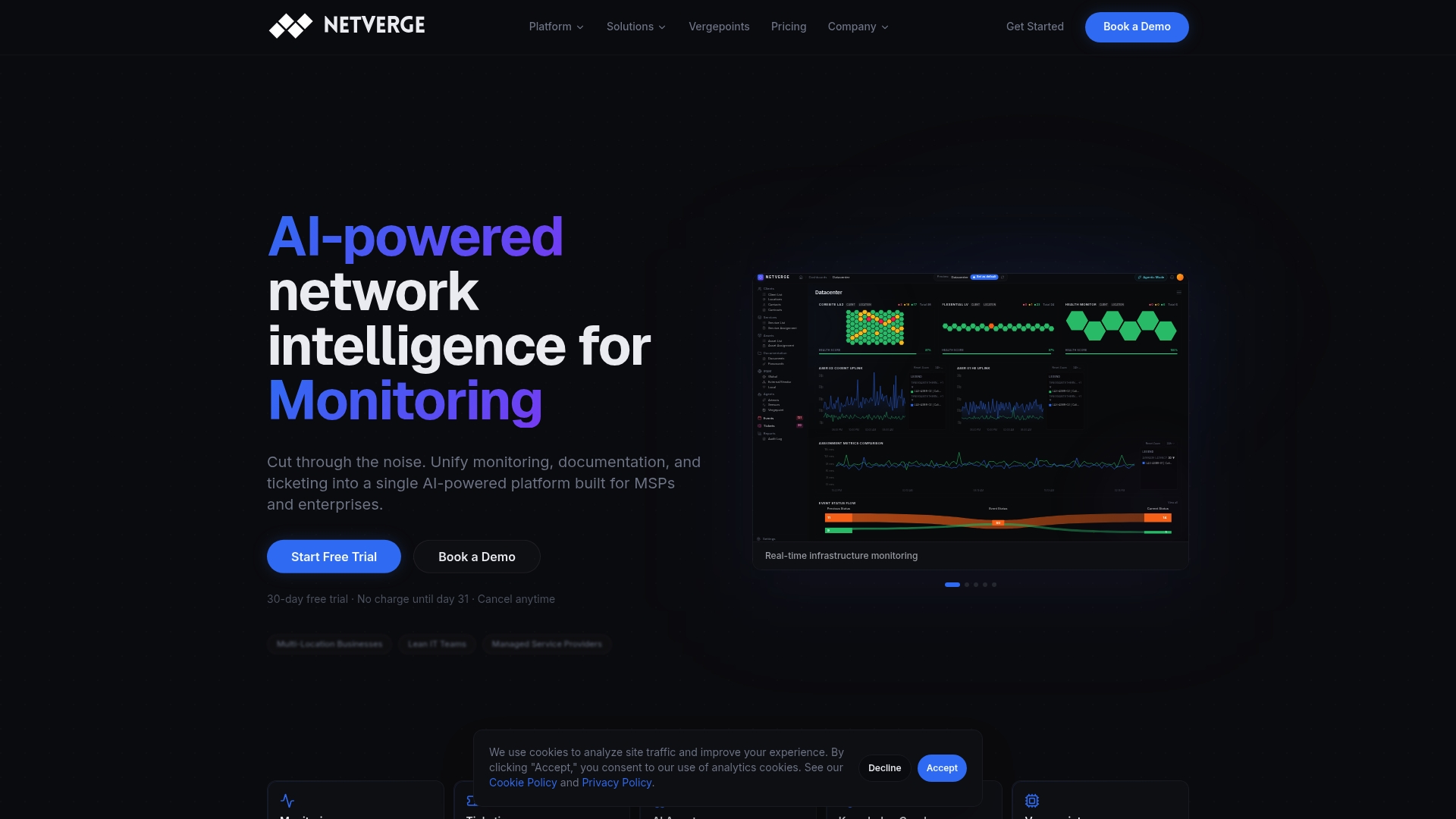
Netverge is built specifically for MSPs that need unified network visibility, AI-driven anomaly detection, and intelligent ticketing in a single platform. Rather than adding another disconnected tool to your stack, Netverge consolidates monitoring telemetry, documentation, and ticket triage into one interface. Its AI-powered network monitoring gives your team real-time infrastructure visibility across all client environments, while the AI-powered ticketing platform routes and triages incidents automatically, keeping SLA clocks accurate without manual intervention. If you are evaluating the best managed service tools for 2026, Netverge is worth a direct look.
FAQ
What are the four must-have MSP tool categories?
The four core categories are RMM, PSA, cybersecurity (EDR/XDR and SIEM), and backup and disaster recovery. These four layers support daily operations, incident response, and client data protection when properly integrated.
Why does RMM-PSA integration matter for SLA compliance?
Automated RMM-PSA workflows start SLA clocks the moment an alert fires, eliminating the manual ticket creation step that introduces delays and errors, especially during incident surges.
Which backup tools are best for MSPs in 2026?
Acronis Cyber Protect Cloud and Datto BCDR are the leading platforms, evaluated on ransomware resilience, immutable storage, automated recovery testing, and client-ready reporting rather than backup speed alone.
How should MSPs approach AI tool adoption?
AI and agentic tools must be embedded into existing PSA and ITSM systems to convert AI outputs into trackable work items. Deploying AI outside your core platforms creates shadow processes that reduce accountability.
How do I choose between EDR, XDR, and MDR for my clients?
EDR suits clients with high endpoint density, XDR fits multi-workload environments requiring cross-platform threat correlation, and MDR is the right choice for MSPs that lack in-house SOC capacity and need analyst-backed detection coverage.