
A network administrator installs, configures, and maintains an organization's LANs, WANs, and core network services — routers, switches, DNS, DHCP, VPNs, and the servers that tie them together. According to the U.S. Bureau of Labor Statistics, the median annual wage for this role was approximately $96,800, with the highest earners making significantly more. Most U.S. employers expect either a bachelor's degree in a computer-related field or a combination of certifications (CompTIA Network+, Cisco CCNA) plus 1–3 years of hands-on or help-desk experience. The O*NET occupational profile classifies this as a Job Zone Four role, meaning considerable preparation is expected before your first hiring.
Table of Contents
- What does a network administrator actually do day to day?
- Skills and tools every network admin needs in 2026
- How to become a network administrator in the U.S.
- Which certifications matter most for network admins?
- Where do network administrators work, and what are the hours like?
- U.S. salary ranges and job outlook for network administrators
- Landing the job: resume bullets, interview questions, and application tips
- How monitoring and automation are changing the role
- Key Takeaways
- What experienced network admins wish they had known sooner
- Authoritative sources and further reading
What does a network administrator actually do day to day?
The role splits cleanly into two layers: daily operations and strategic responsibilities. Both matter, but confusing them is how junior admins stall their careers.
Daily operational tasks include:
- Reviewing monitoring dashboards and alert queues at shift start
- Triaging tickets: port changes, VLAN assignments, VPN access requests
- DNS and DHCP maintenance (adding records, resolving lease conflicts)
- Running packet captures to diagnose latency or drop complaints
- Verifying overnight backup completion and log integrity
- Responding to automated alerts from network monitoring systems
Monthly and quarterly strategic work looks different. According to DevOpsSchool's role blueprint, strategic responsibilities include capacity planning, firmware and patch cycles, documentation reconciliation, and roadmap input. This is where you shift from fixing problems to preventing them.
A practical shift-start checklist for a mid-size enterprise admin:
- Check monitoring dashboard for overnight anomalies
- Review open tickets and prioritize by severity
- Confirm backup jobs completed successfully
- Scan firewall and syslog for unusual traffic patterns
- Process pending port/VLAN change requests
- Update the change log for any configuration edits made
Pro Tip: Every configuration change, no matter how small, belongs in the change log before you close the ticket. Undocumented changes are the single most common cause of extended outage troubleshooting — you will spend hours hunting a problem that a one-line note would have solved in minutes.
Skills and tools every network admin needs in 2026
Employers scan resumes for specific technical categories. Listing "networking skills" without named tools or protocols gets filtered out by ATS before a human sees it.

| Skill Category | What Employers Expect | Key Tools / Protocols |
|---|---|---|
| Routing & Switching | OSPF, BGP, STP, VLANs, inter-VLAN routing | Cisco IOS, Junos |
| Enterprise Wi-Fi | SSID design, RF planning, Wi-Fi 6/6E | Cisco, Aruba, Meraki |
| Network Services | DNS, DHCP, IPAM management | Windows DNS, ISC DHCP |
| VPNs & Remote Access | Site-to-site and client VPN configuration | IPsec, SSL/TLS, SD-WAN |
| Monitoring & Observability | Real-time telemetry, flow analysis, alerting | SNMP, NetFlow, syslog |
| Firewalls & Segmentation | ACL design, zone-based policy, NAC | Palo Alto, Cisco ASA |
| Automation & Scripting | Config templating, automated remediation | Ansible, Python/Netmiko |
Top ATS keywords for 2026 include Cisco IOS, VLAN, OSPF/BGP, Wi-Fi 6/6E, SD-WAN, Ansible, Python/Netmiko, and SolarWinds. Recruiters group these into 6–8 categories on a resume rather than a single comma-separated list.
Soft skills are equally decisive. Communication and problem-solving consistently separate admins who advance from those who plateau. You will explain a BGP route leak to a CFO and a fiber cut to a help-desk team in the same afternoon. The ability to translate technical facts into plain language is what gets you promoted to network engineer.
For an entry role, prioritize three technical skills first: subnetting and IP addressing, VLAN configuration on Cisco IOS, and basic firewall ACL management. Everything else builds on that foundation.
How to become a network administrator in the U.S.
Three realistic pathways exist, each with different timelines and costs.
Pathway 1: Degree first, then a junior role
- Complete a bachelor's degree in computer science, information technology, or network engineering (4 years, $40,000–$120,000+ depending on institution).
- Pursue CompTIA Network+ during your junior or senior year.
- Apply for entry-level titles: junior network administrator, IT support specialist, or network operations center (NOC) analyst.
- Expect 6–12 months to land a first role after graduation.
Pathway 2: Certification-first (self-study + lab)
- Study for and pass CompTIA Network+ (8–12 weeks of self-study, roughly $370 exam fee).
- Build a home lab using Cisco Packet Tracer or GNS3 (free) or physical used gear ($200–$500 on eBay).
- Add Cisco CCNA (12–16 weeks additional study, roughly $330 exam fee).
- Apply to NOC analyst or junior admin roles. Total timeline: 6–9 months. Total out-of-pocket: under $1,000 with free simulators.
Pathway 3: Help desk to network admin
- Start in a help-desk or desktop support role (no certs required for many positions).
- Study for Network+ and CCNA while employed, using employer tuition assistance where available.
- Request internal transfers to NOC or network team after 12–18 months.
- Total timeline to first network admin title: 2–3 years, often with minimal personal cost.
Hands-on lab practice — documented projects and incident recovery walkthroughs — accelerates hiring more than a certificate list alone. Build these specific lab scenarios and document them:
- Configure a multi-VLAN network with inter-VLAN routing and OSPF
- Set up a site-to-site VPN between two simulated branch offices
- Simulate a DHCP conflict and document your resolution steps
- Write a Python script using Netmiko to pull interface status from multiple devices
Hiring managers want to see that you have broken something and fixed it, not just passed an exam.
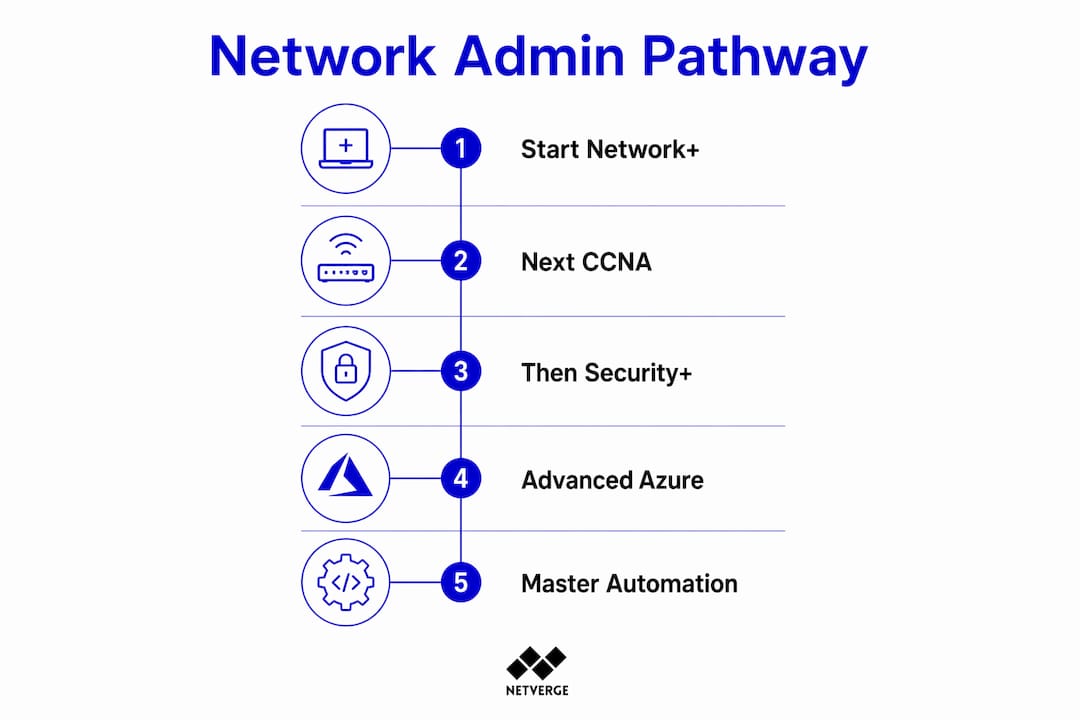
Which certifications matter most for network admins?
Certification sequencing affects both hireability and pay. The wrong order wastes months.
| Certification | Prep Time | Exam Cost (approx.) | When to Pursue |
|---|---|---|---|
| CompTIA Network+ | 8–12 weeks | ~$370 | First cert, before any vendor cert |
| Cisco CCNA | 12–16 weeks | ~$330 | After Network+; required for many roles |
| Cisco CCNP Enterprise | 6–12 months | roughly $370 exam fee | After 2–3 years of hands-on experience |
| Microsoft Certified: Azure Administrator | 8–12 weeks | — | When cloud networking is part of the role |
| CompTIA Security+ | 6–10 weeks | — | Pairs well with CCNA for security-adjacent roles |
| Palo Alto PCNSA | 8–12 weeks | — | For firewall-heavy or security specialist tracks |
Start with Network+ before pursuing Cisco credentials. The vendor-neutral foundation covers subnetting, OSI model, and protocol concepts that make CCNA material click faster. Skipping Network+ and jumping straight to CCNA is possible, but most self-study candidates report the conceptual gaps slow them down.
The CCNA is the practical floor for most U.S. network admin job postings. Many employers list it as required, not preferred. CCNP Enterprise signals senior-level readiness and often correlates with a meaningful salary bump.
Microsoft Certified: Azure Administrator Associate is increasingly relevant as organizations move workloads to hybrid cloud environments. If your target employer runs Azure or Microsoft 365, this cert pairs well with CCNA and differentiates you from candidates with only on-premises experience.
For security-adjacent roles, CompTIA Security+ is the fastest path to meeting DoD 8570 baseline requirements and is widely recognized in government and defense contracting environments.
Where do network administrators work, and what are the hours like?

The work environment varies significantly by employer type, and that variation affects everything from on-call frequency to remote flexibility.
Managed Service Providers (MSPs) expect admins to manage multiple client networks simultaneously. The pace is fast, the tool exposure is broad, and on-call rotations are common. MSP experience builds skills quickly, but burnout risk is real if on-call terms are not negotiated upfront.
Private enterprise IT departments typically focus on a single organization's network. The scope is narrower but the depth is greater. On-call is usually structured as a rotation among a team, and remote work options have expanded significantly since 2020.
Healthcare and education organizations often operate under strict compliance frameworks (HIPAA for healthcare, FERPA for education). Network segmentation, access control, and audit logging take on added weight. These environments tend to offer more stable hours but may pay below private-sector rates.
Government and defense roles frequently require security clearances (Secret or Top Secret/SCI). Clearance eligibility opens a separate salary tier and significantly narrows the candidate pool, which works in your favor if you qualify.
Most admins work full time, and the BLS notes that some work more than 40 hours per week. Evening, night, and weekend work happens when maintenance windows require taking systems offline during low-traffic periods. A typical on-call rotation in a mid-size enterprise runs one week in four, with an escalation path so you are not the only person a 3 AM alert reaches.
U.S. salary ranges and job outlook for network administrators
The 2024 median annual wage for network and computer systems administrators was $96,800. The lowest 10% earned less than $60,320; the highest 10% earned more than $150,320.
| Experience Level | Typical Annual Salary Range | Key Pay Drivers |
|---|---|---|
| Entry-level | — | Network+, CCNA, help-desk background |
| Mid-level (3–6 years) | — | CCNP, cloud skills, automation experience |
| Senior | $96,800 median; the highest earners make significantly more than this | CCNP/CCIE, security clearance, specialization |
Geography moves the needle considerably. Admins in the San Francisco Bay Area, Seattle, and the Washington D.C. metro corridor routinely earn 20–35% above the national median. States with lower costs of living, such as the Midwest and Southeast, tend to track closer to or below the median. Remote roles have partially decoupled pay from geography, though many employers still apply location-based adjustments.
Outlook note: The BLS projects a small decline in employment for this occupation from 2024 to 2034, driven partly by automation of routine tasks and growth in Networks-as-a-Service offerings. Despite that decline, numerous openings per year are still projected over the decade, primarily from workers retiring or moving into adjacent roles like network architect or IT manager.
Cloud skills and automation proficiency are the clearest hedge against that trend. Admins who can manage hybrid cloud networking and write Ansible playbooks are not the ones being replaced by automation; they are the ones running it.
Landing the job: resume bullets, interview questions, and application tips
Job titles to search
Entry-level: NOC Analyst, Junior Network Administrator, IT Support Specialist, LAN Administrator, Network Coordinator. Mid-to-senior: Network Administrator, Network Engineer, Senior Network Administrator, Network Operations Manager, IT Network Specialist.
Resume bullet examples
Weak bullets describe tasks. Strong bullets map tasks to outcomes and include protocol or tool names that ATS systems recognize.
- Weak: "Managed network equipment and resolved issues."
- Strong: "Administered 47-site WAN running OSPF and BGP; reduced mean time to resolution by standardizing a 6-step troubleshooting runbook."
- Strong: "Deployed Ansible playbooks to automate VLAN provisioning across 120 Cisco IOS switches, cutting manual configuration time from 4 hours to 22 minutes per change cycle."
- Strong: "Maintained DNS/DHCP infrastructure for 3,200-user environment; documented all IP allocations in IPAM, eliminating address conflicts over 18 months."
For a practical, layer-by-layer approach to structuring troubleshooting narratives on your resume, the Linux network troubleshooting guide at DevOps AI Toolkit is worth reviewing before your interviews.
Application checklist
- List certs in a dedicated section with exam dates (not just cert names).
- Include 6–8 grouped skill categories with specific tool names, not a single comma list.
- Link to a GitHub repo or lab documentation portfolio.
- Tailor the summary line to the employer type (MSP vs. enterprise vs. government).
- Verify that Cisco IOS, VLAN, OSPF/BGP, Ansible, and Python appear in your skills section.
- Remove generic phrases ("team player," "detail-oriented") and replace with protocol or tool references.
Sample interview questions and how to answer them
Technical: "Walk me through how you would troubleshoot a user who cannot reach a specific subnet." Structure your answer using OSI layers: confirm physical connectivity, check VLAN assignment, verify routing table, test DNS resolution, review firewall ACLs. Name the specific commands you would run (ping, traceroute, show ip route, show vlan brief).
Behavioral: "Describe a time you caused an outage and how you handled it." Use the STAR format (Situation, Task, Action, Result). Be specific about what you changed, how you identified the cause, and what documentation or process change you put in place afterward. Hiring managers are not looking for perfection; they are looking for accountability and learning.
Scenario: "Our DHCP server is handing out addresses in the wrong scope. What do you do?" Walk through scope verification, check for rogue DHCP servers with DHCP snooping logs, confirm relay agent configuration on the router, and describe how you would document the fix.
How monitoring and automation are changing the role
The shift from reactive break-fix to proactive network management is well underway. Automation and unified observability reduce manual ticket volume and centralize visibility across distributed infrastructure, according to DevOpsSchool's analysis of how the role is evolving.
Before automation tooling became accessible, a mid-size enterprise admin might spend 60–70% of a shift on reactive tickets: password resets, port bounces, DHCP conflicts, and VPN access requests. With Ansible playbooks handling routine provisioning and a unified monitoring platform surfacing anomalies before users notice them, that same admin can redirect time toward capacity planning, security posture reviews, and infrastructure documentation.
The skills that rise in value as a result:
- Observability: reading telemetry, correlating alerts across layers, building meaningful dashboards
- Scripting: Python with Netmiko for device interaction, Ansible for config management
- Runbook discipline: writing and maintaining runbooks so any team member can execute a recovery without tribal knowledge
- Documentation hygiene: reconciling live topology against discovery tool output to eliminate ghost assets
Ansible network automation for switches and routers is one of the most practical skills to add in 2026. Platforms like Netverge consolidate telemetry, automated triage, and documentation into a single interface, which means admins who understand what those platforms are doing under the hood are far more effective than those who treat them as black boxes. Integrated dashboards that correlate events across the network layer are covered in depth in Netverge's guide to network dashboards.
Key Takeaways
Becoming a network administrator in the U.S. requires a clear certification sequence, hands-on lab practice, and documented operational experience — not just a degree.
| Point | Details |
|---|---|
| Median salary is around $96,800 | BLS data shows the highest earners make significantly more than this, especially with certifications, cloud skills, or clearance. |
| Start with Network+, then CCNA | Vendor-neutral foundation first accelerates CCNA study and satisfies most entry-level job requirements. |
| Lab projects beat cert lists | Documented lab scenarios (OSPF, VPN, Python/Netmiko) differentiate candidates more than exam badges alone. |
| Automation skills are the hedge | Admins who run Ansible and read telemetry are not replaced by automation; they operate it. |
| 14,300 openings projected yearly | Despite a 4% employment decline, annual openings persist from retirements and role transitions. |
What experienced network admins wish they had known sooner
The conventional advice for breaking into this field focuses almost entirely on certifications. Pass Network+, get your CCNA, land a job. That sequence is correct, but it leaves out the parts that actually determine whether you advance.
Documentation is not a soft skill. It is a technical discipline. Admins who treat the change log as optional spend their careers re-solving the same problems. The ones who document every config change, every IP allocation decision, and every incident resolution build institutional knowledge that makes them indispensable. When you are the only person who knows why a particular VLAN exists, that is not job security; it is a liability for you and your team.
On the career path from admin to network engineer or architect: the transition happens faster when you volunteer for projects outside your current scope. Ask to sit in on capacity planning meetings. Offer to document the network topology. Write the first draft of a change management procedure. These are not glamorous tasks, but they are how you demonstrate readiness for the next level before you have the title.
On-call burnout is real and underestimated. Before accepting a role, ask specifically: How many people share the on-call rotation? What is the escalation path? Is there a separate on-call stipend? A one-in-four rotation with a clear escalation path is manageable. A one-in-two rotation with no escalation is a different job entirely, and you should price it accordingly.
Finally: communication skills compound over time in a way that technical skills do not. A senior admin who can explain a network outage to a non-technical executive, run a calm incident bridge, and write a clear post-mortem will always have options. The technical floor gets you hired; the communication ceiling determines how far you go.
Authoritative sources and further reading
- U.S. Bureau of Labor Statistics — Occupational Outlook Handbook: Network and Computer Systems Administrators — primary source for salary, employment figures, and job outlook.
- O*NET Online: 15-1244.00 Network and Computer Systems Administrators — detailed task lists, knowledge requirements, and skill ratings.
- CompTIA: comptia.org — Network+ and Security+ exam objectives, pricing, and study resources.
- Cisco Learning Network: learningnetwork.cisco.com — CCNA and CCNP exam blueprints, Packet Tracer download, and community forums.
- Microsoft Learn: learn.microsoft.com — Azure Administrator Associate (AZ-104) study paths and free sandbox labs.
- Netverge monitoring platform: Real-time network monitoring guide — practical alerting and telemetry configuration guidance for working admins.
- Netverge network troubleshooting guide: Step-by-step network troubleshooting for IT pros — structured methodology for diagnosing and resolving common network issues.