NETCONF vs SNMP: Differences, Use Cases and When to Use Each
Published
- netconf vs snmp
- snmp vs netconf

NETCONF and SNMP solve different problems. NETCONF is built for configuration: it changes device settings through structured, validated transactions. SNMP is built for broad monitoring: it polls counters and receives alerts from almost any device. Most real networks need both, because a mixed estate cannot rely on NETCONF alone. This guide compares them on the points that matter in daily operations and shows how to decide which one to use where.
TL;DR
- NETCONF is an IETF protocol for installing, changing and deleting device configuration. It uses YANG data models and XML, usually over SSH.
- SNMP uses MIB modules and a manager/agent model over UDP. It remains the common language for reading counters and receiving traps across legacy and modern hardware.
- NETCONF gives you transactions, validation and all-or-none behavior. SNMP SET operations do not offer the same model.
- Use NETCONF where vendors ship good YANG models. Use SNMP for broad coverage. Run both in a mixed estate.
- If you use SNMP, use SNMPv3 with authentication and encryption, and keep management traffic on a separate network where you can.
Table of Contents
- What NETCONF and SNMP are
- NETCONF vs SNMP at a glance
- Configuration: where NETCONF is stronger
- Monitoring: where SNMP still leads
- Data models: MIB vs YANG
- Transport and ports
- Security considerations
- Device support and what to check first
- Which one should you use?
- Perspective
- See it on your own network
- Common mistakes when comparing the two
- FAQ
- Sources
What NETCONF and SNMP are
SNMP, the Simple Network Management Protocol, is an application-layer protocol. TechTarget describes it as a common language that lets routers, servers, printers and other devices share information with a network management system. A manager polls agents on the devices, and agents can send unsolicited notifications (traps) when something changes.
NETCONF, the Network Configuration Protocol, is an IETF network management protocol. AWS defines it as a protocol for installing, updating and deleting network device configurations, using XML encoding and commonly running over secure transports such as SSH. It was designed around configuration, though it can also retrieve operational state.

The IEEE 802 tutorial for SNMP developers frames the split clearly. SNMP uses SMIv2 and MIB modules, runs over UDP, and relies on manager/agent request-response operations and notifications. NETCONF uses YANG data models and XML over SSH, and works on datastores rather than on individual variables.
NETCONF vs SNMP at a glance
| Criterion | SNMP | NETCONF |
|---|---|---|
| Main job | Monitoring: counters, status, traps | Configuration management, plus state retrieval |
| Data model | SMIv2 / MIB modules | YANG models |
| Encoding | BER-encoded variable bindings | XML |
| Transport | UDP (ports 161 and 162) | SSH, typically TCP port 830 |
| Typical operations | Get, GetNext, GetBulk, Set, Trap | get, get-config, edit-config, copy-config |
| Transactions | No transaction model; SET applies varbinds | Datastore validation, all-or-none behavior |
| Device support | Near-universal | Strongest on modern, programmable gear |
| Security options | SNMPv3 authPriv | SSH-based sessions |
The sections below explain each row.
Configuration: where NETCONF is stronger
Configuration is the clearest dividing line. The IEEE tutorial contrasts SNMP operations such as Get, Set, GetNext and GetBulk with NETCONF RPCs such as edit-config and copy-config. It also states that NETCONF provides datastore-based validation and all-or-none transaction behavior, while SNMP applies SET operations through variable bindings and lacks the same transaction model.

In practice, that difference shows up when you push a change that touches several parameters. With NETCONF, the change can be validated against the candidate or running datastore and applied as a unit. With SNMP, you set variables and have to handle partial success yourself. That is one reason many teams treat SNMP as a read channel and keep writes for NETCONF or another model-driven interface.
An academic paper on protocol efficiency argues the same point from the carrier side: SNMP no longer scales efficiently for many management functions such as configuration in complex service provider environments, and protocols such as NETCONF were designed to overcome its limitations.
What a NETCONF change looks like
A typical automated change follows a short sequence:
- Open an SSH session to the device on the NETCONF port.
- Exchange capabilities so both sides know which YANG models the device supports.
- Send an edit-config request against the candidate or running datastore.
- Validate and commit, or discard if validation fails.
Because the payload follows a YANG model, the same request structure can work across devices that implement the same model. That is the main appeal for automation.
Monitoring: where SNMP still leads
SNMP is not obsolete. TechTarget reports that SNMP remains relevant for device discovery, configuration monitoring, fault detection and performance trending across routers, switches, servers and IoT devices. It is also widely supported across routers, switches, wireless access points, printers, scanners and IoT devices, which makes it useful for broad infrastructure monitoring.
An independent comparison notes that NETCONF has not displaced SNMP for reading counters, and was never meant to. If your job is to graph interface utilization on a hundred switches, a UPS and a few printers, SNMP is still the lowest-friction path.
The interaction model differs too. The same comparison describes NETCONF as request-response by design and SNMP as polling-based. In day-to-day monitoring, that means SNMP pollers hit devices on a schedule, while traps add event-driven alerts on top.
Data models: MIB vs YANG
MIBs describe managed objects as a tree of identifiers (OIDs). They are compact and widely implemented, but vendor-specific MIBs vary in quality, and mapping them to configuration intent is often manual work.
YANG models describe configuration and state as structured hierarchies with types, constraints and relationships. According to the IEEE tutorial, NETCONF and SNMP can expose related management information, but NETCONF with YANG is better suited to modern configuration workflows because it adds structured data modeling, explicit transactions, validation and rollback-oriented behavior.
The catch is model quality. NETCONF adoption is strongest where vendors provide good YANG models. Where they do not, you end up writing vendor-specific handling, which reduces the advantage.
Transport and ports
SNMP commonly uses UDP port 161 for requests and 162 for traps. CISA's guidance on router hygiene lists UDP 161 and 162 for SNMP, and associates SNMPv3 with ports 10161 and 10162. UDP keeps overhead low, which suits high-volume polling, but it means no built-in session.
NETCONF over SSH typically defaults to TCP port 830, which is the IANA-assigned port for this service. A firewall rule set for management traffic needs to account for both if you run both.
Security considerations
Both protocols are only as safe as their configuration.
For SNMP, CISA recommends using SNMPv3 with authPriv, preferably on an out-of-band management network, and restricting access to SNMP OIDs with a MIB allow list. In plain terms:
- Use SNMPv3 with both authentication and encryption (authPriv), not community strings.
- Keep SNMP traffic on a dedicated management network.
- Limit which OIDs a monitoring account can read.
For NETCONF, the SSH transport gives you encrypted sessions and standard key or credential management. Apply the same discipline you apply to any administrative SSH access: named accounts, least-privilege roles, and logging of who changed what. If you manage many customer networks, per-tenant separation of credentials matters even more. Netverge describes its approach on its Security and Trust page.
Device support and what to check first
Before committing to either protocol, check three things.
- Does the device support it? SNMP has near-universal support across legacy and modern hardware, including switches, routers, printers and UPS units. NETCONF adoption is strongest in modern, programmable equipment from large network vendors.
- Are the YANG models good? NETCONF is only as useful as the models behind it. Adoption is patchy, so test the specific platform and software version you run.
- What does the monitoring need? If it needs counters and status from every device type, SNMP covers it. If it needs safe, auditable changes, NETCONF covers it where available.
This is also where procurement language matters. When you write scope for multi-provider network support across mixed-vendor environments, stating which management protocols each device class must support avoids surprises later.
Which one should you use?
The decision is rarely either/or. Use this as a starting point.
| Situation | Better fit |
|---|---|
| Polling interface counters and CPU on mixed hardware | SNMP |
| Printers, UPS units, access points, IoT devices | SNMP |
| Pushing validated config changes to modern routers and switches | NETCONF |
| Automating changes with rollback-oriented workflows | NETCONF |
| Legacy devices alongside new platforms | Both |
| Event alerts from older gear | SNMP traps |
If you also weigh HTTP-based options, our comparison of NETCONF and RESTCONF covers rollback and API trade-offs for network engineers.
A practical pattern for mixed estates
A workable approach for MSPs and multi-site teams:
- Use SNMP (v3 wherever possible) as the baseline for discovery, inventory and performance trending on every device.
- Use NETCONF for configuration changes on platforms with solid YANG support.
- Keep CLI or vendor APIs as a fallback for devices that support neither well.
- Feed everything into one monitoring and documentation view so the protocol mix does not fragment your operations.
The last point is where many teams lose time. Separate tools for polling, configuration and documentation mean separate alert streams and separate records. Our guides on key features of network management and infrastructure monitoring strategies explain how to structure that consolidation.
Perspective
Most teams we talk to do not have a protocol problem. They have a visibility problem. The protocol is a means of getting data off a device, and the real work starts after: correlating that data, deciding what matters, and acting on it before a customer notices.
SNMP and NETCONF both feed that work. SNMP gives you reach across everything on the network. NETCONF gives you a safer way to change what you manage. Neither alone replaces a platform that puts monitoring, documentation, ticketing and automation in one place.
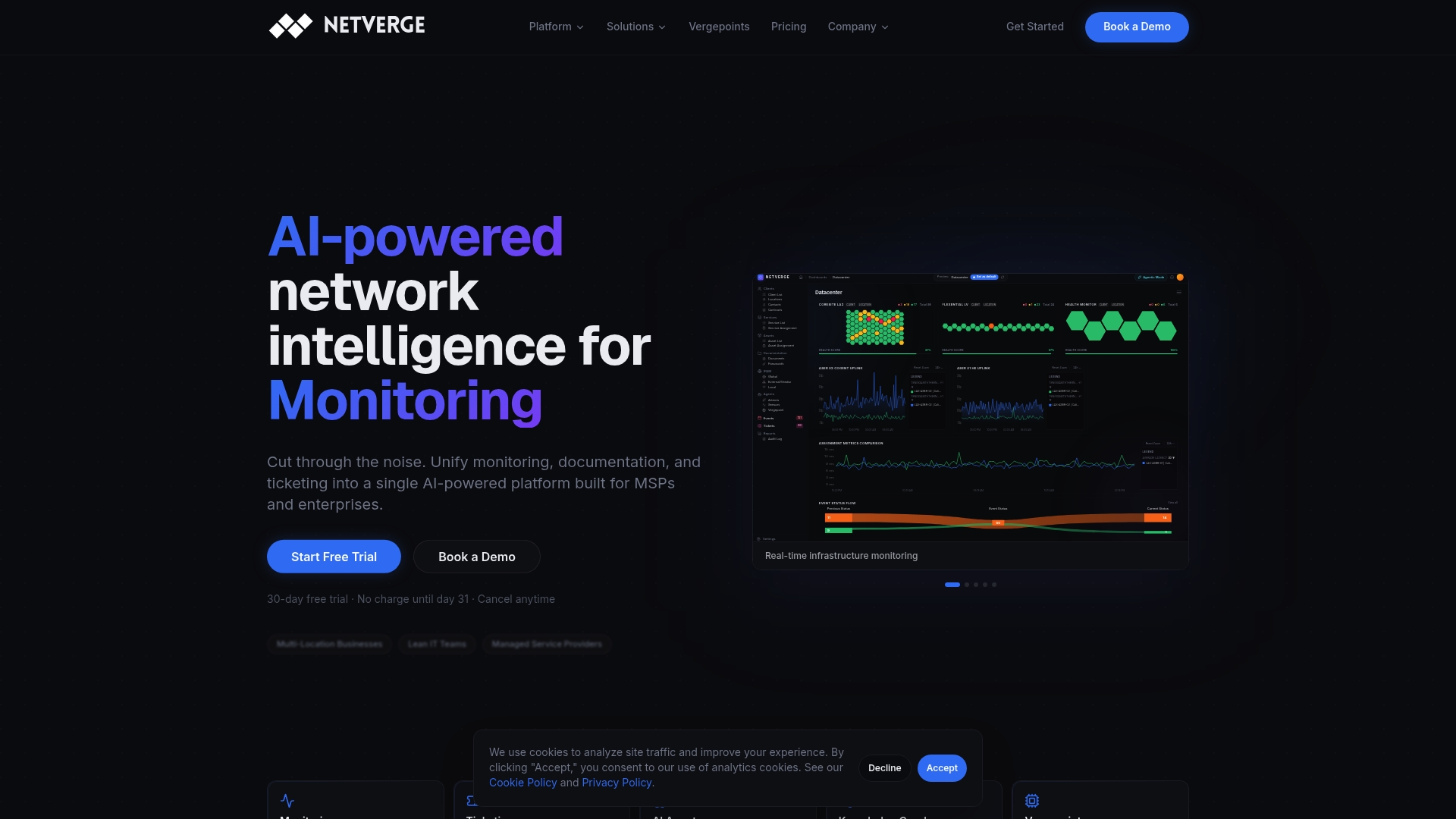
That is how we built Netverge. We designed it to unify network visibility, documentation and ticketing, and to add AI agents that help diagnose issues and triage tickets. Our Vergepoints add on-site visibility at each location, so distributed networks are not a collection of blind spots. Our aim is fewer disconnected tools, less alert noise and faster resolution for MSPs and multi-site IT teams.
If you manage a mixed estate, choose protocols per device class, then make sure the data lands in one place. That is where the time savings come from.
Jim
See it on your own network
Netverge brings monitoring, documentation, ticketing and AI-assisted automation into one platform for MSPs and multi-location enterprises. The Starter Package is $299 per month on our pricing page. Hardware Vergepoints are $49 per month per device, and Software Vergepoints are $29 per month per Vergepoint. Extra capacity, such as 100 additional monitoring sensors, is $100 per month per 100 sensors. Details are in the pricing guide.
To estimate your monthly cost, use the pricing calculator. To see how the platform handles your sites, start your free trial or read about our AI-powered network monitoring and enterprise capabilities.
Common mistakes when comparing the two
Treating NETCONF as a monitoring replacement. It can retrieve state, but it was designed for configuration. Counter polling across a mixed estate still leans on SNMP.
Leaving SNMP on defaults. Community strings and open access are a common weakness. Move to SNMPv3 with authPriv and restrict what each account can read.
Assuming every vendor models equally well. NETCONF value depends on YANG model coverage for your exact platforms and software versions.
Ignoring terminology gaps in the team. Engineers who know MIBs and OIDs often meet YANG, RPCs and datastores for the first time. Our network management terminology guide helps align the vocabulary.
Forgetting the physical layer. Protocols only report what devices expose. Edge hardware that observes the network directly adds a second view; see how hardware-driven monitoring works for MSPs and enterprises.
FAQ
Is SNMP still relevant?
Yes. SNMP remains in wide use for device discovery, fault detection and performance trending across routers, switches, servers and IoT devices, according to TechTarget. Its near-universal device support is the main reason. Newer protocols complement it rather than replace it.
Does SNMP use UDP?
Yes. SNMP commonly uses UDP port 161 for requests and port 162 for traps, as listed in CISA's guidance. NETCONF, by contrast, runs over SSH, typically on TCP port 830.
Can NETCONF replace SNMP?
Not fully in a mixed estate. NETCONF is strongest on modern, programmable devices with good YANG models, while SNMP covers legacy and modern hardware alike. Most teams use NETCONF for configuration and SNMP for broad monitoring.
Which is more secure, NETCONF or SNMP?
Security depends on configuration. For SNMP, CISA recommends SNMPv3 with authPriv, ideally on an out-of-band management network, with a MIB allow list. NETCONF sessions run over SSH, so standard SSH access controls apply.
Sources
- A Guide to NETCONF for SNMP Developers (IEEE 802 tutorial)
- What is Simple Network Management Protocol (SNMP)? (TechTarget)
- Why SNMP remains relevant in enterprise network management (TechTarget)
- What is NETCONF? (AWS)
- RFC 6242: Using the NETCONF Protocol over Secure Shell
- Protocol Efficiencies of NETCONF versus SNMP
- NETCONF vs SNMP: Network Management Protocols Comparison
- CISA advisory AA26-194A: Improve Router Hygiene