
Industry terminology in network management is the standardized vocabulary of terms, acronyms, and concepts that IT professionals use to describe, configure, monitor, and secure networks with precision. Mastering this vocabulary is not optional for network engineers, IT managers, or MSP technicians. Standardized terminology reduces misinterpretation and speeds incident resolution by 20 to 30% in complex environments. That gap matters when a P1 outage is active and your team needs to communicate without ambiguity. This guide covers the core categories of networking vocabulary, clarifies the most commonly confused term pairs, and explains the modern protocols and emerging concepts reshaping how professionals talk about network operations.
What is industry terminology in network management?
Industry terminology in network management spans four functional domains: Monitoring and Performance, Architecture and Topology, Automation and Programmability, and Security and Access Control. Each domain carries its own vocabulary, and professionals who operate across all four need fluency in each. The terms are not interchangeable across domains, and using the wrong word in the wrong context creates real operational risk.
Monitoring and performance terms
Network Performance Management (NPM) is the practice of collecting, analyzing, and acting on metrics that describe how traffic flows across infrastructure. The three metrics that appear most often in NPM discussions are latency (the time a packet takes to travel from source to destination), jitter (the variation in that latency over time), and packet loss (the percentage of packets that never arrive). High jitter above 30ms degrades VoIP calls even when average latency looks acceptable. Understanding the difference between these three metrics prevents misdiagnosis during performance incidents. For a deeper look at how these metrics fit into a structured workflow, the network performance management workflow guide from Netverge covers measurement, baselining, and escalation in practical terms.

Architecture and topology terms
SD-WAN (Software-Defined Wide Area Network) separates the control plane from the data plane, allowing centralized policy management across distributed sites. SASE (Secure Access Service Edge) extends SD-WAN by converging networking and security functions into a single cloud-delivered service. Microsegmentation divides a network into isolated zones at the workload level, limiting lateral movement if a breach occurs. These three terms are frequently used together but describe distinct architectural layers. The network topology architecture guide from Netverge explains how SD-WAN, SASE, and microsegmentation interact in enterprise deployments.
Automation, programmability, and security terms
- Intent-Based Networking (IBN): Administrators define the desired network state in plain language; the system enforces it automatically. IBN shifts management from imperative commands to declarative goals, enabling scaling without proportional headcount growth.
- Infrastructure as Code (IaC): Declarative provisioning of cloud and compute resources using version-controlled configuration files, typically with tools like Terraform or Ansible.
- YANG models: A data modeling language that defines the structure of network configuration and state data in a machine-readable format, used with NETCONF and RESTCONF.
- Zero Trust: A security model that treats every user and device as untrusted by default, requiring continuous verification regardless of network location.
- Network Access Control (NAC): A framework that enforces policy-based access decisions at the point of network entry, often integrating with identity providers.
- Identity-based networking: Access decisions driven by user or device identity rather than IP address or VLAN membership.
Pro Tip: When onboarding new team members, create a one-page domain glossary for each of these four categories. Teams that align on vocabulary before a project starts resolve configuration disputes faster than those that define terms mid-incident.
How do commonly confused network terms differ?
Precise communication breaks down most often around term pairs that sound similar but carry distinct operational meanings. Mixing them up does not just cause confusion. It causes wrong decisions.
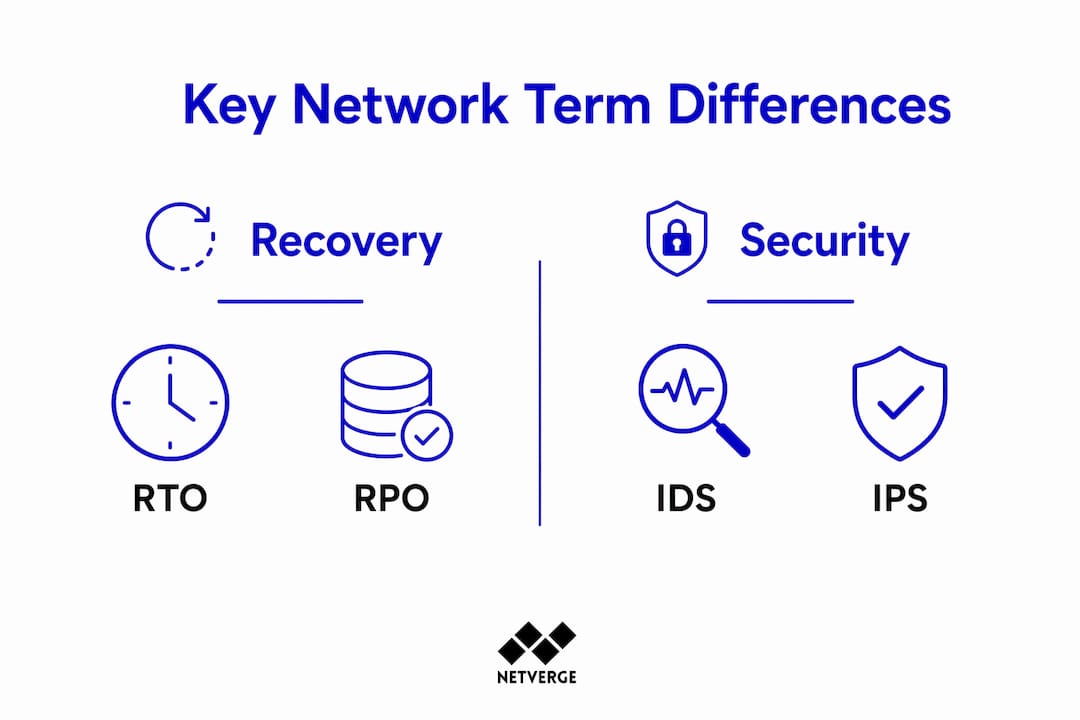
RTO vs. RPO
RTO defines the maximum acceptable time to restore a service after failure. RPO defines the maximum tolerable data loss window, measured in time. RTO answers "how fast must we recover?" RPO answers "how much data can we afford to lose?" A financial services firm might set an RTO of 4 hours and an RPO of 15 minutes, meaning the service must be back within 4 hours and no more than 15 minutes of transactions can be lost. Confusing the two leads to SLA commitments that are technically impossible to meet with the backup infrastructure in place.
IDS vs. IPS
An Intrusion Detection System (IDS) monitors traffic and generates alerts when it detects suspicious patterns. An Intrusion Prevention System (IPS) sits inline and actively blocks traffic that matches threat signatures. The distinction is passive observation versus active intervention. Deploying an IDS when the requirement calls for an IPS leaves threats unblocked. Deploying an IPS incorrectly tuned creates false positives that block legitimate traffic.
VLAN vs. subnet
A VLAN operates at Layer 2 and creates logical broadcast domain separation within a switch fabric. A subnet operates at Layer 3 and defines an IP address range for routing purposes. A single VLAN can contain multiple subnets, and a single subnet can span multiple VLANs in some configurations. Treating them as synonyms causes routing misconfigurations that are notoriously difficult to trace.
Automation vs. orchestration
Network automation executes individual tasks; orchestration coordinates multiple automated tasks into end-to-end workflows. Backing up a device configuration is automation. Provisioning a new branch site by triggering backup, VLAN creation, routing updates, and firewall rule deployment in sequence is orchestration. Confusing these two concepts produces brittle, fragmented operations where tasks run in isolation without coordinated outcomes.
Fault, problem, and incident
Per RFC 9940, these three terms carry distinct meanings in fault management. A fault is a physical or logical defect in a network element. A problem is the underlying cause of one or more faults. An incident is a service disruption experienced by users. A failed SFP module is a fault. The pattern of failing modules from the same vendor batch is a problem. The VoIP outage users report is an incident. Mixing these terms in tickets and postmortems blurs root cause analysis and delays resolution.
| Term pair | Key distinction | Operational risk of confusion |
|---|---|---|
| RTO vs. RPO | Recovery time vs. data loss tolerance | Unachievable SLA commitments |
| IDS vs. IPS | Detection only vs. active blocking | Threats left unblocked |
| VLAN vs. subnet | Layer 2 boundary vs. Layer 3 range | Routing misconfigurations |
| Automation vs. orchestration | Single task vs. coordinated workflow | Fragmented, brittle pipelines |
| Fault vs. incident | Defect vs. service disruption | Delayed root cause analysis |
Pro Tip: Build a shared team glossary in your documentation system and require engineers to link to it when writing runbooks. Ambiguous terms in runbooks are one of the most common causes of incorrect responses during high-pressure incidents.
What protocols and models define network management communication?
Modern network management has moved away from manual CLI parsing toward model-driven management, where YANG data models standardize network configuration and state in a machine-readable format. YANG defines what data exists and how it is structured. The protocols below define how that data is transported and acted upon.
NETCONF and RESTCONF
NETCONF is a transaction-safe protocol that uses XML over SSH to read and write device configuration. Its transactional model means a configuration change either completes fully or rolls back entirely, preventing partial states. RESTCONF is an HTTP-based alternative that exposes YANG-modeled data through REST APIs. NETCONF offers transactional safety; RESTCONF offers simpler integration for teams already working with web APIs but without the same rollback guarantees. Choose NETCONF when configuration integrity is the priority. Choose RESTCONF when integration speed and developer familiarity matter more.
gNMI and streaming telemetry
gNMI (gRPC Network Management Interface) is a protocol for collecting real-time telemetry from network devices using a push model. Unlike SNMP polling, which requests data at fixed intervals, gNMI streams data continuously as state changes occur. This makes gNMI the preferred protocol for modern observability platforms that need sub-second visibility into interface counters, CPU utilization, and routing table changes.
Management layers and API directions
The ITU-T M.3010 management model separates network management into four layers: Element, Network, Service, and Business. Southbound APIs control devices from the management layer above. Northbound APIs expose data upward to orchestration systems, OSS/BSS platforms, or AI engines. Understanding which direction an API faces is critical when integrating monitoring tools, automation platforms, and ticketing systems. A southbound API misconfiguration pushes bad commands to devices. A northbound API misconfiguration corrupts the data your orchestration layer acts on.
| Protocol | Transport | Primary use | Key trade-off |
|---|---|---|---|
| NETCONF | XML over SSH | Configuration management | Transactional safety vs. complexity |
| RESTCONF | HTTP/HTTPS | REST-based config access | Simplicity vs. no rollback |
| gNMI | gRPC | Streaming telemetry | Real-time data vs. higher resource use |
| SNMP | UDP | Legacy polling | Wide support vs. slow and stateless |
What emerging terms are reshaping network operations?
The newest layer of technical language for network management comes from the convergence of software engineering practices with network operations. These terms are frequently misused, and the misuse has real consequences for how teams structure automation pipelines and hire talent.
- Infrastructure as Code (IaC) vs. Network as Code (NaC): IaC focuses on declarative provisioning of cloud and compute resources. NaC applies software engineering discipline, including version control, testing, and CI/CD pipelines, to physical and virtual network configuration. The two overlap but are not synonyms. Treating NaC as just "IaC for networks" misses the operational rigor NaC requires.
- NetDevOps: The application of DevOps principles, including collaboration, automation, and continuous delivery, to network engineering workflows. NetDevOps teams use tools like Git, Jenkins, and Pytest to manage network changes the same way software teams manage code releases.
- GitOps: A specific implementation of NetDevOps where Git repositories serve as the single source of truth for network state. Every configuration change is a pull request. Every deployment is a merge. Drift from the declared state triggers automated remediation.
- Intent-Based Networking (IBN): IBN is the declarative end state of network management evolution. Rather than writing CLI commands or even configuration files, administrators express business intent and the system translates it into device configuration. The shift from imperative to declarative management is the defining characteristic of IBN.
The terminology wars between IaC, NaC, NetDevOps, and GitOps are real. Teams that conflate them end up with misaligned expectations between network engineers, DevOps teams, and management. Precise definitions at the project kickoff stage prevent months of rework. For practical examples of how these concepts apply in AI-driven environments, the AI-powered network management examples resource from Netverge is worth reviewing.
Key takeaways
Mastering industry terminology in network management is the foundation for accurate incident response, effective automation, and productive collaboration across engineering, operations, and vendor teams.
| Point | Details |
|---|---|
| Four core domains | Monitoring, architecture, automation, and security each carry distinct, non-interchangeable vocabulary. |
| Term pairs cause real risk | Confusing RTO/RPO, IDS/IPS, or fault/incident leads to wrong decisions under pressure. |
| Protocols define data exchange | NETCONF, RESTCONF, and gNMI each serve different use cases; choosing the wrong one creates integration gaps. |
| Emerging terms need precision | IaC, NaC, NetDevOps, and GitOps overlap but are not synonyms; misuse misaligns team expectations. |
| Shared glossaries accelerate ops | Teams that standardize vocabulary before projects start resolve incidents and configuration disputes faster. |
Why terminology precision is the most underrated operational skill
I have spent years watching network incidents drag on longer than they should, and the root cause is rarely the technology. It is the language. Two engineers on a bridge call using "incident" and "fault" interchangeably while a third is trying to isolate the actual defect. A project kickoff where "automation" and "orchestration" are used as synonyms, leading to a pipeline that executes tasks in parallel when they needed to be sequential. These are not edge cases. They happen on experienced teams at well-funded organizations.
The uncomfortable truth is that most networking professionals learn terminology organically, picking up terms from colleagues, vendor documentation, and certifications that do not always agree with each other. Cisco's vocabulary, Juniper's vocabulary, and the IETF's vocabulary for the same concept are sometimes different. RFC 9940 defines fault, problem, and incident with precision. Most teams have never read it.
My advice is direct: treat your team's shared vocabulary as infrastructure. Document it, version it, and review it when you onboard new tools or vendors. The teams I have seen operate most effectively under pressure are the ones where every engineer uses the same word for the same thing. That consistency is not a soft skill. It is an operational asset that compounds over time, especially as you add automation and AI-driven tooling that depends on structured, unambiguous data to function correctly.
— Jim
How Netverge operationalizes network management terminology
Netverge is built on the same structured vocabulary this article covers. The platform's AI-powered monitoring maps telemetry data to standardized metrics including latency, jitter, packet loss, and anomaly scores, giving your team a shared, unambiguous view of network state. Autonomous AI agents use the same fault, problem, and incident distinctions from RFC 9940 to triage tickets accurately and route issues to the right team without manual interpretation. For MSPs and multi-location enterprises managing distributed infrastructure, Netverge's enterprise network automation platform translates intent-based policies into device configuration across your entire estate. Start a free trial or request a demo to see how standardized terminology and AI-driven operations work together in practice.
FAQ
What is industry terminology in network management?
Industry terminology in network management is the standardized set of terms, acronyms, and definitions used by IT professionals to describe network components, metrics, protocols, and architectures. Consistent use of this vocabulary reduces misinterpretation and speeds incident resolution across teams.
What is the difference between RTO and RPO?
RTO (Recovery Time Objective) defines the maximum acceptable time to restore a service after failure. RPO (Recovery Point Objective) defines the maximum tolerable data loss window, measured in time before the failure event.
How does network automation differ from orchestration?
Network automation executes individual tasks such as backing up a configuration or pushing a VLAN change. Orchestration coordinates multiple automated tasks into end-to-end workflows, such as provisioning an entire branch site across multiple systems in sequence.
What are NETCONF, RESTCONF, and gNMI used for?
NETCONF and RESTCONF are protocols for reading and writing device configuration using YANG data models, with NETCONF offering transactional safety and RESTCONF offering simpler HTTP-based integration. gNMI is used for streaming real-time telemetry from network devices using a push model.
What is the difference between a fault, a problem, and an incident?
Per RFC 9940, a fault is a physical or logical defect in a network element, a problem is the underlying cause of one or more faults, and an incident is the service disruption experienced by users. Keeping these definitions separate is critical for accurate root cause analysis and ticket routing.