
Network downtime is defined as any period when a network or its services become unavailable to users, and the common causes of network downtime fall into five clear categories: hardware failures, power disruptions, software and configuration errors, human mistakes, and cybersecurity threats. Networking and connectivity issues cause 23% of IT service outages, with power failures close behind at 21%. The financial stakes are severe. 57% of organizations report major outage costs exceeding $100,000, and 20% experience impacts over $1 million. Understanding each root cause is the first step toward building a network that holds up under real-world pressure.
1. Common causes of network downtime: hardware failures
Physical equipment failure is one of the most direct reasons for network outages. Routers, switches, network interface cards, and uninterruptible power supply units all degrade over time. When a core switch fails without a redundant path in place, the entire segment it serves goes dark.

Environmental factors accelerate hardware failure significantly. Overheating from inadequate airflow, dust accumulation on cooling fans, and operating equipment beyond its rated temperature range all shorten device lifespan. A switch running at 95°F in a poorly ventilated closet will fail years ahead of schedule.
Effective mitigation requires a structured approach:
- Schedule quarterly physical inspections of all network hardware
- Monitor device temperature and fan speed through SNMP telemetry
- Maintain hot-spare units for critical devices such as core routers and switches
- Replace end-of-life equipment before vendor support expires
- Apply proactive network maintenance practices to catch degradation early
Pro Tip: Set automated alerts for CPU and memory utilization thresholds on network devices. Sustained utilization above 80% is a reliable early warning sign of impending hardware stress.
Packet loss, WAN congestion, and bandwidth saturation often precede full hardware failures. These intermittent symptoms are easy to dismiss but consistently signal that a device is struggling before it stops responding entirely.
2. Power-related outages and how to safeguard your infrastructure
Power remains the leading cause of impactful outages, with UPS systems and generators frequently implicated. Grid instability, UPS battery failures, and generator fuel exhaustion each represent a distinct failure mode that requires its own mitigation strategy. Grid constraints and high-density workloads compound these risks further in 2026.
Power-related network downtime issues are preventable with the right planning:
- Deploy redundant power supplies in all critical network hardware
- Test UPS batteries on a quarterly schedule, not just annually
- Monitor generator fuel levels continuously and set low-fuel alerts
- Implement automatic transfer switches to shift loads without manual intervention
- Review data center power outage case studies to understand how cascading failures begin with small power errors
Power failures are not sudden events in most cases. They are the result of deferred maintenance, untested backup systems, and fuel management gaps that accumulate over months. A generator that has never been run under load during a real outage is not a backup. It is a liability.
A complete emergency power checklist should cover transfer switch testing, fuel contracts, and runtime calculations for every critical load. Organizations that treat power resilience as a documentation exercise rather than an operational discipline pay for it during the next grid event.
3. Software bugs and configuration errors
Software and configuration issues account for 18% of IT service outages and represent one of the most preventable categories of network failures. Routing misconfigurations, firewall policy conflicts, and VPN tunnel errors each cause connectivity problems that are difficult to diagnose without full visibility into the configuration state of every device.
Configuration drift and inconsistent firmware versions cause unpredictable failures across distributed environments. When one site runs firmware version 12.4 and another runs 12.1, the behavioral differences between them can produce routing anomalies that appear random but are entirely reproducible.
A disciplined approach to software-related network reliability problems includes:
- Enforce a change management process that requires peer review before any configuration push
- Use automated configuration backup tools to capture device state before and after every change
- Audit firmware versions across all devices monthly and maintain a uniform target version
- Test firewall rule changes in a staging environment before applying them to production
- Monitor for configuration drift using telemetry-based comparison against a known-good baseline
Pro Tip: Before assuming a physical network problem, check for expired TLS certificates and DNS resolution errors first. Outages are often misdiagnosed as network failures when the actual root cause is an expired certificate blocking authentication.
Approximately 26% of network incidents are linked to code and infrastructure configuration changes. That concentration makes change management one of the highest-return investments available for reducing outage frequency.
4. Human error and third-party failures
Human error from failure to follow procedures is the leading cause of operational outages. A technician who skips a verification step during a maintenance window, or who misreads a network diagram during a cable installation, can take down a production segment in seconds. The error itself is rarely malicious. It is almost always the result of unclear procedures or inadequate training.
Third-party failures add another layer of risk that is harder to control. External service disruptions account for 20% of outages, and fiber and connectivity outages more than doubled between 2020 and 2025 as network complexity increased. Your organization's uptime is now partially dependent on ISPs, cloud providers, and SaaS vendors whose internal incidents become your incidents.
Key practices for reducing human and third-party risk:
- Document every standard operating procedure with step-by-step checklists, not narrative descriptions
- Require sign-off verification for high-risk changes such as BGP route updates or firewall policy replacements
- Conduct tabletop exercises quarterly to rehearse outage response procedures
- Map all third-party dependencies and assign a single owner responsible for each vendor relationship
- Negotiate SLAs with ISPs that include response time commitments and credit provisions for outages
Real-time network alerts give IT teams the visibility to detect third-party disruptions the moment they affect traffic, rather than waiting for user complaints to surface the problem.
5. Cybersecurity threats and environmental factors
Cybersecurity attacks such as ransomware and DDoS increasingly cause network downtime that requires both security controls and recovery plans to address. A DDoS attack saturates bandwidth and renders services unreachable. Ransomware encrypts network management systems and can disable monitoring tools before IT teams realize an attack is underway. Credential compromise gives attackers the ability to alter routing tables or disable firewall rules from inside the network.
Environmental factors compound these risks in physical locations. Flooding, fire, extreme heat, and seismic events can destroy on-premises hardware without warning. Organizations that rely on a single physical location for all network infrastructure carry a concentration risk that no amount of software monitoring can eliminate.
Effective mitigation combines technology and policy:
- Deploy DDoS scrubbing at the ISP or CDN layer before traffic reaches your infrastructure
- Segment networks using VLANs and zero-trust access policies to limit lateral movement after a breach
- Maintain offline backups of network device configurations and management credentials
- Conduct annual disaster recovery drills that simulate physical site loss, not just device failure
- Integrate security event monitoring with network telemetry so that anomalous traffic patterns trigger alerts automatically
AI-based anomaly detection identifies attack signatures and unusual traffic volumes faster than manual review. Speed of detection directly determines the scope of damage in both DDoS and ransomware scenarios.
Key takeaways
The most common causes of network downtime are hardware failures, power disruptions, configuration errors, human mistakes, and cybersecurity threats, each requiring distinct detection and mitigation strategies to reduce outage frequency and cost.
| Point | Details |
|---|---|
| Hardware needs active monitoring | Track device temperature, CPU, and memory via SNMP telemetry to catch failures before they occur. |
| Power resilience requires testing | UPS batteries and generators must be tested under load, not just inspected on paper. |
| Configuration changes drive 26% of incidents | Enforce peer-reviewed change management and automated configuration backups to reduce this risk. |
| Human error leads operational outages | Clear checklists and tabletop exercises reduce procedure violations that cause most operational failures. |
| Cybersecurity threats need blended defenses | Combine DDoS scrubbing, network segmentation, and anomaly detection to limit attack-driven downtime. |
What I've learned about network downtime after years in the field
The most dangerous assumption in network operations is that downtime comes from a single, identifiable failure. That was true a decade ago, when a dead switch was a dead switch. Network outages increasingly result from cascading failures among interconnected systems, not isolated hardware faults. A power blip triggers a UPS switchover, the switchover causes a brief voltage irregularity, that irregularity resets a core router, and the router's restart clears its ARP cache. Now you have a full outage that looks like a routing problem but started with a 200-millisecond power event.
This is why I think the industry's obsession with prevention is misplaced. Prevention matters, but recovery planning and automation reduce downtime more effectively than prevention alone. Human intervention during active outages is error-prone and slow. Automated recovery processes, pre-staged failover configurations, and scripted remediation playbooks consistently outperform a team of engineers working under pressure.
The second thing I would tell any IT team is to stop treating monitoring as an up/down check. Observability that includes packet loss and latency metrics is the only way to see a failure developing before it completes. By the time a device stops responding to pings, the window for graceful intervention has already closed. Build your monitoring around performance telemetry, and you will catch most outages while they are still recoverable.
— Jim
Netverge: AI-powered monitoring built for network reliability
Network downtime is not always predictable, but it is always detectable earlier than most teams realize. Netverge delivers AI-powered network monitoring that correlates telemetry across your entire infrastructure, flags anomalies before they become outages, and runs automated diagnostics without waiting for a technician to log in.
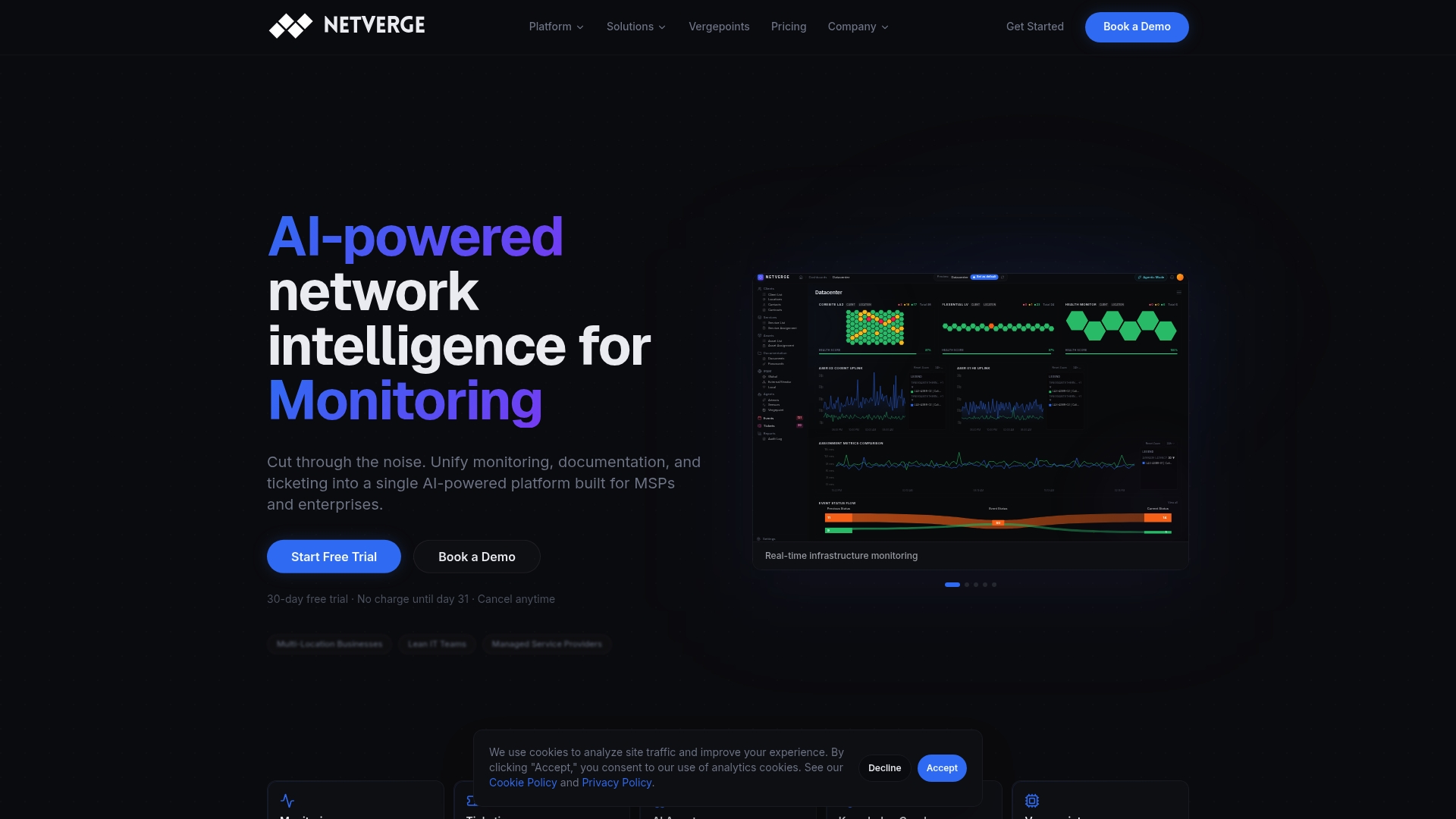
Netverge's autonomous AI agents detect configuration drift, power anomalies, and traffic irregularities in real time. The platform's automated network diagnostics cut mean time to resolution by removing the manual triage steps that slow every incident response. Whether you manage a distributed enterprise or a portfolio of MSP clients, Netverge gives you the visibility and automation to act on problems before your users notice them. Request a demo and see how faster fault detection translates directly into fewer outages.
FAQ
What are the most common causes of network downtime?
The most common causes are hardware failures, power disruptions, software and configuration errors, human mistakes, and cybersecurity attacks. Networking and connectivity issues alone account for 23% of IT service outages, according to Uptime Institute's 2026 analysis.
How does human error cause network outages?
Human error from failure to follow documented procedures is the leading cause of operational outages. Mistakes during maintenance windows, cable installations, or configuration changes can take down production segments immediately.
Why do configuration changes cause so many outages?
Approximately 26% of network incidents are linked to code and infrastructure configuration changes. Inconsistent firmware versions and configuration drift across devices create unpredictable failures that are difficult to diagnose without full telemetry visibility.
How can IT teams prevent power-related network downtime?
Teams should test UPS batteries and generators under load quarterly, deploy redundant power supplies in critical hardware, and monitor fuel levels and transfer switch status continuously. Deferred maintenance on backup power systems is the primary driver of power-related outages.
What role does cybersecurity play in network downtime?
Ransomware and DDoS attacks are now recognized causes of network downtime alongside hardware and software failures. DDoS attacks saturate bandwidth while ransomware can disable monitoring tools, making early detection through integrated security and network telemetry the most effective defense.