
Proactive network maintenance is an operational discipline focused on preventing failures before they affect users, defined by routine checks, structured reviews, and continuous performance tracking. This guide to proactive network maintenance covers the tools, tiered workflows, and AI-driven techniques that network administrators use to keep infrastructure stable and recoverable. The industry term for this practice is proactive network management, and it differs from reactive troubleshooting in one critical way: problems are resolved before tickets are opened. Monitoring metrics like latency, packet errors, and resource saturation form the baseline every maintenance program needs.
What are the essential components of proactive network maintenance?
Effective proactive network management starts with the right toolset and accurate documentation. Without both, even the best maintenance schedule produces incomplete results.
The core tool categories every network administrator needs are:
| Tool category | Function | Purpose |
|---|---|---|
| Monitoring software | Tracks latency, packet loss, and uptime | Detects anomalies before user impact |
| Configuration management | Stores and versions device configs | Enables predictable recovery after failures |
| Backup solutions | Automates config and data backups | Reduces recovery time after incidents |
| Logging infrastructure | Aggregates syslog, SNMP, and flow data | Supports root cause analysis and audits |
| Alert management | Defines thresholds and escalation paths | Reduces noise and ensures timely response |
Accurate device inventory is the foundation underneath all of these tools. You cannot monitor what you have not documented. A complete asset register should include firmware versions, hardware age, interface assignments, and ownership. Baseline performance data for each device gives you the reference point needed to distinguish normal behavior from early warning signs.

Alert thresholds require deliberate tuning. Smart alerting with well-designed escalation paths catches issues early without flooding on-call engineers with false positives. Set thresholds based on observed baselines, not vendor defaults.
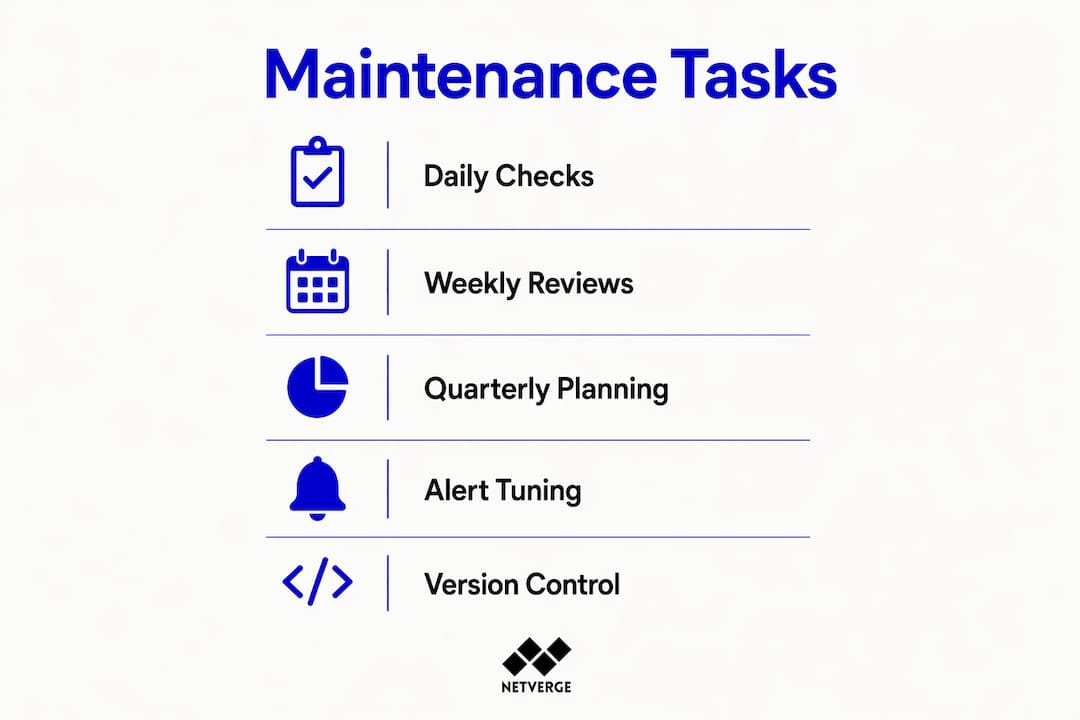
Pro Tip: Version control for network configurations is not optional. Store every config change in a system like Git or a dedicated network configuration management tool, and tag each commit with a change ticket number. Recovery becomes a controlled process instead of a guessing game.
How to implement a tiered operational rhythm for network upkeep
A tiered operational rhythm is the structural backbone of any proactive maintenance program. It separates daily automated checks from weekly analytical reviews and quarterly strategic planning, so no category of work crowds out another.
Daily tasks: automated health checks
- Review active alerts from your monitoring platform and clear or escalate each one.
- Verify that all scheduled backups completed successfully overnight.
- Check CPU, memory, and interface utilization across critical devices.
- Confirm that no new devices have appeared on the network without authorization.
- Review VPN tunnel status and WAN link health for multi-site environments.
Daily work should be fast. If your daily checklist takes more than 30 minutes, your alert thresholds need tightening or your monitoring coverage has gaps.
Weekly tasks: log analysis and security review
Weekly reviews go deeper than daily health checks. Pull syslog data and look for repeated authentication failures, interface flaps, or unusual traffic patterns. Review any account changes made during the week, including new admin accounts or permission escalations. Check your security posture: confirm firewall rules have not drifted from policy, and verify that no unauthorized configuration changes were made.
Follow up on any warnings flagged during the week but not yet resolved. Warnings that sit unaddressed for more than seven days frequently become incidents.
Quarterly tasks: strategic planning and lifecycle management
Quarterly maintenance covers the work that keeps your infrastructure viable over a one to three year horizon. This includes firmware planning and patch rollout, hardware lifecycle assessment, license renewal tracking, and capacity planning based on traffic growth trends. Firewall policy reviews belong here too. Rules accumulate over time, and quarterly audits remove stale entries that create unnecessary attack surface.
Capacity planning at this level requires trend data, not just current utilization. Pull 90-day utilization reports and project forward. If a link is running at 70% average utilization today, you need a plan before it hits 90%.
Pro Tip: Tiered review scheduling prevents alert fatigue by design. Keep daily work automated wherever possible, and protect quarterly planning sessions from being canceled due to daily operational noise. Block them on the calendar like any other critical meeting.
What are common challenges in proactive network maintenance?
The most common mistake in preventive network care is treating monitoring as maintenance. Monitoring identifies symptoms. Maintenance requires acting on those symptoms with configuration changes, recovery tests, and documented procedures. Teams that only monitor tend to discover problems at the worst possible time.
The table below shows the operational difference between a monitoring-only approach and a full maintenance program:
| Operational area | Monitoring only | Full maintenance program |
|---|---|---|
| Failure detection | Alerts fire after threshold breach | Trends caught before threshold breach |
| Recovery time | Unpredictable, config state unknown | Controlled, versioned configs available |
| Configuration drift | Undetected until incident | Caught in weekly or quarterly review |
| Firmware currency | Ad hoc, often delayed | Planned quarterly with rollback tested |
| Documentation accuracy | Rarely updated | Maintained as part of change control |
Configuration drift is a specific risk that grows silently. Without version control and regular recovery testing, network teams risk extended outages and configurations that no longer match documentation. The fix is straightforward: implement a change control process, require config backups before every change, and test recovery procedures on a scheduled basis.
Common mistakes and their corrections:
- Skipping recovery tests. Schedule a recovery drill at least once per quarter. Document the steps and time the process.
- Using vendor-default alert thresholds. Tune every threshold to your observed baseline within the first 30 days of deployment.
- Undocumented manual changes. Require a change ticket for every configuration edit, no exceptions.
- Ignoring warning-level events. Warnings are early indicators. Build a workflow that reviews and closes every warning within seven days.
Monitoring network health effectively requires pairing alert data with documented baselines. Without that pairing, alert data loses context and maintenance actions become guesswork.
How can automation and AI advance your maintenance program?
AI agents represent a meaningful shift in how network reliability improvement works. Rather than waiting for an engineer to act on an alert, AI agents maintain network configurations according to defined policies and can adapt their plans autonomously. This moves IT operations from reactive troubleshooting to continuous, self-correcting maintenance.
Practical use cases for automation and AI in network maintenance include:
- Automated alert triage. AI correlates alerts from multiple sources and suppresses duplicates, so engineers see root causes instead of symptom floods.
- Dynamic bandwidth management. Automated policies adjust QoS rules based on real-time traffic patterns without manual intervention.
- Fault correction. AI agents detect configuration drift and restore the correct state automatically, without waiting for a ticket.
- Anomaly detection. Machine learning models trained on your baseline telemetry flag unusual behavior before it crosses a threshold.
- Automated backup verification. Scripts or agents confirm backup integrity after each scheduled run and alert on failures immediately.
Netverge builds this capability directly into its platform. Autonomous AI agents diagnose and resolve issues automatically, while Vergepoints provide physical visibility across distributed sites. The AI agent designer lets you build no-code automation workflows that fit your specific maintenance schedule without requiring custom scripting.
Pro Tip: Automation without visibility creates blind spots. Every automated action your AI agents take should be logged with a timestamp, the triggering condition, and the action taken. Review those logs weekly. Automation that runs silently is automation you cannot trust.
For a broader look at where AI-driven maintenance is heading, the network monitoring trends for 2026 cover the emerging tools reshaping proactive infrastructure management.
Key Takeaways
A proactive network maintenance program built on a tiered operational rhythm, versioned configuration management, and AI-driven automation reduces unplanned downtime and keeps infrastructure recoverable at every stage.
| Point | Details |
|---|---|
| Tiered rhythm is non-negotiable | Separate daily, weekly, and quarterly tasks to prevent alert fatigue and protect strategic planning. |
| Monitoring is not maintenance | Acting on monitoring data with configuration changes and recovery tests is what prevents outages. |
| Version control enables recovery | Versioned config backups and regular recovery drills make restoration predictable, not improvised. |
| AI reduces human error | Automated fault correction and alert triage free engineers to focus on strategic work. |
| Documentation drives reliability | Accurate device inventory and change control records are prerequisites for every other maintenance activity. |
Why proactive maintenance culture matters more than any single tool
The hardest part of building a proactive maintenance program is not the tooling. It is getting a team to maintain the discipline when nothing is visibly broken. I have seen organizations invest in excellent monitoring platforms and still suffer preventable outages because the weekly review cadence quietly disappeared under operational pressure.
The teams that sustain proactive maintenance treat it as a non-negotiable operational rhythm, not a project. They block quarterly planning sessions months in advance. They assign ownership for each tier of the maintenance schedule to specific engineers, not to the team collectively. Collective ownership is no ownership.
The other pattern I have observed is that teams who adopt predictive maintenance thinking alongside proactive practices improve faster. Predictive approaches use trend data to anticipate failures weeks out. Proactive practices prevent the failures that trend data cannot yet see. Together, they create a genuinely resilient operation.
The network improvement strategies that produce lasting results are the ones embedded in team culture, not just documented in a runbook. Start with the tiered rhythm. Make it boring. Boring maintenance is the sign of a healthy network.
— Jim
Netverge supports your proactive maintenance workflows
Netverge unifies real-time monitoring, AI-driven anomaly detection, automated ticketing, and configuration visibility into a single platform built for MSPs and multi-location enterprises. Every tier of your maintenance schedule, from daily health checks to quarterly capacity reviews, benefits from consolidated telemetry and automated workflows.
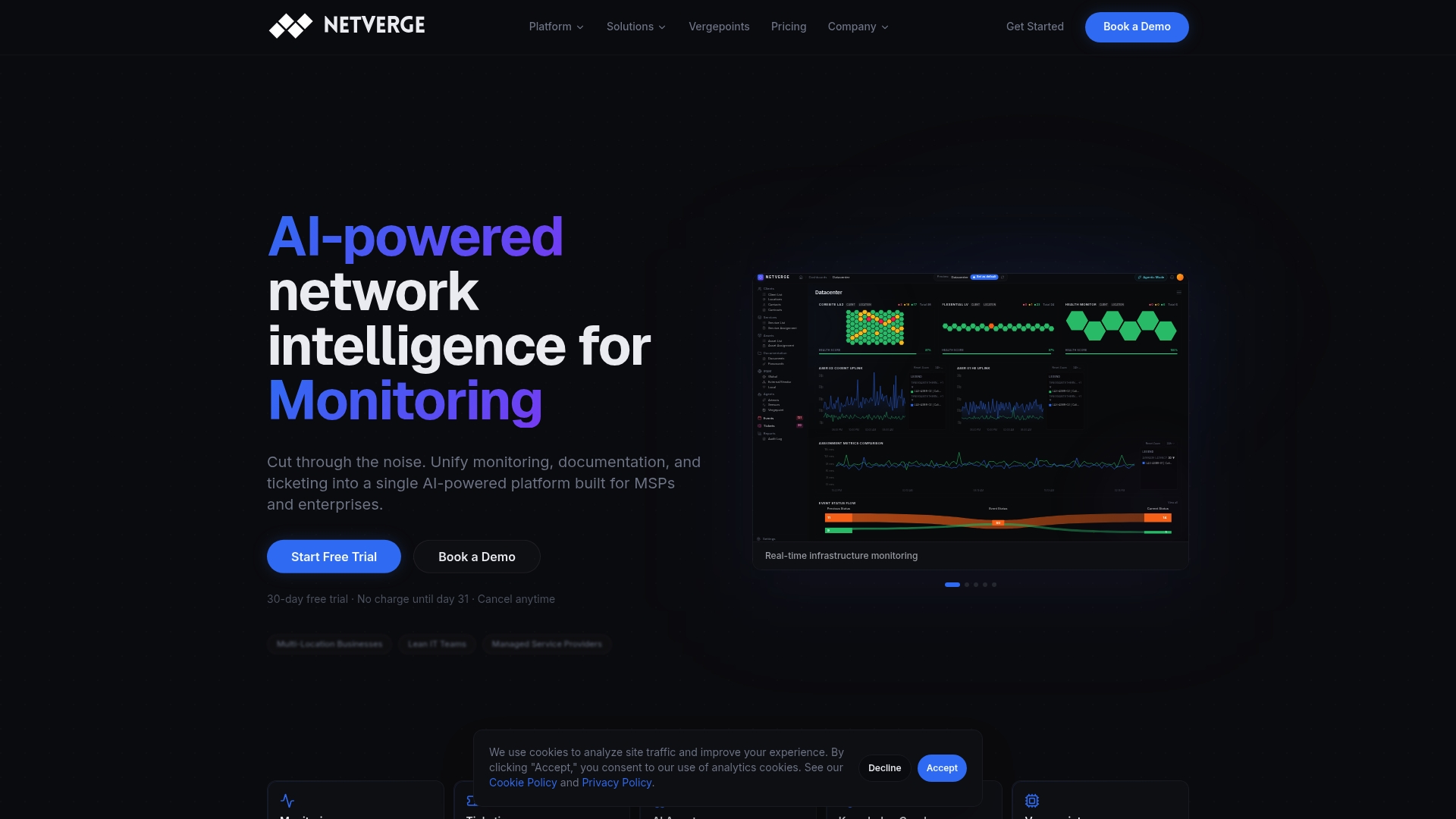
Netverge's AI-powered monitoring gives your team the observability needed to catch issues before users notice them. Vergepoints deploy across distributed sites for physical network visibility, while autonomous AI agents handle fault detection and correction automatically. MSP teams can explore network monitoring for MSPs to see how Netverge fits into multi-client maintenance operations. Request a demo to see the platform in action.
FAQ
What is proactive network management?
Proactive network management is the practice of monitoring, maintaining, and adjusting network infrastructure before failures occur. It relies on continuous telemetry, defined maintenance schedules, and documented recovery procedures.
How does proactive maintenance differ from reactive maintenance?
Proactive maintenance prevents failures through scheduled checks and configuration management. Reactive maintenance responds after a failure has already affected users, typically resulting in longer downtime.
What tasks belong in a daily network maintenance routine?
Daily tasks include reviewing active alerts, verifying backup completion, checking device resource utilization, and confirming no unauthorized devices have joined the network.
Why is configuration management critical for network reliability?
Without versioned configuration backups and recovery testing, teams face unpredictable restoration times after failures. Configuration drift goes undetected and compounds over time.
How do AI agents improve proactive network maintenance?
AI agents autonomously detect configuration drift, triage alerts, and correct faults according to defined policies. This reduces manual workload and catches issues faster than human-only review cycles.