
Change impact analysis (CIA) is a structured evaluation that predicts the ripple effects of a proposed change so leaders can decide scope, testing, and go/no-go with quantified risk and effort estimates. It replaces guesswork with a documented trail: what breaks, who is affected, what it costs to fix, and whether the change is worth approving. Managers, IT operations leads, and enterprise architects use it to protect budgets and uptime alike.
TL;DR:
- Impact scoring should focus on components with high scattering and high change-proneness to prioritize testing and verification efforts effectively.
- Conducting impact analysis on critical or regulated systems necessitates testing in separate environments and documenting risk acceptances before deployment.
- Building a dependency map through automated mapping tools accelerates discovery and improves accuracy compared to manual spreadsheet methods.
- Regular verification, including post-change control testing, is essential to catch regressions and ensure impacted controls still operate correctly.
- Using a structured workflow with clear ownership and visual impact matrices helps teams consistently deliver reliable change impact assessments.
Table of Contents
- What Is a Change Impact Analysis and What Does It Produce?
- Why Change Impact Analysis Matters (And How It Fails)
- How to Conduct a Change Impact Analysis, Step by Step
- Techniques and Metrics: The Four CIA Parameters
- Building an Impact Matrix and Choosing Visualizations
- When to Scale the Analysis and Align With Governance Standards
- Netverge in Practice: Applying CIA to Networked Systems
- Making Change Impact Analysis Stick
- Run Faster Change Impact Analysis With Netverge
- Sources
- FAQ
What Is a Change Impact Analysis and What Does It Produce?
A change impact analysis compares your current state against the proposed future state and maps every dependency that sits between the two. That comparison spans three layers: organizational (who does the work differently), process (which workflows shift), and technical (which systems, code, or configurations change). A software deployment and a merger integration both demand CIA, but the artifacts you produce look different depending on which layer dominates.
A properly run CIA does not end with a narrative memo. It ends with deliverables a decision maker can act on:
- A list of impacted items (systems, roles, contracts, data flows)
- An effort estimate for remediation, usually in hours or story points
- A risk rating, typically low, medium, or high
- A set of recommended mitigations tied to specific owners
Not every change earns the full treatment. A configuration tweak on a single non-production server might warrant a five-minute checklist. A schema change touching a shared database, a vendor contract renegotiation, or a network topology shift for a multi-site enterprise warrants the complete process outlined below. The systematic mapping study on change impact analysis reviewed 111 papers and found that scaling analysis depth to change criticality is standard practice across mature engineering organizations, not an optional shortcut.
Why Change Impact Analysis Matters (And How It Fails)
Organizations that skip CIA pay for it later, usually in the form of production incidents that could have been predicted. Teams that run consistent impact assessments report fewer regressions, tighter test targeting, and lower lifecycle maintenance cost, because effort goes toward the components most likely to break rather than everywhere at once.
Pro Tip: Treat CIA as a gate, not a formality. If a change request arrives without an impact assessment attached, send it back before it reaches a sprint board.
Failure tends to follow the same three patterns:
- Siloed analysis — the technical team maps code dependencies but never asks whether a business rule or compliance requirement is affected.
- Ignoring business rules — a "minor" field rename breaks a downstream reporting process nobody consulted.
- Skipping verification — the change ships, and nobody confirms the impacted controls still function afterward.
Academic research on organizational change backs this up directly: modeling business, process, role, and technical elements together is what catches the failures that a purely technical review misses, according to research on predicting unintended consequences of organizational change. Accountability should be explicit before the first change request lands: a named owner performs the dependency mapping, a change advisory board or delegated manager signs off on the risk rating, and a separate reviewer confirms verification actually happened. Splitting those three roles across three people, not one, closes most of the failure modes above.
How to Conduct a Change Impact Analysis, Step by Step
A change impact analysis process works best as a repeatable sequence, not a one-off exercise reinvented for every request. Here is the operational workflow that scales from a minor system patch to a full enterprise architecture shift.
- Prepare. Collect baseline configurations, current documentation, and a stakeholder list before you touch the change itself. If your baselines are stale, the entire analysis inherits that error.
- Map dependencies. Trace every connected service, business process, user role, data store, and external supplier that touches the item being changed. This is the step most teams underinvest in, and it is where service dependency mapping techniques pay off directly.
- Assess. Apply your chosen metrics (covered in detail below) to score each impacted item for severity and likelihood, then estimate remediation effort per item.
- Decide. Weigh mitigation options against acceptance criteria. Some risks get fixed before rollout; others get accepted with a documented rationale and a monitoring plan.
- Implement and verify. Roll out the change, test it in a separate environment first when the system is sensitive or regulated, then confirm impacted controls still operate as expected.
Each step generates its own checklist:
- Stakeholder list confirmed with names and roles, not just department names
- Dependency map exported and attached to the change request
- Severity and likelihood scores recorded per impacted item
- Mitigation owner assigned for every medium or high risk item
- Test environment results logged before production rollout
- Documentation and configuration baselines updated post-change
Enterprise architecture research supports building this workflow around model propagation: mapping a change through a semantic model of the architecture surfaces business-level consequences that a purely technical scan would miss, according to work on change impact analysis of enterprise architectures. This matters most for multi-location organizations, where a network change in one site can silently break a process in another. A documented network change management framework gives this workflow a home instead of leaving it as a one-off spreadsheet exercise that nobody updates after the first use.
The verification step deserves its own emphasis because it is the one most often skipped in ad-hoc processes. A post-change checklist tied directly back to the impact matrix catches security and functionality regressions that would otherwise surface as a support ticket days or weeks later.
Techniques and Metrics: The Four CIA Parameters
Quantifying change impact analysis comes down to four measurable parameters, according to the systematic mapping study on CIA: instability, amount of change, change-proneness, and changeability. Each one answers a different question, and together they let you rank components instead of treating every impacted item as equally urgent.
- Instability measures how often a component's dependencies shift over time, often proxied by dependency degree or the ratio of incoming to outgoing connections.
- Amount of change captures the raw size of a modification, commonly tracked through code churn or the number of altered configuration lines.
- Change-proneness predicts how likely a component is to require future modification, frequently estimated from historical co-change frequency, meaning how often two items change together.
- Changeability reflects how easily a component can be modified without cascading side effects, often inferred from the number of affected roles or downstream processes.
A practitioner rule of thumb worth adopting: prioritize inspection and testing for components showing both high scattering (the change touches many places at once) and high change-proneness first, according to research on workflow repository management. Low-scattering, high-changeability items can typically wait for a lower-risk maintenance window.
On tooling, the trade-off is straightforward. Static dependency graphs give you a complete picture before anything ships, but they miss runtime behavior. Live telemetry catches actual usage patterns, but only after the system is already running the change. Mature teams pull from both: a static graph for pre-change scoring, and runtime monitoring for post-change verification.
Building an Impact Matrix and Choosing Visualizations
An impact matrix turns scattered notes into a document a reviewer can approve in one pass. Five columns cover most use cases: impact area, severity (low, medium, high), likelihood, estimated remediation cost, and a named owner. Score severity and likelihood independently, then multiply or combine them into a single priority ranking so the highest-risk rows surface at the top.
Visualization choice depends on what layer of the system you are analyzing:
- Call graphs work best for code-level or infrastructure dependency chains, showing exactly which service calls which.
- Treemaps suit repository-level or portfolio-wide impact, where you need to see relative scale across many components at once, an approach validated in research on workflow repository management.
- Process maps fit organizational or business-process CIA, where the impact travels through people and workflows rather than code.
Store the completed matrix and its visualization as an attachment to the change request itself, then link it to the relevant configuration baseline. A documentation strategy that treats these artifacts as living records, not one-time PDFs, keeps them useful for the next change that touches the same components.
When to Scale the Analysis and Align With Governance Standards
Not every change needs the same depth of review, but certain triggers should always push you toward the fuller process: high criticality systems, sensitive data exposure, a regulated environment, or a change with cross-domain effects spanning multiple business units.
Federal guidance offers a useful baseline even for private-sector teams. GSA's Configuration Management guidance requires analyzing impact before implementation, testing changes in a separate environment when necessary, and verifying that impacted controls still operate correctly afterward. NIST SP 800-128 extends this into security-focused configuration management, treating impact analysis as inseparable from baseline management and change control.
Practical scaling rules:
- Route any change touching regulated data through a mandatory separate test environment before production
- Require documented sign-off on the impact matrix for anything rated medium risk or higher
- Feed verified CIA results directly into continuous monitoring baselines, not a separate archive nobody checks
Netverge in Practice: Applying CIA to Networked Systems
For MSPs and multi-site enterprises, the hardest part of change impact analysis is usually not the scoring. It is discovering every dependency in the first place across dozens of sites and disconnected tools. Unified visibility into infrastructure, paired with a knowledge graph that maps relationships between devices, services, and locations, shortens that discovery step considerably compared to manually cross-referencing spreadsheets and legacy monitoring dashboards.

AI-driven ticket triage adds a second layer: when a change does produce an unexpected effect, faster classification of the resulting alert means faster confirmation of whether the impact matrix predicted it correctly. That feedback loop is what makes an impact matrix improve over time instead of going stale. Case studies documenting this workflow across specific customer deployments, along with additional measured outcomes, are best requested directly for the most current figures.
Making Change Impact Analysis Stick
Most CIA programs fail from neglect, not from bad templates. Verification is the step teams cut first, and cross-team mapping the step they never budget time for. Chasing perfectly precise metrics can also cost you the timely decision the analysis was supposed to support. Pick a template, automate dependency mapping wherever you can, and use it on every change above your risk threshold, not just the ones that feel risky.
— Jim
Run Faster Change Impact Analysis With Netverge
Netverge consolidates the dependency mapping, monitoring, and documentation that change impact analysis depends on into one platform, replacing the spreadsheet-and-tribal-knowledge approach most MSPs and multi-site teams default to today.
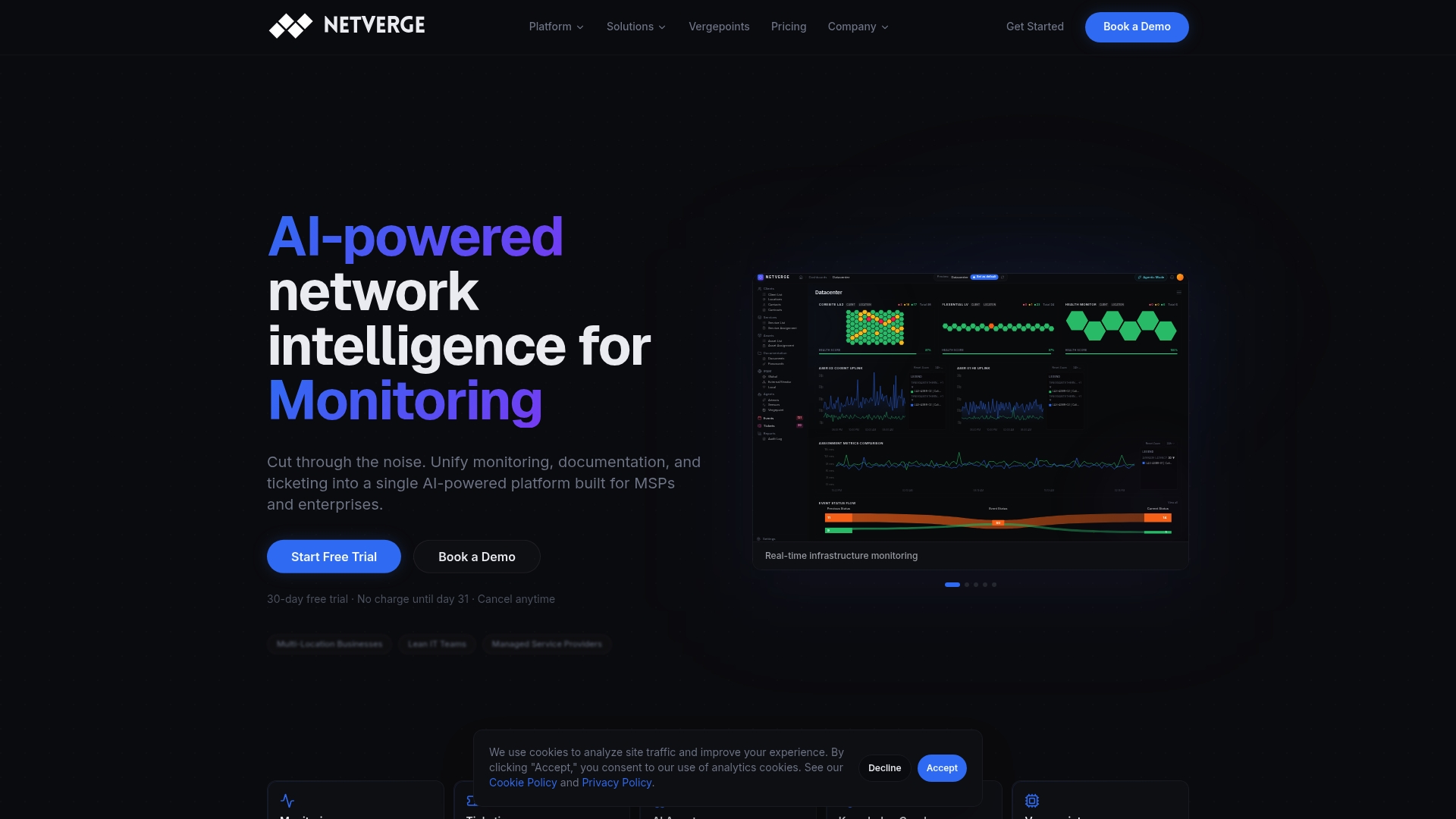
Its knowledge graph tracks relationships across devices, services, and sites automatically, so the mapping step in your CIA workflow starts from real-time data instead of a document someone updated three months ago. Hardware Vergepoints add physical, on-site visibility for networked infrastructure where a purely software-based view misses local context, and AI-driven ticket triage helps confirm whether a change produced the effect your impact matrix predicted. Teams evaluating this for the first time can start with the Starter Package at $299 per month, or start a free trial to see how the platform handles dependency mapping on your own infrastructure before committing to a plan.
Sources
- Change impact analysis: A systematic mapping study
- Change Impact Analysis of Enterprise Architectures
- Configuration Management (CM) — GSA CIO IT Security
- NIST SP 800-128: Guide for Security-Focused Configuration Management of Information Systems
FAQ
What Are the 5 C's of Change Leadership?
Definitions vary across frameworks, but change leadership models commonly emphasize communication, commitment, clarity, capability, and culture as recurring themes. No single canonical "5 C's" list is universally standardized, so check which framework a specific consultant or organization is citing before applying it.
What Are the 10 Aspects of Change Impact According to Prosci?
Prosci's model focuses on organizational change management dimensions like sponsorship, communication, and resistance management rather than a fixed public list of exactly ten aspects. If you need the precise current framework, refer to Prosci's own published materials rather than a secondhand summary.
Can You Provide an Example of Impact Analysis?
A database schema change at a multi-site retailer illustrates it well: mapping reveals the change affects three downstream reporting processes, two vendor integrations, and one compliance report. The impact matrix rates the compliance report high severity, assigns an owner, and requires testing in a separate environment before the schema change ships to production.
What Are the 5 Pillars of Change Management?
Change management frameworks typically build around people, process, technology, communication, and leadership as the core pillars, though exact terminology differs by methodology. Whichever framework you use, change impact analysis functions as the evidence base that informs decisions across all five.
Does Netverge Support Change Impact Analysis Workflows?
Netverge's knowledge graph and real-time monitoring give teams the dependency data needed to run the mapping and verification steps of a CIA process for networked systems. Current pricing, including the Starter Package at $299 per month, is listed on Netverge's pricing page for teams evaluating the platform.