
A network anomaly is defined as any significant deviation from established normal network behavior, and it falls into three distinct categories: point, contextual, and collective anomalies. For network engineers and security analysts, recognizing these deviations is the first step toward catching threats that traditional signature-based tools miss entirely. Anomaly detection focuses on behavioral deviations rather than known attack signatures, which means it catches zero-day exploits and insider misuse that firewalls and intrusion detection systems overlook. The industry term for this discipline is network behavior anomaly detection, or NBAD, and understanding it is now a baseline requirement for any serious network operations team.
What is a network anomaly and how is it classified?
A network anomaly is any deviation from the established normal behavior of a network, categorized into point, contextual, and collective types. Each category describes a different pattern of abnormality, and that distinction directly shapes how your detection systems should respond.
Point anomalies are the most straightforward. A single event stands out sharply from the rest of the data, such as a workstation suddenly transferring 50 GB of data at 2 a.m. when its normal nightly traffic is under 100 MB. The event is isolated, but its magnitude makes it immediately suspicious.

Contextual anomalies depend on surrounding conditions to be meaningful. A spike in authentication attempts at 9 a.m. on a Monday is normal. The same spike at 3 a.m. on a Sunday is not. The event itself is not unusual in isolation. Its context makes it an anomaly.
Collective anomalies are the hardest to catch. Each individual event in a sequence looks completely normal. Together, the sequence reveals a problem. A classic example is a low-and-slow data exfiltration attack, where small file transfers occur repeatedly over days or weeks, each one below any alert threshold, but collectively representing a major breach.
Understanding which type you are dealing with matters because each requires a different detection approach. Point anomalies respond well to threshold-based alerts. Contextual anomalies require time-aware baselines. Collective anomalies demand sequence analysis and behavioral correlation across extended time windows.
Pro Tip: When tuning your detection system, configure separate baseline profiles for business hours, off-hours, and weekends. A single flat threshold misses contextual anomalies entirely.
How does network anomaly detection work?
Network anomaly detection works by establishing a behavioral baseline and then continuously comparing live traffic against that baseline. This is fundamentally different from signature-based detection, which matches traffic against a library of known attack patterns. Signature tools cannot catch what they have never seen before. Behavioral detection can.
The process follows a clear sequence:
- Baseline establishment. The system monitors normal traffic patterns over a defined learning period, recording metrics like flow volume, protocol distribution, connection frequency, and endpoint behavior.
- Continuous monitoring. Live telemetry, including NetFlow, IPFIX, and SNMP data, is compared against the baseline in real time.
- Deviation scoring. Statistical models or machine learning algorithms assign a deviation score to each observed behavior. Scores above a defined threshold trigger alerts.
- Contextual enrichment. Alerts are correlated with logs, API calls, and user activity data to separate genuine threats from benign anomalies.
- Response and investigation. High-confidence alerts are escalated for analyst review or automated response, depending on the platform's configuration.
Machine learning improves this process significantly. Supervised models learn from labeled examples of known attacks. Unsupervised models detect patterns that have no prior label, which is critical for catching novel threats. By 2026, anomaly detection is integrated in firewalls, EDR platforms, and SIEM systems as a default capability rather than an add-on.
Anomaly detection complements traditional security rather than replacing it. Signature tools handle known threats quickly and with low overhead. Behavioral detection handles the unknown. Running both in parallel gives your security stack the coverage it needs.
Pro Tip: When integrating anomaly detection into an existing SIEM, map your network telemetry sources first. Gaps in telemetry coverage create blind spots that no algorithm can compensate for.
What are the biggest challenges in detecting network anomalies?
Anomaly detection is powerful, but three operational challenges consistently reduce its effectiveness in production environments.
Alert fatigue from poorly tuned baselines. Without proper calibration, detection systems generate excessive false positives that analysts begin to ignore. A burn-in period of 2–4 weeks helps the system learn legitimate traffic spikes, such as backup windows and scheduled batch jobs, before alerts go live. Skipping this step is the single most common reason anomaly detection deployments fail.
Encrypted traffic blind spots. Encryption prevents content inspection, which limits what anomaly tools can analyze. Metadata and behavioral telemetry like NetFlow and IPFIX become the primary visibility layer when packet contents are inaccessible. Some environments supplement this with selective TLS inspection at the perimeter, but metadata analysis alone catches the majority of volumetric and behavioral anomalies.
Baseline drift from network evolution. Cloud adoption, new IoT devices, and remote work policies all change what "normal" looks like. Static models fail as network behavior evolves, so teams must schedule periodic baseline recalibration. Quarterly reviews are a minimum. High-change environments need monthly recalibration cycles.
Contextual enrichment addresses a fourth challenge: distinguishing real threats from benign outliers. Correlating anomaly alerts with user event logs, API call records, and endpoint data lets analysts quickly determine whether an unusual traffic pattern reflects a compromised account or a legitimate business activity. Without that correlation layer, analysts waste hours investigating noise.
What are the practical benefits of network anomaly detection?
Network anomaly detection delivers value across three distinct operational areas: security threat identification, compliance monitoring, and proactive network health management.
On the security side, anomaly detection identifies subtle behavioral shifts that signature tools miss entirely. This includes malware beaconing to command-and-control servers, insider threats moving data to unauthorized destinations, and lateral movement by attackers who have already bypassed the perimeter. These are the attacks that cause the most damage precisely because they go undetected the longest.
For compliance, anomaly detection supports continuous monitoring of data access patterns, flagging policy violations in real time rather than during periodic audits. This is directly relevant to frameworks like NIST SP 800-137 and ISO/IEC 27001, both of which require continuous monitoring as part of an information security management program.
Early anomaly detection supports proactive NOC operations by surfacing hidden problems before they affect users. A gradual increase in retransmission rates, for example, signals a degrading link before it fails completely. Catching that pattern early avoids an outage entirely.
| Capability | Signature-based detection | Anomaly-based detection |
|---|---|---|
| Known attack detection | High accuracy | Moderate accuracy |
| Zero-day threat detection | None | High accuracy |
| Insider threat detection | Limited | Strong |
| Encrypted traffic analysis | Very limited | Metadata-based |
| False positive rate | Low (tuned) | Higher without tuning |
| Baseline requirement | None | Required |
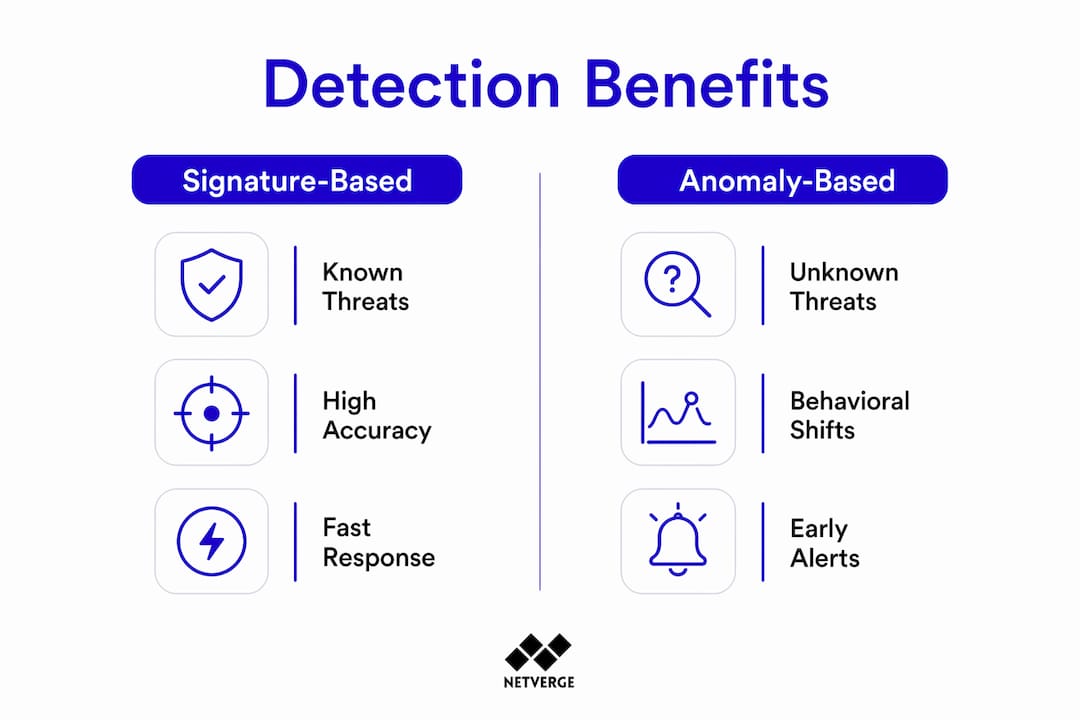
The table above shows why the two approaches are complementary. Signature detection handles known threats efficiently. Anomaly detection covers the gaps. Running both together gives you real-time network visibility across the full threat spectrum.
You can see how these capabilities play out in practice by reviewing real-world detection examples from production IT environments. The patterns there illustrate exactly how each anomaly type surfaces in actual network traffic.
Key Takeaways
Effective network anomaly detection requires behavioral baselines, continuous telemetry, contextual enrichment, and regular recalibration to catch threats that signature tools miss.
| Point | Details |
|---|---|
| Three anomaly types | Point, contextual, and collective anomalies each require different detection approaches and tuning strategies. |
| Behavioral baselines are required | Anomaly detection depends on an accurate baseline; a 2–4 week burn-in period reduces false positives significantly. |
| Encrypted traffic needs metadata | When content inspection is blocked by encryption, NetFlow and IPFIX telemetry maintain detection visibility. |
| Recalibrate as networks change | Cloud adoption and new devices shift normal behavior; static baselines drift and cause detection failures. |
| Complements signature tools | Anomaly detection catches zero-day and insider threats that signature-based systems cannot recognize. |
Why anomaly detection is no longer optional
Network anomaly detection has moved from a specialized capability to a standard operational requirement. I have watched this shift happen over the past several years, and the teams that still treat it as optional are the ones getting caught off guard by slow-burn attacks and insider incidents.
The most common mistake I see is treating anomaly detection as a set-and-forget tool. Teams deploy it, celebrate the coverage, and then ignore the recalibration work. Six months later, the baselines are stale, the false positive rate has climbed, and analysts have quietly started ignoring the alert queue. That is not a technology failure. That is an operational failure.
Anomaly detection is now a baseline necessity embedded in leading security platforms, which means the barrier to entry is lower than ever. The real differentiator is not whether you have it. It is whether you maintain it. Teams that schedule quarterly baseline reviews, correlate alerts with contextual log data, and tune thresholds after every major network change get dramatically better results than those that do not.
The other misconception worth addressing: anomaly detection is not a replacement for your existing security stack. It is an additional layer that catches what signatures miss. The 2026 network monitoring trends point clearly toward tighter integration between anomaly detection, SIEM, and automated response. Teams that build those integrations now will handle incidents faster and with less manual effort.
— Jim
Netverge's AI-powered approach to network anomaly detection
Netverge brings AI-driven anomaly detection into a single platform built for MSPs and multi-location enterprises. Its AI-powered network monitoring platform combines real-time telemetry, behavioral baselines, and autonomous AI agents that diagnose and respond to anomalies without waiting for manual intervention.

Netverge's Vergepoints hardware provides physical network visibility, feeding telemetry directly into the platform's detection engine. Automated alert triage reduces the false positive noise that causes analyst fatigue, and the knowledge graph correlates anomalies with network context to surface only the alerts that matter. For teams managing distributed infrastructure, that combination of AI triage capabilities and unified visibility replaces the fragmented toolsets that slow incident response. Request a demo to see how Netverge handles anomaly detection at scale.
FAQ
What is a network anomaly in simple terms?
A network anomaly is any event or pattern in network traffic that deviates significantly from established normal behavior. It may signal a security threat, a misconfigured device, or a performance issue.
What are the three types of network anomalies?
The three types are point anomalies (isolated unusual events), contextual anomalies (deviations that depend on conditions like time), and collective anomalies (sequences of individually normal events that together indicate a problem).
How do you detect network anomalies?
Detection works by establishing a behavioral baseline and continuously comparing live traffic against it using telemetry sources like NetFlow and IPFIX. Machine learning models score deviations and trigger alerts when behavior exceeds defined thresholds.
Why does anomaly detection generate so many false positives?
False positives occur when baselines are not properly calibrated to account for legitimate traffic spikes. A burn-in period of 2–4 weeks before alerts go live significantly reduces false positive rates.
Can anomaly detection work on encrypted traffic?
Content inspection is not possible on encrypted traffic, but metadata-based telemetry such as flow volume, timing, and connection patterns still provides meaningful detection coverage. Selective decryption at the perimeter can supplement metadata analysis where policy permits.