
Intelligent alerting is defined as an AI-driven, context-aware system that filters IT event notifications and surfaces only the incidents that require human attention. Unlike static threshold alerting, intelligent alerting systems apply machine learning, anomaly detection, and event correlation to evaluate alerts before they reach an operator. Enterprises commonly face alert flooding where multiple monitoring tools generate thousands of alerts for the same underlying problem, overwhelming IT staff. Intelligent alerting solves this by grouping related events into actionable incidents, reducing noise, and giving network administrators the focus they need to resolve issues faster. Netverge builds this capability directly into its AI-powered monitoring platform.
What is intelligent alerting and how does it differ from traditional alerting?
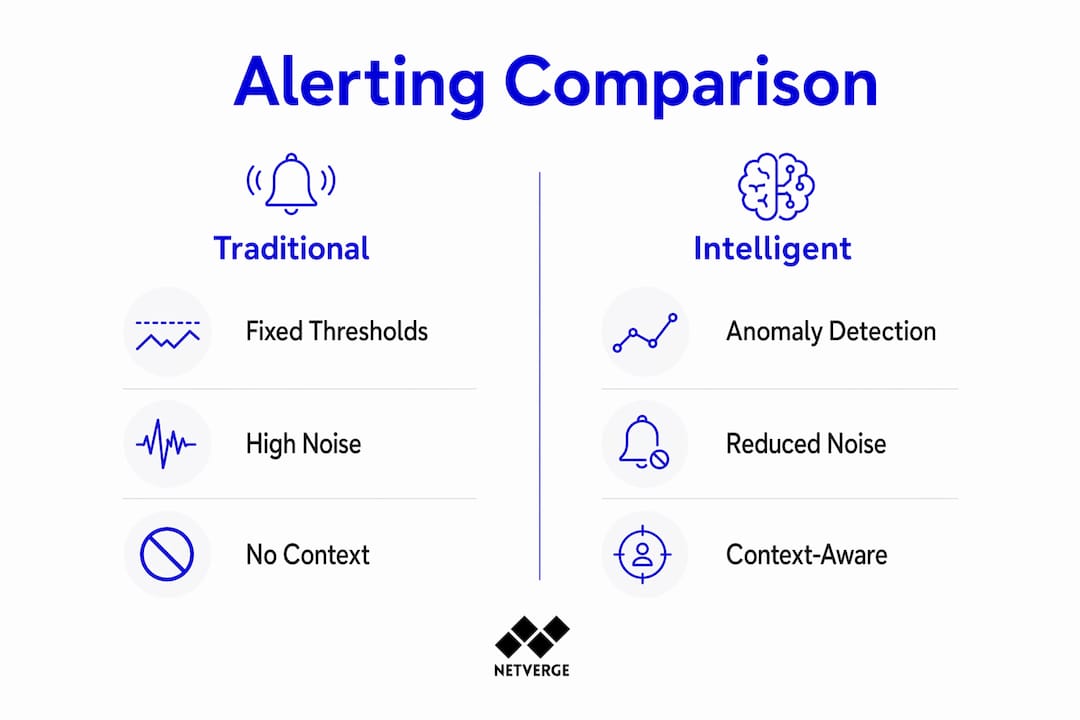
Traditional alerting fires a notification every time a metric crosses a fixed threshold. Set CPU utilization above 80%, and every spike triggers a page, regardless of context, duration, or downstream impact. That model breaks down at scale.
Intelligent alerting moves beyond static thresholds by incorporating anomaly detection and predictive analytics to learn system baselines and trigger alerts based on deviations. The system builds a behavioral model of your infrastructure over time. When something deviates from that learned baseline, it fires. When it does not, it stays silent.

The industry term for this broader discipline is AIOps, or AI for IT operations. Intelligent alerting is one of its core functions, sitting at the intersection of observability, event management, and incident response. Understanding this distinction matters because it frames intelligent alerting not as a feature toggle but as a methodology.
The table below shows how the two approaches compare across key operational dimensions:
| Dimension | Static threshold alerting | Intelligent alerting |
|---|---|---|
| Alert trigger | Fixed metric value | Deviation from learned baseline |
| Context awareness | None | System state, dependencies, history |
| Alert volume | High, often redundant | Filtered, grouped by incident |
| Root cause support | Manual correlation | Topology-aware clustering |
| Operator action required | Every alert | Only when human attention is needed |
Pro Tip: Before deploying any intelligent alerting system, document your existing alert volume per tool per day. That baseline number becomes your primary success metric after tuning.
How does intelligent alerting work in IT systems?
The technical engine behind intelligent alerting combines several methods working in sequence. Each layer adds context that the next layer uses to make a better decision.
The first layer is anomaly detection. Machine learning models analyze telemetry streams, including CPU, memory, latency, packet loss, and error rates, and establish normal behavioral ranges. Alerts fire when readings fall outside those ranges, not when they cross an arbitrary number.
The second layer is event correlation. Related alerts from different monitoring tools get linked together based on shared topology, timing, and causal relationships. Intelligent alert clustering uses streaming machine learning algorithms like DBScan, grouping alerts by creation time and topology distance to unify multiple notifications into actionable incidents. Typical parameters include a 15-minute creation threshold and a minimum cluster density of five points. That density requirement prevents a single noisy device from generating a false incident cluster.
The third layer is topology mapping. The system understands which services depend on which infrastructure components. Without accurate topology knowledge, alert correlation suffers and clusters become fragmented, producing incomplete incident pictures. Topology awareness is what separates genuine root cause identification from educated guessing.
The fourth layer is context enrichment. Before an alert reaches an operator, the system attaches relevant data: dependency status, recent change records, historical incident patterns, and in mission-critical environments, even external factors like maintenance windows. This gives the operator everything needed to act immediately.
- Anomaly detection establishes behavioral baselines from telemetry data
- DBScan clustering groups related alerts by time window and topology distance
- Topology mapping links alerts to actual infrastructure dependencies
- Context enrichment attaches historical and dependency data before notification
- Predictive analytics flag degradation trends before they become outages
What are the key benefits of intelligent alerting for network administrators?
The most direct benefit is noise reduction. Alert flooding caused by isolated monitoring tools forces manual correlation and drains operator attention. Intelligent alerting introduces cross-tool shared intelligence that cuts that volume to a fraction of its original size.
The second benefit is faster root cause identification. When alerts arrive grouped by incident and enriched with topology context, your team spends less time correlating events and more time fixing the actual problem. Mean time to repair (MTTR) drops because the diagnostic work happens before the ticket opens.
"Intelligent alerting acts as the front door to incident response, only interrupting engineers when truly human attention is needed. This preserves focus and improves downstream investigation and resolution efficiency."
The third benefit is cognitive load reduction. Presenting contextual data with alerts preserves operator focus and improves decision accuracy, which is critical in mission-critical environments. Operators see real-time visualizations and dependency status without switching between systems. That single-pane-of-glass experience is not a luxury. It is a measurable operational advantage.
Additional benefits for network administrators include:
- Reduced false positives through multi-factor evaluation of system state and history
- Proactive detection of degradation trends before they cause outages
- Support for 24/7 operations across hybrid and multi-cloud environments
- Faster onboarding for new team members who inherit a filtered, contextualized alert feed
- Better alignment between network operations and incident management workflows
For a deeper look at how alert types map to monitoring strategy, the relationship between alert classification and intelligent filtering becomes clear.
What technical challenges do organizations face implementing intelligent alerting?
Intelligent alerting delivers real value, but implementation is not without friction. Understanding the common failure points before you start saves significant rework.
Topology data quality. The system is only as accurate as its map of your infrastructure. Stale CMDB records, undocumented dependencies, and shadow IT devices all degrade correlation quality. Audit your topology data before you tune any alerting parameters.
Balancing noise reduction against signal integrity. Over-tuning alert thresholds to avoid noise can hide slow-developing but critical issues. The goal is to optimize the signal-to-noise ratio, not to eliminate all alerts. A system that never fires is not a success. It is a liability.
Tool integration complexity. Most enterprises run multiple monitoring platforms across network, application, and security domains. Getting those tools to share event data through a common correlation layer requires API work, schema normalization, and ongoing maintenance. Knowing how to respond to security alerts effectively across integrated tools is a skill set that needs to be built alongside the technical integration.
Continuous tuning requirements. Infrastructure changes constantly. New services, retired devices, and shifting traffic patterns all affect what "normal" looks like. Intelligent alerting models require regular review to stay accurate.
Operator training and adoption. Teams accustomed to raw alert feeds need time to trust a filtered system. Early wins, where the system correctly groups a complex incident, build that trust faster than documentation.
Pro Tip: Run your intelligent alerting system in shadow mode for two to four weeks before going live. Compare its grouped incidents against your existing alert feed to validate accuracy without operational risk.
How is intelligent alerting applied in modern IT infrastructure management?
Real-world application of intelligent alerting spans several operational scenarios, each with distinct requirements and payoffs.
Multi-tool environments and alert storms. Large enterprises typically run separate monitoring tools for network devices, servers, applications, and cloud services. When a core router fails, each tool fires its own alerts independently. Without correlation, an operator sees hundreds of notifications for a single root cause. Intelligent alerting maps those alerts to the failed device and presents one incident. The real-time alerting process becomes manageable instead of paralyzing.
Cloud and hybrid infrastructure. Cloud environments generate telemetry at a volume that manual review cannot handle. Intelligent alerting applies the same clustering and anomaly detection logic to cloud metrics, container health, and API latency that it applies to on-premises hardware. The result is consistent incident quality regardless of where the infrastructure lives.
AIOps integration. Intelligent alerting feeds directly into AIOps platforms that handle automated remediation, ticket creation, and escalation routing. AI triage for network outages depends on receiving pre-correlated, context-rich incidents rather than raw alert streams. The quality of the alerting layer determines the quality of everything downstream.
MTTR reduction in practice. When alerts arrive with topology context and related event history, the first responder already knows which service is affected, which dependencies are involved, and what changed recently. That context cuts the diagnostic phase of incident response significantly. Dwell time in cybersecurity incidents is directly affected by how quickly teams can identify and contain the root cause, and intelligent alerting accelerates that identification step.
For teams managing distributed networks, network anomaly detection examples show how these concepts translate into specific, measurable outcomes across different infrastructure types.
Key Takeaways
Intelligent alerting is the most direct way to reduce operator cognitive load, cut MTTR, and maintain signal integrity across complex IT environments.
| Point | Details |
|---|---|
| Core definition | Intelligent alerting filters IT events using AI, anomaly detection, and topology-aware correlation. |
| How clustering works | DBScan groups alerts by time window and topology distance into unified, actionable incidents. |
| Primary benefit | Noise reduction and faster root cause identification improve incident response speed. |
| Biggest implementation risk | Over-tuning thresholds can hide slow-developing critical issues. Maintain signal integrity. |
| Topology is foundational | Accurate infrastructure mapping is required for meaningful alert correlation and clustering. |
Why topology is the part most teams get wrong
After years of watching IT teams implement alerting improvements, the pattern I see most often is this: teams invest heavily in the machine learning layer and almost nothing in the topology layer underneath it. The result is a system that clusters alerts by time proximity rather than by actual dependency relationships. You get groups that look coherent but point to the wrong root cause.
Topology-aware correlation reflects true infrastructure dependencies, not just temporal proximity. That distinction is critical for root cause analysis. A database slowdown and a web server timeout that happen within the same 15-minute window are not necessarily the same incident. Without topology context, the system treats them as one. With it, the system knows whether the web server depends on that database and can make the right call.
The second thing I would push back on is the framing of intelligent alerting as a configuration project. It is not. Intelligent alerting is evolving from a configuration task into a core reliability capability integral to the full incident lifecycle. That means it needs ownership, review cycles, and alignment with your incident management process. Treat it like infrastructure, not like a setting you tune once and forget.
The cognitive load argument is also undersold. Teams measure success in alert volume reduction. The more meaningful metric is how often an operator receives an alert and already has enough context to act without opening a second tool. That number tells you whether your alerting system is actually working.
— Jim
Netverge and AI-powered network monitoring
Netverge brings intelligent alerting into a unified platform built for MSPs and multi-location enterprises. Its AI-powered monitoring layer applies anomaly detection, event correlation, and topology-aware incident grouping across your entire infrastructure from a single interface.
The platform's AI-powered monitoring combines real-time telemetry, knowledge graph dependencies, and autonomous AI agents that diagnose issues before they escalate. Network administrators get filtered, context-rich incidents instead of raw alert floods. The result is faster response, less manual correlation, and a monitoring operation that scales without adding headcount. If your current alerting setup generates more noise than signal, Netverge is built to fix that.
FAQ
What is the intelligent alerting definition in IT?
Intelligent alerting is an AI-driven system that filters, correlates, and groups IT event notifications using anomaly detection and topology mapping, surfacing only the incidents that require human attention.
How does intelligent alerting reduce false positives?
Intelligent alerting reduces false positives by evaluating multiple factors, including system state, historical patterns, and related events, before notifying operators, so only urgent issues generate a response.
What is the difference between intelligent alerting vs traditional alerting?
Traditional alerting fires on fixed metric thresholds with no context. Intelligent alerting uses machine learning baselines, event correlation, and topology awareness to deliver grouped, context-rich incidents instead of raw notifications.
What is DBScan and why does it matter for alert clustering?
DBScan is a streaming machine learning algorithm that groups alerts by creation time and topology distance. It prevents alert storms by requiring a minimum cluster density before treating a group of events as a single incident.
How does intelligent alerting support infrastructure monitoring?
Intelligent alerting feeds correlated, context-enriched incidents into infrastructure monitoring workflows, reducing MTTR by giving responders topology context and dependency data at the moment an incident opens.