
Predictive network maintenance is defined as a data-driven strategy that uses AI, machine learning, and real-time telemetry to forecast network failures before they cause downtime. Unlike reactive maintenance, which responds to failures after they occur, predictive maintenance acts on early warning signals from network devices, traffic flows, and performance counters. The industry term for this discipline is predictive network management, and it sits at the intersection of network operations and applied machine learning. For IT professionals and MSPs managing distributed infrastructure, understanding what is predictive network maintenance is the difference between controlling your network and being controlled by it.
What is predictive network maintenance and how does it work technically?
Predictive network maintenance works by continuously collecting telemetry data from network devices, analyzing it with machine learning models, and triggering alerts or automated remediation before a failure occurs. The process runs in four distinct stages.
- Telemetry ingestion. Data sources include SNMP traps, syslogs, NetFlow records, and performance counters from routers, switches, firewalls, and access points. Every device state change, interface error, and traffic anomaly feeds the pipeline.
- Feature engineering and normalization. Raw telemetry is cleaned, normalized, and transformed into features that machine learning models can process. This step is where most implementations fail. Incomplete or inconsistent telemetry degrades downstream model performance more than any algorithm choice.
- Anomaly detection and fault prediction. Models including Support Vector Machines (SVM) and neural networks analyze feature sets to identify deviations from baseline behavior. Fault identification models using SVM and neural networks currently achieve 85%–94% accuracy. That accuracy range means most faults are caught before they escalate.
- Alerting and remediation. Predictions trigger alerts routed through SRE playbooks that define exact human or automated responses. Without these playbooks, predictions produce noisy dashboards that operators learn to ignore.
Hybrid machine learning architectures combining supervised algorithms with reinforcement learning improve Remaining Useful Life (RUL) prediction accuracy by 15% compared to single-approach models. RUL prediction tells operators how long a device or link will remain functional, giving them a concrete window for scheduled intervention.
Pro Tip: Prioritize telemetry quality over model sophistication. A well-normalized SNMP and syslog feed running a basic anomaly detection model will outperform a complex neural network fed inconsistent data.

Network anomaly detection examples from real IT environments show that the most common early signals are subtle: rising interface error rates, gradual memory utilization creep, and intermittent packet loss on specific VLANs. These signals are invisible to teams relying on threshold-based alerting alone.
What are the key benefits of adopting predictive network maintenance?
Predictive network maintenance delivers measurable gains in cost, reliability, and service quality. The financial case alone is compelling.
- Cost reduction. Reactive network operations cost 40–50x more than proactive, scheduled maintenance. Predictive maintenance can reduce operational overhead by up to 50%. Those numbers reflect emergency truck rolls, after-hours labor, and the cascading costs of unplanned outages.
- Improved MTTR. ML-driven predictive analysis significantly improves Mean Time to Repair and overall network availability. Faster detection means faster resolution, which directly protects service level agreements.
- Better user experience. AI-based predictive maintenance enables continuous KPI monitoring to catch abnormal deviations before they affect audio calls, video streams, or application performance. Users never know a problem was brewing.
- Operational knowledge growth. Each resolved incident feeds back into the model as labeled training data. Over time, the system gets better at predicting the specific failure patterns in your environment.
- Reduced alert fatigue. Condition-based alerts tied to real predictions replace the flood of threshold breaches that plague reactive monitoring setups.
"The core objective is to detect abnormal KPI deviations impacting service quality early, enabling preemptive corrective actions to preserve user experience." — Orange Hello Future
The benefits of predictive maintenance extend beyond IT networks into industrial automation, but the principle is identical: catching failure signals early is always cheaper than responding to failure events.
How does predictive maintenance compare with traditional network maintenance strategies?
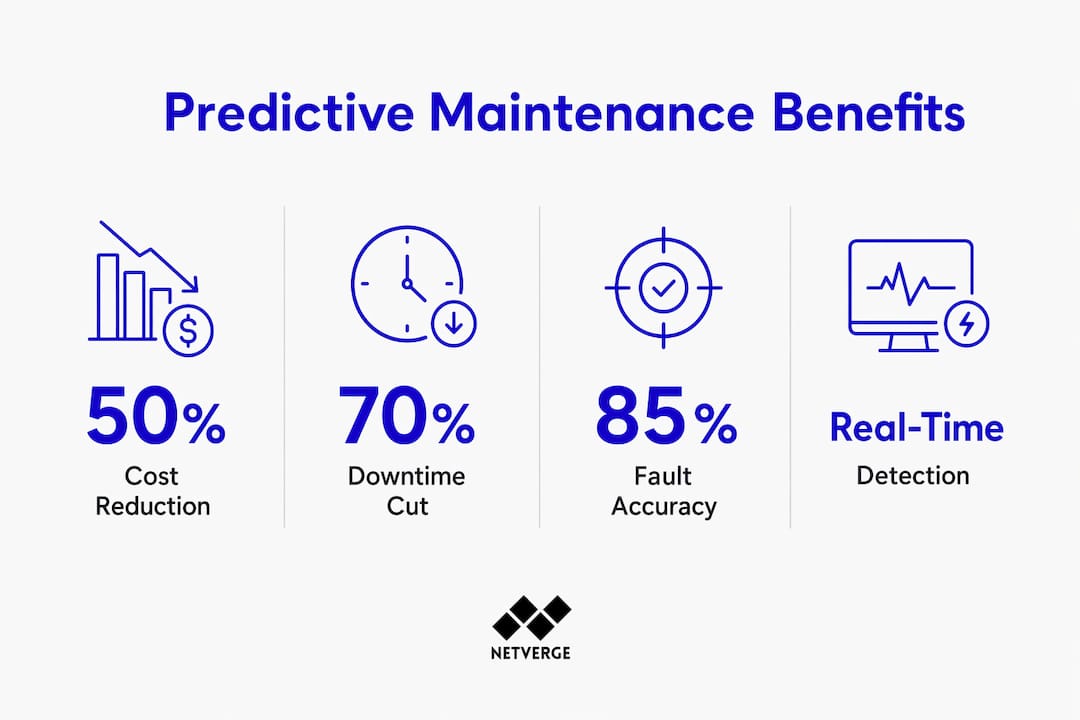
The three network maintenance strategies in common use are reactive, preventive, and predictive. Each has a distinct trigger, cost profile, and operational fit.
| Approach | Trigger | Cost profile | Limitation |
|---|---|---|---|
| Reactive | Device or service failure | Highest. 40–50x more than proactive | Downtime has already occurred |
| Preventive | Fixed schedule (daily, weekly, monthly, annually) | Moderate. Work done regardless of device condition | Over-maintenance or missed failures between cycles |
| Predictive | Condition-based signal from telemetry and ML models | Lowest per incident. Overhead reduction up to 50% | Requires quality telemetry and model investment |
Reactive maintenance is the default for most under-resourced IT teams. It requires no upfront investment in tooling, but the cost per incident is severe. Preventive maintenance improves on reactive by scheduling tasks such as firmware updates, configuration audits, and hardware inspections on fixed cycles. The problem is that a switch running perfectly on a Monday inspection can fail on Wednesday.
Predictive maintenance replaces fixed schedules with condition-based interventions. A device showing rising CRC error rates, abnormal CPU utilization, or degraded optical signal levels gets flagged for replacement or investigation before it fails. AI and machine learning make this possible at scale because no human team can manually correlate telemetry across hundreds of devices in real time.
Automated network diagnostics tools represent the operational bridge between preventive schedules and fully predictive workflows. Teams that start with automated diagnostics build the telemetry discipline needed to support predictive models.
What challenges should IT teams know before implementing predictive maintenance?
Predictive network management fails most often not because of bad models, but because of bad data and poor operational integration. The challenges are predictable and avoidable.
Data quality and completeness. Telemetry gaps are the most common failure point. Devices that drop SNMP polls, syslogs that are not forwarded, or NetFlow collectors that miss traffic segments all create blind spots. The model cannot predict failures it cannot see.
Data imbalance in failure events. Network failures are rare relative to normal operation. Synthetic data techniques and unsupervised anomaly detection methods, including autoencoders and Isolation Forests, help overcome this imbalance by identifying deviations before supervised models are trained on labeled failure data.
Alert fatigue without playbooks. Predictive models generate alerts. Without operational SRE playbooks converting predictions into defined actions, operators face a new source of noise rather than a solution. Every alert must map to a specific response.
Explainability gaps. Explainable AI (XAI) is essential for operator trust. When an alert fires and the operator cannot understand why the model flagged a device, the alert gets dismissed. XAI surfaces the contributing features, such as error rate trends or utilization spikes, so operators can validate and act with confidence.
- Audit telemetry coverage before deploying any predictive model
- Define a response playbook for every alert type before going live
- Use unsupervised anomaly detection as a first layer to catch rare events
- Require explainability outputs from any ML model used in production
- Treat the program as an ongoing operational discipline, not a one-time deployment
Pro Tip: Start with unsupervised anomaly detection on your existing telemetry before investing in supervised fault prediction models. It reveals data gaps and real anomaly patterns with no labeled training data required.
Predictive analytics in networking works best when it is embedded in daily operations, not treated as a separate analytics project. Teams that integrate predictions into their ticketing and change management workflows see the fastest returns.
Key Takeaways
Predictive network maintenance reduces operational costs by up to 50% and cuts unplanned downtime by catching failure signals in telemetry data before devices or links fail.
| Point | Details |
|---|---|
| Telemetry quality is foundational | Incomplete or inconsistent data undermines any predictive model, regardless of its sophistication. |
| ML models achieve high accuracy | SVM and neural network models reach 85%–94% fault identification accuracy when fed quality telemetry. |
| Cost gap is significant | Reactive maintenance costs 40–50x more per incident than proactive, condition-based approaches. |
| Playbooks prevent alert fatigue | Every model alert must map to a defined human or automated response to be operationally useful. |
| Treat it as a discipline | Predictive maintenance delivers compounding returns only when feedback loops continuously improve model accuracy. |
Why predictive maintenance is the foundation of modern network reliability
The shift from reactive to predictive network operations is not primarily a technology decision. It is an operational mindset change, and that distinction matters more than most teams realize.
I have watched organizations deploy sophisticated ML-based monitoring platforms and see zero improvement in network reliability within six months. The technology worked. The operations did not. Alerts fired into a void because no one had defined what to do when a model flagged a degrading optical transceiver at 2 a.m. The platform became another dashboard that people stopped checking.
Maintenance as a feedback loop is the concept that separates teams that succeed from teams that stall. Every resolved incident should feed back into the model as labeled data. Every false positive should trigger a playbook review. The program gets sharper over time only if the organization treats it as a living discipline.
The emerging frontier is self-healing networks, where AI agents detect anomalies, diagnose root causes, and execute remediation without human intervention. That future is closer than most IT leaders expect. But it requires the same foundation: clean telemetry, explainable models, and operational workflows that trust the system enough to act on its outputs.
My advice is to start smaller than you think you need to. Get one device class, one telemetry source, and one alert type working end-to-end with a real playbook. Then expand. The teams that try to predict everything on day one end up predicting nothing reliably.
— Jim
How Netverge supports predictive network maintenance
Netverge brings together real-time telemetry, AI-powered anomaly detection, and automated remediation workflows into a single platform built for MSPs and multi-location enterprises.
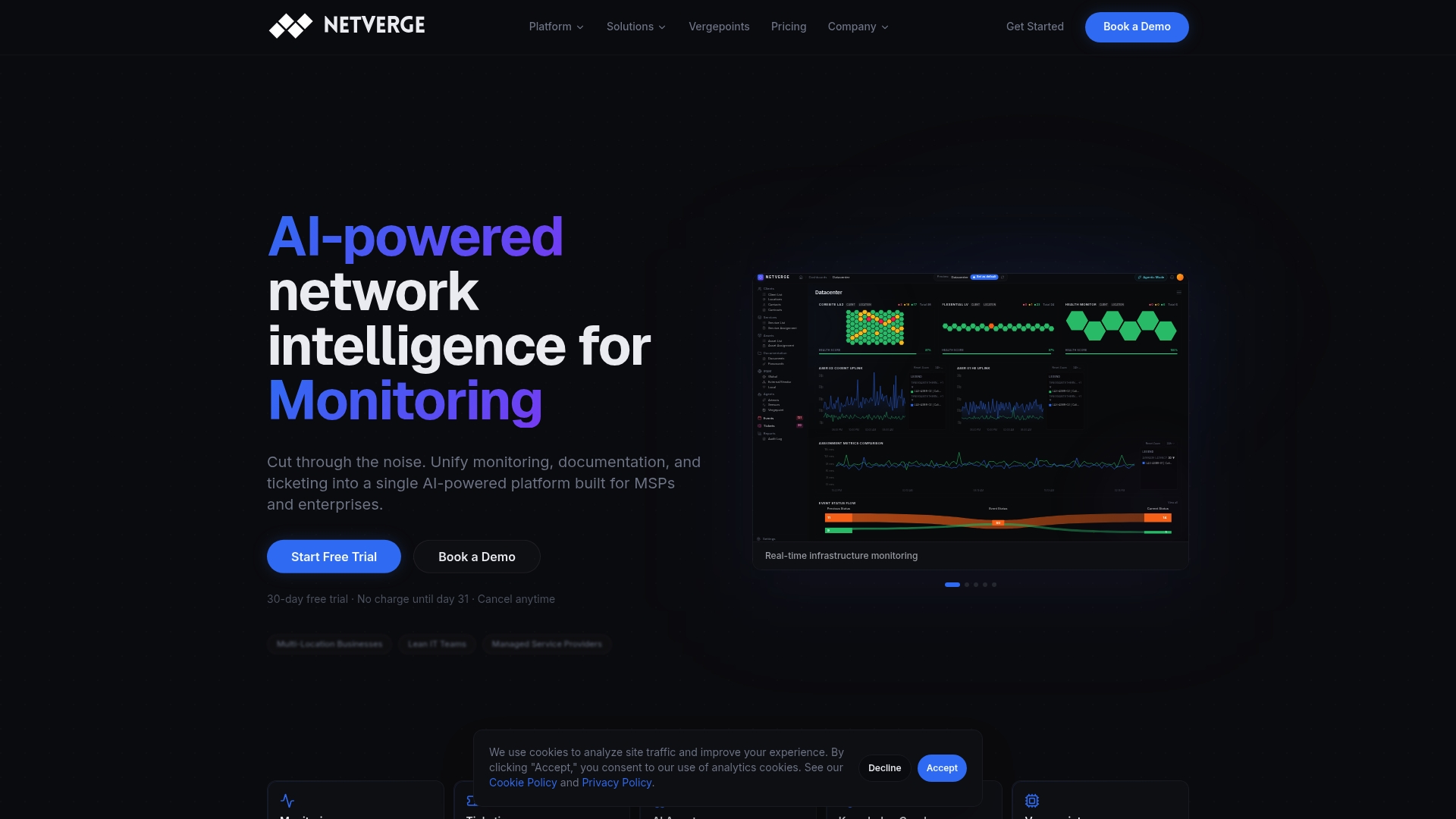
The platform ingests telemetry across distributed infrastructure, correlates signals with its AI monitoring engine, and surfaces prioritized alerts with the context operators need to act. Autonomous AI agents can execute remediation steps directly, reducing the gap between prediction and resolution. Netverge's no-code workflow builder lets your team define response playbooks visually, so every predictive alert maps to a defined action. If you are ready to move from reactive firefighting to condition-based network management, Netverge is built for exactly that transition.
FAQ
What is predictive network maintenance in simple terms?
Predictive network maintenance uses AI and telemetry data to detect early warning signs of network failures before they cause outages. It replaces reactive troubleshooting with condition-based interventions triggered by real device signals.
How accurate are predictive maintenance models for networks?
Machine learning models using SVM and neural networks achieve 85%–94% accuracy in fault identification when trained on quality telemetry data.
What data sources does predictive network maintenance use?
The primary sources are SNMP traps, syslogs, NetFlow records, and device performance counters. Data quality and completeness matter more than the specific algorithm used.
How does predictive maintenance differ from preventive maintenance?
Preventive maintenance runs on fixed schedules regardless of device condition. Predictive maintenance triggers only when telemetry signals indicate a device is approaching failure, reducing unnecessary work and catching failures that fall between scheduled checks.
Why do predictive maintenance programs fail?
Most failures trace back to poor telemetry quality, missing operational playbooks, or lack of explainable AI outputs. Without defined responses to model alerts, predictions generate noise rather than action.