
Distributed network management is the practice of spreading network management tasks, tools, and control across multiple geographically or logically separated sites rather than relying on a single central point. This model covers the full spectrum of network management functions including fault detection, configuration control, performance tracking, accounting, and security across every node in your infrastructure. IBM defines network management as a multifaceted discipline encompassing tools, protocols, and processes to maintain availability, performance, and security at scale. For IT teams running multi-site or hybrid environments, this distributed approach is not optional. It is the architecture that keeps operations consistent when centralized control would buckle under the load.
What is distributed network management and why does it matter?
Distributed network management is defined as a model where management responsibilities are delegated to multiple independent nodes or sites, each handling local monitoring and control while contributing to a unified management view. The FCAPS framework, developed by the ISO, organizes these responsibilities into five tiers: Fault, Configuration, Accounting, Performance, and Security. Each tier must function reliably across every distributed site, not just at headquarters.
The core value of this model is resilience. When one management node fails, others continue operating. That continuity is what separates distributed systems management from traditional centralized approaches, where a single point of failure can blind your entire operation.

How does the FCAPS model apply to distributed network management?
FCAPS is the foundational framework for organizing network management tasks across distributed environments. Each of the five tiers addresses a distinct operational need:
- Fault management: Detects, isolates, and resolves network failures at the local site level before they escalate to the wider network.
- Configuration management: Maintains consistent device configurations across all distributed locations, preventing drift that causes outages.
- Accounting management: Tracks resource usage per site, user, or service to support billing, capacity planning, and compliance.
- Performance management: Monitors throughput, latency, and error rates at each node, feeding data into a unified performance view.
- Security management: Enforces access controls, monitors for anomalies, and applies policy consistently across every distributed segment.
Applying FCAPS to distributed environments introduces real complexity. Configuration consistency is the hardest tier to maintain. A firmware update applied at one site but missed at three others creates security gaps and unpredictable behavior. Fault correlation across sites is equally difficult because a local alarm may actually signal a wider infrastructure problem.
The solution most enterprise teams use is a unified management plane that aggregates FCAPS data from all sites into a single interface. Broadcom's Distributed SpectroSERVER (DSS) is a well-documented example. It handles fault and performance data from geographically distributed devices while presenting operators with a consistent, correlated view.
Pro Tip: Map each FCAPS tier to a specific tool or process before deploying distributed management. Teams that skip this step end up with overlapping fault alerts and blind spots in configuration tracking.
What architectural approaches enable effective distributed network management?
The architecture behind distributed network management determines how well it scales and how reliably it performs under failure conditions. Three design principles define modern distributed network architecture: localized polling, fault-tolerant components, and a separated hub-and-probe messaging model.
Localized polling reduces WAN congestion
Localized polling means each management node polls the devices physically closest to it rather than routing all queries back to a central server. This reduces wide-area link traffic and prevents congestion on the management plane. In Broadcom's DSS architecture, each distributed server polls its local segment independently. The result is faster fault detection and lower latency in performance data collection.
Fault tolerance through standby components
| Component | Primary Role | Failover Behavior |
|---|---|---|
| Primary management server | Handles all local polling and data storage | Fails over to standby on failure |
| Standby server | Replicates state from primary | Activates automatically, reloads database |
| Unified representation layer | Maintains consistent network model | Preserved across failover events |
Unified representations across distributed landscapes are critical for management continuity. When a primary server fails, the standby reloads from a replicated database and resumes operations without losing the current network model. This design eliminates the data gaps that plague less structured distributed deployments.
Hub-and-probe architecture for scalability
Broadcom's DX UIM platform separates distributed management components into hubs and probe robots. Probes carry the intelligence: they collect telemetry, run checks, and generate alerts. Hubs route messages between probes and the central management layer. This separation means you can add new probes to cover additional devices or sites without redesigning the management plane. Scalability becomes a configuration task, not an architecture overhaul.
Pro Tip: Deploy probe robots at each remote site before you need them. Pre-positioned probes give you immediate visibility when a new location comes online, rather than scrambling to install monitoring after an incident.
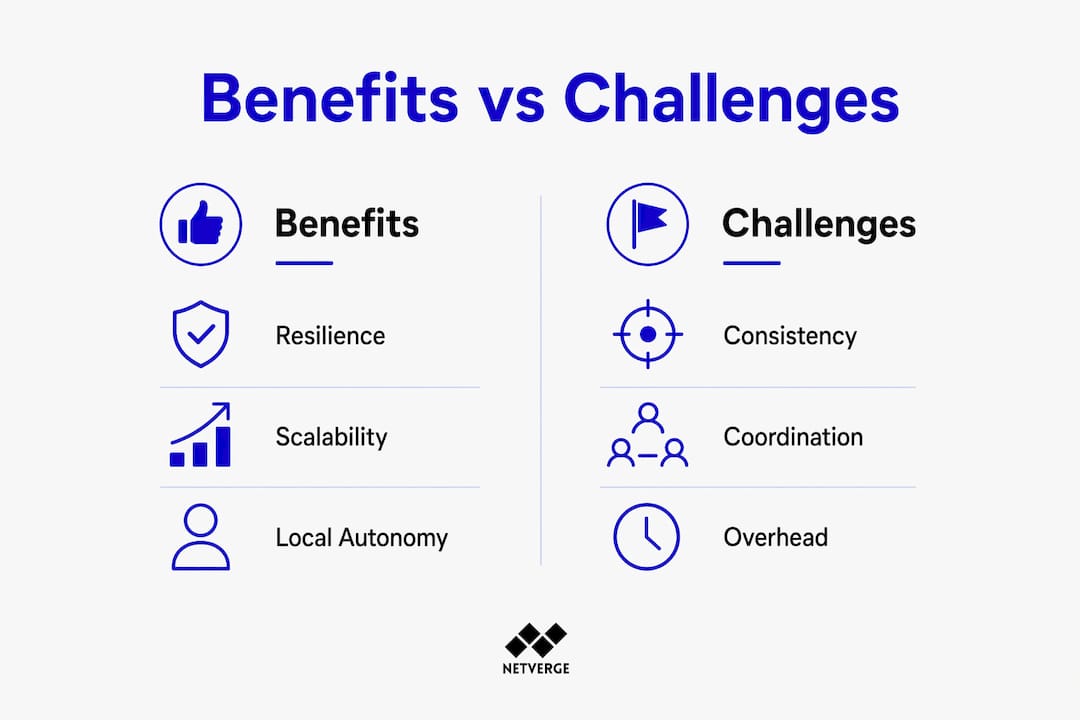
What are the benefits and challenges of managing distributed networks?
Distributed systems management delivers measurable operational advantages, but it also introduces complexity that centralized models avoid. Understanding both sides helps IT decision-makers set realistic expectations.
Benefits
Distributed network management improves scalability, fault tolerance, and reliability by removing centralized bottlenecks. Specific advantages include:
- Scalability: Adding a new site means deploying a local management node, not expanding a central server. The architecture grows with your infrastructure.
- Fault tolerance: Local management continues even when WAN links to headquarters go down. Sites do not lose monitoring coverage during connectivity failures.
- Performance: Localized polling reduces round-trip times for management queries. Fault detection is faster because alerts do not travel across congested WAN links.
- Efficiency: Local teams can manage their segment without depending on a central IT group, reducing ticket queues and response times.
Challenges
The challenges in distributed network management center on consistency, coordination, and communication overhead. Data consistency is the primary risk. When each site maintains its own management database, those databases can diverge. A device decommissioned at one site may still appear active in the central view if synchronization fails.
Coordination across sites adds operational overhead. Change management, patch cycles, and security policy updates must reach every node reliably. Communication overhead between distributed management nodes and the central plane can also consume significant bandwidth if the architecture is not designed with localized polling from the start.
Mitigation requires unified data models, automated synchronization, and fault-tolerant failover. These are not optional features. They are the minimum requirements for a distributed management deployment that stays accurate under real-world conditions.
How can IT teams effectively manage distributed networks in practice?
Practical distributed network management requires a structured approach. The following steps reflect what high-performing IT teams actually do across multi-site and hybrid environments.
Implement FCAPS-aligned tooling at every site. Each location needs tools that cover all five management tiers. Gaps in any tier create blind spots that compound over time. Review the key features of network management your current stack covers before adding new tools.
Deploy real-time monitoring with unified dashboards. Real-time network monitoring is the operational backbone of distributed management. Unified dashboards aggregate telemetry from all sites into a single interface, giving operators correlated visibility rather than isolated site views.
Use AI and automation for anomaly detection and alerting. AI-powered monitoring tools reduce mean time to detect by identifying anomalies before they become outages. Automated ticket triage routes alerts to the right team without manual intervention, cutting response times significantly.
Standardize configuration management across all sites. Use version-controlled configuration templates and automated compliance checks. Any deviation from the baseline triggers an alert. This prevents the configuration drift that causes security vulnerabilities and performance degradation.
Apply layered security management across every distributed segment. Network security for distributed environments requires consistent policy enforcement at every node. Centralized policy definition with local enforcement is the most reliable model. Never rely on site-level teams to independently maintain security configurations.
Plan for WAN failure from day one. Each site's management node must operate independently during connectivity outages. Test failover procedures regularly. A distributed management architecture that requires WAN connectivity to function is not truly distributed.
How does distributed compare to centralized and decentralized models?
IT decision-makers frequently conflate distributed, centralized, and decentralized network management. They are distinct models with different trade-offs.
| Attribute | Centralized | Decentralized | Distributed |
|---|---|---|---|
| Control location | Single central server | Each site operates independently | Multiple coordinated nodes |
| Scalability | Limited by central capacity | High, but inconsistent | High, with unified coordination |
| Fault tolerance | Single point of failure | High local resilience | High, with failover between nodes |
| Management traffic | High WAN load | Minimal WAN load | Optimized via localized polling |
| Consistency | High, easier to enforce | Low, sites diverge | High, requires synchronization |
| Best use case | Small, single-site networks | Isolated branch offices | Multi-site enterprise or MSP environments |
Centralized management works well for small networks where a single server can handle all polling and data storage. Decentralized management suits isolated sites that rarely need to share management data. Distributed management is the right model when you need both local resilience and a unified operational view across many sites.
The shift toward distributed approaches is driven by the growth of multi-site enterprise infrastructure, cloud-hybrid environments, and the increasing cost of WAN bandwidth. For MSPs managing dozens of client networks, distributed network operations are the only practical path to consistent service delivery at scale.
Key takeaways
Distributed network management is the most scalable and resilient model for multi-site IT environments, but it requires unified data representation, localized polling, and FCAPS-aligned tooling to deliver on that promise.
| Point | Details |
|---|---|
| FCAPS is the foundation | All five management tiers must function at every distributed site, not just centrally. |
| Localized polling cuts WAN load | Polling devices at the nearest management node reduces congestion and speeds up fault detection. |
| Fault tolerance requires standby design | Standby servers with replicated state prevent data loss and maintain continuity during failures. |
| Hub-and-probe architecture enables scale | Separating message routing from data collection lets you add sites without redesigning the management plane. |
| Consistency is the hardest challenge | Unified data models and automated synchronization are required to prevent distributed databases from diverging. |
Why most distributed management deployments fail before they scale
After working with IT teams across dozens of multi-site deployments, the failure pattern is almost always the same. Organizations invest in distributed management tools but skip the unified representation layer. Each site ends up with its own management database, its own alert thresholds, and its own naming conventions. The result looks like distributed management but behaves like decentralized chaos.
The teams that get it right treat the unified management plane as the primary deliverable, not an afterthought. They define a single data model, enforce it at every site, and build failover into the design before the first probe goes live. Broadcom's DSS architecture gets this right by making unified representation a core feature, not an optional add-on.
The other overlooked factor is WAN failure testing. Most teams assume their distributed architecture will hold during a connectivity outage. Few actually test it. When a WAN link drops and the local management node cannot reach the central server, you find out quickly whether your architecture is truly distributed or just centralized with extra steps.
My honest recommendation: before you expand to a new site, simulate a complete WAN failure for an existing site and observe what breaks. That test will tell you more about your distributed management maturity than any architecture diagram. Pair that with multi-site network management practices that account for real-world failure modes, and you will build something that actually holds up.
— Jim
How Netverge simplifies distributed network management
Managing distributed networks across multiple sites demands more than traditional monitoring tools can deliver. Netverge unifies network visibility, anomaly detection, automated troubleshooting, and intelligent ticket triage into a single AI-powered platform built for exactly this environment.
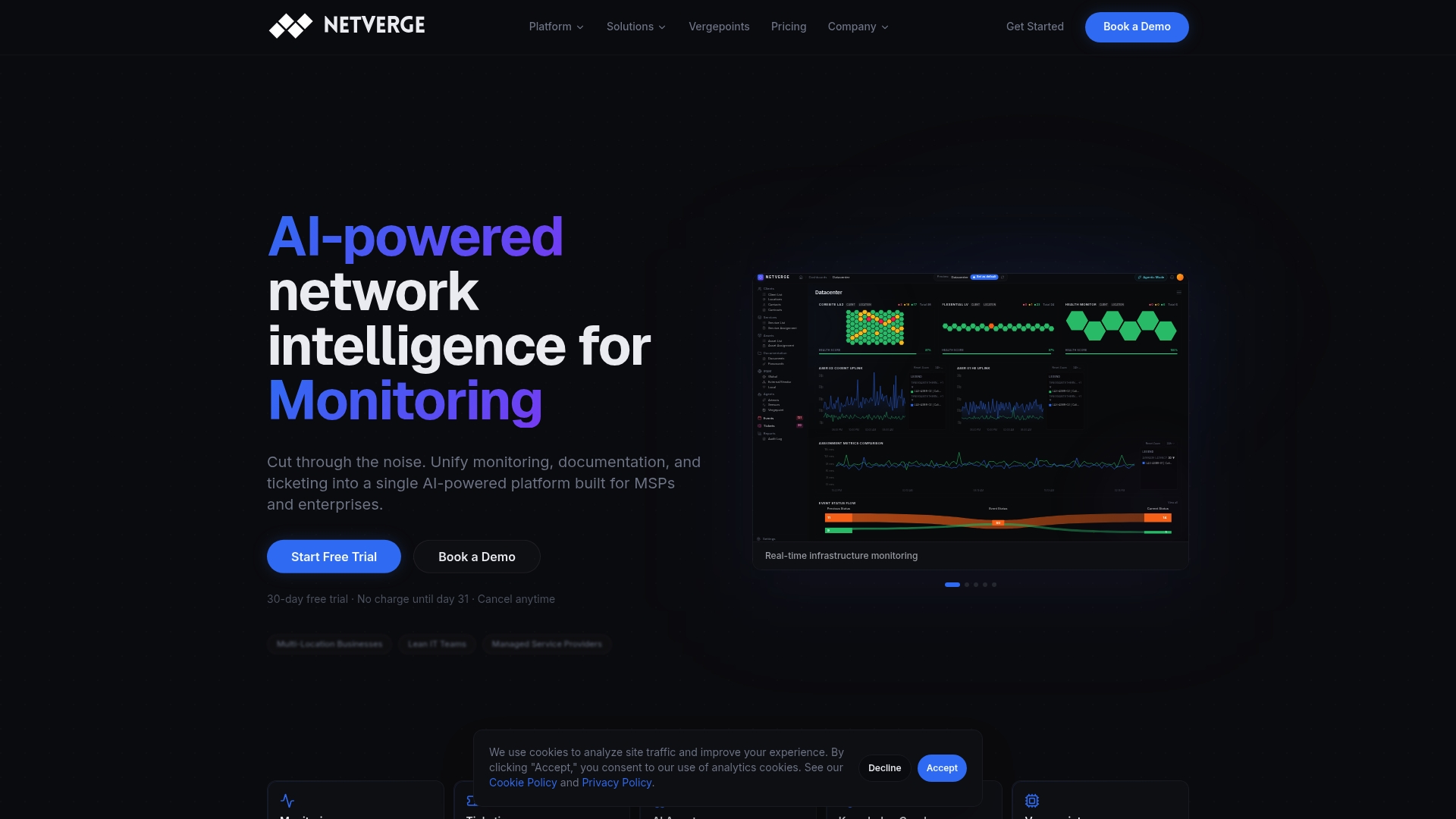
Netverge's AI-powered monitoring covers all FCAPS functions across distributed sites, with real-time telemetry, correlated alerts, and autonomous AI agents that diagnose and resolve issues without manual intervention. Hardware Vergepoints deploy at remote locations to provide physical visibility where software agents cannot reach. For MSPs and multi-location enterprises ready to replace fragmented tools with a unified management plane, Netverge is the direct path to consistent, proactive network operations. Start your free trial today.
FAQ
What is distributed network management?
Distributed network management is the practice of spreading network management tasks across multiple independent sites or nodes, each handling local monitoring and control while contributing to a unified operational view. It covers fault, configuration, accounting, performance, and security management across geographically separated infrastructure.
How does distributed network management differ from centralized management?
Centralized management routes all monitoring and control through a single server, creating a single point of failure and high WAN traffic. Distributed management places management nodes at each site, enabling local resilience and localized polling that reduces wide-area link congestion.
What is the FCAPS framework in network management?
FCAPS is a five-tier ISO framework covering Fault, Configuration, Accounting, Performance, and Security management. It provides the standard structure for organizing network management tasks across both centralized and distributed environments.
What are the biggest challenges in distributed network management?
Data consistency and coordination across sites are the primary challenges. Distributed databases can diverge without automated synchronization, and change management must reach every node reliably to prevent configuration drift and security gaps.
What tools support distributed network management?
Platforms like Netverge, Broadcom's Distributed SpectroSERVER, and distributed monitoring solutions support multi-site management with localized polling, fault tolerance, and unified dashboards. The right tool depends on your scale, FCAPS coverage requirements, and automation needs.